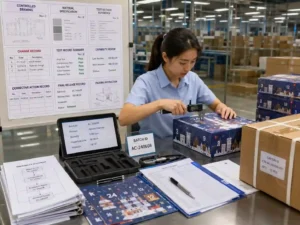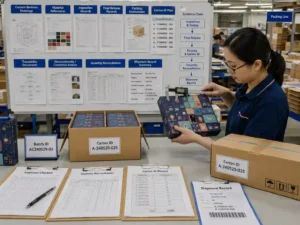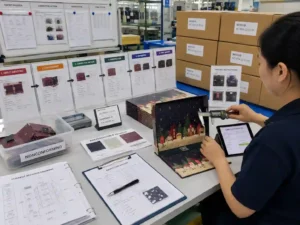
Fold-out advent calendar boxes are used when a brand needs a seasonal gift package that opens into a wider display, story panel, or multi-compartment presentation. For B2B packaging projects, the key question is not only how the box looks, but whether the structure can hold products safely, assemble efficiently, pass quality checks, and ship well in bulk.
This guide explains how to customize fold-out advent calendar boxes from a buyer’s point of view. It covers structure options, inserts, artwork files, sampling, MOQ, lead time, supplier comparison, export packing, and the details you should prepare before asking for a quotation.
If you are comparing suppliers for a seasonal launch, Giftpackpro can support projects through custom advent calendar box services, structural planning, sampling, and bulk production for overseas brands, wholesalers, gift companies, and retail purchasing teams.
What Are Fold-Out Advent Calendar Boxes?
Fold-out advent calendar boxes are advent calendar packages designed with panels, doors, drawers, or trays that open outward from the main body. Instead of a simple front-opening layout, the box can expand into a wider presentation format when opened.
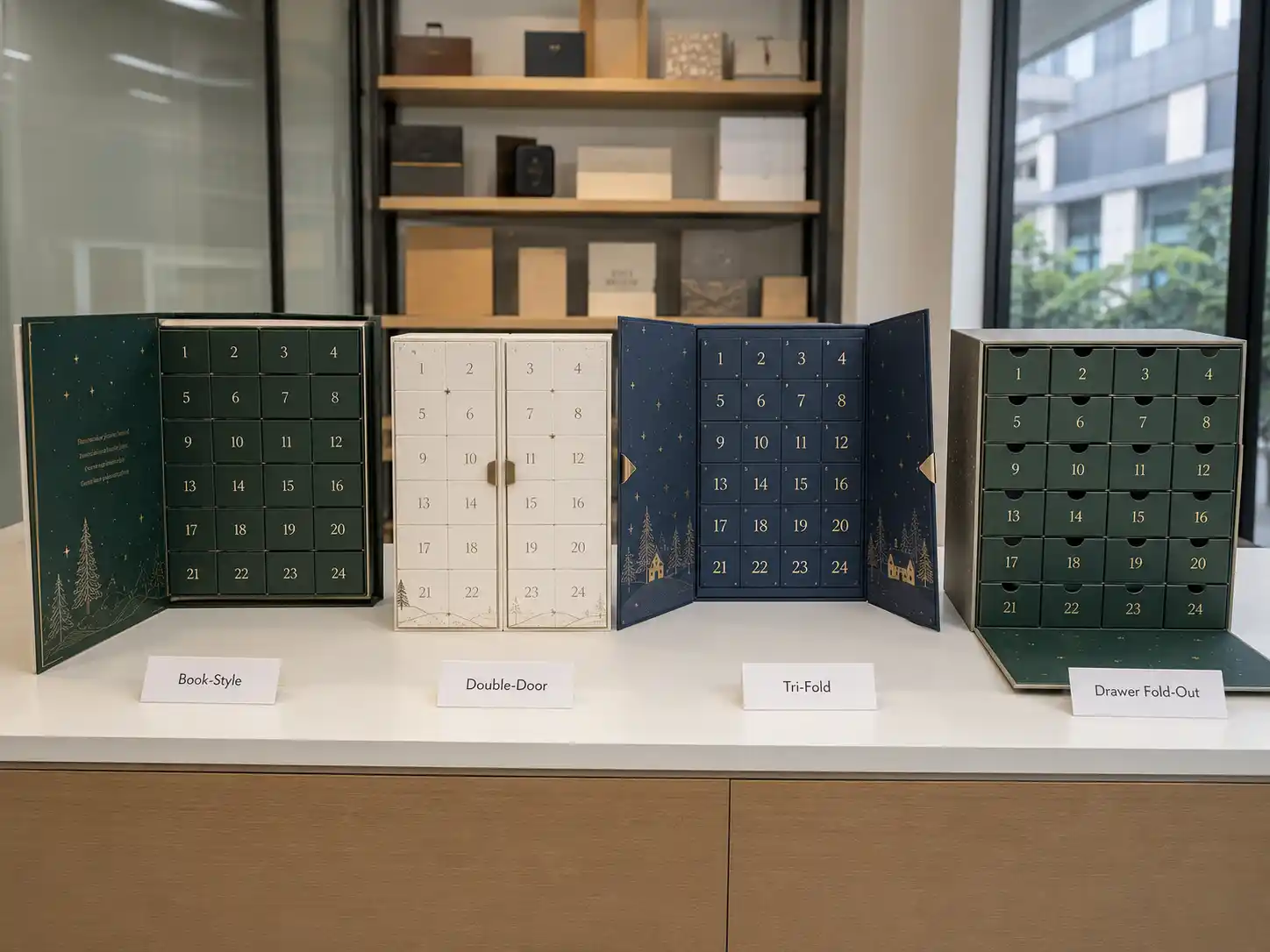
Common fold-out structures include book-style boxes, double-door boxes, tri-fold boxes, drawer-and-panel combinations, and rigid paperboard boxes with multiple opening layers. These structures are often used for cosmetics, skincare, candles, tea, coffee, confectionery, small gifts, promotional kits, and retail seasonal collections.
For B2B buyers, fold-out advent calendar boxes are usually chosen when the project needs stronger visual impact, more room for storytelling, better product separation, or a premium unboxing effect. They are also useful when a retailer wants the package to stand on a shelf or counter as a display unit.
Common Fold-Out Box Structures for B2B Projects
Before discussing printing or decoration, buyers should confirm the structure. The structure affects tooling cost, material usage, insert design, assembly time, carton size, and shipping cost.
Book-Style Fold-Out Advent Calendar Box
A book-style box opens like a hardcover book. The inside can include small drawers, paperboard trays, molded pulp inserts, or die-cut compartments. This structure is suitable for gift sets that need a premium presentation but still need a clear, organized layout.
Double-Door Advent Calendar Box
A double-door structure opens from the center. It works well for skincare sets, fragrance samples, tea sachets, small toys, or promotional products. The two-door opening gives enough surface area for brand artwork and campaign messaging.
Tri-Fold Advent Calendar Box
A tri-fold box opens with three connected panels. It can show a full visual story when opened, which makes it useful for retail gift programs and limited seasonal campaigns. However, it needs careful testing to avoid weak hinges or uneven folding.
Drawer and Fold-Out Combination
Some fold-out advent calendar boxes combine outer panels with inner drawers. This format can improve product access and create a more premium appearance, but it usually requires more assembly work and stricter QC during bulk production.
| Structure Type | Best For | Buyer Notes |
|---|---|---|
| Book-style fold-out box | Cosmetics, skincare, candles, small gifts | Good premium feel; check hinge strength and inner insert tolerance. |
| Double-door advent calendar box | Retail gift sets, sample kits, tea or coffee collections | Strong front display area; confirm magnet, ribbon, or closure method. |
| Tri-fold structure | Storytelling campaigns and seasonal promotional kits | Needs folding tests, flatness checks, and clear assembly instructions. |
| Drawer plus fold-out structure | Premium multi-SKU gift projects | Higher labor and tooling needs; useful when product separation is important. |
How to Match the Structure With Product Requirements
The right structure depends on the product size, weight, quantity, display goal, and retail channel. A 24-piece skincare sample set needs different engineering from a 12-piece candle set or a tea advent calendar with lightweight sachets.
Start with the product list. For each item, prepare the length, width, height, weight, material, and whether it is fragile, liquid-filled, food-related, or sensitive to pressure. This helps the supplier judge the insert style, board thickness, and outer box strength.
Buyers can also review existing custom advent calendar box products to compare formats before deciding whether a fold-out design is necessary. In many cases, a simpler structure may be more cost-effective if the project has a tight budget or short lead time.
Insert Options for Fold-Out Advent Calendar Boxes
Inserts are one of the most important parts of fold-out advent calendar boxes. A beautiful outer box can still fail if the products move during transport or if the compartments are difficult to fill during assembly.
Paperboard Inserts
Paperboard inserts are common for lightweight items such as sachets, small samples, stationery, chocolate packs, or promotional gifts. They are cost-efficient and easy to print, but they need accurate die-cutting for stable product placement.
Corrugated Inserts
Corrugated inserts are stronger than standard paperboard inserts. They are suitable for heavier products or items that need better shock resistance. For export orders, corrugated inserts can reduce movement inside the calendar box.
Molded Pulp or Paper-Based Trays
Molded pulp trays may be suitable for buyers who want a paper-based insert solution. If sustainability claims are important, buyers should avoid vague wording and confirm material source, certification, and recycling requirements with the supplier.
Foam or EVA Inserts
Foam or EVA inserts can be used for fragile bottles, jars, or premium products. However, they may not match every brand’s packaging policy. Buyers should confirm destination-market requirements before choosing non-paper inserts.
Artwork, Dielines, and Visual Customization
Fold-out advent calendar boxes usually include more printable areas than standard boxes. The outer cover, inner panels, drawer fronts, compartment numbers, side panels, and instruction cards can all carry artwork. This makes file control very important.
Ask your supplier for a confirmed dieline before final artwork. The dieline should show cut lines, crease lines, glue areas, bleed, safe zones, opening direction, drawer sequence, and insert position. For complex fold-out structures, one artwork mistake can affect multiple panels.
For brands preparing a new seasonal collection, the advent calendar box buying guides section can be used together with supplier consultation to understand structure planning and quotation details before finalizing artwork.
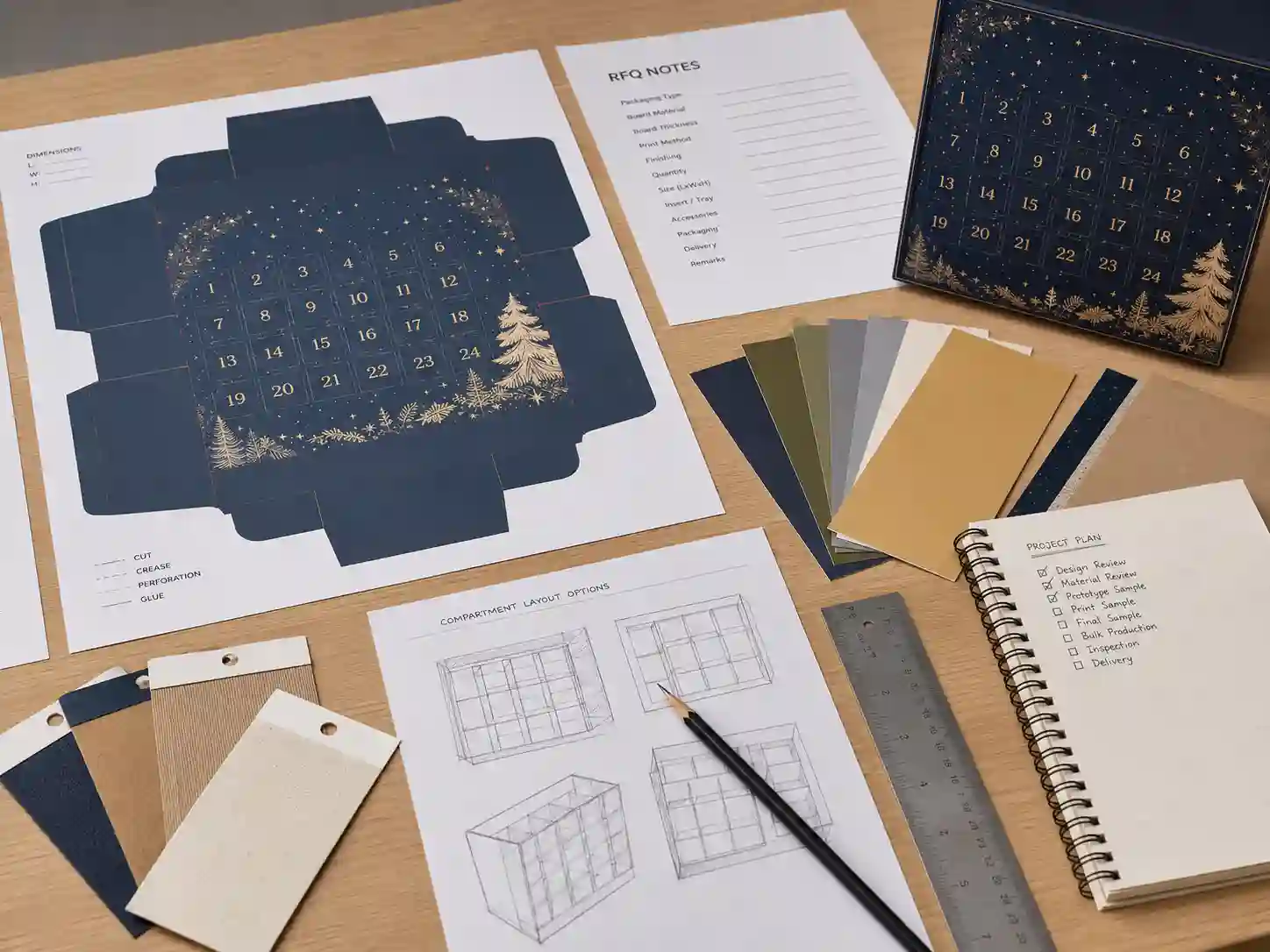
Customization Process for Fold-Out Advent Calendar Boxes
A reliable customization process should move from structure confirmation to sample approval and then to bulk production. Skipping steps may save a few days at the beginning but can create expensive problems later.
Step 1: Confirm Product Details
Prepare a product list with dimensions, weights, quantities, and special handling notes. If the products are still under development, provide estimated sizes and confirm when final dimensions will be available.
Step 2: Choose the Box Structure
Decide whether the project needs a book-style, double-door, tri-fold, drawer, or mixed structure. For large programs, ask the supplier to suggest a structure based on cost, assembly efficiency, and retail display needs.
Step 3: Develop the Dieline
The supplier creates or adjusts the dieline according to product sizes and insert requirements. Buyers should check panel direction, numbering order, compartment layout, and whether the box can be filled easily during production.
Step 4: Prepare Artwork Files
Artwork should be supplied in editable vector format where possible. Buyers should confirm CMYK color mode, bleed, font outline, image resolution, spot colors, foil stamping areas, embossing areas, and coating instructions.
Step 5: Make and Review Samples
Samples help verify structure, insert fit, printing effect, opening experience, product loading, carton packing, and handling. For fold-out advent calendar boxes, the sample should be tested both empty and filled with products.
Step 6: Approve Bulk Production
After the sample is approved, the supplier can proceed with material purchasing, printing, surface finishing, die-cutting, mounting, assembly, QC, and export packing.
For projects that need engineering support from concept to shipment, buyers can review Giftpackpro’s custom advent calendar box services or contact the team directly to request a custom quote.
MOQ, Lead Time, and Cost Factors
MOQ for fold-out advent calendar boxes depends on structure, material, printing method, surface finishing, insert type, and assembly complexity. A simple printed paperboard version may have a different MOQ from a rigid box with magnets, drawers, ribbons, and multiple inserts.
Lead time also depends on the project stage. Dieline development, sample making, sample shipping, artwork revision, material purchasing, and bulk production should all be included in the schedule. For seasonal packaging, buyers should avoid starting too close to the retail launch date.
The main cost factors include board grade, box size, number of panels, insert material, printing coverage, special finishing, manual assembly, product packing, carton quantity, pallet requirements, and export shipping method.
Quality Control Points Buyers Should Check
Fold-out structures need more QC attention than simple folding cartons. The box must open smoothly, stay aligned, hold the insert, protect products, and maintain a clean appearance after assembly.
Structure and Opening Test
Check whether the panels open evenly, whether hinges are strong enough, whether magnets or closures align properly, and whether drawers or compartments can be opened without tearing.
Insert Fit Test
The insert should hold products securely without making loading difficult. If the product size changes after sample approval, the insert may need to be revised before bulk production.
Printing and Finishing Check
Check color consistency, registration, lamination, varnish, foil stamping, embossing, glue marks, scratches, and edge cleanliness. Fold-out advent calendar boxes often have large visible surfaces, so small defects can be more noticeable.
Drop and Packing Review
For export orders, buyers should confirm inner packing, master carton strength, shipping marks, carton labeling, and pallet method. If the product is fragile, additional transit testing may be needed.
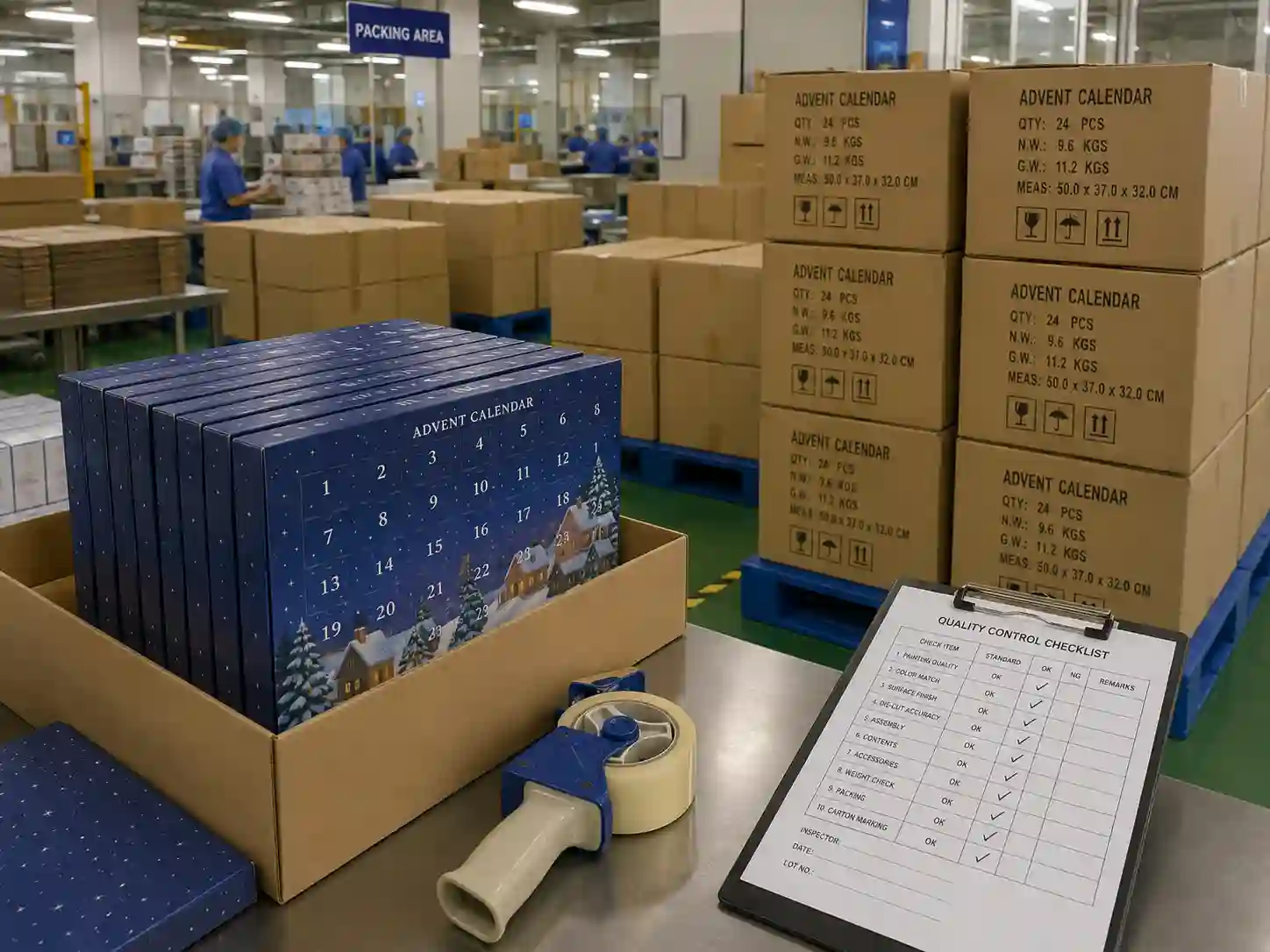
Export Packing and Compliance Considerations
Export packing should be discussed before bulk production, not after the boxes are finished. Buyers should confirm whether the calendar boxes will be shipped empty, filled with products, flat packed, semi-assembled, or fully assembled.
For paper-based packaging claims, buyers can refer to the official Forest Stewardship Council website when FSC-certified material is required. For quality management expectations, the official ISO 9001 quality management page is also a useful reference when discussing supplier systems.
If the packaging will contact food, cosmetics, or regulated products, buyers should confirm destination-market rules with their compliance team. The box supplier can provide packaging information, but the buyer is usually responsible for confirming final product and market compliance.
What to Prepare Before Requesting a Quote
A clear RFQ helps the supplier quote faster and more accurately. Instead of asking only for a general price, prepare the project details in a structured format.
- Target box structure, such as book-style, double-door, tri-fold, drawer, or mixed fold-out structure
- Finished box size or product sizes for each compartment
- Number of calendar days or compartments, such as 12, 24, or 25
- Product weight and whether products are fragile, liquid-filled, or irregular in shape
- Preferred insert material, such as paperboard, corrugated board, molded pulp, foam, or EVA
- Printing requirements, including CMYK, Pantone color, inside printing, and numbering
- Surface finishing, such as matte lamination, gloss lamination, soft-touch coating, foil stamping, embossing, or spot UV
- Estimated order quantity and expected delivery date
- Export packing method, shipping marks, carton limits, and pallet requirements
- Destination country and any retailer packaging requirements
If you are still comparing options, you can start with a basic structure brief and ask the supplier to recommend a cost-efficient format. A professional custom advent calendar boxes manufacturer should be able to explain how each design choice affects tooling, assembly, packing, and bulk production.
How to Compare Fold-Out Advent Calendar Box Suppliers
When comparing suppliers, do not judge only by the unit price. Fold-out advent calendar boxes require structural accuracy, sample control, artwork checking, assembly experience, and export packing knowledge.
Ask whether the supplier has experience with similar box structures, whether they can provide dieline support, how they manage sample approval, what QC checks are used during production, and how export cartons are packed. For overseas buyers, communication speed and quote clarity are also important.
It is also useful to understand the factory background. Buyers can learn more about the Giftpackpro packaging factory when evaluating production capability, export experience, and project support.
Practical B2B Example: 24-Piece Skincare Fold-Out Calendar
A skincare brand plans a 24-piece seasonal gift set with small jars, sachets, and sample bottles. A double-door fold-out rigid box may work well because it gives a premium front display and enough inside space for numbered compartments.
The buyer should provide product sizes, filled weights, bottle orientation, artwork direction, and target retail shelf requirements. The supplier can then suggest an insert layout, board thickness, door closure, carton packing method, and sample schedule.
In this type of project, the most common risk is product size change after the insert has already been sampled. To reduce rework, buyers should freeze product dimensions before approving the insert tooling.
Practical B2B Example: Tea or Coffee Fold-Out Calendar
A tea or coffee company may need lightweight compartments for sachets, capsules, or small bags. In this case, a paperboard fold-out structure may be more cost-efficient than a heavy rigid box.
The buyer should still confirm compartment depth, loading direction, product removal experience, and whether the box must stand upright in retail. If the product is food-related, the buyer should also confirm inner packaging and compliance requirements before production.
Final Buying Advice
Fold-out advent calendar boxes can create strong shelf presence and a better unboxing experience, but they need careful planning. Structure, inserts, artwork, sampling, QC, and export packing should be considered together, not as separate decisions.
For purchasing teams, the best starting point is a clear RFQ with product dimensions, order quantity, target delivery date, artwork requirements, and packing expectations. From there, Giftpackpro can help review structure options, prepare samples, and support bulk production for overseas packaging projects.
To continue planning your project, explore advent calendar box buying guides, review custom advent calendar box products, or request a custom quote with your product list and packaging brief.