When Are Fold-Out Advent Calendar Boxes the Right Choice?
Brands should choose fold-out advent calendar boxes when the project needs strong visual presentation, multiple product compartments, and a more interactive opening experience than a simple flat box or standard drawer structure.
This structure is often used for beauty sets, chocolate collections, tea and coffee samples, stationery gifts, fragrance minis, wellness products, promotional kits, and seasonal retail campaigns. For B2B buyers, the decision is not only about appearance. It affects insert design, carton size, assembly time, artwork layout, sampling cost, and export packing.
Giftpackpro works as a custom advent calendar boxes manufacturer for brands, wholesalers, gift companies, and retail buyers that need custom structure planning before bulk production.
What Is a Fold-Out Advent Calendar Box?
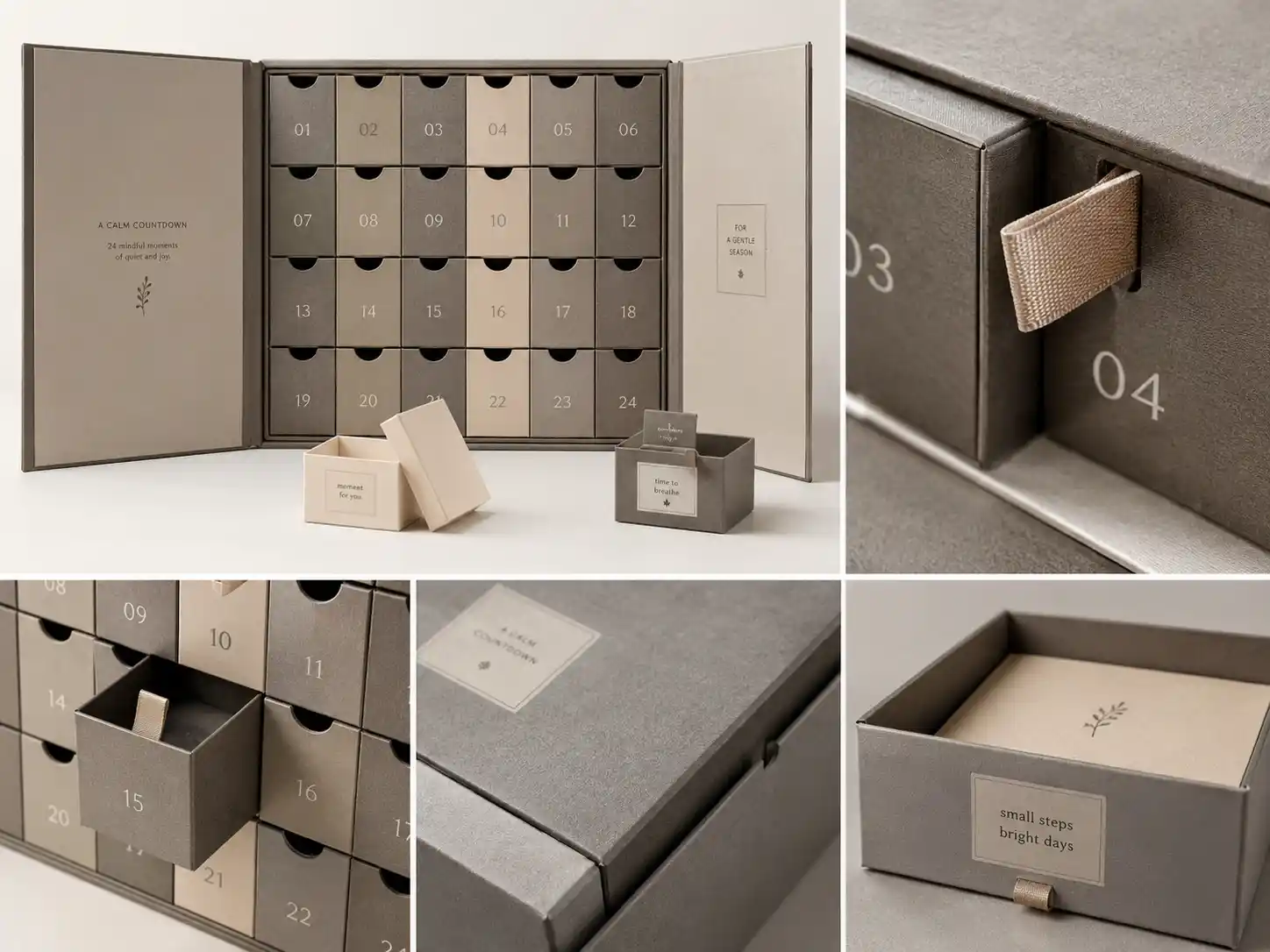
A fold-out advent calendar box usually opens from the center or side panels and expands outward to show multiple doors, drawers, compartments, or product windows. Compared with a basic single-panel advent calendar, it gives more display area and a stronger retail presentation.
The box can be designed as a book-style fold-out, double-door fold-out, tri-fold structure, wing-panel structure, or fold-out gift set with internal trays. The best structure depends on product weight, number of SKUs, insert material, and how the buyer wants the consumer to open the set.
Common B2B Use Cases
Fold-out structures are useful when buyers need:
- Multiple small products arranged in a clear sequence.
- A premium shelf display for seasonal retail campaigns.
- More artwork space for brand storytelling and product categories.
- Separate compartments for fragile, liquid, or sample-size items.
- A stronger unboxing effect for e-commerce gift sets.
Buyers comparing different structures can review custom advent calendar box products to understand how size, insert layout, and opening style affect the final packaging format.
When Should Brands Choose Fold-Out Advent Calendar Boxes?
1. When the Product Set Has Many Small Items
Fold-out advent calendar boxes are a strong option for projects with 12, 24, or more compartments. Beauty minis, tea sachets, chocolate pieces, candles, accessories, and promotional samples can be arranged in a clean layout instead of being packed randomly inside a large box.
For example, a skincare brand may need 24 small compartments for sample tubes, jars, and sachets. A fold-out design allows the buyer to separate product types by panel, such as cleansing, serum, cream, and mask items. This makes the package easier to understand for retail buyers and end users.
2. When Retail Presentation Matters
Retail buyers often prefer packaging that looks organized on the shelf and communicates value quickly. A fold-out structure can create a wider front-facing display area, which helps artwork, product numbers, campaign messages, and category labels appear more clearly.
This is useful for department stores, beauty retailers, gift shops, supermarkets, and seasonal promotional areas where the box may compete with many other holiday or gift-pack products.
3. When the Brand Needs More Artwork Space
A basic advent calendar box may limit the amount of artwork, instructions, product details, or campaign messaging. Fold-out advent calendar boxes provide extra printable surfaces on outer panels, inner panels, doors, sleeves, and inserts.
Before preparing artwork, buyers should confirm dieline size, bleed, safe area, folding direction, and whether inner panels need separate artwork. For a project with many panels, a clear artwork checklist can reduce revision time before sampling.
4. When Products Need Better Separation
Fold-out boxes can work with paperboard inserts, corrugated inserts, EVA, foam, molded pulp, or custom trays. The insert choice depends on product shape, weight, fragility, sustainability targets, and budget.
For paper-based projects, buyers may also need to consider responsible sourcing. Information from the Forest Stewardship Council can help teams understand FSC-related sourcing language when they request paper packaging materials.
Fold-Out Advent Calendar Box Structure Comparison
| Structure Type | Best For | Planning Point |
|---|---|---|
| Double-door fold-out box | Beauty, fragrance, chocolate, tea, and promotional gift sets | Check magnet strength, opening angle, and inner panel artwork alignment. |
| Tri-fold advent calendar box | Brands that need more display space and product grouping | Confirm folded thickness, carton size, and whether panels stay flat after opening. |
| Book-style fold-out box | Premium seasonal launches and retail gift collections | Review spine width, hinge durability, insert fit, and sample opening performance. |
| Fold-out box with drawers | Higher-value products or reusable gift packaging | Test drawer sliding, pull-tab strength, and labor cost for assembly. |
| Fold-out box with paperboard insert | Lightweight samples, sachets, small accessories, and confectionery | Confirm compartment tolerance and whether products move during transport. |
When Fold-Out Boxes May Not Be the Best Option
Fold-out advent calendar boxes are not always the most efficient structure. Buyers should consider a simpler option when the product is heavy, the MOQ is very small, the budget is tight, or the campaign timeline is too short for custom sampling and structure testing.
Choose a Simpler Structure If:
- The project only needs a few large compartments.
- The products are too heavy for wide fold-out panels.
- The buyer needs the fastest possible production schedule.
- The artwork team cannot prepare multi-panel dielines in time.
- The export carton size would become too large or inefficient.
For these cases, a drawer advent calendar, rigid gift box, paperboard insert box, or standard door-opening advent calendar may be more practical. Buyers can compare options through custom advent calendar box services before confirming a structure.
Customization Questions Buyers Should Solve Early
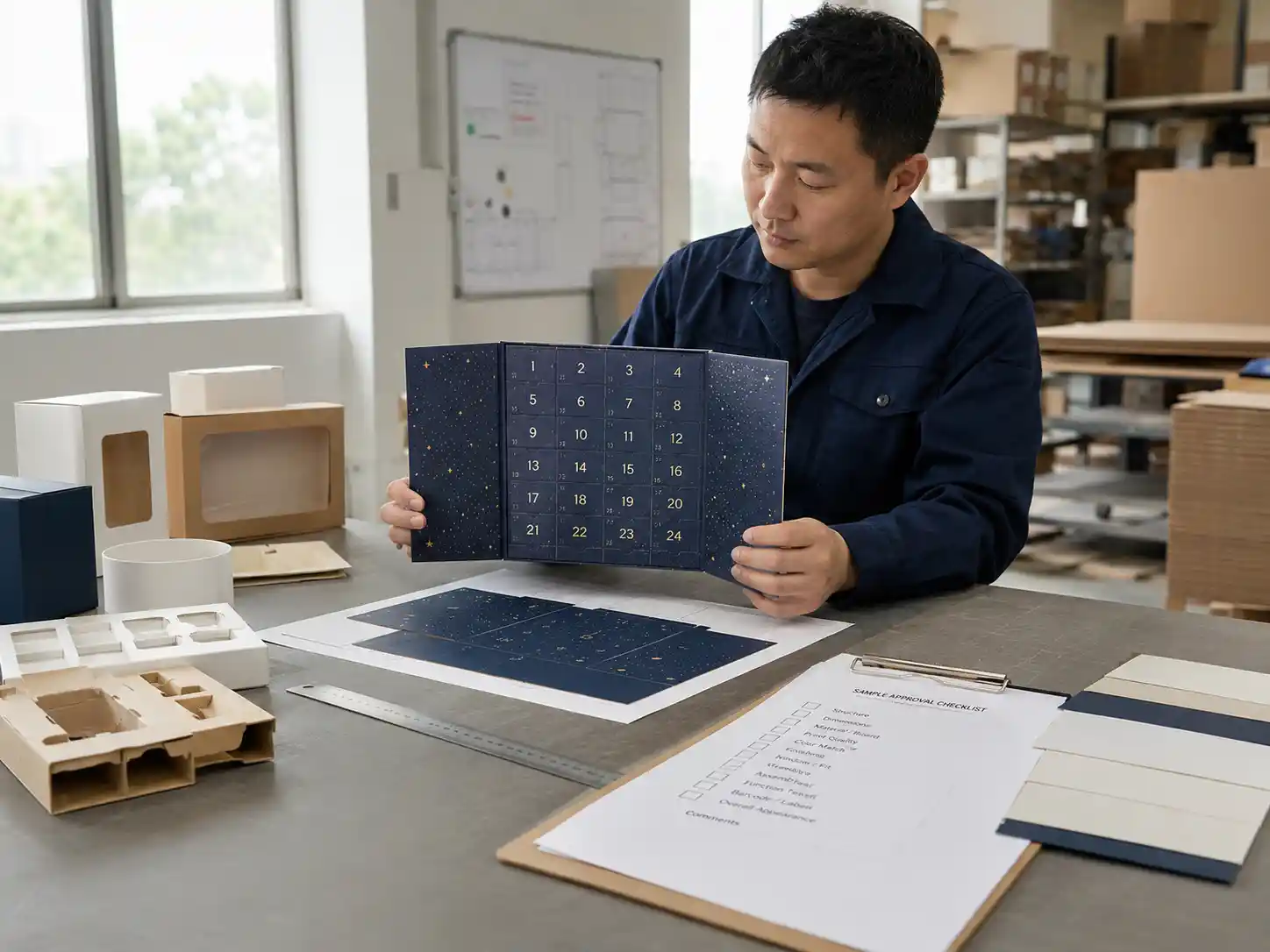
Most production problems start when structure, insert, artwork, and packing details are confirmed too late. For fold-out advent calendar boxes, early planning is especially important because each panel affects the next step.
Key Customization Details
Before requesting a sample, prepare the following information:
- Final product size, weight, and quantity for each compartment.
- Number of days, doors, drawers, or product positions.
- Preferred opening style, such as double-door, tri-fold, or book-style.
- Insert material preference and sustainability requirements.
- Artwork files, logo placement, color references, and printing finish.
- Expected MOQ, launch date, delivery country, and packing method.
Giftpackpro can help review these details during the early planning stage, especially when buyers need the packaging to match retail shelf requirements, e-commerce shipping, or seasonal campaign timing.
Common Finishing Options
Fold-out boxes can use matte lamination, gloss lamination, soft-touch finish, spot UV, embossing, debossing, foil stamping, ribbon pulls, magnetic closure, or custom printed inserts. The best choice should match the brand position and budget, not only the design preference.
For example, a premium cosmetics set may use rigid greyboard, magnetic closure, matte lamination, and foil logo. A promotional tea sample set may use paperboard structure, printed dividers, and a lighter finish to control cost.
Sampling and Production Problems to Avoid
Problem 1: Compartments Look Good but Do Not Fit the Real Products
Buyers sometimes approve a dieline before checking the real product size. This can lead to loose products, tight compartments, broken inserts, or poor opening experience.
The safer method is to send exact product dimensions, product weight, and product photos before structural sampling. If possible, provide real samples or dummy samples for insert testing.
Problem 2: Artwork Does Not Match Folding Direction
Fold-out structures have more panels than simple boxes. If artwork is prepared without checking the folding direction, some text or graphics may appear upside down after assembly.
Ask the supplier for a marked dieline with panel names, folding lines, glue areas, bleed areas, and visible surfaces. This is one of the most useful checks before printing proof approval.
Problem 3: The Box Looks Premium but Is Too Expensive to Assemble
Complex fold-out boxes may need more hand assembly than flat paperboard boxes. More panels, drawers, ribbons, magnets, and inserts can increase labor time.
For bulk orders, buyers should ask whether the box will be shipped flat, semi-assembled, or fully assembled. This affects unit cost, master carton size, warehouse handling, and final delivery cost.
QC and Export Packing Checks
Quality control for fold-out advent calendar boxes should cover structure, printing, inserts, assembly, and transport protection. A nice sample does not guarantee smooth mass production unless the QC points are clear.
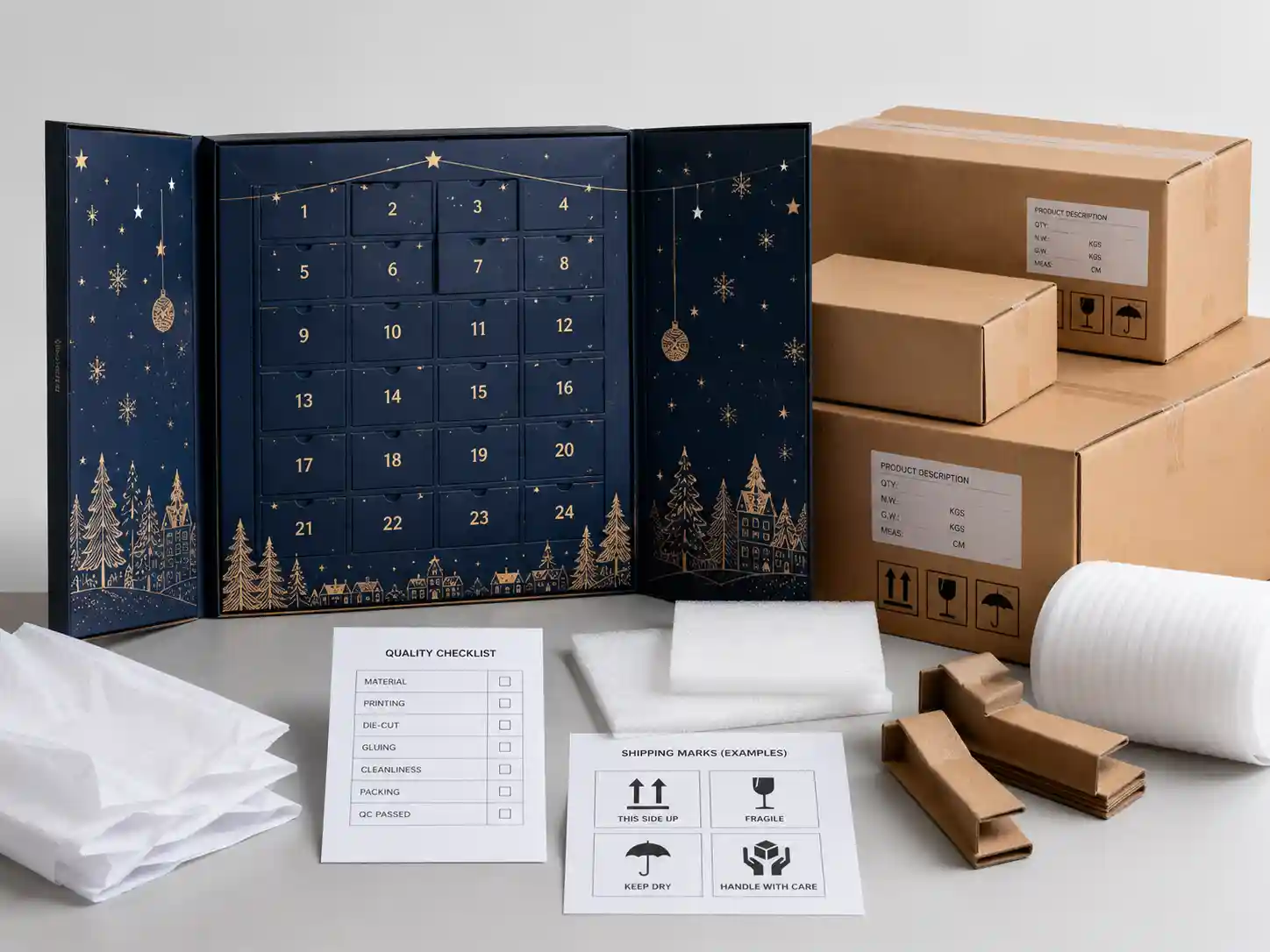
Recommended QC Checklist
- Check opening and closing performance after repeated use.
- Confirm magnets, ribbons, hinges, drawers, and doors are secure.
- Measure compartment size and insert tolerance.
- Check color consistency against approved proof or sample.
- Inspect glue marks, scratches, dents, folding lines, and edge quality.
- Confirm carton labels, shipping marks, and packing quantity per carton.
For export projects, buyers should also review packaging and recycling rules in the destination market. The European Commission provides information about packaging waste and recycling requirements that may be useful for teams selling into the EU.
Quote Preparation Advice for B2B Buyers
A clear quote request helps the supplier provide a more accurate price and avoids repeated revisions. For fold-out advent calendar boxes, the quotation should not be based only on length, width, and height.
Send These Details for a Better Quote
- Box structure reference or sketch.
- Target outer size and product compartment size.
- Number of compartments, doors, drawers, or panels.
- Product weight for each position.
- Material preference, such as greyboard, paperboard, kraft paper, or corrugated board.
- Insert type, such as paperboard, EVA, foam, molded pulp, or custom tray.
- Printing method and surface finish.
- Order quantity and expected repeat order plan.
- Destination country and export packing requirements.
- Sample deadline and bulk delivery schedule.
If the project is still in the planning stage, buyers can start with a reference image, product list, and target budget. The supplier can then suggest a structure that balances presentation, durability, and cost.
Teams that need structure advice, sampling, and bulk production support can request a custom quote with product details and campaign timing.
FAQ: Fold-Out Advent Calendar Boxes
Are fold-out advent calendar boxes suitable for heavy products?
They can be used for some medium-weight products, but the structure must be reinforced. Heavy items need careful insert support, stronger board, and transport testing. For very heavy products, a simpler rigid box or drawer structure may be safer.
Can fold-out boxes be shipped flat?
Some fold-out paperboard structures can be shipped flat, but many rigid fold-out advent calendar boxes are shipped semi-assembled or fully assembled. The packing method should be confirmed before quotation because it affects carton volume and freight cost.
What MOQ is common for custom fold-out advent calendar boxes?
MOQ depends on structure, material, printing, and finishing. For many custom paper gift packaging projects, buyers should expect MOQ to be discussed around several hundred pieces or more, but the final quantity depends on the exact design.
How long does sampling take?
Sampling time depends on structure complexity, artwork readiness, material choice, and finishing. A simple printed sample is faster than a complex rigid fold-out box with magnets, drawers, foil stamping, and custom inserts.
Can the insert be changed after the outer box is approved?
Sometimes, but it is better to confirm the insert before final approval. Insert thickness, compartment size, and product position can affect the outer box size, panel balance, and packing method.
What files should buyers prepare for artwork?
Buyers usually need logo files, brand colors, artwork references, product information, barcode position if needed, and print-ready design files based on the approved dieline.
Final Decision: Should Your Brand Choose a Fold-Out Structure?
Choose fold-out advent calendar boxes when your project needs strong shelf impact, multiple compartments, organized product presentation, and a more premium opening experience. Avoid this structure when the budget is very tight, the products are too heavy, or the timeline does not allow proper sampling.
The best result comes from early structure planning, accurate product measurements, realistic insert testing, clear artwork files, and export packing review. For more planning topics, visit our advent calendar box buying guides or learn more about Giftpackpro packaging factory support for custom seasonal paper packaging projects.