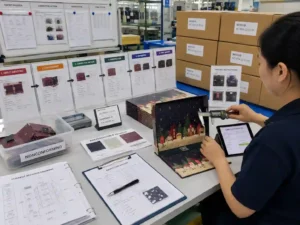
Quick answer: Advent calendar boxes need more quality checks than standard boxes because they combine multiple components, repeated compartments, product inserts, opening mechanisms, printed surfaces, and hand-assembly steps in one package. A small dimensional error can affect 12, 24, or more doors and drawers instead of one lid or tuck flap. Effective advent calendar box quality checks must therefore cover dielines, board thickness, insert fit, compartment alignment, drawer movement, door opening, product retention, printing, finishing, loaded testing, and export packing. Buyers should include these inspection requirements in the quotation stage because structure complexity, sampling, labor, inspection frequency, and packing protection directly affect MOQ, cost, and lead time.
Why do advent calendar boxes require more inspection than standard boxes?
A standard folding carton may have one main cavity, a few glue seams, and a simple opening method. A custom advent calendar can contain dozens of interacting parts, so its acceptable quality depends on the combined accuracy of every board panel, insert cavity, drawer, door, divider, and printed position.
The main difference is cumulative tolerance. A 1 mm variation may be unimportant on a large outer carton, but the same variation repeated across a grid of small drawers can produce tight movement, uneven gaps, blocked compartments, or a visibly crooked front panel. The outer box may look acceptable while individual doors or drawers fail during use.
Advent calendars also require loaded inspection. An empty structure may function correctly, but the result can change after cosmetic bottles, chocolate packs, tea sachets, coffee capsules, candles, jewelry cards, toys, or promotional gifts are inserted. Product weight can bow an insert, pull drawers forward, distort a folding carton, or place too much pressure on a door panel.
QC tip: Quality should be judged on the approved structure with the intended products loaded, not only on an empty white prototype.
How do quality risks compare with those of standard boxes?
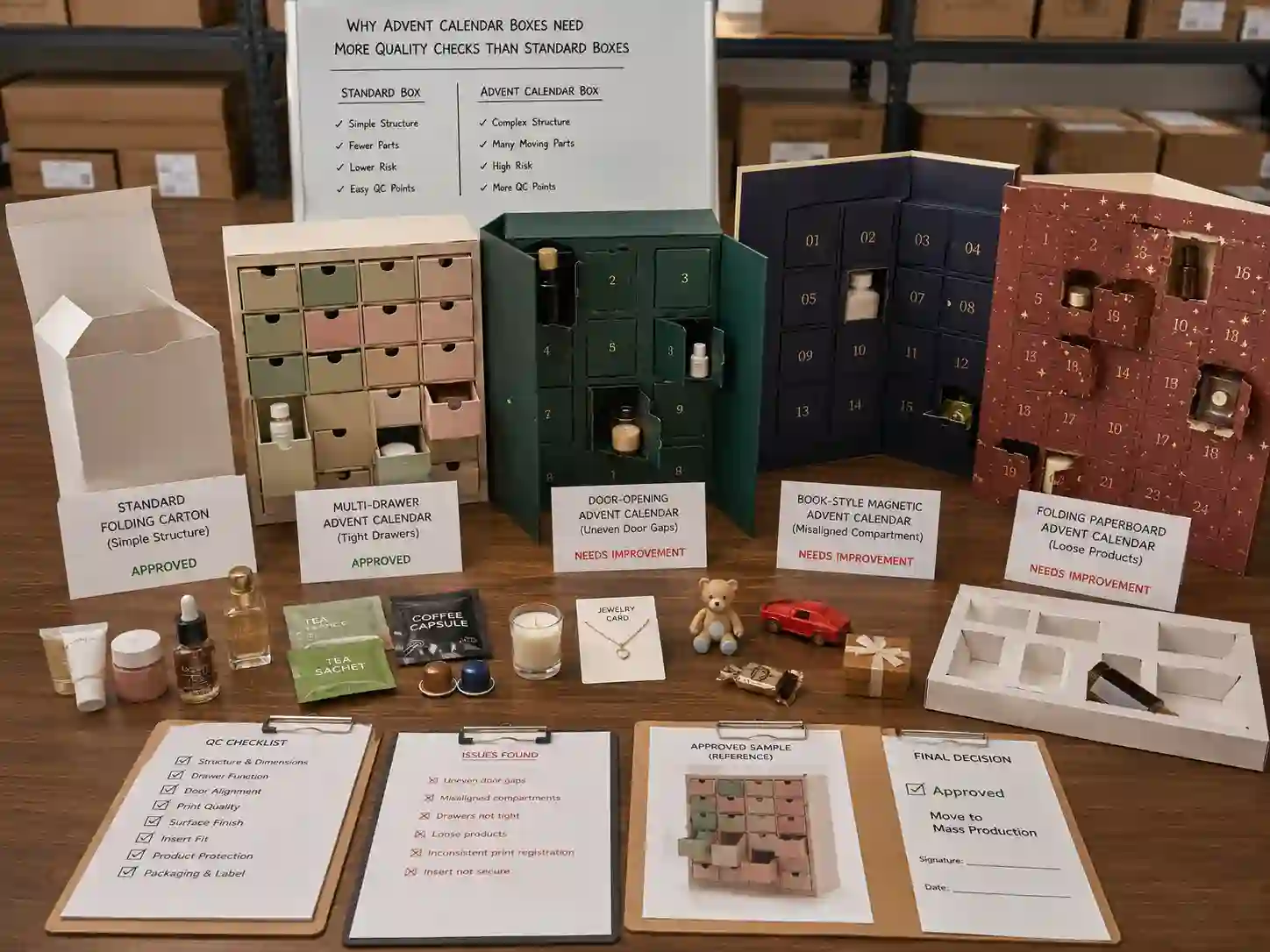
Advent calendar packaging has more inspection points because it is both a printed package and a multi-part dispensing system. The following comparison helps buyers understand why quotations for these projects include more engineering, assembly, sampling, and QC work.
| Inspection area | Standard box | Advent calendar box | Typical buyer risk |
|---|---|---|---|
| Structural components | Usually one carton body with limited panels | Outer shell, trays, drawers, doors, dividers, sleeves, magnets, or ribbons | One inaccurate component can interfere with several others |
| Dimensional tolerance | Mainly affects closing and product clearance | Affects repeated cavity alignment, gaps, drawer movement, and door positions | Cumulative variation becomes visible across the full calendar |
| Insert fit | Often one product or one simple insert | Multiple products with different dimensions, weights, and orientations | Loose, tight, tilted, or inaccessible products |
| Artwork registration | Usually checked across a few panels | Numbers, perforations, doors, drawers, and graphics must align | Numbers or graphics may be cut, hidden, or positioned on the wrong compartment |
| Functional testing | Open, close, glue, and compression checks | Repeated opening, drawer cycling, door tearing, product removal, and loaded stability | Some compartments work while others fail |
| Assembly labor | Frequently machine-folded and glued | Often includes manual wrapping, tray placement, drawer loading, and final alignment | Variation between operators or production batches |
| Export protection | Outer carton protects a relatively uniform shape | Raised finishes, corners, drawers, doors, and loaded cavities need additional control | Scuffing, crushed corners, shifted drawers, or displaced products |
Which advent calendar structures create the most QC work?
The required inspection plan depends on the structure. Buyers should compare designs based not only on appearance but also on assembly tolerance, loading method, production repeatability, inspection time, packing volume, and target budget.
Rigid drawer boxes
A rigid drawer box normally uses wrapped greyboard for the outer shell and individual drawers. QC must check drawer dimensions, sleeve clearance, pull-tab strength, drawer stops, edge wrapping, gap consistency, and movement after loading.
If the clearance is too small, matte lamination, wrapped paper thickness, glue buildup, or seasonal humidity may make the drawer difficult to open. If the clearance is too large, the front looks uneven and drawers may move during transport. Each drawer should be cycled several times and compared with the approved sample.
Door-opening rigid boxes
A door-opening box requires accurate alignment between the front artwork, cut doors, internal compartments, and products. Inspection should cover door size, hinge strength, finger access, perforation or cut-line consistency, internal depth, and whether adjacent doors interfere with each other.
Doors must remain closed during packing and shipping but still open without damaging the surrounding printed surface. When magnets are used in book-style or double-door rigid boxes, magnet position and polarity also need checking.
Folding-carton calendars
A folding carton made from paperboard is generally more economical and space-efficient than a rigid box, but it depends heavily on accurate die cutting, creasing, gluing, and erection. QC should check whether the front remains flat, perforated doors tear cleanly, tabs lock correctly, and internal partitions stay upright after products are loaded.
Thin paperboard may bow under concentrated product weight. Increasing board thickness can improve stability, but it may also change creasing behavior, folding resistance, packing volume, and cost.
Book-style and fold-out calendars
Book-style and fold-out structures introduce hinges, connecting panels, ribbons, magnetic closures, and multiple opening directions. Buyers should request checks for hinge cracking, panel alignment, opening angle, closure strength, balance, and repeated folding.
Buyer tip: Select the simplest structure that delivers the required retail presentation. Unnecessary drawers, magnets, ribbons, or layered panels increase material, labor, QC points, assembly time, and rejection risk.
How do inserts and product fit increase quality-control requirements?
An insert must hold every product securely while allowing practical loading and removal. Because advent calendars commonly contain mixed products, insert engineering is one of the largest differences between these boxes and standard packaging.
A paper insert can be economical and recyclable in suitable applications, but its folded walls and locking tabs must remain stable. A clear PET tray provides precise cavities and product visibility during loading, while EVA insert or foam can provide stronger retention for fragile or premium items. Molded pulp may suit selected product shapes but requires early tooling and fit evaluation.
For every cavity, the supplier should verify:
- Maximum product dimensions, including caps, seals, wrappers, and irregular protrusions.
- Product weight and center of gravity, especially for glass bottles, candles, or metal accessories.
- Loading orientation and whether the product can rotate during shipping.
- Finger-access space so users and packing workers can remove the item.
- Clearance between the product and door, drawer front, or outer lid.
- Retention after shaking, tilting, and repeated opening.
- Whether product pressure causes insert deformation or visible panel bulging.
A cavity should not be designed from a nominal product diameter alone. Production tolerances, labels, sealed wrappers, and protective bags can change the actual loaded size. Buyers should send physical products or verified production samples before final insert tooling.
Factory tip: Use the heaviest and largest acceptable product samples during fit approval. Testing only with the smallest sample can create failures when mass-production goods reach the upper tolerance limit.
Which materials, printing, and finishing details need extra checks?
Material and finishing choices must be evaluated together with the structure. A paper, coating, or decorative process that looks suitable on a flat proof may behave differently after die cutting, folding, wrapping, gluing, and repeated opening.
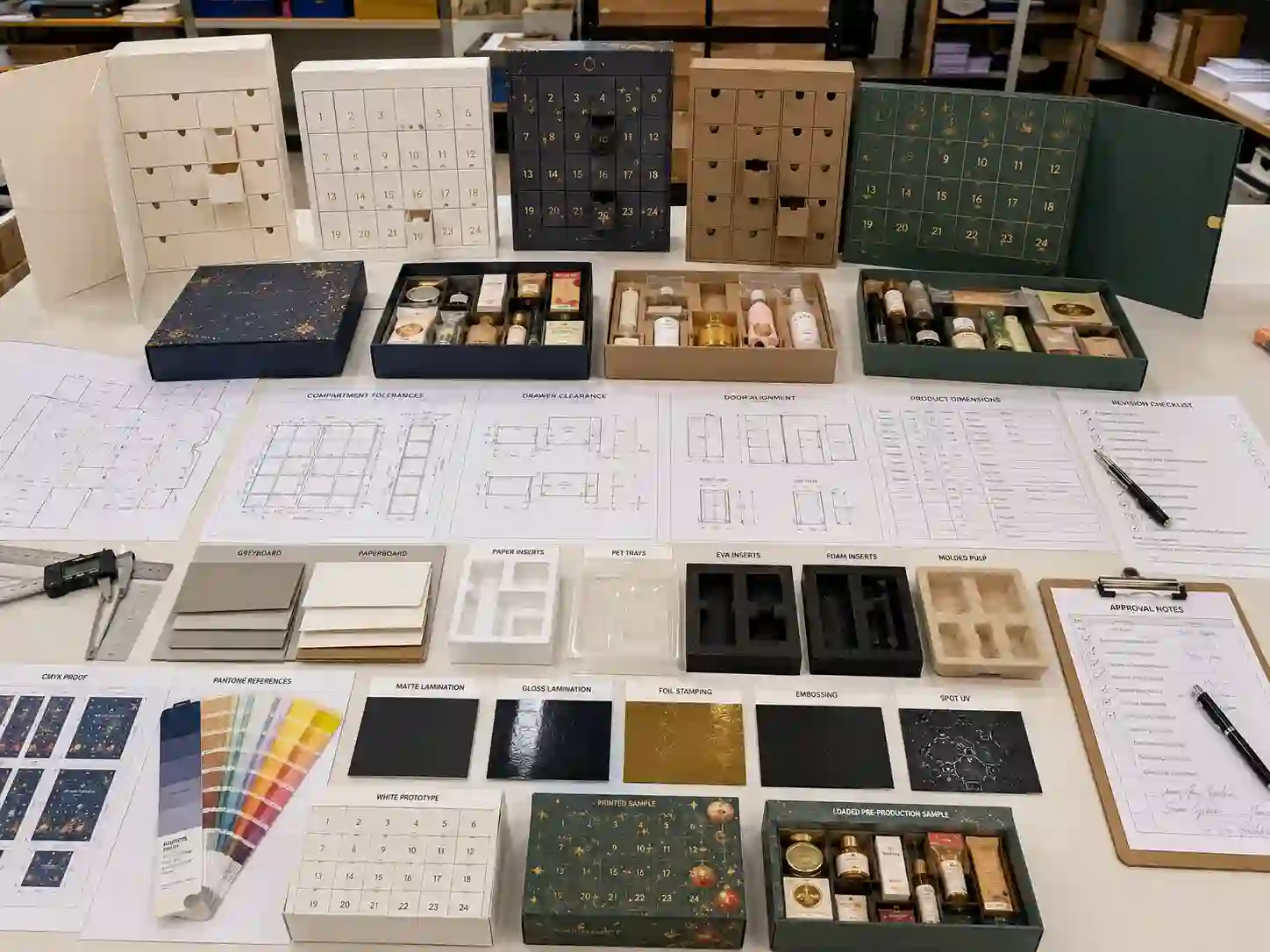
Rigid boxes typically combine greyboard with printed or specialty wrapping paper. Folding cartons use paperboard that must be suitable for scoring and repeated door opening. Buyers should confirm the specified board grade, thickness, stiffness, surface paper, grain direction, and acceptable color variation before mass production.
Artwork should be checked against the final supplier dieline, including bleed, safe areas, door numbers, compartment sequence, barcode position, glue zones, perforation lines, and panel orientation. CMYK may be appropriate for photographic artwork, while Pantone references can improve control of important brand colors. Physical color references should be agreed where color accuracy is commercially important.
Finishing processes add separate QC points:
- Matte lamination: check scuffing, silvering, glue compatibility, and cracking near folds.
- Gloss lamination: inspect scratches, trapped dust, bubbles, and uneven reflection.
- Foil stamping: verify registration, coverage, pinholes, pressure, and adhesion around door edges.
- Embossing: check depth, reverse-side distortion, registration, and structural weakening.
- Spot UV: inspect gloss level, edge definition, curing, and alignment with printed graphics.
When artwork crosses multiple drawers or doors, the supplier should assemble a complete printed sample rather than approving isolated flat sheets. A graphic can be correctly printed but appear misaligned after wrapping and assembly.
What sampling stages should buyers require before mass production?
Buyers should separate structural approval, printed appearance approval, and loaded production approval. One sample rarely answers every engineering and commercial question.
- Dieline and engineering review: Confirm outer dimensions, compartment sequence, insert cavity sizes, product orientation, board thickness, artwork zones, and packing method.
- White prototype: Test the unprinted structure, door or drawer operation, product fit, overall balance, and assembly logic.
- Printed sample: Review CMYK or Pantone color, lamination, foil stamping, embossing, spot UV, numbering, wrapping, and visual alignment.
- Loaded pre-production sample: Use final or production-equivalent materials with the intended products, inserts, accessories, and packing protection.
- Signed approval reference: Define which sample, artwork file, color reference, specification sheet, and defect limits will control mass production.
Changes after printed sample approval should be documented. Moving a cavity, changing a product, increasing board thickness, or replacing PET with paper may affect the dieline, artwork registration, carton size, pallet quantity, unit cost, and lead time.
Buyers reviewing custom advent calendar box products should treat samples as engineering tools rather than presentation models. The approved sample must represent a repeatable production specification.
How do extra quality checks affect MOQ, price, and lead time?
More QC does not simply mean adding one final inspection. The cost is created by engineering time, tooling, material setup, hand assembly, loaded testing, inspection frequency, defect sorting, protective packing, and documentation throughout production.
MOQ is often influenced by printing setup, die-cutting tools, insert tooling, specialty paper purchasing, finishing setup, and the amount of manual assembly. A highly customized rigid drawer calendar may require a different commercial MOQ from a simpler folding-carton calendar, even when both contain 24 compartments.
| Cost driver | Why it increases cost | Possible cost-control decision |
|---|---|---|
| Complex structure | More components, tooling, assembly steps, and inspection points | Reduce unnecessary layers, closures, or drawer variations |
| Mixed insert cavities | More engineering, product-fit checks, and loading control | Group products into repeatable cavity sizes where practical |
| Premium materials | Higher board, specialty paper, wrapping, and rejection costs | Use premium material on visible surfaces and simplify hidden parts |
| Multiple finishes | Separate setups and registration checks for foil, UV, and embossing | Prioritize one or two finishes with the strongest visual value |
| Hand assembly | Longer production time and greater operator variation | Design components for clear, repeatable assembly |
| High inspection level | Additional labor for measurement, function checks, and sorting | Define critical defects and sampling requirements early |
| Protective export packing | More sleeves, tissue, dividers, corner guards, and carton volume | Optimize unit protection and master-carton quantity together |
Lead time should include structural development, sample revisions, artwork approval, material ordering, printing, finishing, assembly, loading where applicable, QC, and export packing. A low quotation that excludes adequate sampling or inspection can create higher costs later through rework, replacement, air freight, or missed retail dates.
Buyer tip: Compare quotations line by line. Confirm whether sample charges, tooling, insert molds, finishing, individual packing, export cartons, shipping marks, palletization, inspection, and freight terms are included or excluded.
What should a reliable supplier inspect during production?
A reliable supplier should use stage-based inspection rather than waiting until completed calendars are packed. Early checks prevent one incorrect component from being assembled into thousands of finished units.
A practical advent calendar QC checklist should include:
- Approved dieline, dimensions, board thickness, material, and grain direction.
- Incoming paper, greyboard, paperboard, PET, EVA, foam, or molded pulp inspection.
- Print color comparison against approved proof or physical Pantone reference.
- Die-cutting, creasing, perforation, numbering, and registration checks.
- Foil stamping, embossing, spot UV, matte lamination, or gloss lamination inspection.
- Wrapped-edge quality, corner shape, glue marks, scratches, dents, and surface contamination.
- Insert dimensions, cavity position, locking tabs, retention, and product access.
- Door-opening force, tear performance, hinge durability, and closure consistency.
- Drawer clearance, movement, front alignment, pull-tab strength, and loaded retention.
- Compartment sequence and correct loading of each SKU.
- Loaded shake, tilt, handling, and stacking checks.
- Comparison with the signed pre-production sample and approved specification.
- Final quantity, accessory, barcode, shipping mark, carton, and pallet checks.
Buyers can also ask how the supplier separates critical, major, and minor defects, records inspection results, identifies rejected goods, and prevents repaired products from being mixed with approved production.
When evaluating a custom advent calendar boxes manufacturer, ask to see a sample inspection checklist, dimension report, color-approval process, and packing specification. Buyers should verify any claimed quality-management certification directly rather than relying only on a logo in a sales document.
How should buyers compare advent calendar box suppliers?
The best supplier is not automatically the factory offering the lowest unit price. Buyers should compare engineering capability, sample accuracy, material control, production repeatability, QC documentation, communication, and export-packing experience.
Practical supplier decision guide
- Check engineering questions. Does the supplier ask for product dimensions, weights, orientation, opening sequence, insert material, and retail-use requirements?
- Review sample logic. Does the supplier distinguish a white prototype from a printed sample and loaded pre-production sample?
- Compare quotation detail. Are material thickness, printing, finishing, insert, assembly, packing, MOQ, tooling, lead time, and trade terms clearly stated?
- Evaluate tolerance control. Can the supplier explain drawer clearance, door alignment, insert tolerance, color control, and approved defect limits?
- Confirm production checks. Are incoming, in-process, functional, final, and packing inspections included?
- Assess export readiness. Does the supplier specify export carton strength, unit protection, carton quantity, gross weight, pallet plan, and shipping marks?
- Check communication reliability. Are revisions documented, files version-controlled, and approvals confirmed before production?
Information about Giftpackpro packaging factory and its custom advent calendar box services can help purchasing teams assess whether the supplier’s development process matches the complexity of the project.
What export-packing checks are necessary?
Export packing must protect the calendar’s structure, printed finish, compartments, and loaded products through carton handling, stacking, warehousing, and international transport. A visually approved box can still fail if drawers shift, corners crush, surfaces rub, or products leave their inserts.
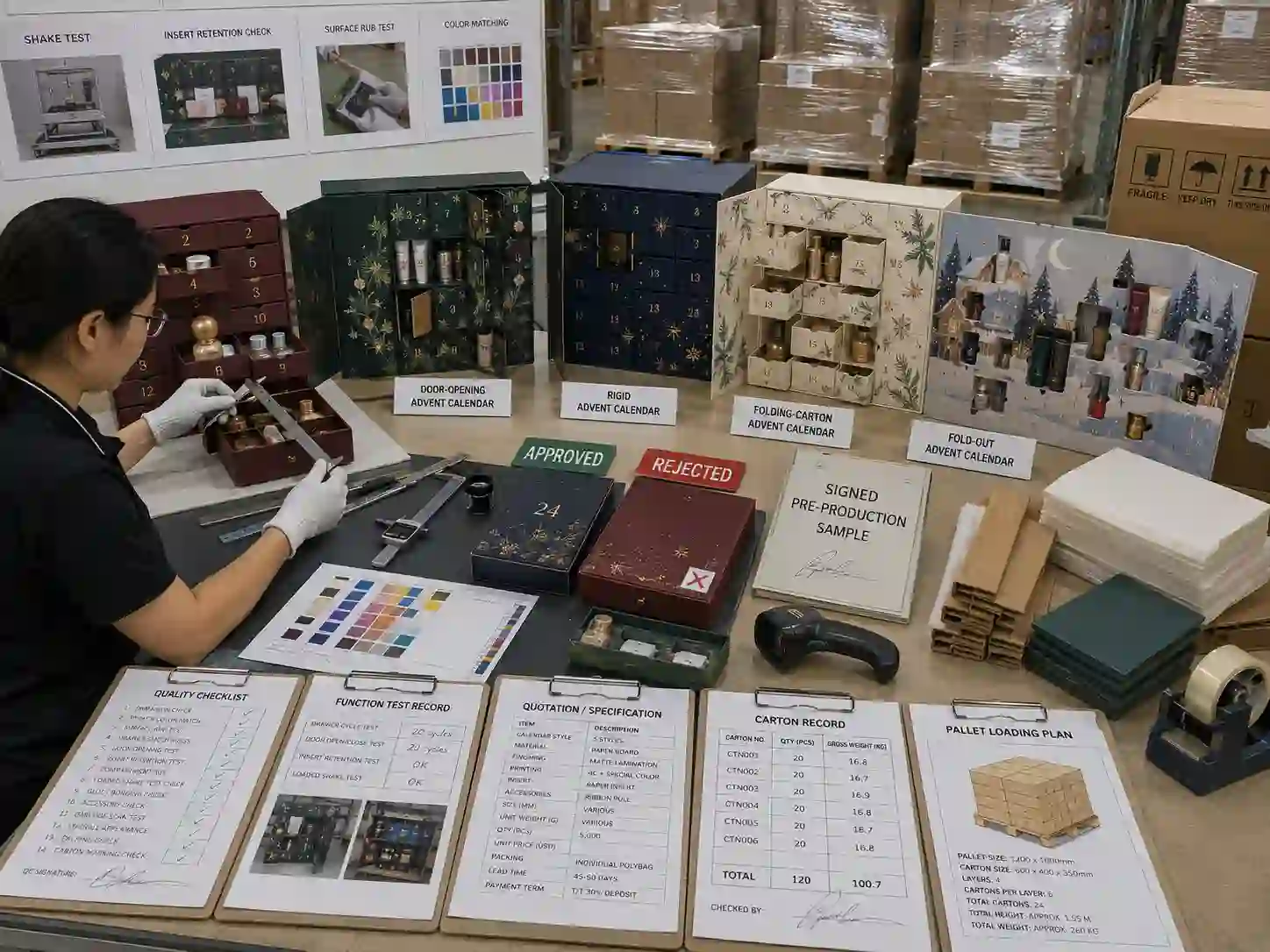
Each calendar may need tissue, a fitted sleeve, protective bag, paper pads, dividers, corner guards, or an individual corrugated shipper. The export carton should be sized to reduce movement without creating damaging compression. Carton quantity, net weight, gross weight, dimensions, stacking direction, and pallet pattern should be confirmed before shipment.
Shipping marks should match the purchase order and packing list, including SKU, carton number, quantity, destination, dimensions, and handling information where required. Barcode and logistics-label formats can be checked against applicable GS1 standards. For projects requiring formal transport simulation, buyers can discuss suitable test procedures with the supplier and review guidance from the International Safe Transit Association.
Export-carton and pallet decisions also affect quotation comparisons. A low unit price may be offset by oversized cartons, poor container utilization, additional pallets, or avoidable freight volume.
What should buyers prepare before requesting a quotation?
A useful quotation depends on complete product and packaging information. Sending only a reference image and required quantity usually produces a provisional price with assumptions that may change later.
Prepare the following RFQ details:
- Required calendar style, opening method, compartment count, and approximate finished dimensions.
- Product list with dimensions, weights, photographs, materials, and loading orientation.
- Preferred rigid box, folding carton, drawer box, door-opening box, or fold-out structure.
- Insert preference, such as paper insert, PET tray, EVA insert, foam, or molded pulp.
- Artwork status, number of designs, CMYK or Pantone requirements, and color references.
- Finishing requirements, including lamination, foil stamping, embossing, or spot UV.
- Order quantity, acceptable MOQ, target delivery date, and destination country.
- Sample requirements and whether physical products can be provided for fit testing.
- Individual packing, export carton, pallet, barcode, and shipping-mark requirements.
- Inspection expectations, defect criteria, testing requests, and required quotation terms.
Buyers can review additional advent calendar box buying guides before finalizing the RFQ. When the product list and specifications are ready, use the contact page to request a custom quote for structure development, sampling, production, QC, and export packing.
Which common quality and purchasing mistakes should be avoided?
The most common mistake is approving appearance without confirming loaded function. A calendar may photograph well but still have tight drawers, blocked doors, loose products, weak dividers, or insufficient shipping protection.
- Designing insert cavities from estimated rather than verified product dimensions.
- Changing products after the insert and dieline have been approved.
- Approving flat artwork without checking a fully assembled printed sample.
- Using one board thickness across all parts without considering weight distribution.
- Adding multiple finishes without checking fold, door, and glue performance.
- Comparing unit prices without comparing specifications and packing inclusions.
- Skipping a loaded pre-production sample to save initial time or cost.
- Failing to define critical defects, functional checks, or approval references.
- Leaving shipping marks, carton quantities, and pallet requirements until production is complete.
- Choosing a complicated structure that exceeds the project budget or available lead time.
Frequently asked questions about advent calendar box quality checks
How many compartments should be function-tested?
Critical functions should be checked across different positions, production stages, and cartons rather than only on one front-row compartment. The inspection plan should consider order quantity, structure risk, product weight, and agreed defect limits. High-risk mechanisms may justify broader checks than simple paper doors.
Is a white prototype enough for approval?
No. A white prototype is useful for structure and product fit, but it does not confirm printed color, lamination, foil registration, wrapped-edge quality, glue interaction, or final material behavior. A printed and loaded pre-production sample provides a more complete approval reference.
Why can drawers become tight after printing and wrapping?
Wrapping paper, lamination, glue layers, board variation, and environmental conditions can reduce clearance. Drawer dimensions should therefore be tested with production-equivalent materials rather than calculated only from nominal greyboard dimensions.
Do more quality checks always make the box more expensive?
They add inspection and management work, but early checks can reduce larger costs caused by rework, rejected production, repacking, replacement shipments, or missed delivery dates. Buyers should focus QC resources on the defects that create the greatest functional, visual, or logistics risk.
Can a lower MOQ reduce quality-control requirements?
A lower quantity does not remove the need for dieline approval, insert testing, color checking, functional inspection, and export-packing verification. In some cases, fixed engineering, tooling, sampling, and setup costs are spread across fewer units, which can increase the unit price.
When should export-carton testing be discussed?
Discuss it during quotation and packaging development, especially for heavy loaded calendars, fragile contents, long transport routes, e-commerce distribution, or strict retailer requirements. The test method should match the actual distribution risk rather than being added after production.
How should buyers plan quality, cost, and supplier control?
Effective advent calendar box quality checks begin before the purchase order. The structure, products, insert, artwork, materials, finishing, sample stages, defect criteria, export carton, pallet plan, MOQ, lead time, and quotation inclusions should be aligned before mass production.
A well-engineered calendar may require more inspection than a standard box, but the purpose is practical: every compartment must look correct, open correctly, hold the intended product, survive packing, and arrive ready for retail or e-commerce distribution. Preparing accurate RFQ information and approving a loaded pre-production sample gives buyers a stronger basis for comparing suppliers, controlling cost, and reducing production risk.