
Quick answer: The most effective way to control advent calendar box production risk is to approve the packaging in stages rather than moving directly from a quotation to mass production. Buyers should confirm the product dimensions, structural dieline, insert fit, material specifications, artwork, printing proof, finished sample, assembly tolerances, packing method, and inspection criteria before bulk manufacturing begins. A blank prototype identifies structural problems, a printed sample confirms appearance and finishing, and a pre-production sample establishes the final production standard. Clear written approvals, controlled revisions, loaded-product testing, and an agreed QC checklist reduce costly rework, delivery delays, and inconsistent finished boxes.
Why do advent calendar box orders carry more production risk?
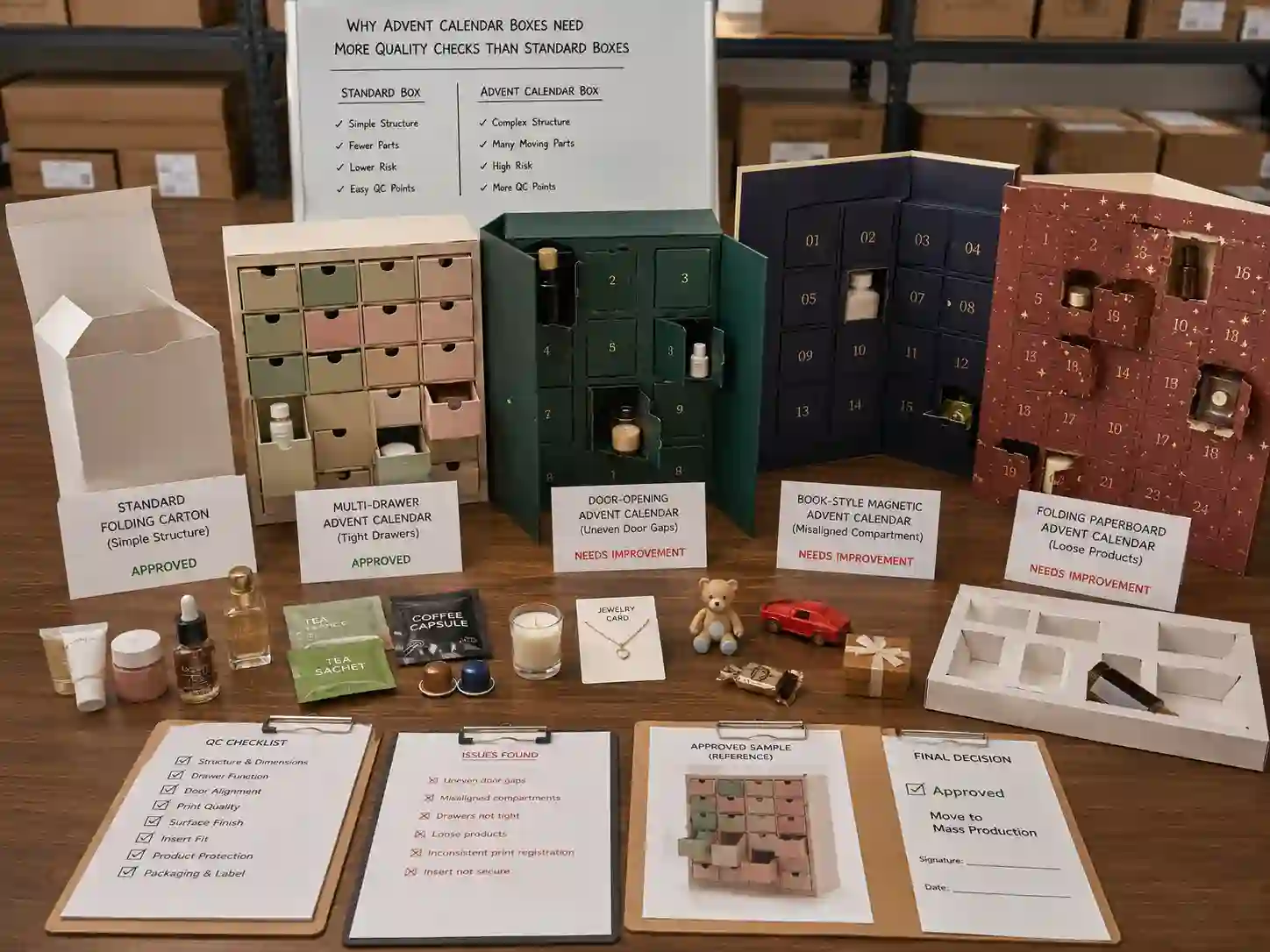
Advent calendar packaging has more interacting components than a standard folding carton. A small error in one part can affect the operation, appearance, packing efficiency, or product security of the entire box.
A multi-drawer rigid box may contain an outer shell, 12 or 24 drawers, drawer sleeves, pull tabs, printed wraps, internal supports, and several insert styles. A door-opening calendar may depend on accurate perforation, door spacing, cavity depth, product retention, and artwork registration across many repeated compartments.
The main sources of risk include:
- Incorrect product dimensions or incomplete product samples
- A dieline that does not allow sufficient assembly clearance
- Drawers that become tight after paper wrapping or lamination
- Doors that tear poorly, open too easily, or reveal adjacent cavities
- Inserts that hold products during display but fail during shipping
- Artwork that does not align across doors, drawers, panels, or folds
- Finishing that changes color, surface friction, or folding performance
- Bulk materials that differ from the approved sample specification
- Export cartons that permit movement, abrasion, or corner damage
Buyer tip: Treat the calendar as a packaging system rather than a single box. Structure, insert, artwork, assembly, product loading, and export packing must be evaluated together.
How can buyers reduce advent calendar box production risk?
Buyers can reduce advent calendar box production risk by creating approval gates before mass production. Each gate should answer a different question: Does the structure work? Does the product fit? Does the printed appearance meet expectations? Can the factory reproduce the approved result consistently?
| Approval stage | Main purpose | What the buyer should check | Risk if skipped |
|---|---|---|---|
| Specification review | Define the project accurately | Product sizes, weights, box style, materials, quantities, destination, and deadline | Quotation changes, wrong assumptions, and unsuitable structure |
| Blank structural sample | Verify dimensions and operation | Drawer clearance, door opening, folds, insert cavities, product loading, and overall size | Structural defects discovered after printing |
| Artwork and proof approval | Confirm printable files and color expectations | Dieline placement, bleed, fonts, CMYK values, Pantone references, barcodes, and finishing areas | Misregistration, incorrect color, missing text, or finishing errors |
| Printed sample | Evaluate the finished visual result | Printing, lamination, foil stamping, embossing, spot UV, wrapping, and assembly quality | Appearance disputes after bulk production |
| Pre-production sample | Set the mass-production standard | Final materials, artwork, inserts, accessories, product fit, and packing method | Bulk goods made to an outdated or incomplete sample |
| Production and final QC | Confirm consistency and shipment readiness | Dimensions, function, print, assembly, loaded tests, carton marks, and quantities | Defective or incorrectly packed goods reaching the buyer |
Which advent calendar structure creates the lowest risk for the project?
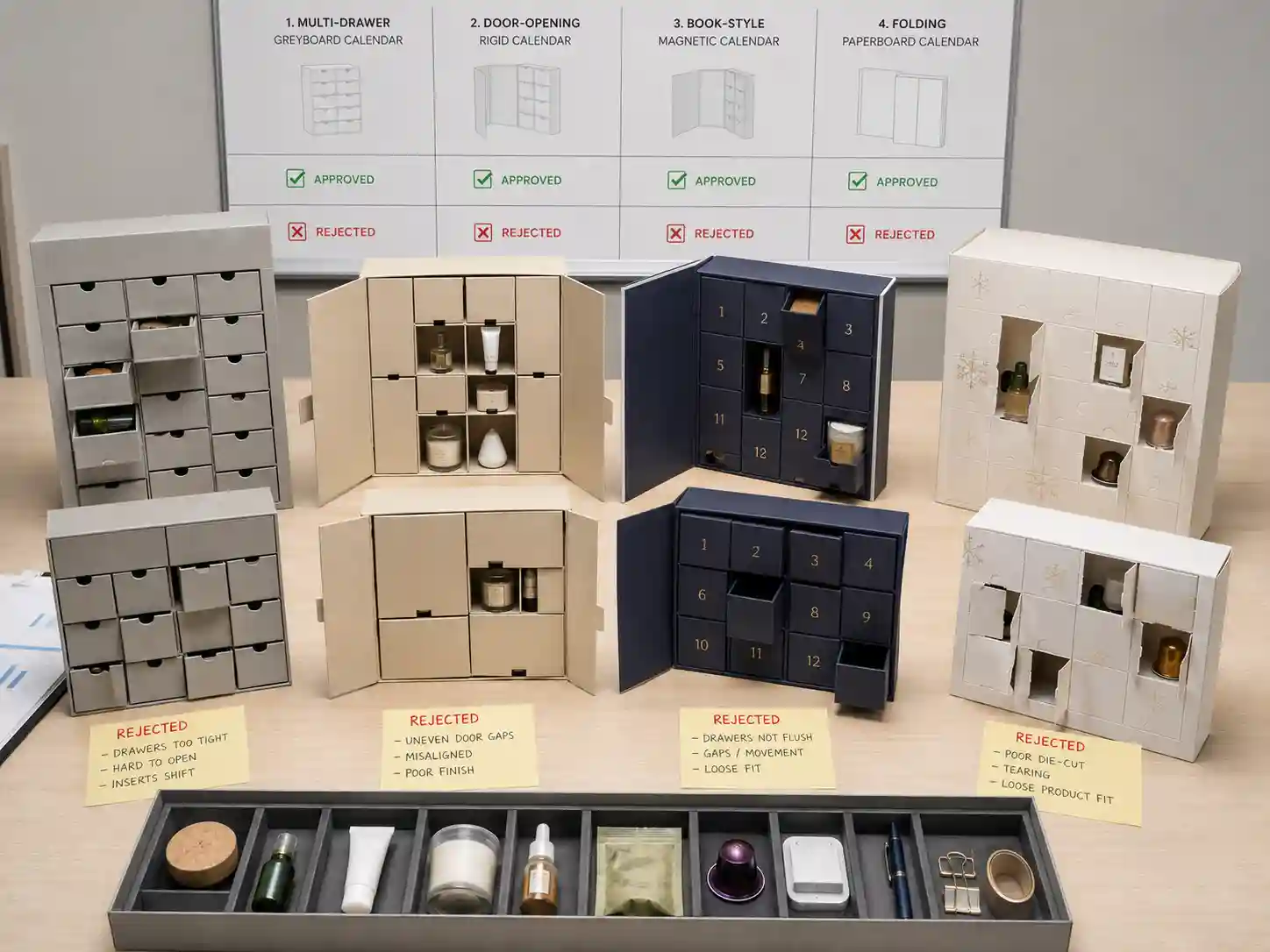
The lowest-risk structure is the one that matches the products, target price, retail presentation, assembly method, and shipping conditions. A simpler structure is not automatically better, but additional moving parts usually create more dimensions and tolerances to control.
When is a folding carton calendar appropriate?
A folding paperboard calendar can be efficient for lighter products, higher-volume campaigns, flat or semi-flat packing, and cost-sensitive retail programs. Perforated doors require careful cutting, creasing, print registration, and cavity alignment.
Buyers should test whether doors remain closed during transport but open cleanly for the end user. The paperboard grain direction, door size, perforation pattern, lamination, and distance from the cavity edges can all affect opening performance.
When does a rigid box reduce or increase risk?
A rigid box provides stronger presentation and better protection, but it introduces greyboard cutting, paper wrapping, corner finishing, adhesive control, and manual assembly variables. It is commonly selected for cosmetics, jewelry, candles, premium food gifts, and corporate gift programs.
Rigid drawer boxes need enough operating clearance after the greyboard and wrapping paper are combined. A drawer that moves correctly as an unwrapped prototype may become tight after printed paper and matte lamination are added.
What should buyers check on drawer and door-opening boxes?
- Drawer movement with the actual surface finish applied
- Consistent gaps between repeated drawers or doors
- Pull-tab position, strength, and attachment
- Magnet alignment where magnetic closures are used
- Door perforation strength and opening direction
- Product visibility when a compartment is opened
- Whether one compartment interferes with another
- Overall box balance when products have different weights
Buyers comparing structures can review Giftpackpro’s custom advent calendar box products and discuss engineering options with a custom advent calendar boxes manufacturer before committing artwork to a final dieline.
Why should a blank sample come before a printed sample?
A blank sample should normally come first because structural revisions are less costly before printing plates, foil dies, embossing dies, or production materials are prepared. Its purpose is engineering validation, not final visual approval.
A useful blank prototype should be made at the intended finished dimensions and use materials reasonably close to the planned paperboard or greyboard thickness. It should also include representative drawers, doors, inserts, magnets, ribbons, or other functional parts.
The buyer should load actual products or accurate product dummies into the blank sample. Checking an empty calendar is not enough because weight distribution can change drawer movement, panel bending, insert retention, and shipping performance.
Factory tip: Send product samples from the same version planned for the commercial launch. A packaging insert developed around an early bottle, sachet, candle, capsule, or accessory may become unusable if the final product dimensions change.
What should be recorded during blank-sample approval?
- Finished external dimensions of the calendar
- Internal dimensions of each compartment or drawer
- Product orientation and loading sequence
- Clearance around caps, pumps, lids, seals, and fragile features
- Insert material, thickness, cavity depth, and retention method
- Drawer, door, hinge, magnet, ribbon, and closure performance
- Required revisions and the revision number of the dieline
- Approval status: approved, approved with changes, or rejected
Never approve a structural sample only through photographs when operation and fit are critical. Physical review is particularly important for tightly fitted rigid boxes, mixed product assortments, fragile components, and heavy calendars.
How should inserts be tested before artwork approval?
Inserts should be tested with production-representative products before artwork is finalized. Cavity changes can alter compartment dimensions, door positions, drawer depths, and the printable layout.
Different insert materials introduce different risks:
- Paper insert: recyclable-looking and printable, but fold geometry and paper grain must provide enough support.
- PET tray: offers accurate formed cavities and product visibility, but tooling, flange dimensions, material thickness, and static or scratching concerns should be reviewed.
- EVA insert: provides controlled fit and a premium appearance, but density, odor, color, cutting tolerance, and surface compatibility matter.
- Foam insert: can protect irregular or fragile products, but compression recovery and surface rubbing should be tested.
- Molded pulp: may support fiber-based packaging goals, but tooling, draft angles, surface texture, moisture response, and dimensional tolerance require evaluation.
A cavity should not merely match the product outline. The packaging engineer must consider how the product is inserted, how the buyer removes it, whether labels or decorated surfaces rub against the insert, and whether the item can escape during a loaded shake test.
For mixed-product calendars, identify the heaviest, smallest, tallest, most fragile, and most easily scratched items. These products usually determine the most important engineering checks.
What must be approved on the artwork and printed sample?
The buyer must approve both digital artwork accuracy and the physical printed result. A screen preview can confirm content and placement, but it cannot fully represent paper color, ink absorption, lamination, metallic foil, embossing depth, or gloss contrast.
Before sample production, review the final dieline version, bleed, safe areas, panel orientation, compartment numbers, barcode size, legal text, and finishing layers. Fonts should be outlined or correctly supplied, and linked images should have sufficient resolution.
For color control, specify whether the project uses CMYK process printing, Pantone spot colors, or a combination. A physical Pantone reference or signed color target is more useful than descriptions such as “deep red” or “premium gold.”
The printed sample should be checked under consistent lighting for:
- Color against the approved proof or physical reference
- Registration around small doors, numbers, borders, and fine text
- Matte or gloss lamination consistency
- Foil-stamping position, coverage, pinholes, and edge quality
- Embossing or debossing depth and alignment
- Spot UV registration and gloss level
- Cracking at folds, hinges, corners, and perforations
- Scuffing, glue marks, bubbles, wrinkles, and exposed greyboard
Buyers sourcing certified fiber-based materials can verify the supplier’s claims and scope through the official Forest Stewardship Council rather than relying only on a logo shown in a quotation.
When is a pre-production sample necessary?
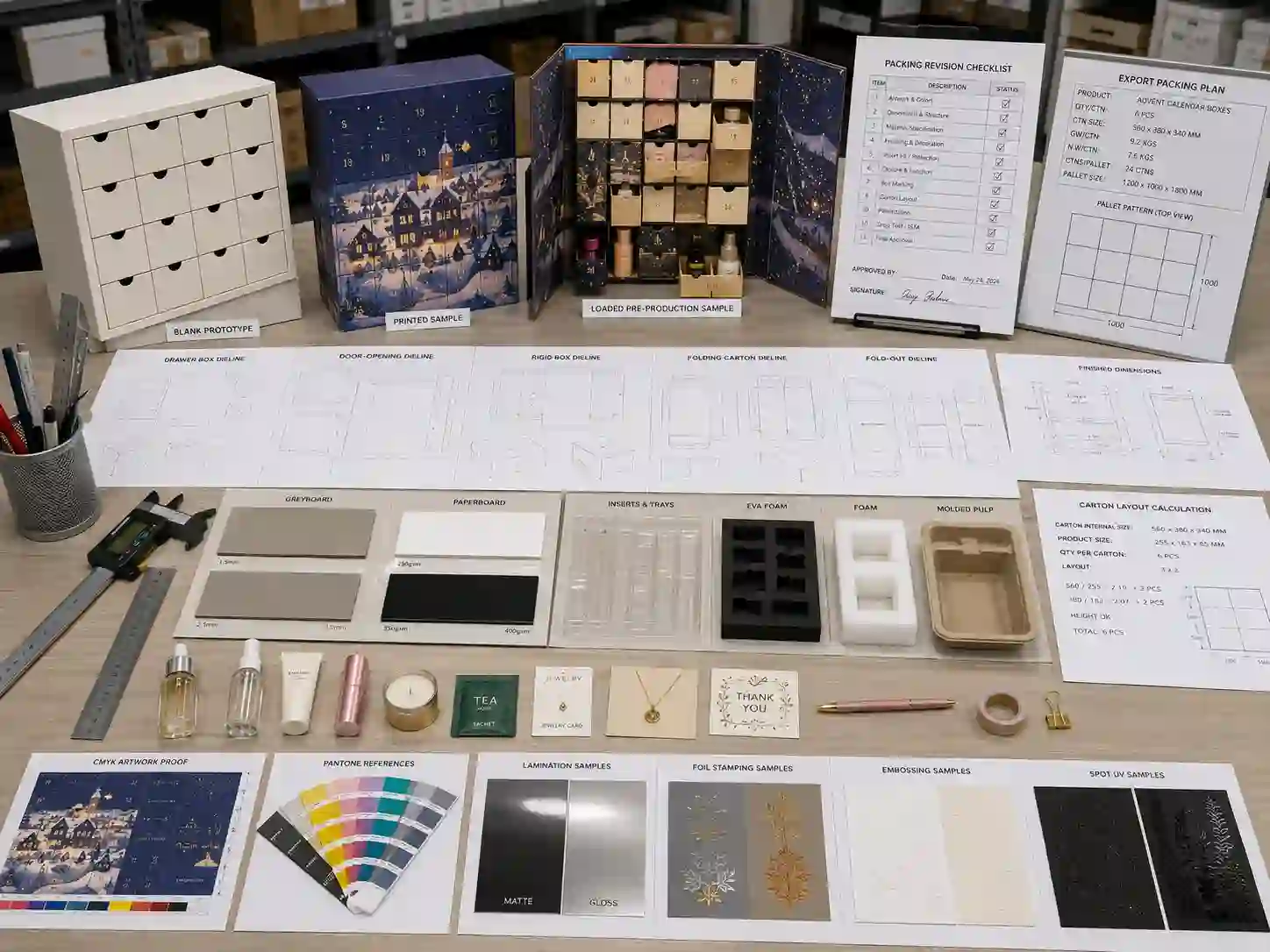
A pre-production sample is especially useful when the approved printed prototype was handmade, the design has been revised, the insert changed, or bulk machinery and materials may produce a different result. It should represent the specification intended for mass production as closely as practical.
The pre-production sample should incorporate the final dieline, artwork, paper, greyboard, insert, surface finish, accessories, assembly sequence, and packing configuration. It becomes a reference for production teams, inspectors, and the buyer.
Quotable purchasing principle: A signed sample is useful only when its specification and revision number match the purchase order. An unnumbered sample without written material and finishing details leaves too much room for interpretation.
What should a sample approval document include?
- Project name, SKU, purchase-order reference, and sample date
- Dieline and artwork revision numbers
- Finished dimensions and agreed tolerances
- Paper, greyboard, corrugated board, and insert specifications
- Printing method and approved color references
- Lamination, foil, embossing, spot UV, ribbons, magnets, and accessories
- Product-fit and functional test results
- Approved packing method and carton quantity
- Photographs identifying any accepted handmade limitations
- Buyer and supplier approval records
Giftpackpro’s custom advent calendar box services can be used to coordinate structural prototypes, printed samples, revisions, and pre-production checks before bulk manufacturing.
How do sample revisions affect MOQ, cost, and lead time?
Revisions affect cost and lead time according to when they occur. Dieline changes made during blank sampling are normally easier to manage than artwork, tooling, or structural changes made after materials have been ordered.
Important cost drivers include structural complexity, box dimensions, material thickness, number of components, insert type, printing coverage, specialty finishes, tooling, manual assembly, product loading, inspection requirements, and export packing.
MOQ is not determined by box style alone. It may be influenced by paper purchasing, printing-sheet utilization, tooling economics, machine setup, finishing processes, insert production, and the number of SKUs or artwork versions.
To control revisions:
- Use one authorized contact to consolidate buyer feedback.
- Mark every dieline and artwork file with a revision number and date.
- Separate structural corrections from visual preferences.
- Confirm whether a revision changes tooling, materials, unit cost, or delivery.
- Close previous versions after the new version is approved.
- Do not release mass production from informal chat comments alone.
Buyer tip: Build sample approval time into the purchasing schedule. A rushed approval does not remove risk; it transfers unresolved decisions into mass production, where correction is more expensive.
What QC controls should be agreed before mass production?
QC criteria should be agreed before production so the factory and buyer evaluate the same characteristics. Inspection should cover function and construction, not only visible printing.
Practical pre-production and final QC checklist
- Confirm the approved sample, specification sheet, dieline, and artwork revision
- Measure finished box, drawer, door, cavity, and insert dimensions
- Check paperboard or greyboard thickness and construction
- Test representative drawers through repeated opening cycles
- Check door perforations, hinges, magnets, ribbons, and closures
- Load actual or equivalent products into all compartment types
- Perform controlled tilt and shake tests for product retention
- Compare print color with the signed proof or approved sample
- Inspect foil, embossing, spot UV, lamination, folds, corners, and glue areas
- Check numbering sequence, barcodes, warnings, and shipping marks
- Confirm accessories, inserts, instruction sheets, and packing quantities
- Inspect export cartons, protective materials, pallet pattern, and labeling
Inspection sampling levels and acceptance criteria should be specified according to the project and buyer requirements. Buyers may ask suppliers how defects are classified, how inspection samples are selected, and how failed results are corrected, rather than assuming that “standard QC” means the same process at every factory.
The Giftpackpro packaging factory can provide project-specific inspection points for structures such as rigid drawer calendars, door-opening boxes, folding cartons, and mixed-compartment gift sets.
How should export packing be approved during sampling?
Export packing should be designed before the final quotation is closed because carton size, protective materials, pallet use, and packing labor affect cost and shipment volume. Packaging that looks acceptable on a sample table can still fail through abrasion, compression, vibration, or movement in transit.
Common protections include tissue sheets, fitted sleeves, paper pads, dividers, corner guards, reinforced corrugated export cartons, pallet corner boards, and stretch wrap. The correct combination depends on the calendar’s surface finish, weight, dimensions, structure, and shipping method.
High-rub surfaces, dark matte lamination, metallic foil, protruding ribbons, and exposed rigid-box corners may need additional separation. A loose master carton can allow repeated impact, while an excessively tight carton can crush corners during packing.
Where shipment testing is important, buyers can discuss relevant procedures with their logistics or testing provider and consult the official International Safe Transit Association resources.
Before shipment, confirm:
- Units per export carton
- Carton board grade and finished dimensions
- Gross and net weight limits
- Internal protection and product orientation
- Carton-sealing method
- SKU, purchase-order, carton-number, destination, and handling marks
- Pallet dimensions, stacking pattern, corner boards, and stretch wrap
- Whether cartons ship palletized or floor-loaded
How should buyers compare advent calendar box suppliers?
Compare suppliers by their ability to identify, document, and control project risks—not only by the lowest quoted unit price. A reliable supplier should ask detailed questions before confirming the structure, cost, or delivery plan.
Supplier decision guide
| Buyer priority | What to ask the supplier | Positive evidence |
|---|---|---|
| Structural reliability | How will drawer clearance, door function, and repeated compartments be tested? | Blank prototypes, measurement records, and function-test criteria |
| Product security | Will the insert be tested with actual products and a loaded box? | Fit-testing photos, product orientation plan, and retention checks |
| Revision control | How are dieline, artwork, and sample versions identified? | Numbered files, written change logs, and signed approvals |
| Print consistency | What physical proof or color target will production follow? | Approved printed sample, Pantone reference, or controlled color proof |
| Production QC | Which defects, dimensions, and functional points are inspected? | Project-specific checklist and documented inspection results |
| Export readiness | How are carton size, protection, shipping marks, and pallet loading confirmed? | Packing specification, carton data, and pallet plan |
Reviewing a supplier’s questions is often as important as reviewing its answers. A quotation issued without confirmed dimensions, products, materials, finishing, quantities, packing, and delivery requirements may rely on assumptions that later become surcharges or schedule changes.
What information should be prepared before requesting a quotation?
A complete RFQ allows suppliers to compare the same specification and reduces the risk of receiving quotations based on different structures or material assumptions.
Quotation preparation checklist
- Target calendar style: rigid box, drawer box, door-opening box, folding carton, or another structure
- Target external dimensions or maximum retail footprint
- Product list with dimensions, weights, photos, and orientation
- Number and arrangement of compartments
- Preferred insert material or required performance
- Paperboard, greyboard, printing, lamination, and finishing preferences
- Order quantity and number of SKUs or artwork versions
- Blank sample, printed sample, and pre-production sample requirements
- Product loading, accessories, instruction sheets, and packing services
- QC requirements and any third-party inspection plans
- Export-carton, shipping-mark, pallet, and logistics requirements
- Delivery destination, target shipment date, and trade terms
Buyers can use Giftpackpro’s advent calendar box buying guides to prepare project specifications and review common sourcing decisions before sending an RFQ.
Which common production-risk mistakes should buyers avoid?
- Approving artwork before the structure: Later cavity or panel changes can force artwork revisions.
- Providing only nominal product capacity: A bottle volume does not define its physical dimensions, cap, pump, or label position.
- Testing an empty box: Product weight can reveal insert, drawer, panel, and balance problems.
- Assuming screen color is a production standard: Physical paper, ink, lamination, and lighting change appearance.
- Combining feedback from multiple uncoordinated reviewers: Conflicting comments create version errors.
- Approving a handmade sample without documenting limitations: Handmade construction may differ from machine-assisted bulk production.
- Changing products after insert approval: Even a small size change can affect loading and retention.
- Leaving packing decisions until production is complete: Carton and pallet requirements can affect cost, lead time, and protection.
- Comparing quotations only by unit price: Different sample stages, materials, inserts, QC, and export packing can make prices non-equivalent.
Frequently asked questions about advent calendar box production risk
Is a blank sample always required?
A blank sample is strongly recommended when the structure, compartment layout, product fit, or opening mechanism is customized. It may be less critical for a proven standard structure with minimal changes, but the buyer should still verify dimensions and product compatibility.
What is the difference between a printed sample and a pre-production sample?
A printed sample mainly demonstrates appearance and construction for approval. A pre-production sample is intended to represent the final mass-production specification, including approved materials, artwork, inserts, accessories, assembly, and packing details.
Can one sample approve several product SKUs?
Only when the structures, materials, dimensions, inserts, artwork variables, and products are sufficiently similar. Separate fit tests or samples may be needed when SKUs use different products, cavity layouts, finishes, or packing methods.
When should mass production begin?
Mass production should begin after the buyer has approved the required structural, artwork, color, insert, finishing, and packing details in writing. The purchase order and approval records should reference the current revisions.
How can buyers prevent sample-to-production differences?
Use a signed approval sample together with a detailed specification sheet, revision-controlled files, material descriptions, tolerance requirements, and a project-specific QC checklist. Production teams should compare bulk output against both the sample and written specification.
Does more sampling always eliminate production risk?
No. Sampling reduces risk only when each sample has a defined purpose, uses representative materials and products, receives careful review, and results in controlled written approval. Repeated samples without clear decision criteria can add cost without resolving the underlying issue.
Prepare the project before requesting a sample or quotation
Effective advent calendar box production risk management begins with accurate product data and staged approval. Before contacting Giftpackpro, prepare the intended box style, product dimensions and weights, compartment plan, insert preference, artwork status, order quantity, sample requirements, finishing expectations, destination, and target schedule.
Explore custom advent calendar box services, review relevant custom advent calendar box products, or request a custom quote with your RFQ details. A clear specification enables the factory to recommend the right prototype sequence, identify engineering risks early, and prepare a more comparable quotation.


