Quick answer: The best material for rigid advent calendar boxes is usually a combination of high-density greyboard for structural strength and premium paper wrapping for appearance, with the final choice depending on product weight, insert requirements, opening style, and target market. For most B2B projects, buyers should compare greyboard thickness, paper finish, insert compatibility, printing requirements, assembly tolerance, and export durability before approving production. A suitable material combination helps prevent box deformation, improves shelf presentation, supports accurate insert fitting, and reduces quality risks during mass production.
For brands ordering custom advent calendar boxes manufacturer solutions, material selection is not only a design decision. It affects prototype approval, quotation accuracy, production lead time, shipping protection, and customer experience.
What material should buyers choose for rigid advent calendar boxes?
The most common choice for rigid advent calendar boxes is a greyboard-based structure wrapped with printed paper. Greyboard provides the rigid strength needed for premium box bodies, while coated paper, specialty paper, or printed sheets create the required artwork appearance.
Unlike folding cartons made mainly from paperboard, a rigid box uses thicker structural materials. This makes it suitable for premium seasonal packaging where brands need stronger panels, better shelf presence, and more reliable product protection.
Why is greyboard commonly used for rigid advent calendar boxes?
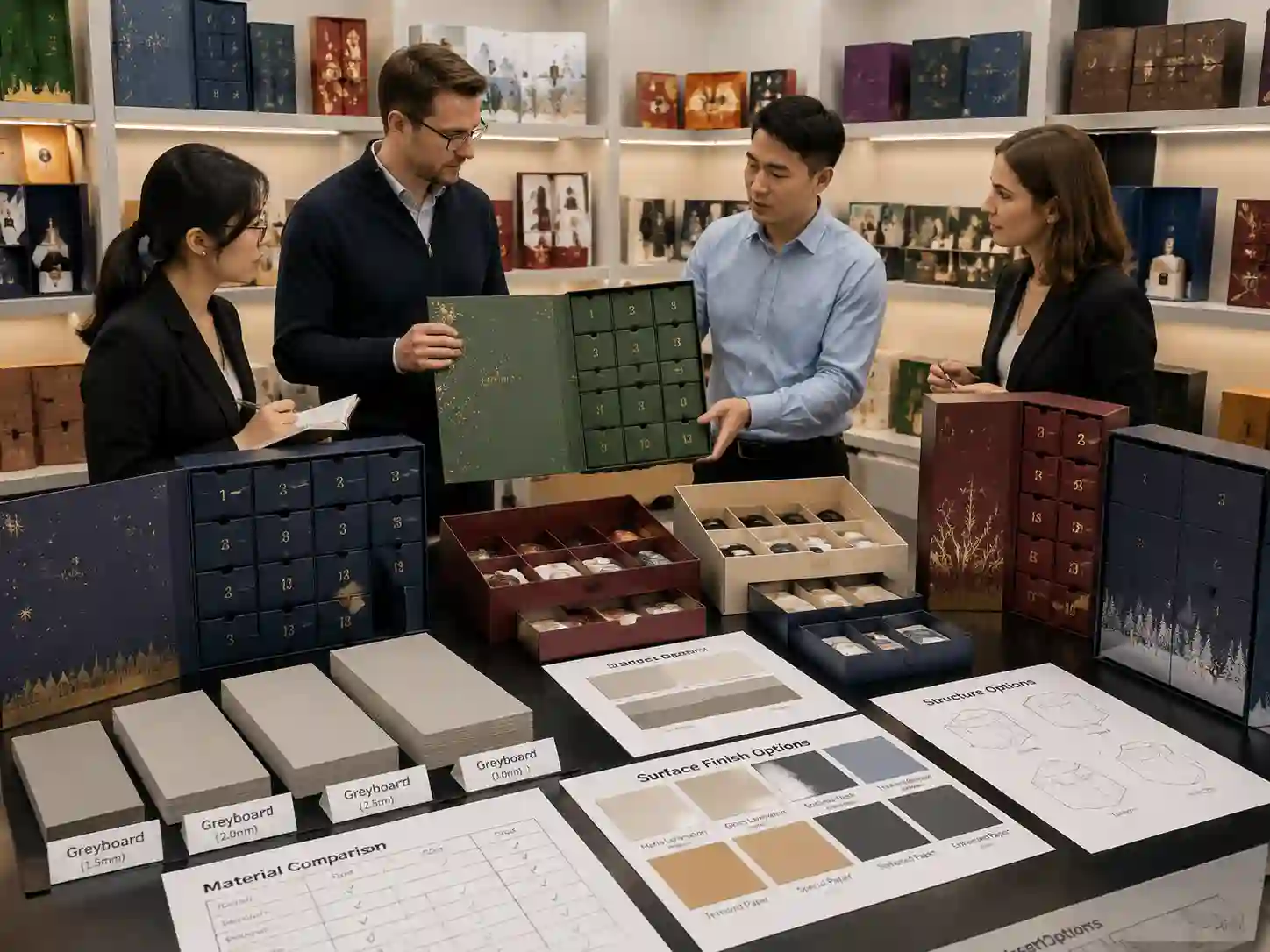
Greyboard is the core structural material in many rigid boxes because it provides stiffness, compression resistance, and dimensional stability. During production, manufacturers cut greyboard panels according to the approved dieline and assemble them with wrapping paper to create the final box structure.
- Strength: Supports heavier products and multi-compartment designs.
- Flatness: Helps maintain clean panels and accurate printing alignment.
- Structure flexibility: Works well with drawer boxes, door-opening boxes, book-style boxes, and magnetic closure structures.
- Premium appearance: Creates the solid feel expected from luxury packaging.
Factory tip: Buyers should confirm greyboard thickness during sampling instead of judging only from appearance. A thicker board may improve strength but can also increase weight, cost, and shipping requirements.
How do different materials compare for rigid advent calendar box production?
The best material depends on the application. A chocolate advent calendar box, cosmetic advent calendar box, and luxury gift box may require different material combinations because product weight, food-contact requirements, and insert design vary.
| Material option | Main advantages | Common applications | Buyer considerations |
|---|---|---|---|
| Greyboard + wrapped paper | Strong structure, premium appearance, flexible finishing options | Luxury gifts, cosmetics, retail advent calendars | Confirm thickness, panel strength, and wrapping quality |
| Paperboard | Lighter weight, lower cost, easier folding production | Entry-level seasonal packaging | Less rigid than greyboard structures |
| PET tray insert | Precise cavities and product visibility | Chocolate, cosmetics, small accessories | Check fit tolerance and sustainability requirements |
| EVA or foam insert | Soft protection and premium positioning | Jewelry, electronics, luxury gifts | Confirm thickness and product access |
| Molded pulp insert | Fiber-based protective option | Eco-focused packaging projects | Test appearance and cavity accuracy |
For many B2B buyers, the most practical solution is not selecting one single material. It is combining materials correctly: greyboard for the outer structure, printed paper for branding, and a suitable insert material for product protection.
Should buyers choose rigid boxes or folding cartons for advent calendars?
Rigid boxes are better when buyers need premium presentation, stronger construction, and reusable packaging value. Folding cartons are usually selected when cost efficiency and lower shipping weight are the main priorities.
| Comparison point | Rigid advent calendar box | Folding carton advent calendar |
|---|---|---|
| Structure | Thick greyboard construction with wrapped paper | Folded paperboard structure |
| Appearance | Premium, luxury, gift-oriented | Lightweight and economical |
| Product protection | Higher rigidity and impact resistance | Suitable for lighter products |
| Cost factors | Higher material and labor cost | Lower production cost |
| Typical buyer | Premium brands, retail gift programs, seasonal launches | High-volume promotional campaigns |
Buyer tip: When requesting quotations, explain the target product category first. A supplier can recommend better material combinations when they know whether the box will hold chocolates, skincare products, candles, toys, tea samples, or promotional items.
What insert materials work best with rigid advent calendar boxes?
The insert should be selected together with the rigid box structure because cavity accuracy directly affects assembly quality and product protection.
Paper insert
Paper inserts are cost-effective and suitable for lightweight products. They can be printed, folded, and integrated with the box design. Buyers should check whether the paper structure provides enough support during shipping.
PET tray insert
PET trays are commonly used when products require precise positioning. They are suitable for chocolates, cosmetics, and small retail items because each cavity can be designed according to product dimensions.
EVA or foam insert
EVA and foam inserts provide cushioning and a premium opening experience. They are often used for higher-value products but require accurate cutting to avoid loose fitting or difficult product removal.
Molded pulp insert
Molded pulp is considered for projects where fiber-based materials are preferred. Buyers should request samples because surface appearance, cavity accuracy, and product support can vary depending on design complexity.
QC tip: Insert testing should include product placement, removal testing, transportation simulation, and checking whether doors, drawers, or lids operate smoothly after the insert is installed.
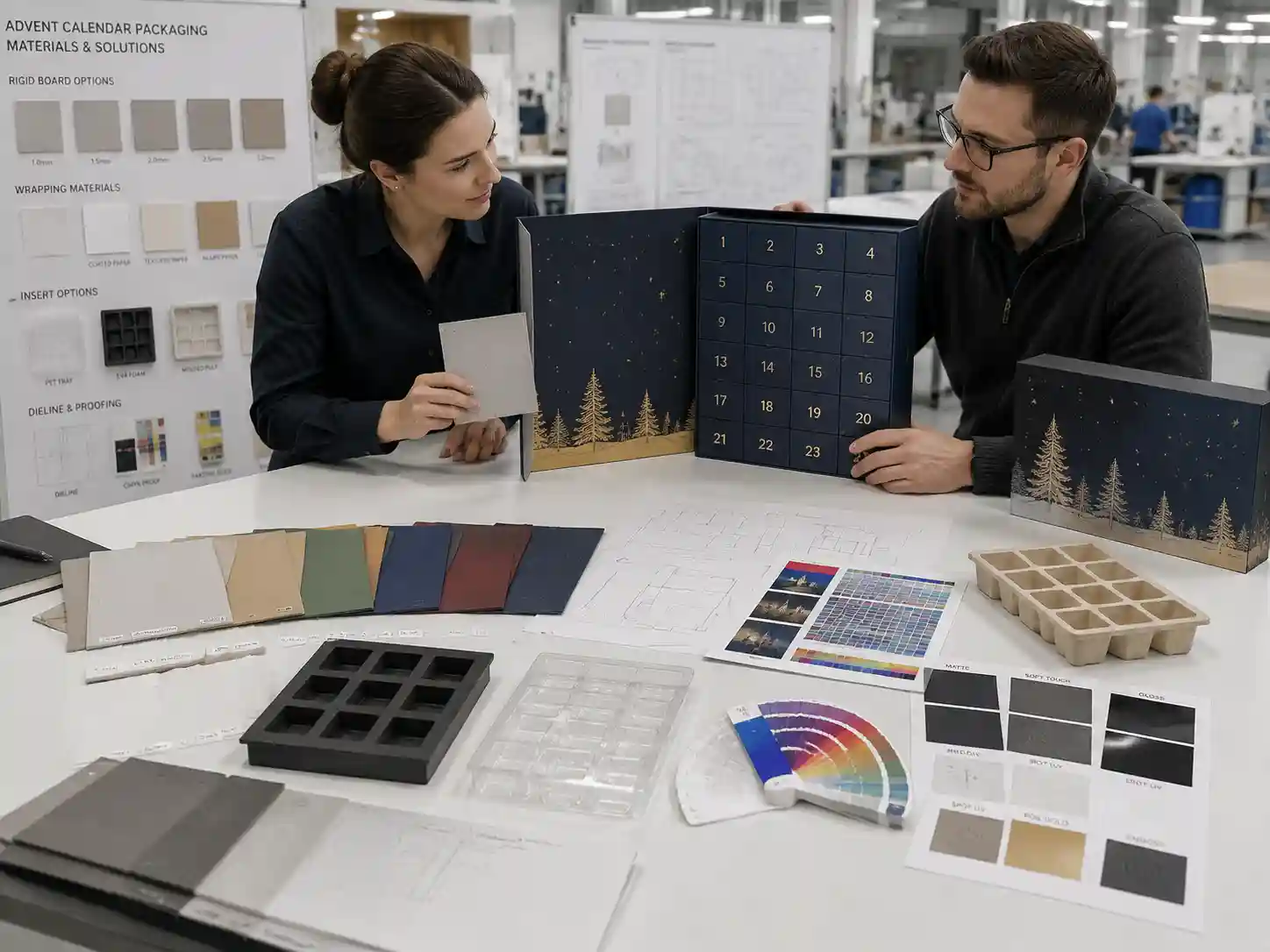
How do materials affect printing and finishing quality?
Material selection directly affects artwork results. Before mass production, buyers should confirm how the wrapping paper, coating, and finishing methods interact with the rigid box surface.
- CMYK printing: Used for detailed artwork and multi-color graphics.
- Pantone matching: Helps control important brand colors.
- Matte lamination: Creates a soft premium appearance.
- Gloss lamination: Provides stronger shine and surface protection.
- Foil stamping: Adds metallic decorative effects.
- Embossing: Creates raised or textured details.
- Spot UV: Highlights selected design areas.
Buyers should approve a printed sample or pre-production sample before bulk manufacturing. Colors, paper texture, foil position, and surface effects can look different between digital artwork and finished packaging.
What production and QC checks matter for rigid advent calendar boxes?
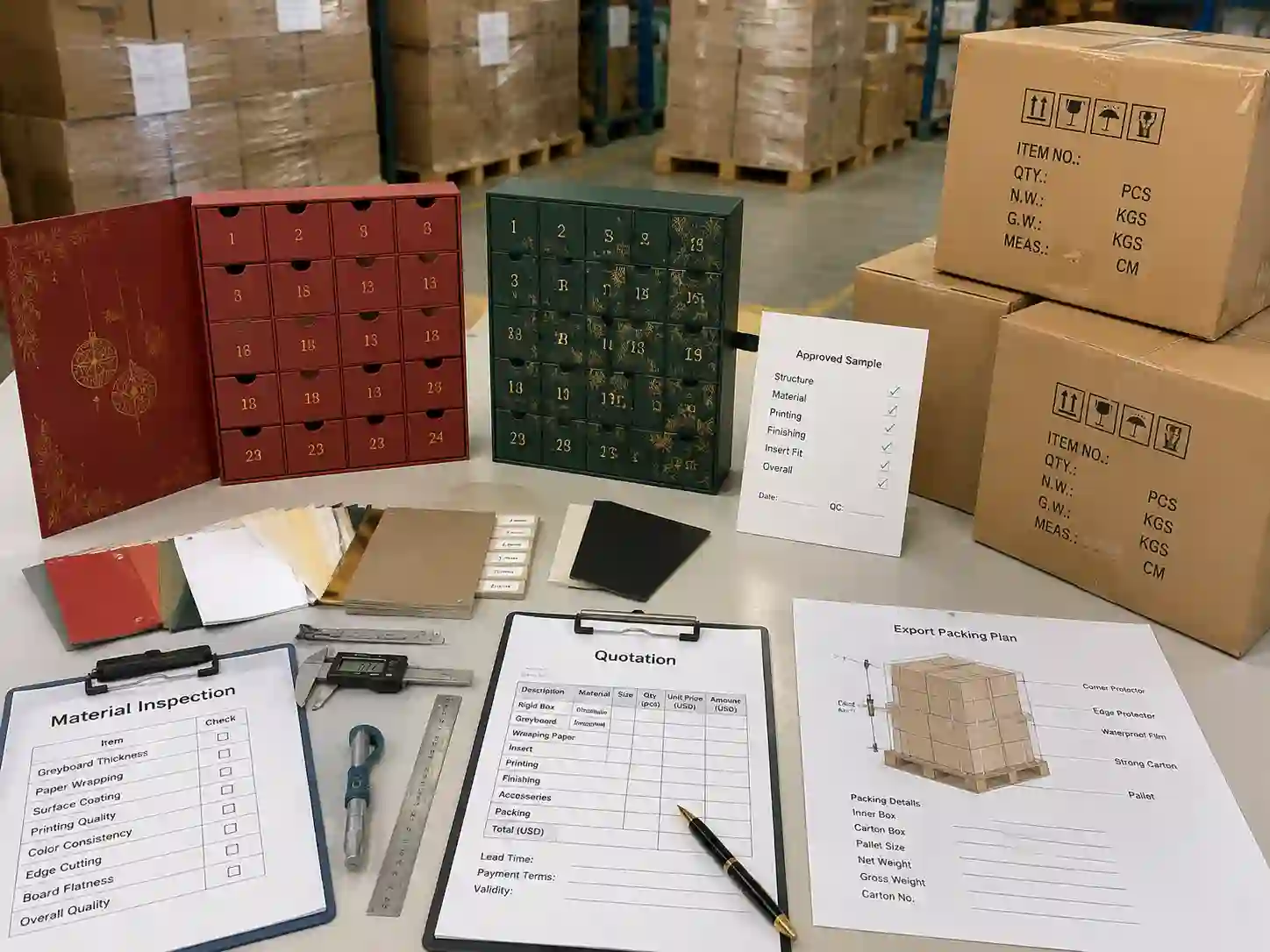
Reliable rigid advent calendar box production requires control at every stage, from material inspection to final export packing. Buyers should not only review the finished appearance but also verify structural performance.
Key production inspection points
- Greyboard thickness and material consistency.
- Dieline accuracy before cutting.
- Wrapping paper alignment and edge finishing.
- Drawer movement or door-opening performance.
- Insert cavity accuracy and product fit.
- Printing color consistency between approved sample and bulk production.
- Assembly tolerance and corner quality.
Practical buyer QC checklist
- Confirm the approved material sample matches bulk production material.
- Check box dimensions against the approved specification.
- Test opening functions repeatedly.
- Verify product placement inside every insert cavity.
- Inspect printing, lamination, foil, and embossing quality.
- Review export cartons and protection methods before shipment.
Factory tip: The most reliable QC process compares mass production samples against the signed pre-production sample, not only against digital artwork files.
How should buyers prepare before requesting a rigid advent calendar box quotation?
A complete RFQ helps suppliers provide more accurate pricing, sampling plans, MOQ recommendations, and lead time estimates.
Before contacting a supplier, prepare:
- Box structure preference: rigid box, drawer box, door-opening box, or other design.
- Product dimensions and weight.
- Required insert type and cavity quantity.
- Artwork files or design references.
- Printing and finishing requirements.
- Target quantity and expected MOQ.
- Delivery destination and export packing requirements.
- Sample requirements and approval schedule.
Giftpackpro supports buyers through custom advent calendar box services, including structure discussion, sampling, production coordination, and quality control preparation.
How do MOQ, sampling, and lead time influence material decisions?
Material choice affects MOQ, tooling requirements, labor cost, and production scheduling. Custom inserts and complex rigid structures usually require more development time than standard packaging formats.
- Sample stage: Confirms structure, material combination, insert fit, and finishing effects.
- Prototype approval: Reduces risk before mass production.
- Bulk production: Requires consistent materials and controlled assembly processes.
- Lead time planning: Should include artwork approval, material preparation, sampling, production, inspection, and shipping.
Buyers can review more practical topics in the advent calendar box buying guides section before starting a packaging project.
What export packing details should buyers confirm?
Rigid advent calendar boxes need careful export packing because premium structures can be damaged by compression, moisture, or poor carton planning.
- Use suitable export cartons with correct internal spacing.
- Add corner protectors or separators when required.
- Prevent movement inside cartons during transportation.
- Confirm pallet arrangement and stacking method.
- Review shipping marks, carton numbers, and destination information.
QC tip: Export packing should be checked together with the finished box quality. A perfect product can still arrive damaged if carton design and protection methods are not properly planned.
Decision guide: How can buyers choose the best material for rigid advent calendar boxes?
The best choice depends on product requirements rather than material price alone.
| If your priority is… | Recommended approach |
|---|---|
| Luxury retail appearance | Greyboard rigid structure with premium wrapping paper and advanced finishing |
| Product protection | Strong greyboard body combined with accurate inserts |
| Lower shipping weight | Optimize board thickness and insert design |
| Complex product arrangement | Use custom PET, EVA, foam, or molded inserts |
| Eco-focused packaging | Evaluate paper-based structures and fiber insert options |
FAQ: Best material for rigid advent calendar boxes
What is the most common material used for rigid advent calendar boxes?
The most common combination is greyboard wrapped with printed paper because it provides structural strength, premium appearance, and flexible customization.
Is greyboard better than paperboard for advent calendar packaging?
Greyboard is generally stronger and more suitable for premium rigid boxes, while paperboard is often selected for lighter and more cost-sensitive packaging projects.
Do inserts affect rigid box material selection?
Yes. Insert size, product weight, and cavity design influence the required box strength and internal structure.
Should buyers request samples before mass production?
Yes. Samples allow buyers to confirm material quality, insert fit, printing, finishing, and assembly performance before bulk production.
What information should be included in a quotation request?
Buyers should provide structure, dimensions, quantity, materials, inserts, artwork requirements, finishing details, delivery location, and sample expectations.
Prepare your rigid advent calendar box project with Giftpackpro
The right material combination helps buyers control quality, cost, production risk, and delivery reliability. For a successful project, prepare your product details, structure ideas, insert requirements, artwork files, and target quantity before requesting a quotation.
Giftpackpro provides custom advent calendar box products and factory-side support for sampling, production planning, QC coordination, and export preparation. Learn more about the Giftpackpro packaging factory or request a custom quote for your next rigid advent calendar box project.
For sustainability-related material evaluation, buyers can also review official guidance from FSC regarding responsible forest-based materials and packaging sourcing considerations.