Quick answer: The best insert for chocolate advent calendar boxes depends on chocolate size, protection requirements, packaging structure, food-contact considerations, production volume, and shipping conditions. For most B2B chocolate packaging projects, paper inserts work well for lightweight assortments, PET trays provide accurate cavity positioning, EVA or foam inserts suit premium gift presentations, and molded pulp supports sustainability-focused designs. Buyers should evaluate insert fit through blank samples, printed samples, and pre-production checks before approving mass production because insert accuracy directly affects product protection, assembly efficiency, and final packaging cost.
Choosing the right insert is one of the most important decisions when developing custom advent calendar boxes. A visually attractive box can still fail if chocolates move inside, doors do not close properly, or the insert creates unnecessary production difficulty.
What should buyers understand before choosing an insert for chocolate advent calendar boxes?
The best insert should match the chocolate format, box structure, and supply chain requirements before artwork and mass production begin. Buyers should first confirm product dimensions, cavity layout, protection level, and whether the insert needs to support retail display or international shipping.
Chocolate advent calendar packaging usually combines an outer structure such as a rigid box, folding carton, drawer box, or door-opening box with an internal insert system. The insert is not only a holder; it affects product presentation, assembly speed, material usage, and quotation accuracy.
- Product size: Mini chocolates, pralines, chocolate bars, and mixed gift sets require different cavity designs.
- Protection needs: Fragile chocolate shapes require stronger separation and reduced movement.
- Presentation requirements: Premium retail products often need clean opening experiences and visible product arrangement.
- Shipping requirements: Export orders need inserts that prevent shifting during carton handling and transportation.
Buyer tip: Prepare product dimensions, weight, quantity per calendar, and packaging goals before requesting a sample. These details help the supplier recommend a realistic insert structure instead of only quoting based on the outer box size.
Which insert materials are best for chocolate advent calendar boxes?
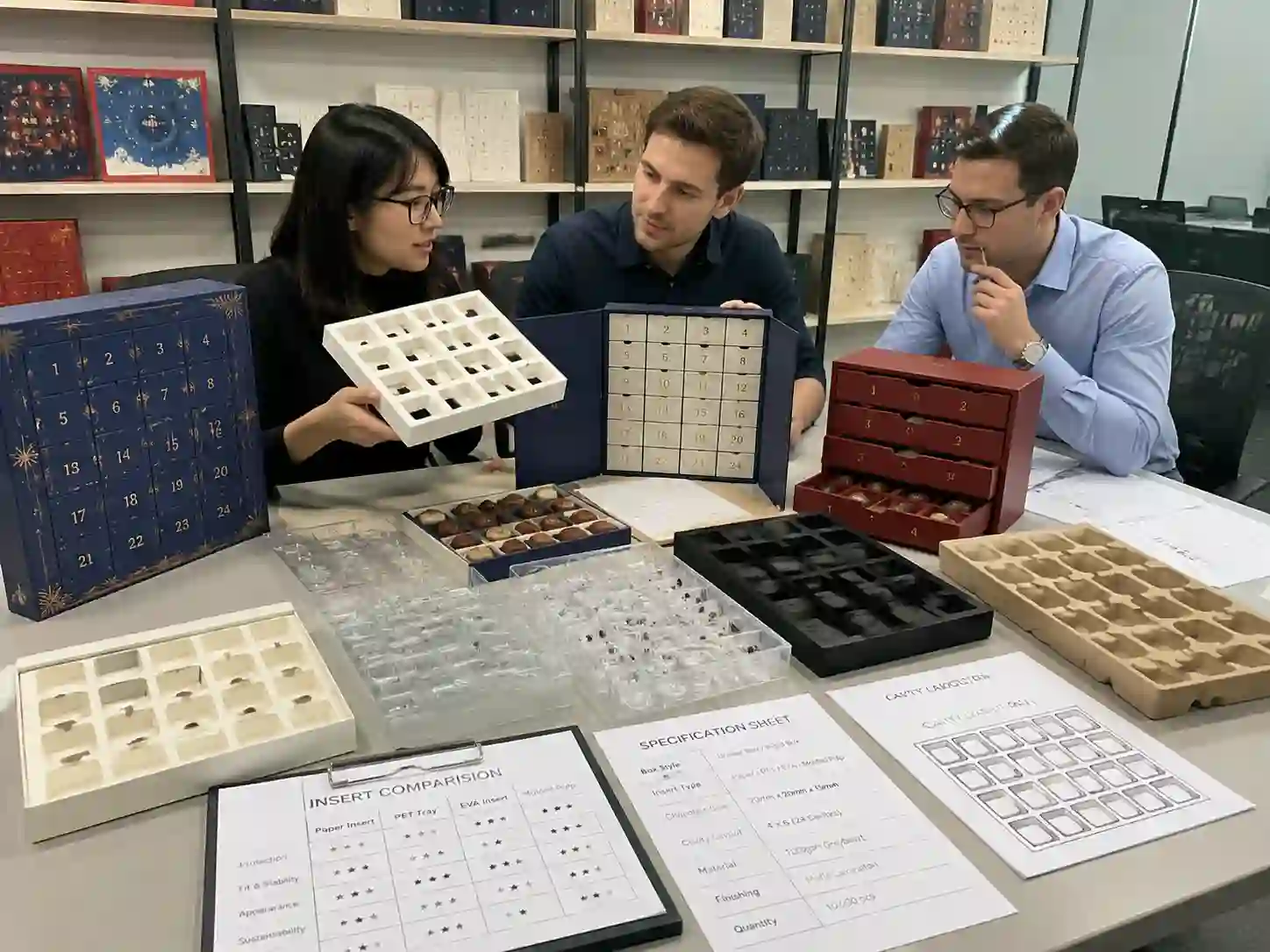
The best insert material depends on the balance between appearance, protection, cost, and production requirements. Paper insert, PET tray, EVA insert, foam insert, and molded pulp each solve different packaging challenges.
| Insert Type | Best Application | Advantages | Buyer Considerations |
|---|---|---|---|
| Paper Insert | Standard chocolate assortments and lightweight products | Cost-effective, printable, easy to customize, suitable for paper packaging systems | Requires accurate structure design to maintain cavity strength |
| PET Tray | Multiple chocolate pieces requiring precise positioning | Excellent cavity accuracy, clean appearance, efficient assembly | Confirm material requirements and recycling considerations with supplier |
| EVA Insert | Premium chocolate gift boxes | Soft protection, luxury appearance, strong product holding | Higher material cost and more complex cutting process |
| Foam Insert | Special protection requirements | Lightweight cushioning and flexible design options | Appearance and material preference should be reviewed before production |
| Molded Pulp Insert | Sustainability-focused packaging projects | Paper-based structure, custom molded cavities, protective design | Requires tooling development and sample testing |
How do paper inserts compare with PET, EVA, foam, and molded pulp?
Paper inserts are often the first choice for large-volume chocolate advent calendar projects because they integrate well with paperboard packaging and can reduce complexity. However, premium brands may choose PET, EVA, foam, or molded pulp when product protection or presentation has higher priority.
| Buyer Priority | Recommended Insert Option | Reason |
|---|---|---|
| Lower cost and efficient production | Paper insert | Suitable for standard chocolate sizes and high-volume orders |
| Exact product positioning | PET tray | Provides consistent cavities and clean retail presentation |
| Luxury gift experience | EVA or foam | Creates premium appearance and stronger cushioning |
| Sustainability positioning | Molded pulp | Supports paper-based packaging concepts when properly developed |
Factory tip: Insert selection should happen together with box structure selection. A drawer box, rigid box, and door-opening box may require different insert layouts because opening direction, panel thickness, and available internal space change the engineering design.
How do insert design and box structure work together?
The insert and the outer box must be developed as one packaging system. A correct insert cannot compensate for an unsuitable box structure.
For example, a rigid box with a removable tray may require a different insert depth compared with a folding carton. A door-opening advent calendar box needs careful cavity placement because doors, hinges, and printed panels must align with internal compartments.
- Rigid box: Common for premium chocolate gifts because it provides strong support and a high-end presentation.
- Folding carton: Suitable for efficient production and cost-sensitive retail projects.
- Drawer box: Requires accurate insert height control to ensure smooth opening.
- Door-opening box: Requires precise cavity layout so doors close without pressure on chocolates.
At the development stage, buyers should request a dieline review and confirm internal measurements before approving printing. Giftpackpro provides custom advent calendar box services that support structure planning, insert development, sampling, and production preparation.
What sampling process should buyers follow before mass production?
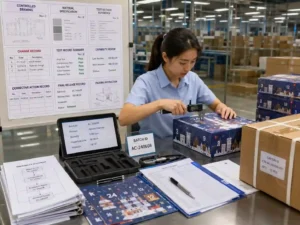
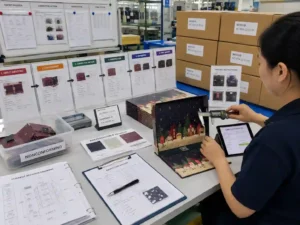
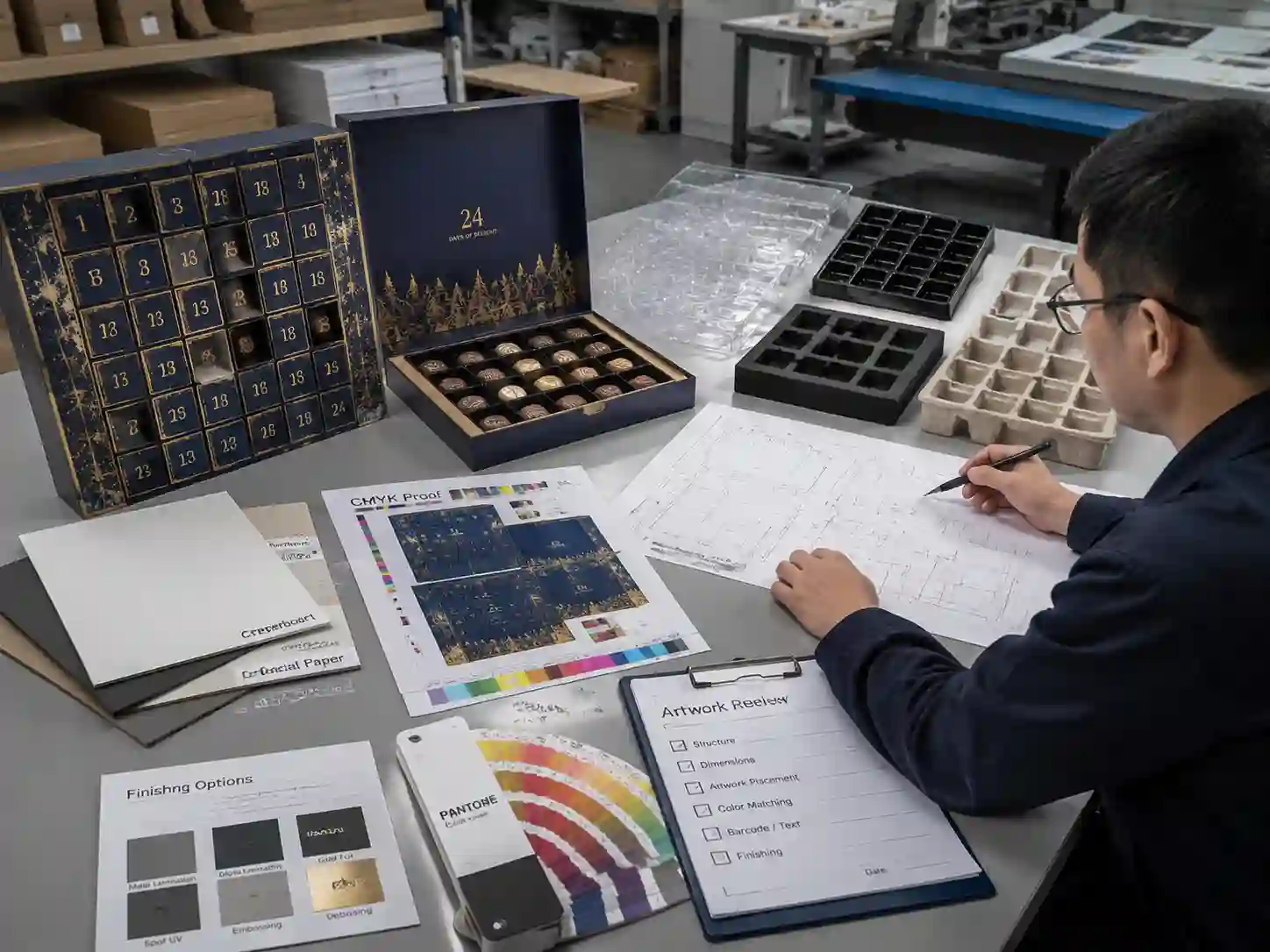
A proper sample process helps buyers verify insert performance before committing to bulk production. The most reliable workflow usually includes blank samples, printed samples, revisions, and a final pre-production sample approval.
- Blank structural sample: Check box size, insert dimensions, cavity fit, opening method, and assembly tolerance.
- Printed sample: Review artwork placement, CMYK color, Pantone matching, finishing effects, and product presentation.
- Revision stage: Adjust insert depth, cavity size, materials, or structure based on testing results.
- Pre-production sample: Approve the final version before mass production begins.
QC tip: Do not only check whether chocolates fit into the insert. Test whether products can be inserted quickly during packing, removed easily by customers, and remain stable after transportation simulation.
What customization details affect insert cost and quotation?
Insert cost depends on material, tooling, cavity quantity, production method, assembly requirements, and order volume. Buyers should provide detailed information before requesting a quotation to avoid inaccurate estimates.
- Chocolate dimensions and quantity per box
- Preferred insert material and appearance
- Outer box structure and size
- Printing requirements including CMYK, Pantone, foil stamping, embossing, spot UV, matte lamination, or gloss lamination
- Target MOQ and expected annual order volume
- Packaging requirements for export cartons and pallet shipment
The custom advent calendar box products available from Giftpackpro can be developed with different structures and insert solutions depending on buyer requirements.
What food packaging issues should chocolate buyers consider?
Chocolate packaging requires attention to separation, cleanliness, odor awareness, moisture protection, and labeling space. Insert materials should be reviewed according to the product requirements and intended market.
- Product separation: Cavities should prevent chocolates from touching each other when different flavors or shapes are included.
- Odor awareness: Packaging materials should be evaluated to avoid unwanted odor transfer affecting product experience.
- Moisture awareness: Buyers should consider the chocolate type, packaging barrier requirements, and storage conditions.
- Food-contact discussion: Buyers should confirm applicable material requirements and documentation with suppliers for their destination market rather than assuming every insert material has the same suitability.
- Labeling space: Leave enough area for required product information, barcodes, or retail labels when needed.
For official food-contact guidance, buyers can review relevant government resources such as FDA food contact substance information when evaluating packaging requirements for the United States market.
How should buyers check insert quality before shipment?
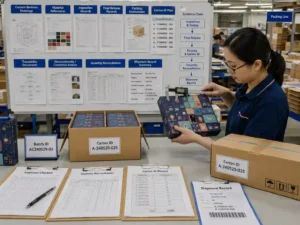
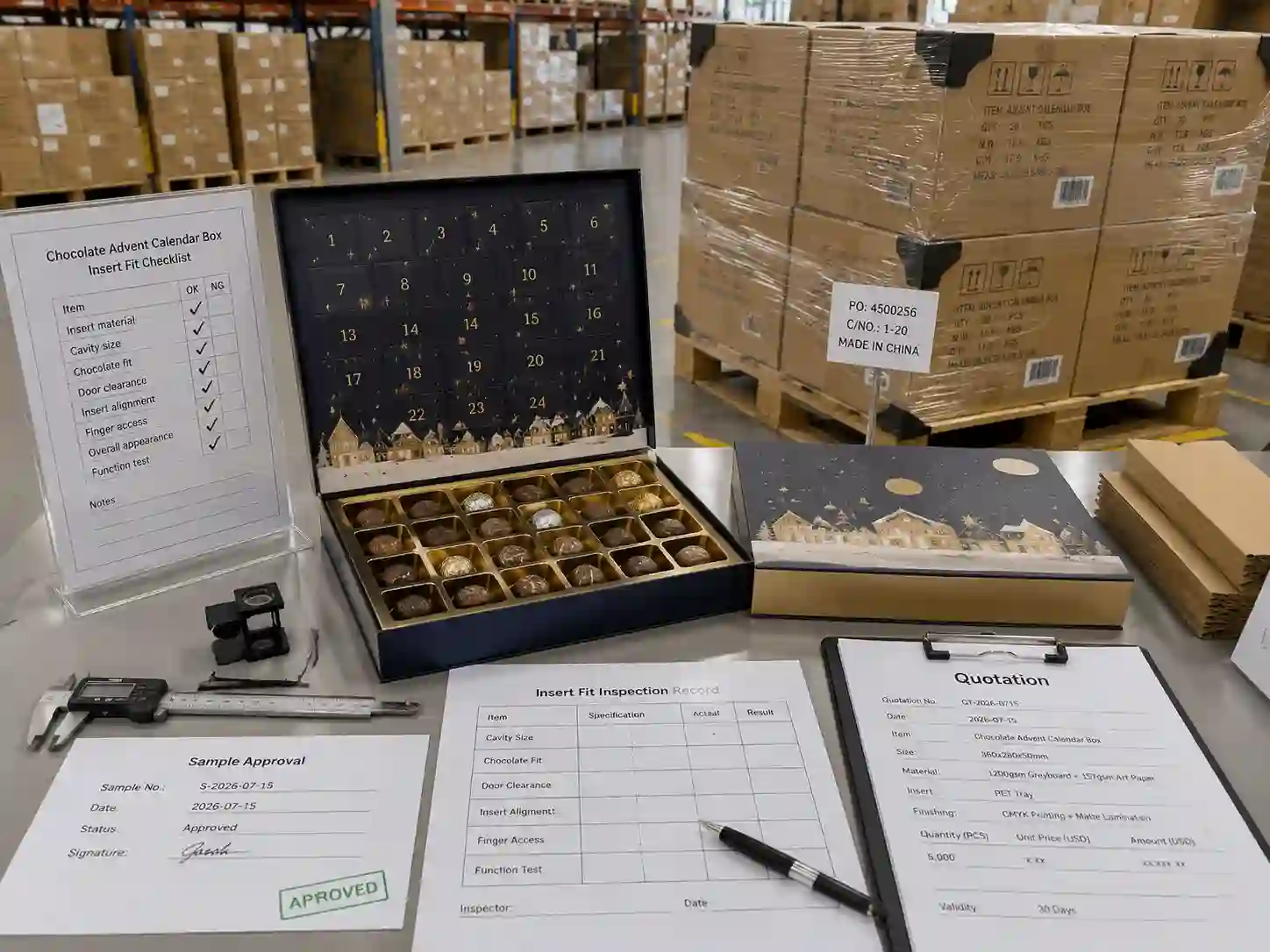
Quality control should verify both the insert itself and how the insert performs inside the complete advent calendar box. A supplier should check structure, materials, printing, assembly, and export packing conditions.
Chocolate advent calendar insert QC checklist:
- Confirm cavity dimensions match approved sample
- Check chocolate movement after box closing
- Verify insert alignment with doors, drawers, or panels
- Inspect material appearance and cutting accuracy
- Confirm printing and finishing consistency when inserts are printed
- Check carton protection, corner protection, and pallet stability for export shipments
- Verify shipping marks and carton information before dispatch
How can buyers prepare a quotation request for chocolate advent calendar boxes?
A complete RFQ helps suppliers provide more accurate pricing, sampling recommendations, and lead time estimates. Buyers should prepare technical information before contacting a packaging factory.
- Product type: chocolate size, shape, weight, and quantity
- Box structure preference: rigid box, drawer box, folding carton, or door-opening box
- Insert requirement: paper insert, PET tray, EVA, foam, or molded pulp
- Artwork status: finished design, dieline availability, or design support needed
- Printing and finishing requirements
- Expected MOQ and delivery schedule
- Destination country and export packing requirements
Buyers can also review more advent calendar box buying guides before preparing specifications. When ready, they can request a custom quote with product details, reference images, and target quantities.
What mistakes should buyers avoid when selecting inserts?
The most common mistakes happen when buyers focus only on appearance and overlook manufacturing and shipping requirements.
- Choosing an insert before confirming product dimensions
- Approving artwork before checking the dieline and cavity layout
- Skipping physical sample testing
- Selecting premium insert materials without considering MOQ and budget
- Ignoring export carton protection and transportation conditions
- Failing to confirm final production samples before bulk manufacturing
Frequently asked questions about the best insert for chocolate advent calendar boxes
What is the best insert for chocolate advent calendar boxes?
The best insert depends on product requirements. Paper inserts are suitable for efficient production, PET trays provide accurate positioning, EVA and foam create premium protection, and molded pulp supports specific sustainability-focused designs.
Should chocolate advent calendar boxes use PET trays?
PET trays are useful when precise cavities and consistent product placement are important. Buyers should confirm material requirements and market expectations with their packaging supplier.
When should buyers approve the insert design?
Insert approval should happen before mass production after blank sample testing, printed sample review, and pre-production confirmation.
Does insert material affect MOQ and lead time?
Yes. Material selection, tooling requirements, assembly complexity, and production processes can influence MOQ, sampling time, and bulk production schedules.
Conclusion: How should buyers choose the right insert?
The best insert for chocolate advent calendar boxes is the one that balances product protection, presentation, manufacturing efficiency, and shipping reliability. Buyers should compare insert materials, test samples, confirm artwork and structure, and review QC requirements before starting mass production.
Working with an experienced supplier such as Giftpackpro packaging factory helps buyers connect insert design, custom advent calendar boxes, sampling, production, and export preparation into one controlled process.
Before requesting a sample or quotation, prepare: chocolate dimensions, box structure preference, insert material preference, artwork files, quantity target, destination market, and shipping requirements.