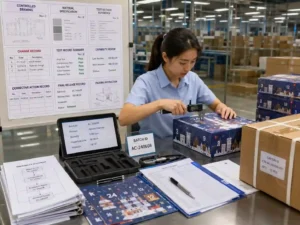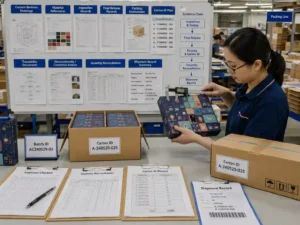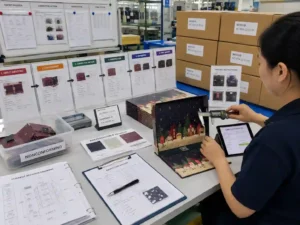
Quick answer: Toy advent calendar boxes are custom seasonal packaging boxes designed to hold multiple toy items in numbered compartments, drawers, trays, or doors for retail, e-commerce, promotional, and gift-set campaigns. For B2B buyers, the most important decisions are not only the outside artwork. You need to confirm toy size range, compartment layout, insert material, paperboard or greyboard thickness, child-safe structural details, labeling areas, sample testing, MOQ, production lead time, QC standards, and export carton protection before placing an order. A reliable supplier should help convert your toy list, artwork, and shipping requirements into a practical dieline, prototype, quotation, and mass production plan.
What should buyers understand before ordering toy advent calendar boxes?
Buyers should first understand that toy advent calendar boxes are packaging systems, not just printed gift boxes. Each box must match the toy assortment, compartment opening method, retail display plan, labeling requirements, and export shipping route.
For overseas brands, wholesalers, gift companies, retail buyers, and e-commerce sellers, the key challenge is usually product variation. A toy set may include mini figures, blocks, puzzles, stickers, keychains, accessories, plush items, stationery toys, or small novelty gifts. These items often have different sizes, weights, shapes, and fragility levels. The box structure and insert design must control movement while keeping the opening experience consistent.
Giftpackpro works as a custom advent calendar boxes manufacturer for buyers who need practical packaging planning before production. In a good RFQ process, the supplier should ask for the product list, approximate dimensions, item weights, target quantity, artwork expectations, and packing method before recommending a rigid box, folding carton, drawer box, door-opening box, or other custom advent calendar boxes.
Buyer tip: Do not choose the box style only from a reference photo. For toy advent calendars, the correct structure depends on the heaviest item, the thickest item, the most fragile item, and the way the buyer wants the consumer to open the box.
Which toy advent calendar box structure is best for your project?
The best structure depends on product weight, number of compartments, retail price position, and packing budget. Rigid boxes are better for premium toy sets, while folding carton calendars are often more cost-efficient for lightweight items and higher-volume retail campaigns.
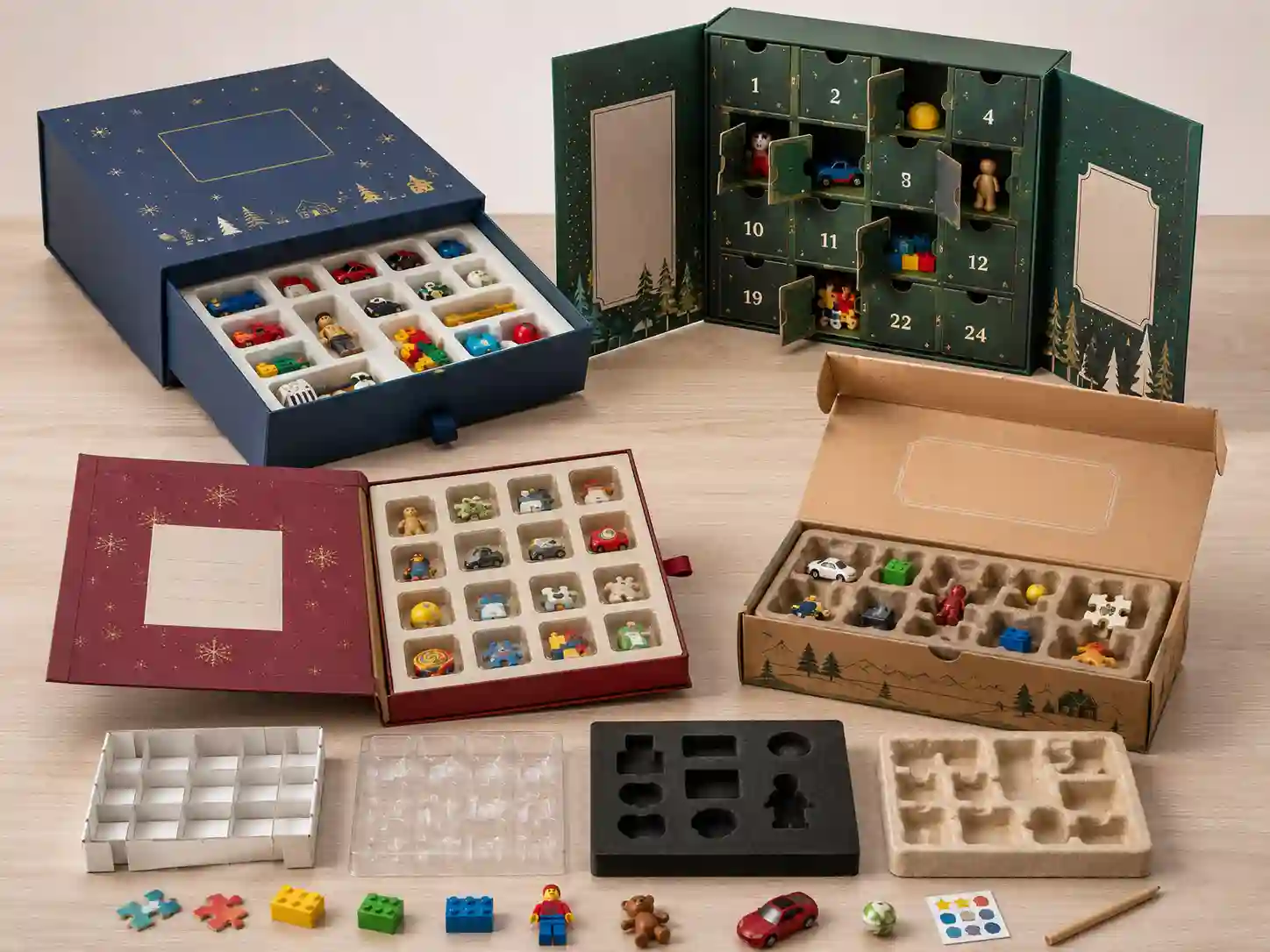
| Box Structure | Best For | Key Benefits | Buyer Watch Points |
|---|---|---|---|
| Door-opening box | Mini toys, stickers, stationery toys, small accessories, lightweight collectibles | Classic numbered reveal format, strong retail shelf impact, flexible compartment layout | Door perforation strength, internal product movement, accurate compartment spacing |
| Rigid drawer box | Premium toy gift sets, heavier toy assortments, subscription-style gift boxes | Stronger greyboard structure, reusable feel, premium presentation | Higher unit cost, assembled packing volume, drawer sliding tolerance |
| Folding carton advent calendar | High-volume promotional sets, lightweight toys, mass retail programs | Lower material weight, easier flat packing, cost-efficient for larger runs | Lower compression strength than rigid box, requires careful insert and carton testing |
| Book-style calendar box | Story-based toy sets, educational toys, activity kits, branded gift programs | Good display value, large artwork area, premium opening experience | Magnet, ribbon, or closure details may affect cost and lead time |
| Tray-and-sleeve structure | Simple toy collections, e-commerce gift sets, compact product lines | Clean structure, efficient packing, good for simple compartment plans | May need extra locking design or sleeve friction control for shipping |
A door-opening box is often selected when the buyer wants a strong retail countdown format. The front panel can carry numbered perforated doors, while the inside insert or tray keeps each item in position. This structure is useful when toy pieces are small and the buyer wants each day or compartment to be easy to identify.
A rigid drawer box is suitable for a higher perceived value. It can use greyboard wrapped with printed paper, matte lamination, foil stamping, embossing, or spot UV. The drawer can hold a paper insert, PET tray, EVA insert, foam insert, or molded pulp insert depending on product protection needs.
A folding carton calendar is suitable when cost control, flat packing, and high-volume production matter more than luxury feel. However, buyers should confirm board strength, locking method, insert stability, and master carton durability before mass production.
How should inserts be designed for mixed toy sizes?
Insert design should start from the actual toy list, not from a generic compartment grid. Mixed product sizes require careful cavity planning so small items do not disappear inside large compartments and larger items do not deform the box.
Common insert options include paper insert, PET tray, EVA insert, foam, and molded pulp. Each option has a different cost, appearance, protection level, and sustainability profile. For lightweight toy sets, paperboard inserts are often enough if the compartment walls are properly designed. For shaped toys, a PET tray or molded pulp insert may improve positioning. For premium or fragile toy pieces, EVA or foam can provide better cushioning, though buyers should confirm whether plastic-free options are required by their market or retailer.
Factory tip: For toy packaging with many SKUs, send a product size table with length, width, height, and weight for every item. A simple photo is not enough for accurate insert engineering because depth and tolerance affect the final dieline.
Plastic-free insert options for toy advent calendar boxes
Plastic-free insert options usually include folded paperboard, corrugated paperboard, molded pulp, or paper wrap structures. These are useful when buyers want to reduce plastic content, support retailer sustainability requirements, or align with recycling guidance. Buyers can also review responsible sourcing information from official organizations such as FSC when discussing paper material claims with suppliers.
However, plastic-free does not automatically mean stronger or cheaper. A molded pulp insert may require tooling and sampling time, while a paper insert may need more folding structure to hold irregular toy shapes. Buyers should compare protection, appearance, tooling cost, MOQ, and assembly efficiency before selecting the insert.
Which material choices affect strength, cost, and retail presentation?
Material choice affects box strength, unit cost, display quality, and export performance. For toy advent calendar boxes, the main material decision is usually between rigid greyboard construction and paperboard folding carton construction.
Rigid box structures normally use greyboard wrapped with printed art paper. They feel more premium and resist deformation better during display and handling. Folding carton structures use paperboard such as white card, kraft board, or coated board. They are lighter and often better for flat packing and cost control.
For toy packaging, structure safety matters. Sharp inner edges, weak locking tabs, loose plastic windows, and unstable display panels should be avoided. If the box is intended for children’s toy retail, buyers should leave enough space for required labeling areas, age grade information, warning text, barcode, recycling marks, importer information, and local compliance details. Packaging suppliers can support dieline and artwork placement, but buyers should verify toy safety and market labeling requirements with their own compliance team.
Quotable B2B statement: “For toy advent calendar boxes, the safest material choice is the one that passes product fit testing, door-opening testing, carton compression review, and buyer labeling review before mass production.”
What artwork and printing details should be confirmed before sampling?
Artwork should be confirmed on the final dieline before printed sampling begins. Buyers need to check numbered doors, cut lines, bleed, barcode position, warning areas, color system, finishing effects, and panel alignment.
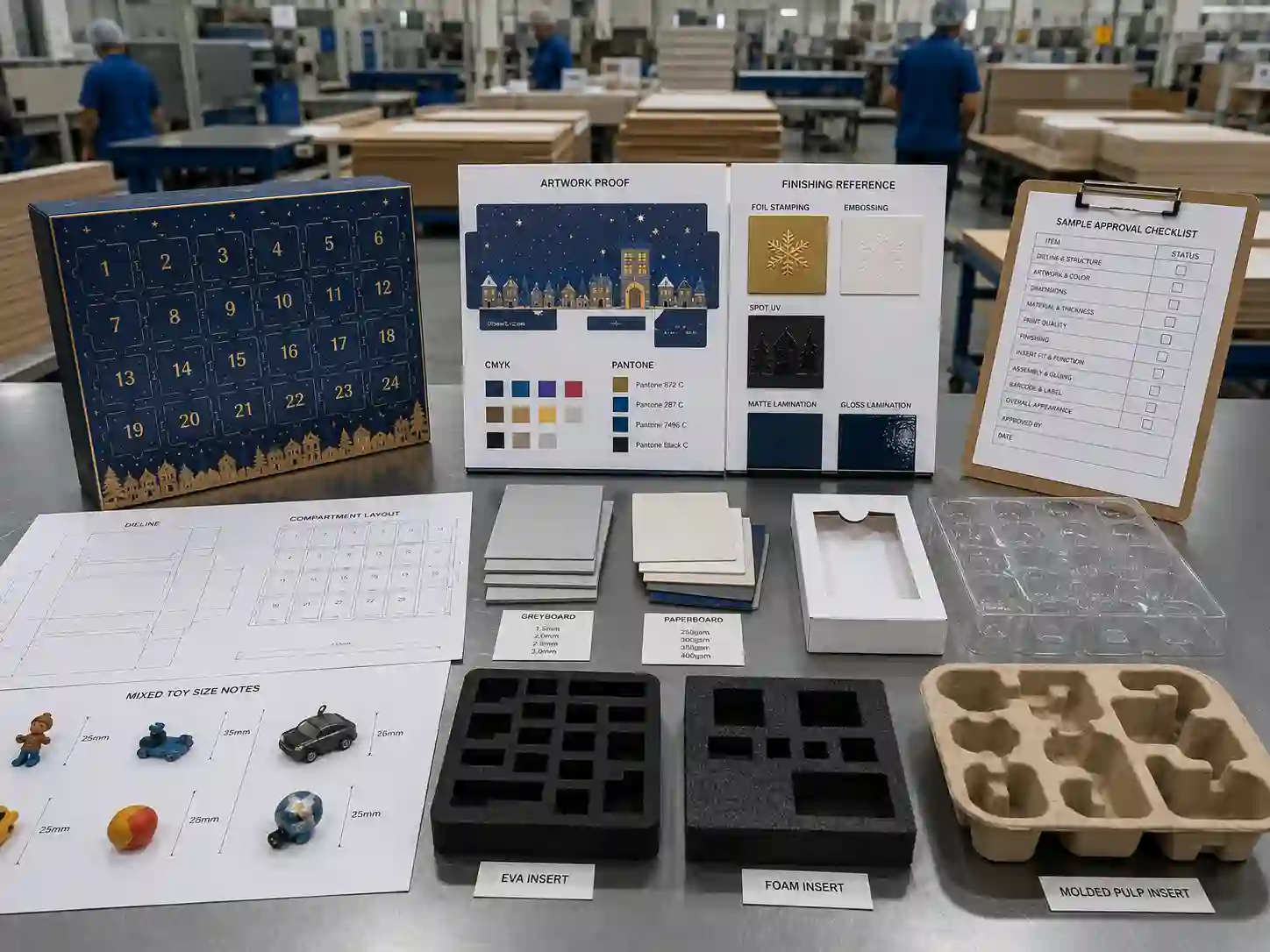
Most custom toy advent calendar projects use CMYK printing for full-color artwork. Pantone colors may be used when brand colors must be controlled more closely. Surface finishes can include matte lamination, gloss lamination, foil stamping, embossing, debossing, and spot UV. These effects can improve shelf appeal, but they also increase cost, lead time, and sample complexity.
Door-opening boxes require extra artwork attention because numbered doors, perforation lines, and inner compartment positions must align. If the artwork is moved after the dieline is confirmed, the supplier should recheck the layout before plate making or mass printing.
Buyer tip: If the toy assortment has several versions, such as different colorways or seasonal editions, confirm whether the same outer box can be used with different labels or whether each version needs separate printing plates and artwork approval.
How should buyers compare MOQ, cost drivers, and lead time?
Buyers should compare MOQ and price based on the complete specification, not only the outside box size. Structure, insert type, printing process, finishing, assembly method, packing method, and sample requirements all affect cost and lead time.
Common cost drivers include greyboard thickness, paperboard grade, number of compartments, insert material, molded tray tooling, printing colors, Pantone matching, foil stamping area, embossing depth, spot UV coverage, magnet or ribbon use, manual assembly time, individual polybag or paper wrap, export carton strength, and pallet requirements.
MOQ is also affected by material purchasing, printing setup, die-cutting setup, and assembly efficiency. A simple folding carton toy calendar may have a different MOQ from a rigid drawer calendar with EVA insert and foil stamping. Buyers should avoid comparing quotes if the suppliers are quoting different structures or different packing assumptions.
Lead time should be separated into design confirmation, blank sample, printed sample, pre-production sample, mass production, final QC, and export packing. For seasonal toy campaigns, late artwork approval is one of the most common reasons for schedule pressure.
What samples should be approved before mass production?
Buyers should approve at least one physical sample before mass production, especially when the calendar holds mixed toy sizes. A prototype helps confirm structure, insert fit, opening function, artwork placement, and packing assumptions.
Sample stages may include a blank structural sample, a printed sample, and a pre-production sample. A blank sample is useful for checking size, insert layout, drawer movement, door function, and product fit before final artwork. A printed sample helps confirm color, finishing, lamination, numbering, barcode area, and visual presentation. A pre-production sample should match the final approved specification before bulk production starts.
For detailed planning support, buyers can review Giftpackpro’s custom advent calendar box services to understand how sampling, structure design, printing, and bulk production are usually coordinated.
Sample approval checklist for toy advent calendar boxes
- Confirm outer dimensions, inner dimensions, and compartment layout against the toy size list.
- Test every toy item in its intended compartment, including the thickest and heaviest pieces.
- Check door perforation, drawer sliding, tray removal, and closure stability.
- Review paperboard or greyboard thickness, edge finishing, glue strength, and assembly tolerance.
- Check CMYK or Pantone color, matte lamination, gloss lamination, foil stamping, embossing, and spot UV against the artwork proof.
- Verify barcode, warning text, age label area, recycling symbols, importer information area, and shipping label area.
- Confirm whether the product will be flat packed, semi-assembled, or fully assembled.
- Record sample approval comments before releasing mass production.
QC tip: Keep one signed or clearly confirmed approval sample for the buyer and one for the factory. During mass production, the approved sample becomes the reference for color, structure, insert fit, and finishing quality.
What QC points matter most during bulk production?
QC should focus on structure accuracy, insert fit, printing consistency, opening function, glue strength, and carton packing. For toy advent calendar boxes, a visually attractive box can still fail if the toy pieces shift, doors tear incorrectly, or cartons crush during export.
Important in-process checks include paper material inspection, print color control, lamination adhesion, die-cut accuracy, folding accuracy, tray or insert fit, drawer tolerance, glue position, and final assembly cleanliness. Final inspection should include random product fit checks, opening function checks, scuff and scratch checks, barcode readability checks, and export carton review.
If the buyer uses several toy sizes, QC should test the smallest item and largest item again during production, not only during sampling. Mixed toy sets can fail when a cavity is slightly too loose or when a larger product puts pressure on the front door panel.
Buyers can learn more about factory-side process planning by reviewing the Giftpackpro packaging factory page and comparing how suppliers manage sample approval, production coordination, and quality control.
How should export packing be planned for toy advent calendar boxes?
Export packing should protect both the finished box and the opening mechanism during long-distance shipping. Buyers should confirm master carton strength, carton size, packing direction, corner protection, pallet pattern, shipping marks, and carton label details before shipment.
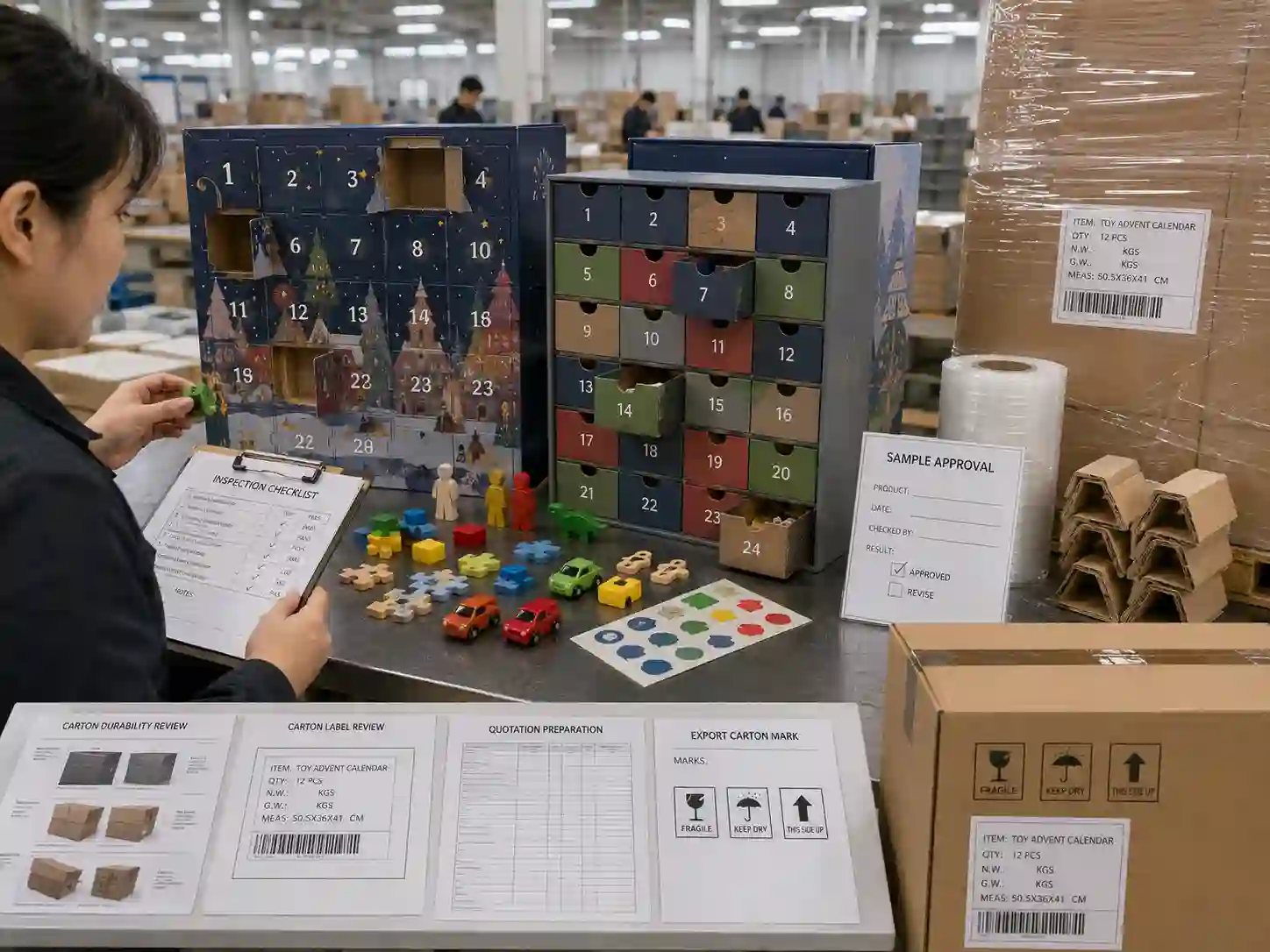
Rigid toy advent calendar boxes are often packed assembled, which increases carton volume but protects the box shape and premium presentation. Folding carton calendars may allow flat packing, which can reduce shipping volume, but buyers must confirm whether final assembly will happen at the factory, warehouse, co-packer, or buyer’s facility.
For export cartons, the supplier should consider carton burst strength, stacking pressure, inner packing method, moisture protection, pallet wrap, and handling marks. If the shipment goes through multiple warehouses or e-commerce fulfillment centers, stronger cartons and clear shipping marks become more important.
Buyers may also refer to official transport testing resources from ISTA when discussing package testing expectations with logistics teams. Not every project needs formal lab testing, but high-value or long-distance toy calendar shipments should have a clear carton durability plan.
Decision guide: how should buyers choose the right specification?
Buyers should choose the specification by balancing product protection, retail positioning, sustainability requirements, assembly efficiency, budget, and delivery schedule. The right answer is usually the simplest structure that protects the toy set, presents the brand well, and survives export shipping.
- For premium retail toy sets: choose a rigid box, drawer box, or book-style box with a custom insert and stronger export carton.
- For lightweight promotional toys: consider a folding carton advent calendar with paperboard insert and efficient flat-packing plan.
- For mixed-size toy assortments: request a custom insert layout based on actual product dimensions instead of a standard grid.
- For plastic-reduction goals: compare paper insert and molded pulp options, but test product movement and visual appearance before approval.
- For e-commerce fulfillment: prioritize carton durability, corner protection, barcode placement, and shipping label areas.
- For retailer programs: confirm display angle, shelf footprint, hang tab or display tray needs, barcode location, and required labeling area early.
How should buyers compare toy advent calendar box suppliers?
Buyers should compare suppliers by asking how they manage dieline design, sample approval, insert testing, artwork checking, production QC, export packing, and communication. The lowest quotation is not useful if the specification is unclear or the supplier has not considered toy fit and carton durability.
A capable supplier should be able to explain structure options, recommend material thickness, review artwork files, prepare a prototype, test inserts, separate sample and production timelines, and provide a clear quotation breakdown. Buyers should also confirm whether the supplier can handle both small customization details and bulk production consistency.
When reviewing supplier information, compare real process capability instead of only catalog photos. Useful questions include: Can the supplier build a custom dieline? Can they test a paper insert, PET tray, EVA insert, foam insert, or molded pulp insert? Can they provide a pre-production sample? How do they manage color difference between sample and mass production? What export carton standard is included in the quote?
Buyers can also review related advent calendar box buying guides to compare packaging structures, insert options, sampling steps, and procurement questions before sending an RFQ.
What information should buyers prepare before requesting a quotation?
To receive an accurate quotation, buyers should prepare the toy list, box size target, quantity, structure preference, insert requirement, artwork plan, finishing request, sample need, packing method, and delivery destination. A complete RFQ saves time and reduces pricing errors.
Before asking Giftpackpro to request a custom quote, prepare the following details:
- Product list with quantity per calendar and dimensions of each toy item.
- Target calendar format, such as 12-day, 24-day, 25-day, or custom compartment count.
- Preferred structure, such as rigid box, drawer box, door-opening box, folding carton, book-style box, or tray-and-sleeve box.
- Insert preference, such as paper insert, PET tray, EVA insert, foam, molded pulp, or plastic-free option.
- Estimated order quantity and expected delivery schedule.
- Artwork status, including whether the final dieline artwork is ready or design support is needed.
- Printing and finishing requirements, including CMYK, Pantone, matte lamination, gloss lamination, foil stamping, embossing, or spot UV.
- Retail labeling needs, barcode location, warning area, age label area, and shipping label requirements.
- Packing preference, such as flat packed, semi-assembled, fully assembled, master carton quantity, pallet requirement, and shipping marks.
- Destination country, shipping method, and any retailer carton or labeling requirements.
What common mistakes should toy packaging buyers avoid?
The most common mistakes are choosing a structure before checking toy dimensions, approving artwork before confirming the dieline, ignoring insert tolerance, and underestimating export carton protection. These mistakes can cause sample revisions, production delays, or shipping damage.
Buyers should avoid using only approximate product sizes. A few millimeters can matter when the item is behind a perforated door or inside a tight tray cavity. Buyers should also avoid adding premium finishing effects late in the process because foil stamping, embossing, and spot UV require additional checking and may affect sample timing.
Another mistake is treating labeling as a final step. Toy advent calendar boxes often need front, back, side, or bottom panel space for barcode, warning, age grade, recycling information, importer details, SKU labels, and carton labels. These areas should be reserved during dieline development.
Factory tip: If a toy calendar will be sold through retail and e-commerce channels, design the box and export carton for both shelf presentation and shipping handling. A beautiful retail box still needs carton protection, pallet stability, and readable shipping marks.
FAQ: Toy advent calendar boxes for B2B buyers
What are toy advent calendar boxes used for?
Toy advent calendar boxes are used to package multiple small toy items in a numbered or compartment-based seasonal gift format. They are commonly used by brands, wholesalers, retail buyers, gift companies, and e-commerce sellers for promotional sets, retail launches, and seasonal gift programs.
Can toy advent calendar boxes be made with different compartment sizes?
Yes. Custom compartment sizes are recommended when the toy assortment includes mixed product sizes. The supplier should create a dieline and insert layout based on actual item dimensions and test the fit during sampling.
Which insert is best for plastic-free toy advent calendars?
Paperboard inserts and molded pulp inserts are common plastic-free options. Paper inserts are usually flexible and cost-efficient, while molded pulp can help with shaped cavities but may require tooling and extra sample time.
Is a rigid box or folding carton better for toy calendars?
A rigid box is better for premium presentation and heavier toy sets. A folding carton is often better for lightweight toys, larger retail quantities, and cost-sensitive campaigns. The best option depends on product weight, target price, shipping method, and display needs.
What is the difference between a sample and a pre-production sample?
A sample may be used to test structure, artwork, or finishing during development. A pre-production sample should represent the approved final specification before mass production begins, including material, insert, printing, finishing, and packing method.
What affects the quotation for toy advent calendar boxes?
The quotation is affected by size, structure, material, insert type, compartment count, printing, finishing, MOQ, sample requirements, assembly labor, export carton strength, pallet requirements, and delivery schedule.
How early should buyers start a toy advent calendar packaging project?
Buyers should start as early as possible because structure design, insert testing, artwork approval, sampling, mass production, QC, and export packing all require time. Seasonal campaigns are more successful when the packaging specification is confirmed before the production schedule becomes tight.
CTA: Prepare your toy advent calendar box RFQ
Before requesting a quotation for toy advent calendar boxes, prepare your toy list, product dimensions, target quantity, structure preference, insert requirements, artwork status, labeling needs, shipping destination, and expected delivery date. This allows Giftpackpro to recommend the right structure, build a practical dieline, plan a sample, and quote the project more accurately.
Buyers can review custom advent calendar box products for structure ideas, compare service options, and then send project details through the quote form. A clear RFQ helps the supplier check material, insert, printing, MOQ, lead time, QC, export carton, pallet, and shipping marks before production starts.