Quick answer: Makeup advent calendar boxes should be planned around the size, weight, fragility, and display value of each cosmetic SKU before artwork or finishing is confirmed. For B2B buyers, the most important decisions are box structure, insert material, cavity tolerance, printing method, surface finishing, sample approval, MOQ, QC standard, and export packing method. A lipstick-heavy calendar, a palette-and-brush gift set, and a mixed mini-bottle campaign may all need different inserts and carton protection. The best result comes from matching product layout, dieline, material strength, print control, and shipping requirements before mass production begins.
For overseas brands, wholesalers, retailers, e-commerce sellers, and packaging distributors, makeup advent calendar boxes are not only decorative seasonal packaging. They are multi-SKU packaging systems that must protect cosmetics, support retail presentation, and remain efficient for factory assembly and export shipping. This guide explains how to compare structures, inserts, materials, printing, sampling, QC, and quotation details before choosing a supplier.
What should buyers understand before choosing makeup advent calendar boxes?
Buyers should understand that a makeup advent calendar box is a custom packaging project, not a standard empty box purchase. The supplier needs to know product dimensions, product weight, SKU sequence, retail channel, packing method, and campaign deadline before recommending the right structure.
Cosmetic advent calendars often include mixed items such as lipstick tubes, lip gloss, compact palettes, mini bottles, brushes, jars, mascara, and sample-size products. These items may have different heights, cap shapes, surface finishes, and breakage risks. If the box layout is decided only by appearance, the result may look attractive in a rendering but fail during assembly, shipping, or retail handling.
As a custom advent calendar boxes manufacturer, Giftpackpro usually reviews the product list, estimated order quantity, artwork direction, and delivery schedule before suggesting rigid boxes, drawer boxes, door-opening boxes, folding cartons, or hybrid structures. This early review helps avoid expensive changes after dieline development.
Buyer tip: Treat the cosmetic product list as the starting point. Structure, insert, and printing decisions should follow the products, not the other way around.
Which box structure works best for makeup advent calendar boxes?
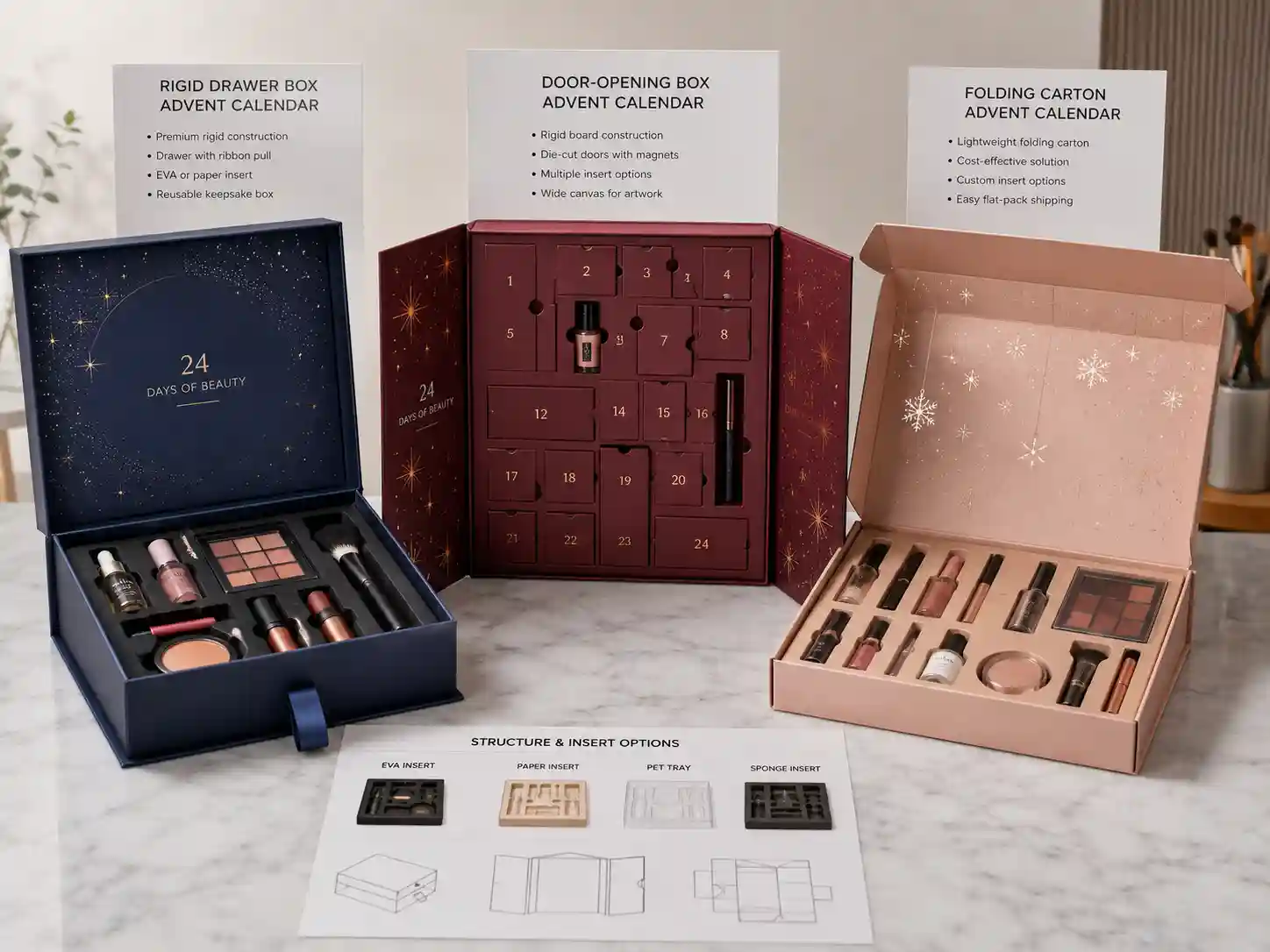
The best structure depends on product weight, retail price positioning, display method, and assembly budget. Rigid boxes feel premium and protect heavier cosmetic sets, while folding carton calendars can reduce weight and freight cost for lighter promotional campaigns.
| Structure option | Best for | Main advantages | Buyer caution |
|---|---|---|---|
| Rigid door-opening box | Premium makeup sets with palettes, bottles, brushes, and mixed SKUs | Strong presentation, good shelf impact, suitable for magnetic or ribbon opening | Higher material cost, larger export carton volume, longer production time |
| Rigid drawer box | Luxury campaigns, influencer kits, and reusable cosmetic gift sets | Good unboxing experience, strong product separation, premium feel | Drawer movement and insert fit must be tested carefully |
| Folding carton calendar | Lightweight mini items, mass retail promotions, e-commerce bundles | Lower unit weight, efficient flat packing, easier volume production | Needs enough board strength for doors and product weight |
| Book-style calendar | Retail shelves, brand storytelling panels, seasonal launches | Large printable surface, strong display effect, good for cosmetic collections | Spine, hinge, and closure tolerance should be checked in sample stage |
| Two-piece rigid box with tray | Simple premium sets with fewer products | Clean structure, strong protection, easier assembly than complex calendars | Less “daily reveal” function unless combined with printed sleeves or numbered compartments |
A rigid box normally uses greyboard wrapped with printed paper. A folding carton uses paperboard that can be die-cut, printed, laminated, and shipped flat in many cases. For heavier makeup palettes or glass mini bottles, buyers should check board thickness, glue strength, hinge durability, and insert support instead of judging only by surface appearance.
Factory tip: A premium structure is not automatically the best structure. The best structure is the one that protects the exact products, fits the retail channel, meets the campaign budget, and can be assembled consistently in bulk production.
How should buyers choose inserts for mixed cosmetic SKUs?
Insert choice should be based on product shape, fragility, weight, visual presentation, sustainability goals, and assembly speed. For makeup advent calendar boxes, insert fit is often more important than the outer box design because it controls product movement inside the package.
Common insert options include paper insert, PET tray, EVA insert, foam, molded pulp, and layered paperboard structures. Each option has a different effect on protection, presentation, cost, and recycling claims. Buyers should not select an insert only from a photo; they should test it with actual filled products or accurate dummy samples.
When is a paper insert suitable?
A paper insert is suitable for many lightweight cosmetic products, especially lipsticks, pencils, small tubes, and mini jars. It is often preferred when buyers want a paper-based packaging direction and a clean retail appearance.
Paper inserts can be folded, layered, or built with cavities. However, they require accurate dielines and enough support around each cavity. Tall tubes may tilt if the cavity is too shallow, and heavy palettes may deform the insert if the paperboard is too thin.
When is a PET tray suitable?
A PET tray is useful when cosmetic products have irregular shapes or require tighter molded positioning. It can hold mini bottles, compacts, and tubes with better cavity definition than simple paper inserts.
For beauty packaging, PET trays can help keep products neat during shipping and unboxing. Buyers should check tray thickness, transparency, recyclability requirements in the destination market, and whether the tray appearance matches the brand’s sustainability positioning.
When is EVA or foam suitable?
EVA and foam inserts are suitable for fragile, heavy, or premium items that need cushioning and accurate positioning. They are often used for glass bottles, compact palettes, or influencer presentation boxes.
The caution is cost, material perception, and possible environmental concerns. Buyers should confirm thickness, density, cutting accuracy, odor control, and whether the insert surface may rub against decorated cosmetic components.
When is molded pulp suitable?
Molded pulp is useful when buyers want a protective paper-based insert for selected product shapes. It can support heavier products better than simple folded paper, but it requires tooling, shape confirmation, and enough lead time.
Molded pulp may not always create the sharp premium look required for luxury makeup launches, so buyers should compare sample appearance, cavity tolerance, and surface texture before confirming.
QC tip: Insert testing should include shaking, opening, closing, product removal, re-insertion, and carton packing simulation. A cavity that looks correct on a table may still fail after export handling.
What printing and finishing choices matter most for cosmetic calendars?
Printing and finishing choices matter because cosmetic packaging depends heavily on color consistency, premium shelf appearance, and close-up photography. Buyers should control CMYK, Pantone color matching, lamination, foil stamping, embossing, spot UV, and proof approval before mass production.
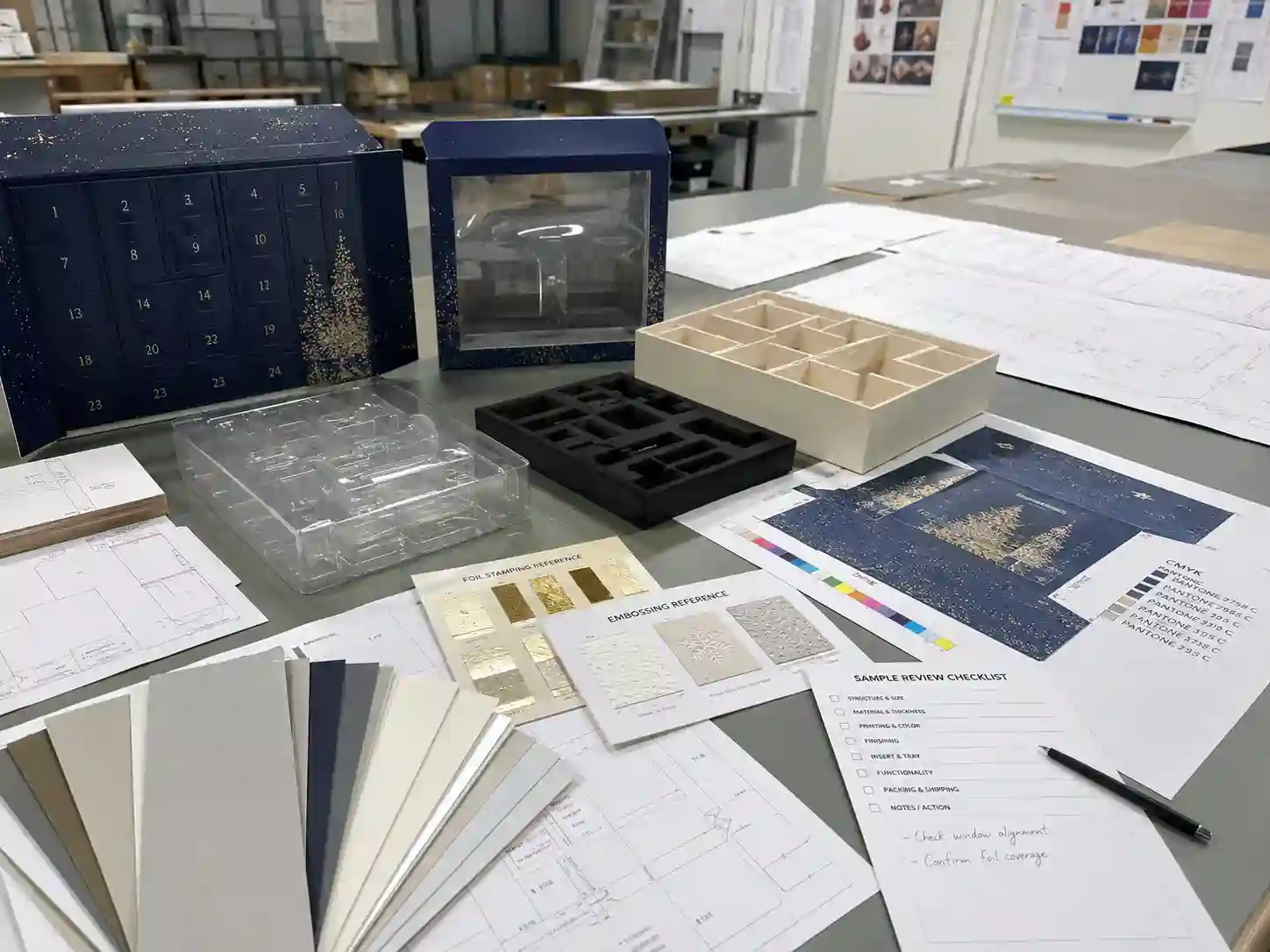
Makeup brands often use soft gradients, metallic colors, skin-tone palettes, luxury neutrals, or bold seasonal campaign colors. These designs can be sensitive to paper type, lamination, ink density, and lighting. A printed sample or pre-production sample is important when the calendar will be photographed for retail pages, influencer seeding, or e-commerce listings.
How should buyers manage color consistency?
Buyers should provide print-ready artwork, Pantone references where needed, and approved color targets before production. CMYK is suitable for full-color images, while Pantone is useful for brand colors that require tighter consistency.
Color may shift between coated paper, uncoated paper, greyboard wrapping paper, paperboard, and laminated surfaces. If the campaign includes matching sleeves, cartons, inserts, and product labels, buyers should ask the supplier to check color consistency across all printed components.
Which finishing options are common for makeup advent calendar boxes?
Common finishing options include matte lamination, gloss lamination, soft-touch lamination, foil stamping, embossing, debossing, spot UV, textured paper, and metallic paper. These finishes can improve shelf impact, but they also add cost, process risk, and production time.
- Matte lamination: Often used for premium cosmetic packaging, but dark colors may show scratches more easily.
- Gloss lamination: Creates stronger shine and color contrast, but may feel less subtle for luxury beauty lines.
- Foil stamping: Suitable for logos, dates, numbers, borders, and seasonal details; stamping position needs tolerance control.
- Embossing or debossing: Adds tactile detail, but should be tested on the selected paper and board thickness.
- Spot UV: Highlights patterns, numbers, or product windows; registration should be checked carefully.
Quotable B2B statement: “For cosmetic advent calendars, print approval should confirm not only color but also lamination effect, foil position, door numbering, insert alignment, and how the finished sample photographs under retail lighting.”
How should buyers prepare artwork and dielines?
Buyers should prepare artwork after the structure and insert layout are confirmed, because the dieline controls door positions, fold lines, glue areas, safety margins, and product cavity locations. Changing product layout after artwork approval can affect every printed panel.
A good dieline review should include outer dimensions, door size, drawer size, bleed, safe area, barcode location, legal text area, opening direction, insert placement, and carton packing orientation. If the design includes numbered doors, buyers should check whether the numbers match the product sequence and whether the door opening will damage nearby artwork.
For retail and e-commerce channels, buyers may also need space for SKU codes, product descriptions, recycling marks, warning labels, or country-specific packaging information. GS1 barcode guidance can be checked through the official GS1 barcode standards when barcode placement or scanning requirements matter.
Buyer tip: Do not send only a visual mockup and ask for mass production. Send editable artwork, dieline files, product dimensions, product weight, and packing requirements so the factory can check technical feasibility.
What is the practical sampling process before mass production?
The sampling process should confirm structure, size, insert fit, printing, finishing, assembly, and packing method before bulk production starts. For makeup advent calendar boxes, one sample rarely answers every question, so buyers should understand the difference between blank samples, printed samples, and pre-production samples.
| Sample type | Purpose | What buyers should check |
|---|---|---|
| Blank structural sample | Confirms size, opening style, insert layout, and product fit | Cavity tolerance, product movement, door function, drawer sliding, box strength |
| Printed sample or prototype | Checks artwork, color direction, finishing, and visual presentation | CMYK result, Pantone match, foil stamping, embossing, lamination, number readability |
| Pre-production sample | Represents final approved materials and production method | Material, print, insert, assembly process, carton packing, approval notes |
Buyers using custom advent calendar box services should keep sample approval records clear. Each revision should identify what changed: box size, cavity depth, board thickness, artwork, finishing, packing, or carton label. This avoids confusion when the purchasing team, brand team, and factory team are reviewing different versions.
Factory tip: A sample should be approved with comments, photos, and version numbers. “Looks good” is not enough for complex makeup advent calendar boxes with multiple SKUs and finishing processes.
What MOQ and lead time factors affect the project?
MOQ and lead time depend on structure complexity, material selection, printing method, finishing process, insert type, sample revisions, and production season. Buyers should ask for realistic timelines instead of assuming all custom calendars follow one standard schedule.
Rigid boxes usually need more production steps than simple folding cartons, including greyboard cutting, wrapping, mounting, drying, assembly, and inspection. Foil stamping, embossing, spot UV, molded trays, magnetic closures, ribbons, and special paper may increase both cost and lead time. During seasonal peaks, material booking and production capacity can become more important than the nominal production time.
MOQ may also vary by printing setup, material purchase quantity, tray tooling, and labor efficiency. A supplier may be able to make a small prototype, but bulk unit pricing often becomes more stable only after the order reaches a production-efficient quantity.
Buyer tip: Ask suppliers to separate sample lead time, production lead time, and shipping lead time. A quotation that only says “30 days” may not include artwork checking, sample revision, carton packing, customs documents, or sea freight schedule.
How should buyers compare suppliers for cosmetic advent calendar packaging?
Buyers should compare suppliers by engineering support, sample accuracy, insert testing, printing control, QC process, export packing experience, communication quality, and quotation transparency. The lowest unit price may not be the lowest project cost if revisions, damage, delays, or repacking occur.
A reliable supplier should be able to explain the difference between rigid box and folding carton construction, recommend insert options based on SKU details, review dielines, provide material suggestions, and confirm how final inspection will be handled. Buyers can also review custom advent calendar box products to compare structure possibilities before sending an RFQ.
Supplier comparison checklist
- Can the supplier review product dimensions and recommend cavity tolerance?
- Can they produce blank samples and printed samples before bulk production?
- Do they explain material options such as greyboard, paperboard, PET tray, EVA insert, foam, or molded pulp?
- Do they check CMYK, Pantone, foil stamping, embossing, spot UV, and lamination risks?
- Can they provide carton packing, pallet, shipping marks, and export carton suggestions?
- Do they record sample approval details before mass production?
- Do they provide a clear quotation with structure, material, size, quantity, finishing, insert, packing, and lead time?
The Giftpackpro packaging factory supports custom seasonal paper gift packaging projects where buyers need structure development, sampling, production coordination, and export packing review. Buyers should still verify every technical detail for their own product line, destination market, and logistics route.
What QC points matter before shipment?
QC should check structure, insert fit, printing, finishing, assembly, cleanliness, carton packing, and shipping marks before shipment. Makeup advent calendar boxes can fail in small details: loose tubes, scratched lamination, misaligned foil, weak doors, crushed corners, or wrong SKU sequence.
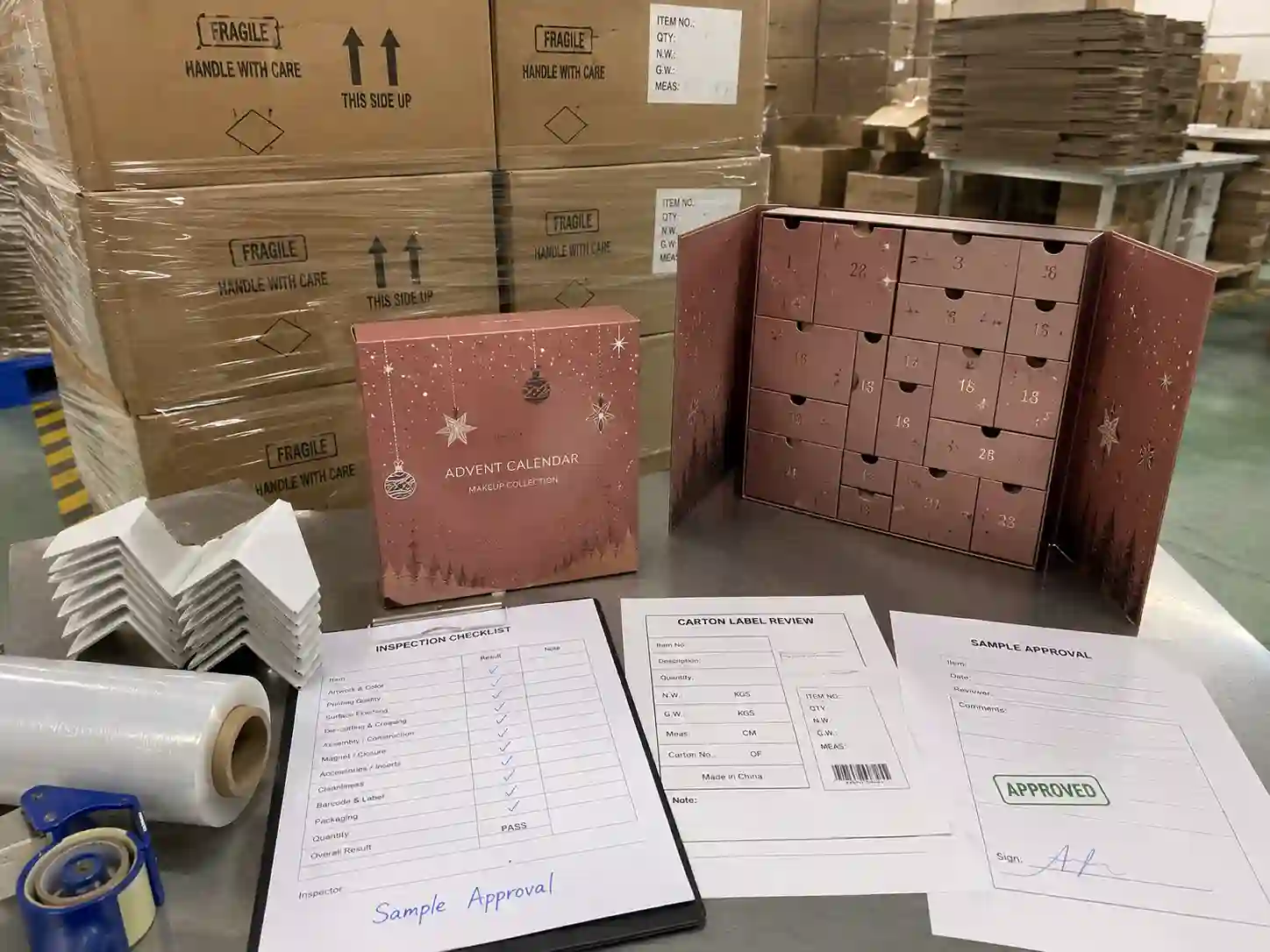
A practical final inspection should include both appearance checks and function checks. For example, inspectors should open doors or drawers, confirm product cavities, check glue areas, review surface finishing, compare colors against approved samples, and verify that cartons match the packing list.
Practical QC checklist for makeup advent calendar boxes
- Outer box size, structure, opening direction, and board strength match the approved sample.
- Insert cavities hold lipsticks, palettes, tubes, brushes, jars, and bottles securely.
- Printed colors match approved CMYK or Pantone references within agreed tolerance.
- Foil stamping, embossing, spot UV, and lamination are clean and correctly positioned.
- Numbered doors or drawers open without tearing surrounding panels.
- Cosmetic products do not rub, rattle, fall out, or press against fragile windows or panels.
- Export cartons use suitable board strength, corner protection, inner packing, and sealing method.
- Shipping marks, carton labels, quantity, SKU information, and pallet details are correct.
If buyers require packaging performance testing for distribution, they can discuss test expectations with the supplier or logistics partner. For transport testing programs, the official ISTA test procedures page is a useful non-competitor reference for understanding packaged-product testing concepts.
QC tip: Final inspection should compare mass production against the signed pre-production sample, not against a memory of the design file. The approved sample is the practical standard for factory-side checking.
How should export packing be planned for overseas shipments?
Export packing should be planned according to box structure, finished box size, carton quantity, shipping route, pallet method, and damage risk. Cosmetic advent calendar boxes often have decorated surfaces and corners that need protection from compression, moisture, and rough handling.
Rigid boxes may ship assembled, which increases carton volume but protects the premium structure. Folding carton calendars may sometimes ship flat, reducing freight volume but shifting assembly work to another location. Buyers should compare total landed cost, not just unit packaging price.
Important export packing details include master carton size, carton weight, inner polybag or tissue protection, corner protectors, pallet wrap, pallet height, shipping marks, barcode labels, and carton drop-risk. If the boxes are for Amazon, retail distribution centers, or promotional fulfillment warehouses, buyers should confirm carton label rules and receiving requirements early.
Quotable B2B statement: “For makeup advent calendar boxes, export packing is part of the product specification because a perfect retail box still fails the project if it arrives with crushed corners, rubbed surfaces, or mixed carton labels.”
What information should buyers prepare before requesting a quotation?
Buyers should prepare product details, structure preference, target quantity, artwork status, insert requirements, finishing ideas, packing method, destination, and deadline before requesting a quotation. The more specific the RFQ, the more accurate the supplier’s price, lead time, and sample plan will be.
RFQ preparation checklist
- Product list with dimensions, weight, material, and fragility notes for each makeup SKU.
- Preferred calendar structure, such as rigid drawer box, door-opening box, book-style box, or folding carton.
- Expected number of compartments, door sequence, drawer sequence, or product layout.
- Insert preference, such as paper insert, PET tray, EVA insert, foam, or molded pulp.
- Artwork files, dieline status, brand color references, and printing expectations.
- Finishing requirements, such as matte lamination, gloss lamination, foil stamping, embossing, or spot UV.
- Estimated order quantity, target MOQ, sample quantity, and expected reorder plan.
- Export packing needs, carton marks, pallet requirements, and destination country.
- Required delivery date, retail launch date, or warehouse receiving deadline.
Buyers who are still comparing options can read more advent calendar box buying guides before finalizing the RFQ. If the structure is already selected, the next step is to send the above details and request a custom quote for sampling and production review.
Decision guide: Which packaging direction should you choose?
The right direction depends on whether the project is driven by premium presentation, cost efficiency, product protection, or fast campaign execution. Use the guide below to narrow the first discussion with the factory.
| Buyer priority | Recommended direction | Reason |
|---|---|---|
| Premium influencer or retail launch | Rigid door-opening or drawer box with paperboard or EVA insert | Strong unboxing effect, better structure, suitable for high-value cosmetic sets |
| Mass retail promotion | Folding carton calendar with reinforced paper insert | Lower weight, more efficient production, practical for larger quantities |
| Fragile palettes or mini bottles | Rigid structure with PET, EVA, foam, or molded pulp support | Better cavity control and cushioning during export shipping |
| Eco-positioned paper packaging | Paperboard structure with paper insert or molded pulp insert | Supports paper-based packaging direction, but must be tested for strength |
| Fast quotation comparison | Standard structure reference plus clear product dimensions and quantity | Allows suppliers to quote with fewer assumptions and less revision risk |
What common mistakes should buyers avoid?
Buyers should avoid confirming artwork before structure, choosing inserts without product testing, ignoring export packing, and comparing quotations without checking specifications. These mistakes can create delays, higher costs, or product damage during shipping.
- Mistake 1: Using approximate product dimensions. Even small errors can affect cavity fit, door opening, and carton packing.
- Mistake 2: Selecting the cheapest insert without testing. A loose insert may cause cosmetic products to rattle, scratch, or fall out during transport.
- Mistake 3: Approving color from screen images only. Cosmetic packaging should use printed proof or sample approval when color and finish matter.
- Mistake 4: Forgetting assembly tolerance. Doors, drawers, ribbons, magnets, and trays need real production tolerance, not only perfect rendering alignment.
- Mistake 5: Comparing suppliers by unit price only. Material, insert, finishing, carton packing, sample process, and QC scope may be different.
- Mistake 6: Leaving shipping marks until the end. Wrong carton labels can create receiving problems for retailers, warehouses, or fulfillment centers.
FAQ: Buyer questions about makeup advent calendar boxes
Can one box hold many different makeup product sizes?
Yes, but the insert must be designed around each SKU. Mixed lipstick tubes, palettes, jars, mini bottles, and brushes need different cavity depths and support points. Buyers should provide exact product dimensions and weight before sampling.
Is a rigid box always better than a folding carton?
No. A rigid box is better for premium presentation and heavier products, while a folding carton may be better for lightweight promotional calendars, flat packing, and cost-sensitive retail campaigns.
Should buyers choose paper insert, PET tray, EVA, or molded pulp?
Choose the insert based on product protection, appearance, sustainability positioning, and cost. Paper inserts work well for many light items; PET trays offer molded cavity control; EVA and foam protect premium or fragile products; molded pulp supports paper-based protection but needs sample testing.
How early should a buyer start the project?
Buyers should start as early as possible before the seasonal launch because structure design, dieline checking, sampling, artwork revision, mass production, QC, export packing, and shipping all require time. Complex rigid calendars with special finishing need more planning than simple cartons.
What affects the quotation most?
The main cost drivers are size, structure, board thickness, insert material, printing coverage, finishing process, order quantity, sample requirements, assembly complexity, carton packing, and shipping method.
Can the same calendar design be used for retail and e-commerce?
Sometimes, but e-commerce shipping usually needs stronger outer packing and better internal product control. Retail shelves emphasize presentation, while direct-to-consumer shipping adds more handling risk.
What should be approved before mass production?
Buyers should approve the pre-production sample, dieline, artwork, color standard, finishing effect, insert fit, packing method, carton label, and written specification before mass production begins.
CTA: How to prepare your makeup advent calendar boxes project for Giftpackpro
Before contacting Giftpackpro about makeup advent calendar boxes, prepare your product list, target structure, quantity, artwork status, insert preference, finishing requirements, delivery deadline, and export destination. If you are unsure which structure is best, send product photos, dimensions, and campaign goals so the team can suggest suitable custom advent calendar boxes, sample steps, and quotation details.
A clear RFQ helps the factory check structure feasibility, insert fit, printing process, MOQ, lead time, QC points, and export packing before production decisions are locked. This makes the project easier to compare, easier to sample, and safer to ship for seasonal retail, e-commerce, wholesale, and promotional campaigns.