
A large advent calendar used for retail display must remain stable while handling repeated opening, closing, product loading, transport movement, and customer interaction. The main stability controls are structural panel strength, base support, hinge performance, magnet positioning, drawer or door alignment, and assembly consistency. A reliable design is developed through drawings, prototypes, measurement checks, and validation before mass production.
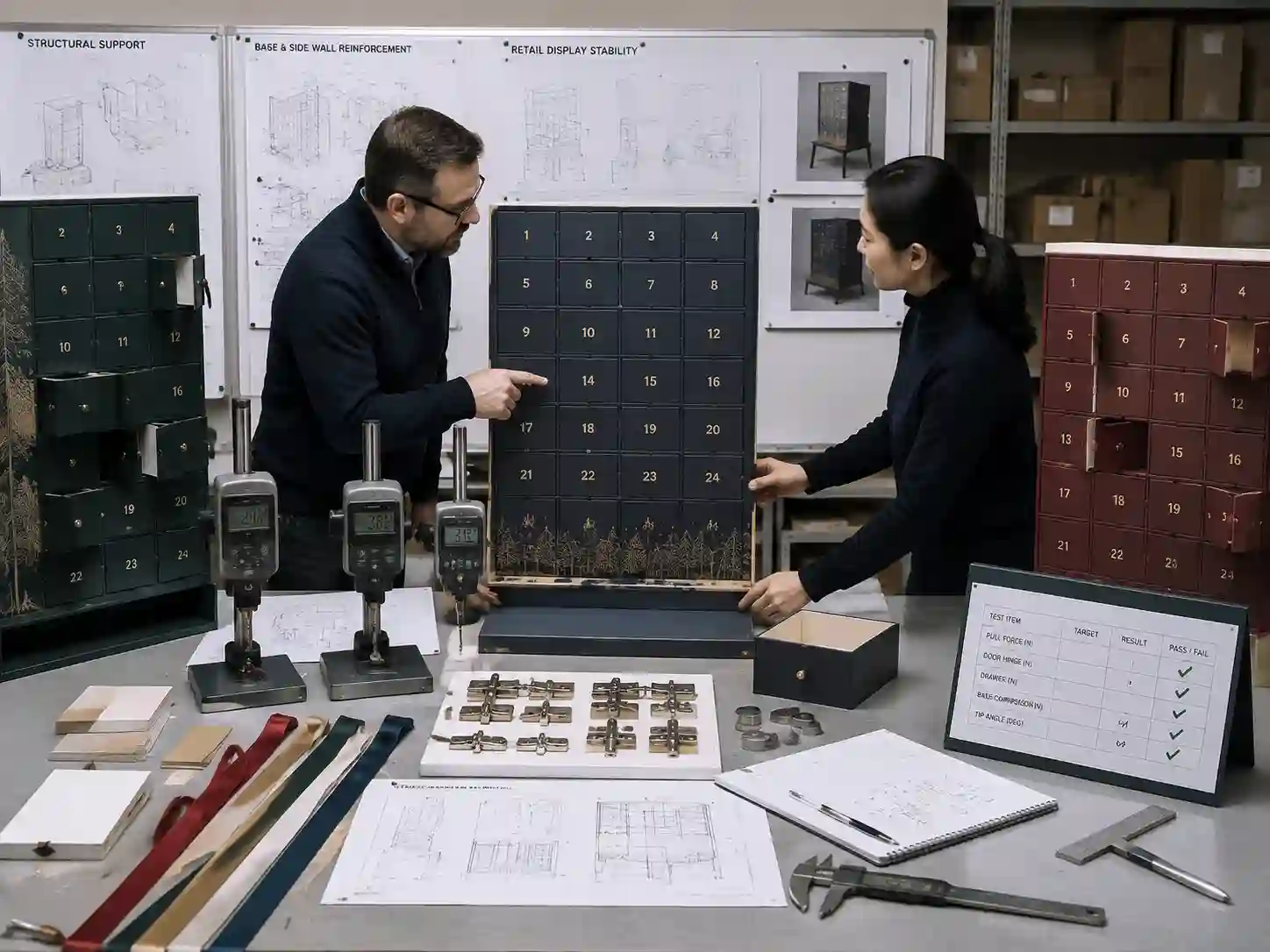
What Determines Retail Display Calendar Stability?
Retail display calendar stability depends on how the structure manages weight, opening forces, and external handling. The most important factors are the load-bearing panels, connection points, opening mechanisms, and the way the finished calendar contacts the display surface.
Large formats usually require more engineering attention because wider panels can flex, tall structures can become unstable, and repeated door or drawer movement can create stress around hinges and magnetic closures.
Which structural areas should be reviewed first?
- Main panels: Check whether back panels, side walls, and shelves maintain flatness under the expected loaded condition.
- Base structure: Confirm that the bottom construction provides enough support and prevents rocking on retail surfaces.
- Opening components: Review drawer tracks, doors, hinges, ribbons, and magnets because repeated movement transfers force into the surrounding structure.
- Assembly joints: Verify that glued, folded, or connected areas maintain alignment after production assembly.
How Should Engineers Reinforce a Large Advent Calendar Structure?
Engineers normally improve stability by balancing reinforcement with material efficiency. Adding unnecessary layers can increase weight and cost, while insufficient reinforcement may cause deformation during display use.
| Structural area | Common risk | Typical engineering review |
|---|---|---|
| Large front and side panels | Bowing or twisting | Check board thickness, internal support, panel size, and flatness after assembly |
| Drawer compartments | Misalignment or difficult movement | Verify drawer clearance, slide direction, and repeated opening performance |
| Doors and hinges | Loose movement or uneven gaps | Inspect hinge location, folding lines, and opening angle consistency |
| Magnetic closures | Weak holding or excessive pull force | Measure magnet position, attraction strength, and closure alignment |
| Bottom support | Tilting on display shelves | Check base stiffness and contact area |
How Do Drawer and Door Mechanisms Affect Stability?
Drawer and door systems directly influence the overall stability of a large advent calendar because every opening action creates mechanical stress. A drawer that fits too tightly can pull the structure forward, while a loose drawer can reduce the perceived quality of the product.
For door-style calendars, hinge placement and panel support are critical. Large doors create leverage when opened, so the surrounding frame must prevent distortion. Magnet placement should also be tested because incorrect positioning can cause uneven closing pressure.
How Can Buyers Verify a Stable Advent Calendar Before Production?
Stability should be verified through physical samples, structural drawings, and inspection records rather than appearance checks alone. The validation process should confirm that the design performs under realistic handling conditions.
What testing steps are commonly used?
- Review structural drawings for panel dimensions, support points, folding areas, and connection methods.
- Assemble a prototype using the intended materials and construction method.
- Measure panel flatness, alignment gaps, base stability, and opening movement.
- Perform repeated drawer or door operation checks to identify weak points.
- Record adjustments and approve the final structural version before production.

What Failure Modes Should Be Checked During Development?
Most large advent calendar stability problems appear during sampling or early production review. Identifying these risks early helps prevent structural changes after manufacturing begins.
- Panel bowing: Large surfaces may bend because of insufficient support, uneven material tension, or incorrect assembly.
- Door sagging: Heavy doors may shift if hinges, folding areas, or surrounding panels are not strong enough.
- Drawer friction: Poor clearance control can cause difficult movement or damage to internal surfaces.
- Magnet misalignment: Incorrect positioning can create weak closure or excessive pulling force.
- Base instability: An insufficient support area can make the calendar tilt during retail display.
Which Stability Details Need Buyer Approval Before Production?
Some stability decisions depend on the final product requirements and should be confirmed through buyer approval records. These include appearance tolerance, opening feel, display orientation, product weight inside compartments, and acceptable structural variations.
Verifiable facts: Material specifications, structural drawings, sample measurements, inspection records, and approved prototypes provide objective evidence of the design condition.
Project-dependent recommendations: Reinforcement methods, hinge selection, magnet strength, and panel construction vary according to calendar size, product weight, opening frequency, and retail environment.
Buyer approvals: The final structure, sample appearance, functional movement, and acceptable tolerances should be approved before bulk production.
How Does Quality Control Confirm Large Calendar Stability?
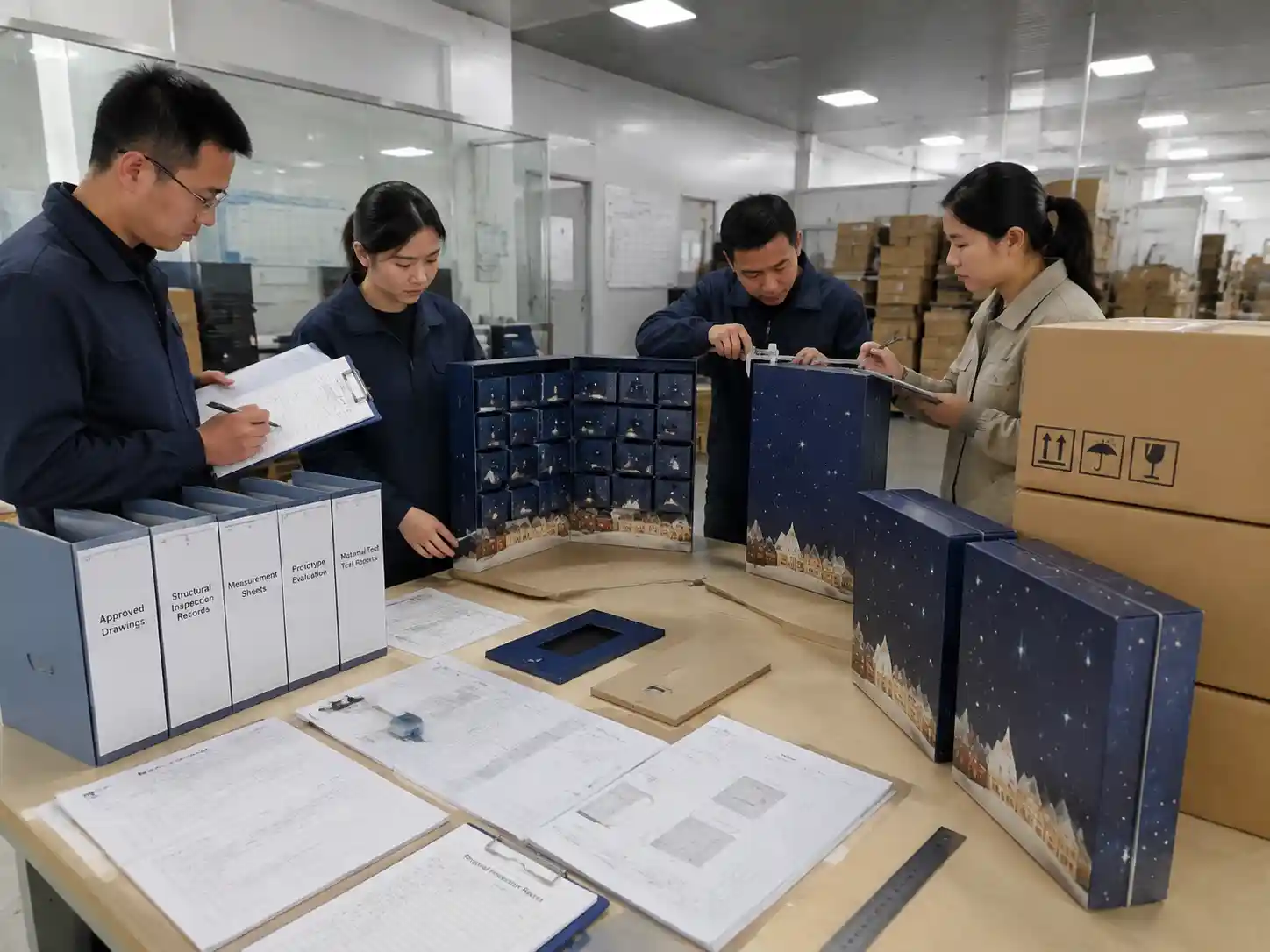
Quality control teams verify stability by comparing production samples with approved specifications. Checks may include dimensional measurements, panel alignment inspection, opening mechanism review, and packaging condition verification.
For commercial projects, documentation such as inspection sheets, approved drawings, and sample records helps maintain consistency between development, production, and final delivery. Giftpackpro supports custom structural development through custom advent calendar box services and production coordination.
FAQ: Large Advent Calendar Stability
Can a large advent calendar remain lightweight and stable?
Yes. Stability does not always require adding more material. Proper panel sizing, reinforcement placement, and mechanism design can improve performance without unnecessary structure.
Do magnets improve the stability of advent calendar doors?
Magnets improve closure control, but they do not replace structural support. The door frame, hinge area, and surrounding panels must still maintain alignment.
Why should stability be checked during sampling?
Sampling reveals issues that drawings may not show, including movement resistance, panel deformation, assembly tolerance, and handling performance.
For large custom formats, review the structure, validate the prototype, and confirm the final requirements before production. You can also explore custom advent calendar box products or request a custom quote for your project requirements.


