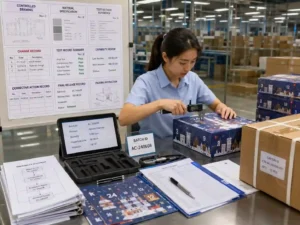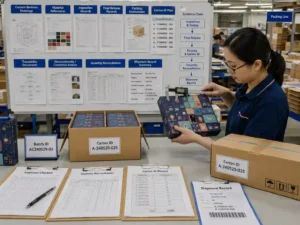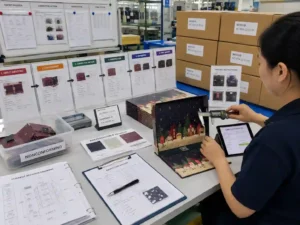
Quick answer: To design pet product advent calendar boxes for seasonal campaigns, buyers should first confirm the product mix, weight, compartment size, box structure, insert material, artwork, sampling process, QC checks, and export packing method. Pet treats, chew toys, grooming accessories, waste bag rolls, and small pet samples all require different compartment strength and insert tolerances. A reliable supplier should check the dieline, test product fit, control color proofing, inspect assembly quality, and pack cartons for long-distance shipping before mass production.
What should buyers confirm before choosing pet product advent calendar boxes?
Buyers should confirm the product list, quantity per set, size range, weight, retail channel, and launch schedule before choosing the box structure. Pet product advent calendar boxes are not only visual retail packaging; they must hold mixed products securely through filling, handling, shipping, warehousing, and seasonal display.
For a pet campaign, the product mix may include sealed pet treat pouches, dental chews, small toys, grooming wipes, paw balm samples, waste bag rolls, collars, accessories, or trial-size pet care products. These items are often irregular in shape and weight. A soft treat pouch behaves differently from a hard chew, and a round waste bag roll needs different insert support from a flat grooming sachet.
Before requesting a quotation, buyers should prepare actual product dimensions or 3D drawings. Length, width, depth, unit weight, and packing orientation are all important. If the buyer only provides a rough product list, the factory may quote a general structure, but the insert fit and final box size may change after sample testing.
Buyer tip: For mixed pet product sets, do not design the box only around the largest item. The smallest and loosest items also need attention because they may move during shipping, damage the printed doors, or create noise when the carton is handled.
Which box structure works best for seasonal pet product campaigns?
The best structure depends on product weight, campaign positioning, assembly method, retail display needs, and budget. For B2B buyers, the main choices are rigid box, drawer box, door-opening box, folding carton, and book-style calendar box.
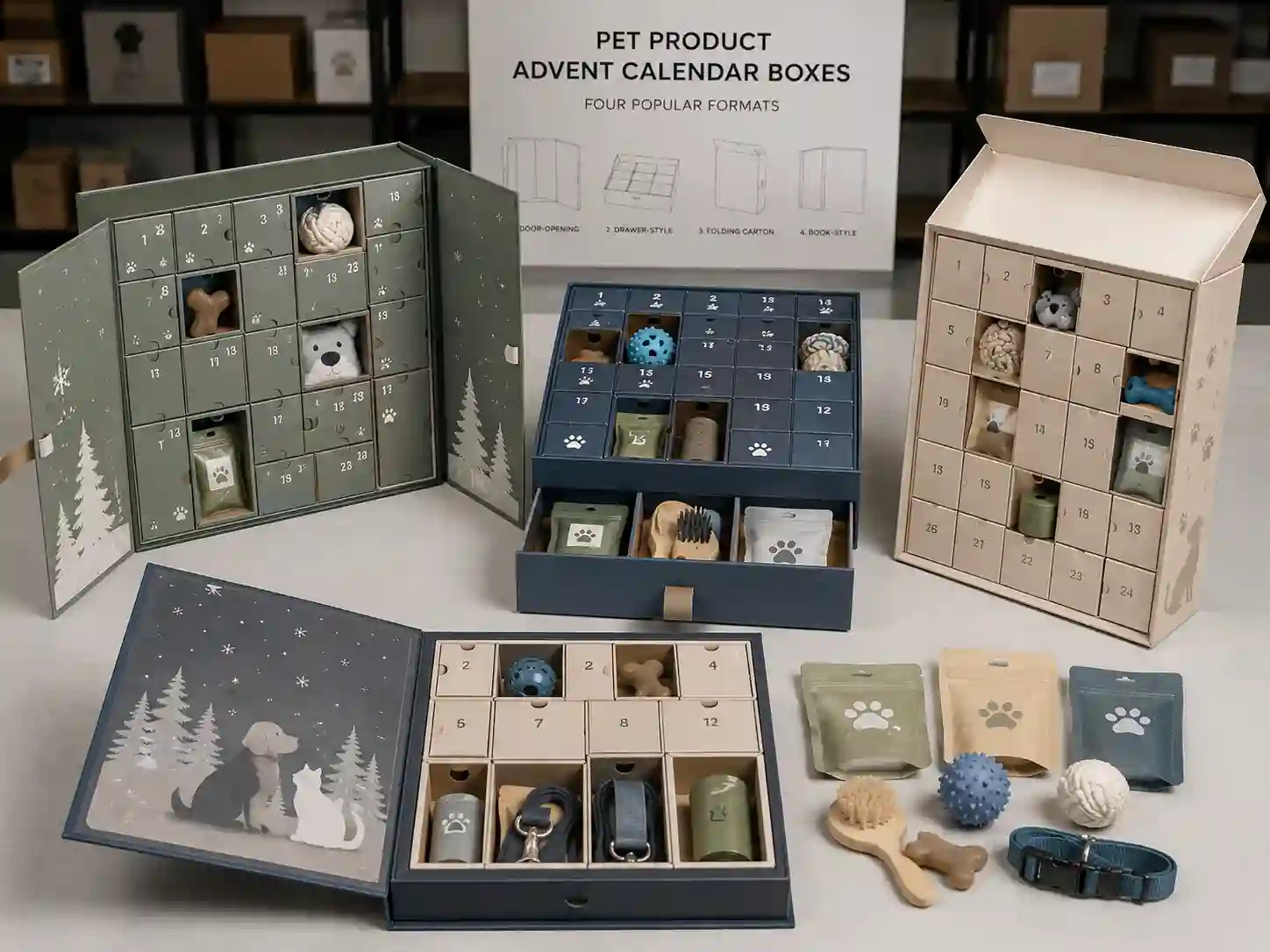
| Structure option | Best for | Key advantage | Buyer risk to check |
|---|---|---|---|
| Rigid door-opening box | Premium pet treats, toys, grooming sets, multi-item gift campaigns | Strong greyboard body, good shelf impact, suitable for numbered doors | Higher material and labor cost; door perforation and insert alignment must be tested |
| Drawer box | Pet treat pouches, accessories, reusable gift sets, higher perceived value | Good unboxing experience and strong product protection | Drawer friction, rail alignment, and loaded weight must be checked during sampling |
| Folding carton calendar | Lightweight pet samples, short campaigns, budget-sensitive retail programs | Lower unit cost and more efficient flat packing | Less rigid under heavy products; requires careful paperboard selection |
| Book-style rigid box | Pet care gift sets, grooming kits, accessory assortments | Premium opening style and large artwork area | Magnetic closure, hinge strength, and insert support need durability checks |
| Fold-out calendar | Promotional pet campaigns and e-commerce gift sets | Flexible layout with strong visual storytelling | Complex assembly and larger shipping volume may increase cost |
A rigid box is often preferred when the calendar contains heavier pet products or when the buyer wants a premium retail display. A folding carton may be suitable for lightweight sealed samples, but it needs a stronger paperboard grade if the box has many compartments. Drawer designs can work well for reusable pet gift sets, but the drawer must slide smoothly after loading.
Giftpackpro can support buyers comparing structures through custom advent calendar box services, especially when the project requires a balance between retail appearance, compartment strength, and mass production efficiency.
How should inserts be designed for pet treats, toys, and accessories?
Inserts should be designed around actual product fit, not only the outer box size. For pet product advent calendar boxes, the insert controls product position, door support, shipping stability, and the customer’s opening experience.
Common insert options include paper insert, PET tray, EVA insert, foam insert, and molded pulp. Each option has different cost, tooling, sustainability, protection, and appearance implications. For sealed pet treat pouches, a paperboard insert may be enough if the pouch is light and flat. For small bottles, grooming accessories, or round items, PET or molded pulp may provide better shape control. EVA and foam can protect delicate accessories, but buyers should confirm whether the material is suitable for the brand’s market positioning and compliance expectations.
What insert details should be checked before mass production?
The factory should test compartment depth, finger access, door clearance, insert locking points, and product movement. A compartment that looks correct in a dieline may still fail if the product bulges, shifts, or blocks the numbered door from opening cleanly.
- Check whether each pet treat pouch fits without bending the outer door.
- Confirm whether chew toys or hard accessories create pressure marks on the printed surface.
- Test whether round waste bag rolls rotate or fall out during carton shaking.
- Confirm whether grooming sachets can be removed easily by hand.
- Check whether mixed product heights require stepped inserts or different compartment depths.
- Verify whether the insert can be assembled efficiently during bulk production.
Factory tip: For pet advent calendar inserts, 1–2 mm of tolerance can decide whether mass production is smooth or difficult. Insert fit should be tested with real filled products, not empty mockups only.
Which materials should buyers compare for strength, cost, and presentation?
Buyers should compare paperboard, greyboard, surface paper, insert material, and lamination based on product weight and sales channel. Material selection affects durability, printing result, MOQ, unit cost, and export carton performance.
Rigid pet calendars usually use greyboard wrapped with printed art paper. Folding carton calendars use printed paperboard directly. For stronger premium boxes, greyboard thickness should be selected according to box size, loaded weight, and structure. A large door-opening calendar with heavy chews may require stronger board than a small calendar filled with sample pouches.
If the buyer wants a more responsible material story, paper-based options and certified paper sources can be discussed during material selection. Buyers who need certified paper should verify requirements through official sources such as FSC and confirm certificate scope with the supplier before ordering.
For pet products, buyers should also separate primary product safety from secondary packaging. If treats are already sealed in qualified pouches, the advent calendar box normally functions as secondary packaging. If any edible item will directly contact paper, tray, coating, ink, or insert material, buyers should confirm the applicable food-contact requirements for the destination market before production.
How should artwork, printing, and finishing be controlled?
Artwork should be checked against the dieline before sampling, and printing should be controlled by CMYK values, Pantone references, proof approval, and finishing instructions. Pet product advent calendar boxes often have many small doors, numbers, icons, and compartment positions, so artwork accuracy is a production-critical issue.
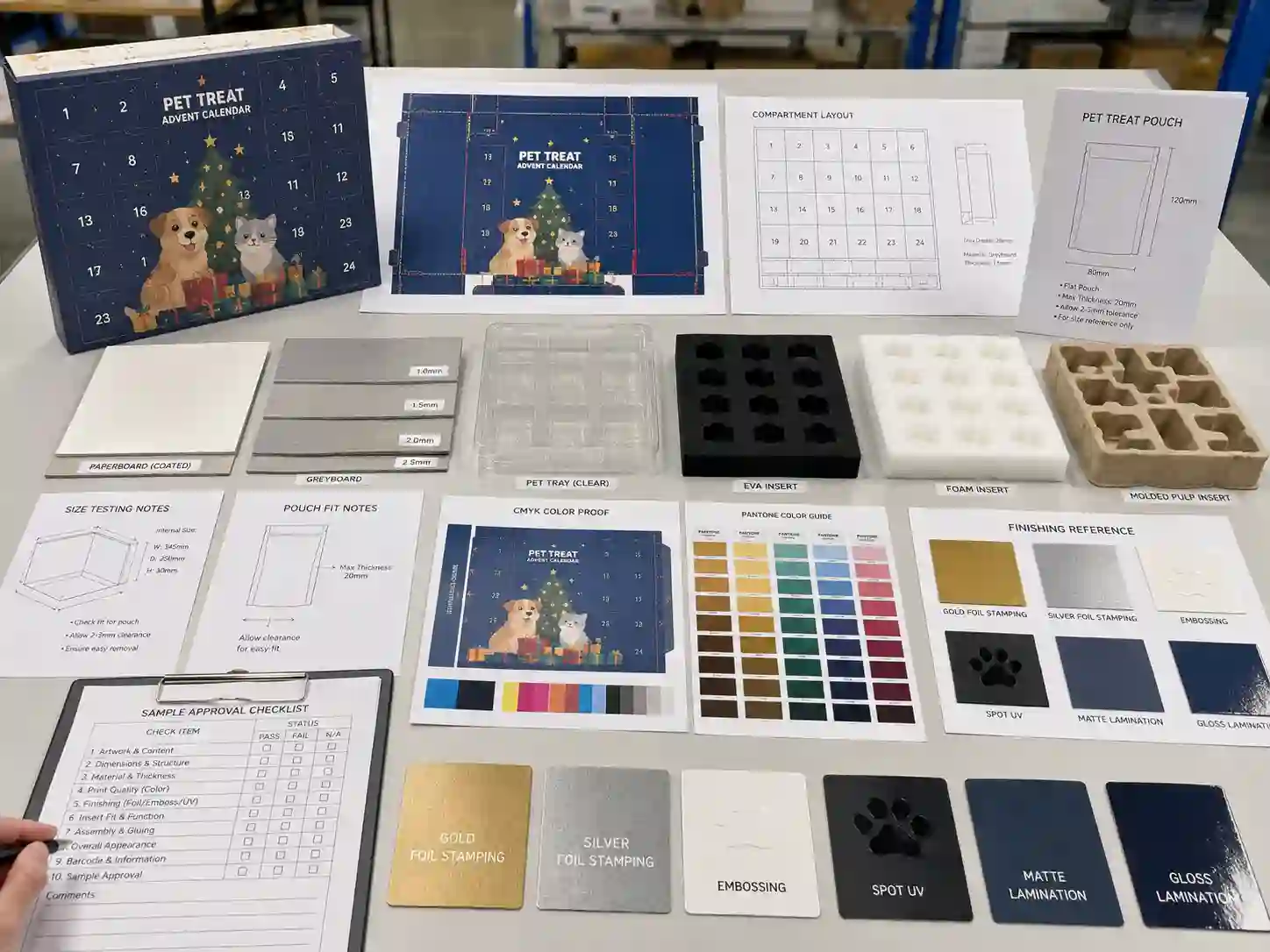
Buyers should provide editable artwork files with bleed, cut lines, crease lines, perforation areas, safe zones, and numbering positions. If the calendar has 12, 24, or 25 compartments, the number placement must match the actual insert layout. A beautiful design can become unusable if door numbers do not align with the right products.
Which printing and finishing options are common?
Common options include CMYK printing, Pantone spot color, matte lamination, gloss lamination, foil stamping, embossing, debossing, and spot UV. For pet brands, matte lamination is often used for a softer retail look, while spot UV or foil can highlight campaign names, numbers, or pet-themed graphics. However, finishing should not weaken door perforations or create cracking on fold lines.
QC tip: When approving a color proof, check solid background color, small text, barcode area, door numbering, fold lines, and finishing registration. Do not approve artwork based only on the front panel image.
What sampling process reduces production risk?
A good sampling process should move from structure confirmation to printed sample approval and then to pre-production sample control. For custom advent calendar boxes, sampling is not a formality; it is the main stage where buyers and factories catch fit, structure, artwork, and assembly problems.
- Product information review: Buyer provides product size, weight, product photos, quantity per calendar, and packing direction.
- Initial structure proposal: Factory suggests rigid box, drawer box, folding carton, or another suitable structure.
- Dieline development: The dieline defines outer size, compartments, doors, insert layout, bleed, and fold lines.
- Blank sample: The buyer checks structure, size, opening method, insert fit, and product loading before final artwork.
- Printed sample or digital proof: The buyer reviews color, artwork position, finishing, and overall presentation.
- Pre-production sample: The final approved sample becomes the reference for mass production and QC.
For pet product campaigns, buyers should send real products or accurate samples when possible. If the factory tests with substitute items, the result may not reflect actual pouch thickness, chew hardness, or accessory shape.
As a custom advent calendar boxes manufacturer, Giftpackpro can help buyers move from product-fit review to sample approval before bulk production starts.
What QC checks matter most during mass production?
Mass production QC should cover material, printing, die-cutting, lamination, finishing, insert assembly, product loading simulation, carton packing, and final inspection. Pet product advent calendar boxes contain many small functional parts, so quality control must be more detailed than a simple visual check.
Important inspection points include board thickness, surface paper bonding, color consistency, door perforation, drawer movement, insert position, glue strength, magnet position if used, compartment fit, and outer carton strength. If the calendar is shipped assembled, the factory should also check whether the loaded box can resist compression during export handling.
Practical QC checklist for pet product advent calendar boxes
- Confirm board grade and material match the approved sample.
- Check CMYK or Pantone color against the approved proof under consistent lighting.
- Inspect foil stamping, embossing, spot UV, matte lamination, or gloss lamination for registration issues.
- Test door-opening strength so doors open cleanly without tearing nearby panels.
- Check drawer pull resistance if using a drawer box structure.
- Load sample pet products into compartments and check shifting, bulging, and removal access.
- Inspect insert placement and glue points for lifting or movement.
- Check printed numbers, warnings, barcode area, and shipping marks if included.
- Review export carton quantity, carton weight, carton label, and pallet plan.
- Compare final goods with the approved pre-production sample before shipment.
Quotable B2B statement: “For pet product advent calendar boxes, the insert is not just decoration; it is the part that protects the retail promise during assembly, shipping, and daily door opening.”
How should durability be tested before shipment?
Durability should be tested by simulating real handling conditions: opening, closing, loading, carton stacking, vibration, and long-distance transport. A seasonal box may look good in a sample room but fail if the door tears, insert loosens, or cartons crush during export shipping.
Buyers can ask suppliers about internal drop checks, carton compression review, tape strength, pallet stacking, and transit simulation. For more formal packaging performance testing, buyers may refer to official transport testing organizations such as ISTA and confirm which test level is appropriate for the product and shipping route.
Durability requirements depend on the packing method. Flat-packed folding cartons reduce shipping volume but require more local assembly. Fully assembled rigid boxes save downstream labor but use more carton space and need stronger export protection. If the calendar will be sold through e-commerce, the box may need stronger protection than a palletized retail shipment.
How do MOQ, cost, and lead time affect the design?
MOQ, cost, and lead time are shaped by structure complexity, material choice, printing method, finishing, insert tooling, sampling rounds, and packing method. Buyers should compare the total project cost, not only the unit price.
Cost drivers for pet product advent calendar boxes include greyboard thickness, paperboard grade, box size, number of compartments, insert material, foil stamping area, embossing mold, spot UV coverage, magnetic closure, manual assembly time, export carton size, and pallet loading efficiency. A lower unit price may become more expensive if it creates high damage risk, slow assembly, or inefficient shipping volume.
Lead time usually depends on artwork readiness, sample revisions, material availability, production schedule, finishing complexity, and inspection requirements. Buyers planning a seasonal campaign should leave time for product-fit testing and pre-production sample approval before mass production.
Decision guide: how to choose the right specification
| Buyer priority | Recommended direction | Reason |
|---|---|---|
| Premium retail shelf impact | Rigid box, drawer box, book-style box, foil or embossing | Stronger structure and better presentation for gift campaigns |
| Lower cost and lighter products | Folding carton with paperboard insert | More efficient material use and lower packing volume |
| Mixed product shapes | Custom insert with product-by-product compartment testing | Reduces shifting, bulging, and assembly problems |
| Fragile accessories or small bottles | PET tray, EVA, foam, or molded pulp after fit testing | Improves location control and protection |
| E-commerce shipment | Stronger outer box, reinforced insert, tested export carton | Improves resistance to parcel handling and compression |
How should export packing be planned for overseas buyers?
Export packing should protect the printed calendar, maintain carton strength, and make warehouse handling easy. Overseas buyers should confirm export carton size, quantity per carton, gross weight, pallet plan, shipping marks, barcode label area, and whether goods ship flat-packed or assembled.
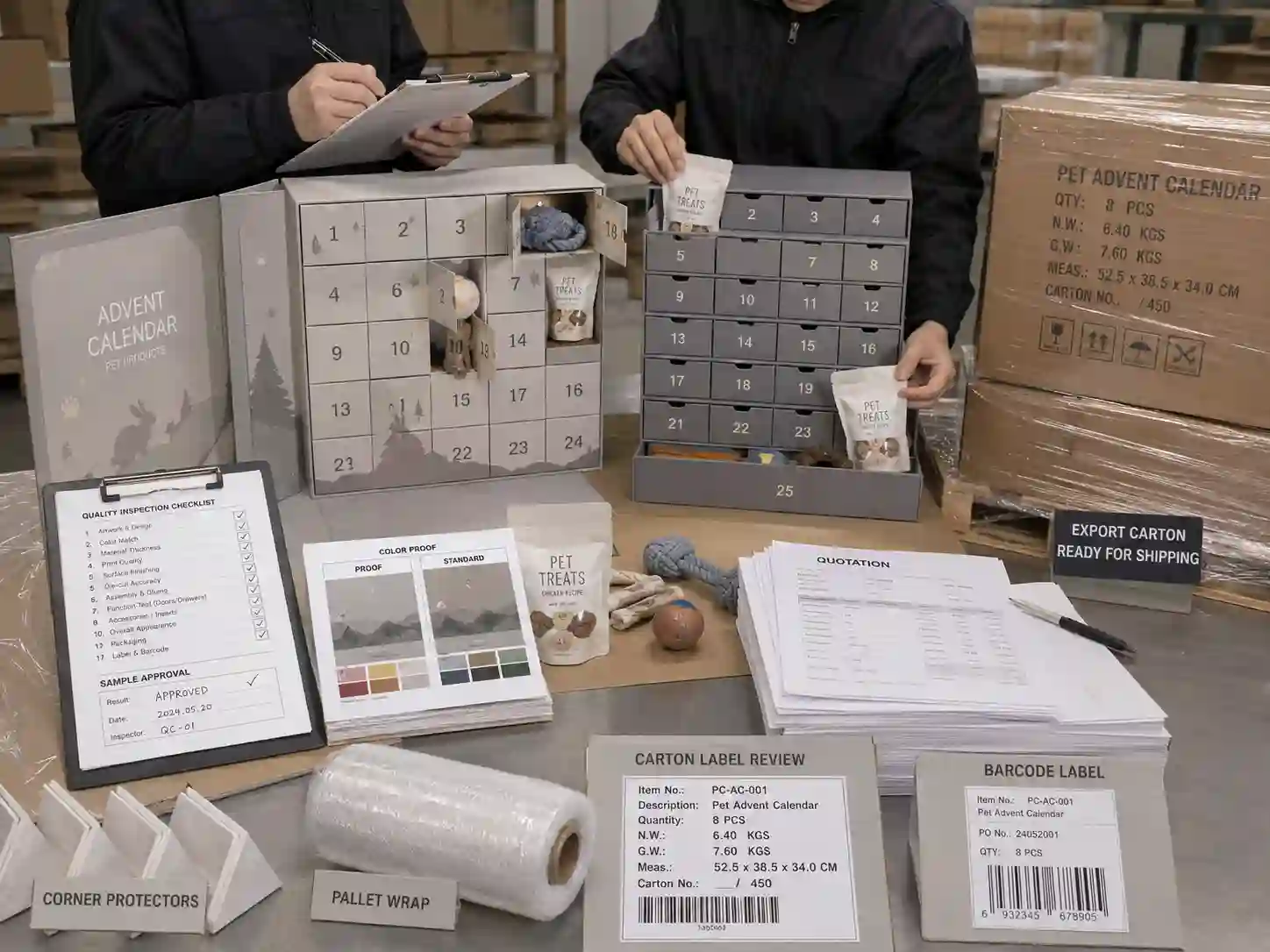
For rigid calendars, corner protection and suitable master cartons are important because printed corners can be damaged during container loading. For folding carton calendars, flat packing may reduce freight cost, but buyers must confirm local assembly labor and packing instructions. If products will be loaded in the destination market, the insert should be easy for the buyer’s packing team to use consistently.
Shipping marks should be clear and practical. Buyers may need item number, PO number, carton quantity, gross weight, net weight, carton dimensions, country of origin, barcode label area, and handling symbols. These details should be confirmed before carton printing or label production.
Buyers can review more related topics in Giftpackpro’s advent calendar box buying guides, especially when comparing export packing, MOQ planning, and seasonal campaign timelines.
How should buyers compare pet advent calendar box suppliers?
Buyers should compare suppliers by engineering support, sampling discipline, insert testing, QC process, communication speed, export packing experience, and quotation clarity. A low quote is not enough if the supplier cannot control fit, printing, and assembly during mass production.
A strong supplier should be able to explain why a certain structure fits the product mix, what insert material is suitable, how the dieline will be checked, how color proofing will be controlled, and how final goods will be inspected. Buyers should also ask whether the factory has experience with multi-compartment seasonal paper packaging, not only standard gift boxes.
When evaluating a Giftpackpro packaging factory or another production partner, buyers should request practical evidence: blank sample photos, printed sample process, inspection checklist, packing photos, carton information, and clear revision records. If certified materials, special testing, or destination-market compliance is required, buyers should verify documents before confirming the order.
What information should buyers prepare before requesting a quotation?
Buyers should prepare product details, quantity, structure preference, artwork requirements, insert expectations, packing method, target delivery date, and destination before requesting a quotation. A complete RFQ helps the factory provide a realistic price and avoid later changes.
Quotation preparation checklist
- Product list for each calendar compartment.
- Product size, weight, photos, and packing orientation.
- Preferred calendar count, such as 7, 12, 24, or 25 compartments.
- Expected structure: rigid box, drawer box, door-opening box, folding carton, or book-style box.
- Insert preference: paper insert, PET tray, EVA insert, foam, molded pulp, or factory recommendation.
- Artwork files or design direction, including CMYK, Pantone, logo placement, and numbered doors.
- Finishing requirements such as matte lamination, gloss lamination, foil stamping, embossing, or spot UV.
- Estimated order quantity and target MOQ range.
- Sample needs: blank sample, printed sample, prototype, or pre-production sample.
- Export packing requirements, pallet preference, shipping marks, and destination port or country.
- Target launch date, warehouse arrival date, and required lead time.
Buyers can also review custom advent calendar box products to compare structure ideas before sending a final RFQ.
What common mistakes should buyers avoid?
Buyers should avoid choosing a structure before confirming product fit, approving artwork without checking the dieline, and focusing only on unit price. Most production problems in pet product advent calendar boxes come from incomplete product information, weak insert design, rushed sampling, or unclear inspection standards.
- Mistake 1: Using estimated product sizes. Real products may be thicker, softer, heavier, or more irregular than expected.
- Mistake 2: Ignoring product weight distribution. Heavy chews or accessories placed on one side may cause the calendar to lean or deform.
- Mistake 3: Treating the insert as a simple divider. Insert design controls fit, protection, and assembly speed.
- Mistake 4: Approving colors from screen images only. Printed CMYK, Pantone, lamination, and surface paper can change the final appearance.
- Mistake 5: Skipping pre-production approval. Mass production should follow an approved reference sample, not only a digital file.
- Mistake 6: Forgetting export carton planning. Carton strength, pallet loading, and shipping marks affect damage rate and receiving efficiency.
Buyer tip: A pet advent calendar project should be reviewed as a complete supply-chain package: product fit, box structure, insert, printing, assembly, inspection, carton packing, and delivery schedule all affect the final result.
FAQ: Pet product advent calendar boxes for B2B buyers
What is the best structure for pet product advent calendar boxes?
The best structure depends on product weight and campaign positioning. Rigid door-opening boxes are suitable for premium mixed pet products, drawer boxes work well for reusable gift sets, and folding cartons are more suitable for lightweight sample campaigns.
Which insert is best for pet treats?
For sealed pet treat pouches, a paperboard insert is often practical if the pouch is light and flat. For irregular chews, small bottles, or mixed accessories, buyers may need PET, molded pulp, EVA, or foam after product-fit testing.
Can one calendar box hold treats, toys, and grooming products together?
Yes, but the insert layout must be engineered for different sizes, weights, and removal methods. The supplier should test each compartment with real products before mass production.
Do buyers need a blank sample before printed sampling?
A blank sample is strongly recommended for custom pet advent calendar boxes because it confirms structure, compartment size, insert fit, opening method, and product loading before printing costs are added.
What affects the MOQ for custom pet advent calendar boxes?
MOQ is affected by material purchasing, printing setup, finishing molds, insert tooling, box structure, and production efficiency. More complex structures and custom inserts may require higher production quantities to control unit cost.
How early should buyers start a seasonal pet calendar project?
Buyers should start early enough to allow product measurement, dieline development, blank sampling, printed sample approval, pre-production sample confirmation, mass production, inspection, and export shipping. Rushed timelines increase the risk of fit and printing problems.
CTA: How to start a pet product advent calendar box project with Giftpackpro
To start a custom project, prepare your product list, product dimensions, estimated quantity, preferred structure, insert requirements, artwork files, finishing ideas, sample needs, delivery schedule, and export packing requirements. These details help Giftpackpro recommend a practical structure, develop the dieline, estimate MOQ, and prepare a more accurate quotation.
If you are comparing pet product advent calendar boxes for a seasonal campaign, you can request a custom quote from Giftpackpro with your product details and target launch schedule. The more complete your RFQ is, the easier it is to control sample revisions, mass production quality, lead time, and final export packing.