Choosing custom advent calendar boxes is not only a design decision. For B2B buyers, it affects product fit, retail presentation, sampling speed, bulk production stability, packing cost, and seasonal delivery planning.
A strong advent calendar box should protect the products, match the brand artwork, open smoothly, and arrive ready for retail or promotional distribution. The best result usually comes from preparing clear product details before requesting a quotation.
This guide explains how overseas brands, distributors, and project buyers can choose the right structure, insert, artwork, material, and supplier process for custom advent calendar boxes. It is written for practical sourcing, not gift-story inspiration.
Start With the Product and Sales Channel
Before choosing a box style, define what the calendar needs to hold and where it will be sold. A cosmetics launch calendar, a chocolate countdown box, a promotional gift set, and a jewelry sample kit may all look similar from the outside, but their internal requirements can be very different.
For example, fragile glass bottles need stronger separation and better drop protection. Lightweight paper items may only need paperboard compartments. Food products may require extra attention to packaging contact requirements, inner wrapping, and carton sealing. Retail products may also need barcode placement, product labeling, and shelf-ready export packing.
If you are still comparing structures, it helps to review more advent calendar box buying guides before sending final artwork. For a first project, you can also contact a custom advent calendar boxes manufacturer with product sizes, target quantity, and reference photos so the supplier can suggest a workable direction.
Choose the Right Advent Calendar Box Structure
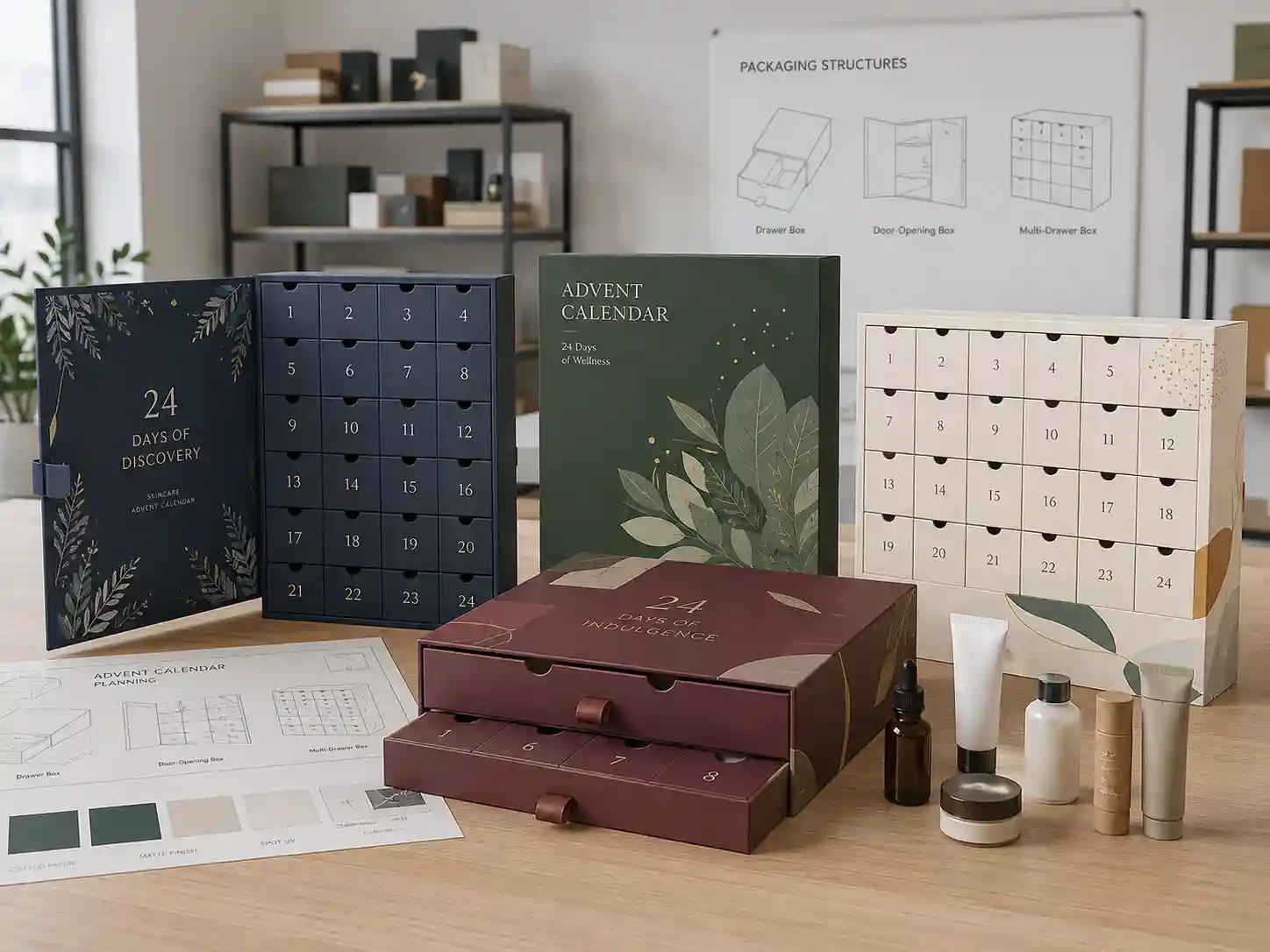
The structure is the first major cost and production factor. It affects material usage, labor, packing volume, product protection, and the final customer experience. A beautiful design can fail if the structure is too weak, too complex, or difficult to assemble during bulk production.
Drawer Style Advent Calendar Boxes
Drawer style calendars are common for cosmetics, jewelry, small accessories, tea samples, and premium gift sets. Each small drawer can hold one item or one daily surprise. This structure often feels high-end, but it may require more labor, more precise fitting, and stronger outer support.
When choosing drawer style custom advent calendar boxes, ask how the drawers will be tested. The drawer should slide smoothly without being too loose. It also should not become stuck after printing, lamination, or humidity changes during shipping.
Door-Opening Calendar Boxes
Door-opening boxes use numbered perforated doors or windows. This style is often used for chocolate, candy, small packaged gifts, and lightweight promotional items. It can be cost-effective for some projects, but the perforation design must be tested carefully.
If the door is too weak, it may open during transport. If it is too strong, the end user may damage the box when opening it. A pre-production sample is important before bulk production.
Rigid Advent Calendar Boxes
Rigid structures are suitable for premium brand campaigns, PR gifts, and luxury holiday packaging. They can support stronger visual impact and better product protection. However, they usually require more material, more handwork, and more packing space.
For premium retail planning, confirm the box weight, outer carton size, and pallet packing method early. A rigid design may look excellent in photography, but shipping efficiency still matters for B2B projects.
Foldable Paperboard Calendar Boxes
Foldable paperboard designs can help reduce storage and shipping volume. They are often useful for promotional campaigns or projects that need a practical balance between appearance and logistics.
The key is to check assembly difficulty. If the structure takes too long to fold, load, or close, the total project cost may increase during fulfillment.
| Structure Option | Best For | Key Buyer Check |
|---|---|---|
| Drawer style | Cosmetics, jewelry, tea, premium samples | Drawer fit, inner support, handwork cost, sample accuracy |
| Door-opening style | Chocolate, candy, lightweight gifts, retail countdown boxes | Door strength, perforation test, product movement control |
| Rigid box | Luxury campaigns, PR kits, premium seasonal packaging | Box weight, export carton size, structure strength, finish stability |
| Foldable paperboard | Promotional projects, cost-sensitive seasonal programs | Assembly speed, locking method, packing efficiency |
Plan the Insert Before Finalizing the Artwork
The insert is often more important than buyers expect. It decides whether each product stays in place, whether the calendar feels organized, and whether the box survives handling during shipping.
Common insert options include paperboard dividers, molded pulp trays, EVA or foam inserts, PET trays, and custom folded paper structures. The right option depends on product weight, product shape, breakage risk, and brand positioning.
For a practical quotation, send the supplier the size and weight of every product inside the calendar. If you do not have final products yet, send dummy product dimensions. The supplier can then prepare a dieline and insert concept based on real fit instead of guessing.
If your project includes many different product sizes, do not approve the outer box before checking the insert. A small change in bottle height or product diameter can affect the full calendar layout.
Prepare Artwork, Dieline, and Numbering Details
Artwork for custom advent calendar boxes is more than a front cover design. The supplier usually needs artwork for the outer box, drawer fronts, door numbers, side panels, inside panels, inserts, labels, and sometimes export carton marks.
Ask for the dieline before final artwork placement. The dieline should show cut lines, fold lines, glue areas, bleed, safe zones, and opening direction. This helps your designer avoid placing important text or logos on folds, cuts, or hidden glue areas.
For numbered calendars, check the number sequence carefully. Make sure the numbering matches the product loading plan. If drawer 1 should contain a hero product and drawer 24 should contain a premium item, the factory needs the correct loading map before production.
For barcode or retail labeling, follow your sales channel requirements. If your calendar will enter a large retail or distribution system, check whether barcode, carton label, and supply-chain data need to follow standards such as GS1 standards.
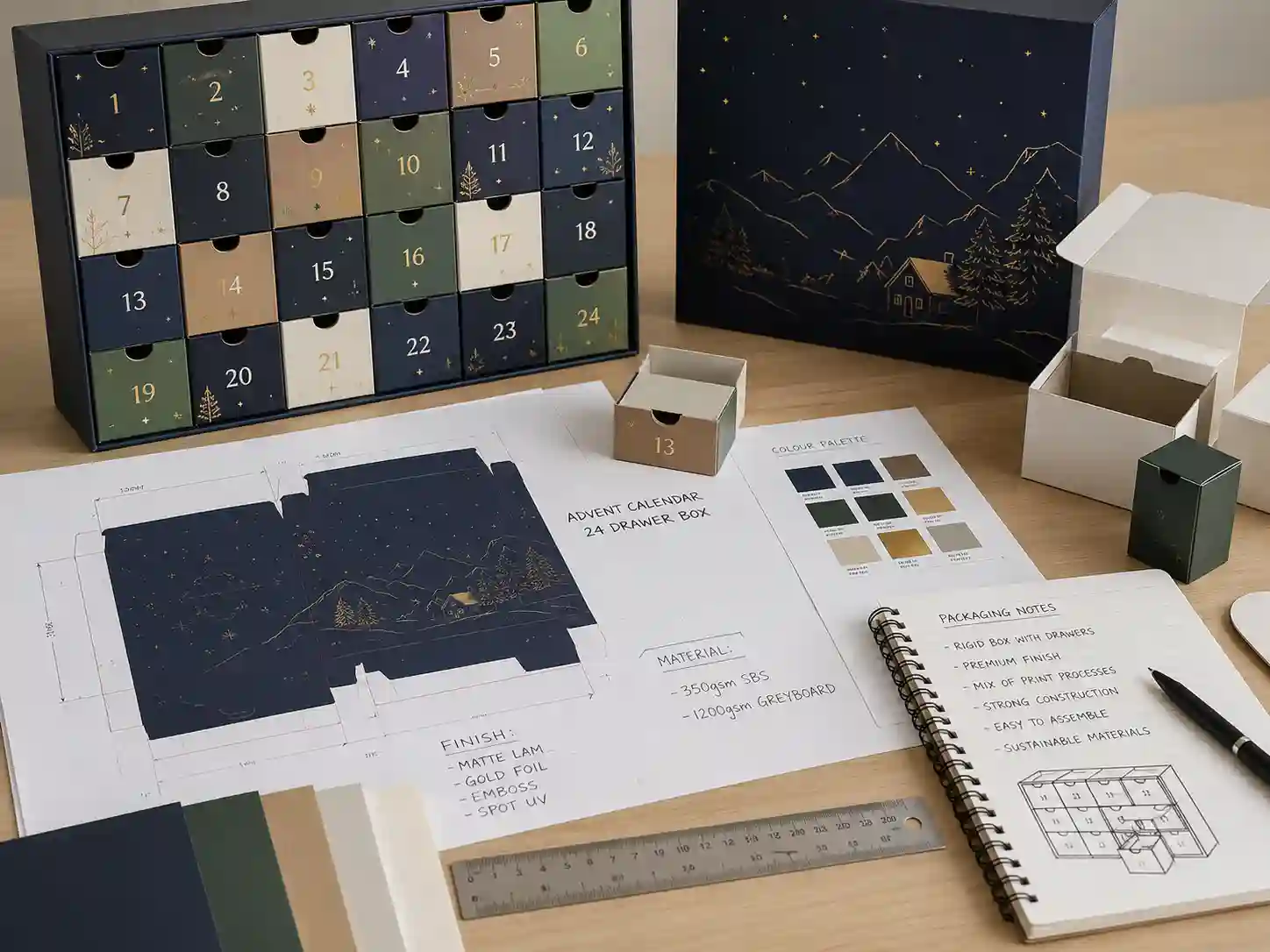
Compare Materials and Surface Finishing
Material choice affects strength, print result, appearance, and cost. Common options include grey board for rigid boxes, white card, kraft paperboard, corrugated board, specialty paper, and laminated paper surfaces.
For premium custom advent calendar boxes, buyers often consider matte lamination, gloss lamination, soft-touch coating, foil stamping, embossing, debossing, spot UV, ribbon pulls, magnetic closure, or special paper textures. These finishes can improve shelf impact, but they also add sampling and production control requirements.
If responsible paper sourcing matters for your brand, ask your supplier what paper options are available and what documentation can be provided. You can also review general information from FSC when discussing responsible paper sourcing with your internal team. Do not assume a supplier has certification unless they provide valid documents for the project.
Understand MOQ, Sampling, and Bulk Production Factors
MOQ for advent calendar packaging depends on structure, material, printing method, insert type, finishing, and labor requirements. For some custom paper packaging projects, MOQ is usually around 300-500 pcs depending on structure, but this should be confirmed by the supplier for your exact design.
A more complex rigid drawer calendar may require a different MOQ from a simple paperboard door-opening calendar. Special paper, foil stamping, custom inserts, and multiple components may also affect minimum order quantity.
Sampling is a key step. A sample helps confirm size, product fit, opening experience, printing effect, insert strength, and packing method. Do not use a flat artwork proof alone as final approval for a seasonal packaging project. A physical sample is much safer for B2B buying decisions.
When discussing custom advent calendar box services, ask whether the supplier can support structure advice, dieline preparation, sample making, artwork checking, bulk production, and export packing. A supplier that only prints boxes may not provide enough support for a complex calendar project.
Check Quality Control Points Before Production
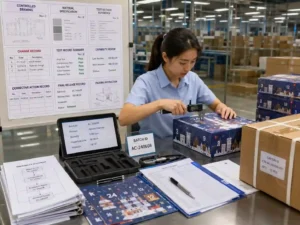
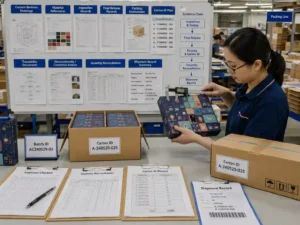
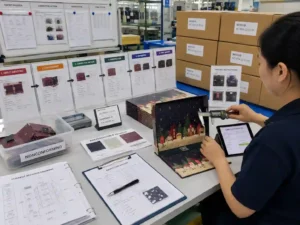
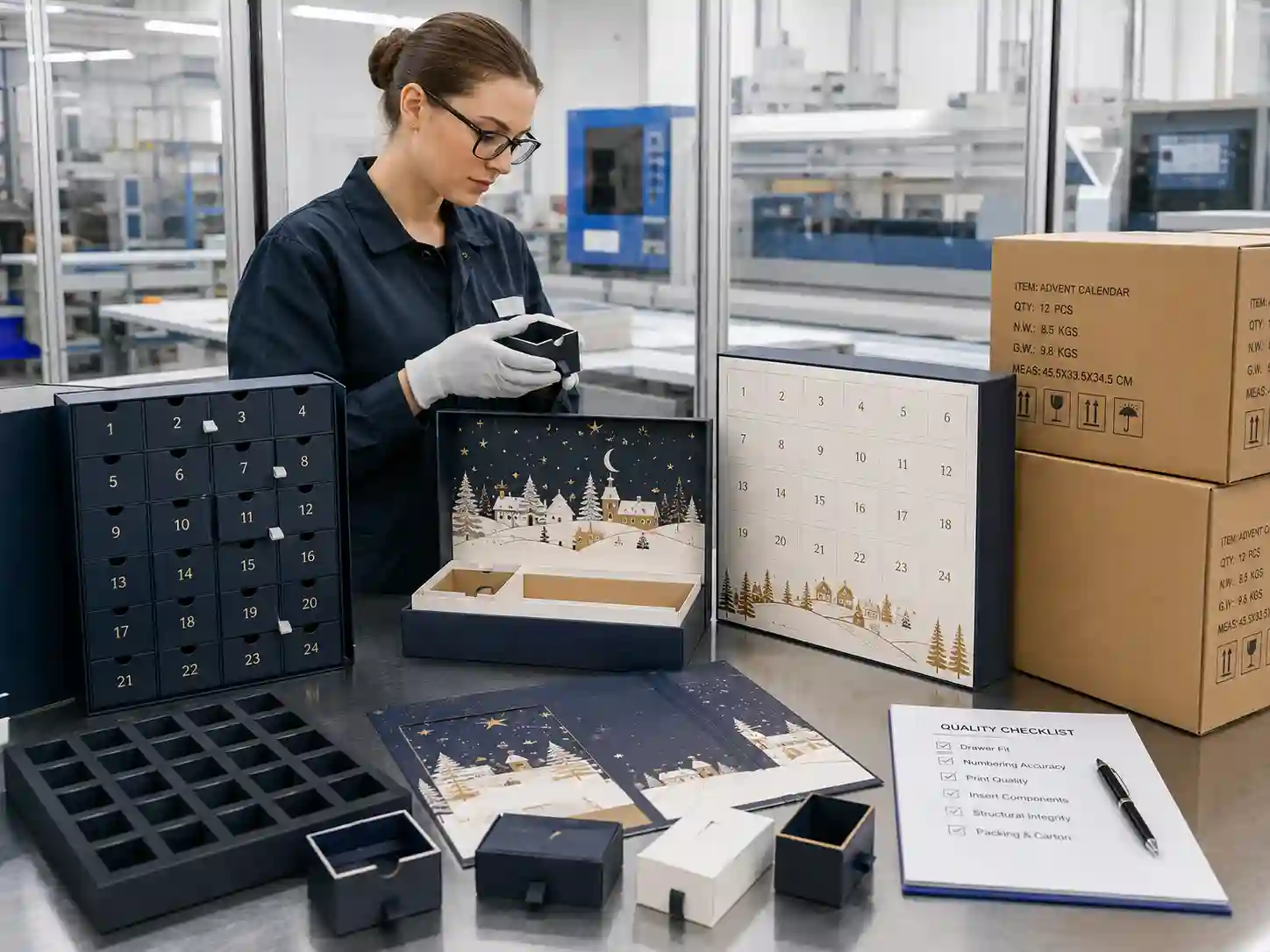
Quality control should be planned before bulk production starts. The goal is not only to inspect finished boxes. It is to prevent mistakes in structure, printing, fitting, loading, and packing.
Useful quality checks include material confirmation, dieline review, color checking, surface finishing review, insert fit testing, drawer sliding test, door opening test, glue strength check, carton packing test, and final random inspection.
For drawer calendars, test whether every drawer opens and closes properly. For door-opening styles, test the perforated windows. For rigid boxes, check corner wrapping, glue marks, board warping, and closure alignment. For all structures, check whether the product remains stable after handling.
| Project Stage | What to Check | Why It Matters |
|---|---|---|
| Dieline stage | Product layout, fold lines, safe zones, opening direction | Prevents artwork and structure errors before sampling |
| Sample stage | Product fit, drawer movement, door opening, insert support | Confirms the calendar works before bulk production |
| Pre-production stage | Material, print color, finishing, carton plan | Reduces mismatch between sample and bulk order |
| Final inspection | Assembly quality, surface defects, packing, labeling | Helps protect retail presentation and export delivery |
Plan Export Packing and Seasonal Timing Early
Seasonal packaging has a hard deadline. A delay in artwork, sampling, material approval, or product loading can affect the full launch plan. This is especially important for Christmas, holiday campaigns, beauty launches, and promotional gift programs.
Ask your supplier how the calendars will be packed for export. Important details include inner bag use, carton quantity, carton dimensions, carton weight, protective materials, pallet suggestions, and outer carton marks. If the calendar has many small drawers or fragile components, export packing should be tested carefully.
Seasonal retail planning should also include buffer time for sample revision, artwork correction, material purchasing, bulk production, inspection, shipping, customs clearance, and local distribution. Do not wait until the final artwork is perfect before discussing production feasibility with your supplier.
What to Send for an Accurate Quotation
A clear quotation request saves time. Instead of asking only for a general price, prepare the project information that affects structure, cost, and delivery planning.
- Target box structure, such as drawer style, door-opening style, rigid box, or foldable paperboard box
- Product list with size, weight, and quantity for each compartment
- Target order quantity and possible reorder plan
- Reference photos or sketches showing the expected style
- Artwork status, including whether a dieline is needed
- Material preference, such as white card, kraft paper, grey board, or specialty paper
- Surface finishing requirements, such as lamination, foil stamping, embossing, or spot UV
- Insert preference, such as paperboard, molded pulp, EVA, foam, or PET tray
- Retail labeling, barcode, or export carton mark requirements
- Target delivery window and destination country
If you are not sure which structure is best, send the product details first and ask the Giftpackpro packaging factory team to review the packaging direction. For an early budget estimate, you can also request a custom quote with photos and product dimensions.
How to Compare Advent Calendar Box Suppliers
Supplier comparison should include more than unit price. A low price may not help if the structure is weak, the sample is inaccurate, or the factory cannot handle the loading and export packing requirements.
When comparing suppliers, check whether they ask practical questions. A capable supplier should care about product size, insert design, artwork, structure, material, sample approval, production method, and packing plan. If a supplier gives a final price without asking for key details, the quotation may not be reliable.
Also compare communication speed, technical feedback, sample quality, and ability to explain production risks. For custom advent calendar boxes, small structure mistakes can create large problems during assembly or shipping.
FAQ About Custom Advent Calendar Boxes
What information should I prepare before ordering custom advent calendar boxes?
Prepare the product sizes, product weights, target quantity, preferred structure, artwork status, material preference, insert requirements, and destination country. Reference photos are also useful, but the final design should be adjusted to your products and retail plan.
Can I customize the drawer count or door count?
Yes, the count can usually be customized based on your campaign. Common projects may use 12, 24, or 25 compartments, but the best layout depends on product size, structure, and brand concept.
What affects the MOQ for advent calendar boxes?
MOQ can be affected by structure, material, printing, finishing, insert type, and assembly complexity. Some projects are usually around 300-500 pcs depending on structure, but buyers should confirm the exact MOQ after sharing project details.
Do I need a physical sample before bulk production?
Yes. A physical sample is strongly recommended because it confirms product fit, drawer or door function, artwork placement, material feeling, and packing method before bulk production starts.
Can the supplier help create the dieline?
Many custom packaging suppliers can prepare a dieline after reviewing the product sizes and structure. The buyer or designer can then place artwork on the dieline with bleed, safe zones, and fold lines in mind.
How early should brands start seasonal advent calendar packaging projects?
Start as early as possible because structure confirmation, sampling, artwork revision, production, inspection, export shipping, and local distribution all take time. Seasonal packaging has less room for late changes.
Need Custom Advent Calendar Boxes?
If your brand is planning a seasonal retail launch, promotional gift set, beauty calendar, food calendar, or premium countdown packaging project, Giftpackpro can help you review structure, inserts, artwork, sampling, and export packing requirements. Share your product sizes, target quantity, preferred style, and delivery plan to request a custom quote.