
Cosmetic Advent Calendar Boxes: Custom Packaging Guide for Brands
Cosmetic advent calendar boxes are not simple seasonal gift boxes. For beauty brands, retailers, wholesalers, and purchasing teams, they need to protect multiple SKUs, present a premium unboxing experience, support accurate artwork, and remain practical for bulk production and export shipping.
This guide explains how to plan custom cosmetic advent calendar packaging from structure and inserts to CMYK printing, Pantone color control, lamination, foil stamping, embossing, spot UV, artwork checks, sampling, quality control, and quotation preparation.
Why Cosmetic Advent Calendar Boxes Need Early Packaging Planning
A cosmetic advent calendar usually contains many small products in one set, such as lip balm, mini perfume, skincare tubes, cream jars, beauty tools, trial-size bottles, masks, or sample sachets. Each item may have a different height, weight, surface finish, and fragility level. If the structure is planned too late, the final box can look attractive but fail during packing, retail handling, or export transportation.
For B2B buyers, early packaging planning helps control four important areas: product fit, visual consistency, production cost, and lead time. A buyer who prepares product dimensions, artwork files, finish requirements, and target order quantity before asking for a quote will usually receive a more accurate proposal.
Giftpackpro works as a custom advent calendar boxes manufacturer for overseas brands, gift companies, retail buyers, and purchasing teams that need custom structures, printed artwork, inserts, samples, and bulk production support.
Common Structures for Cosmetic Advent Calendar Boxes
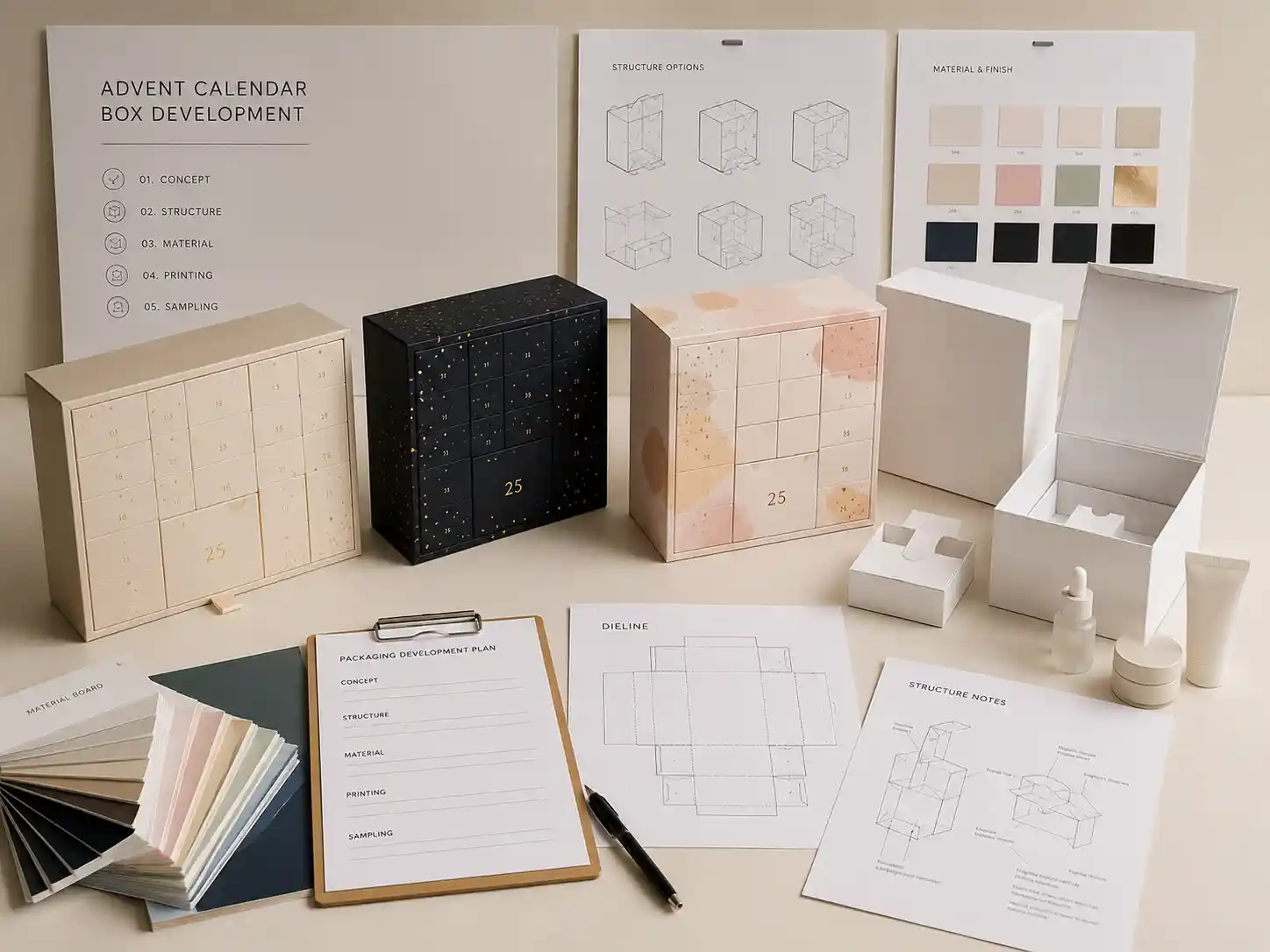
The structure of cosmetic advent calendar boxes should match the product mix, retail price level, shipping method, and assembly plan. A premium skincare calendar may need a rigid drawer structure, while a lighter makeup sample calendar may use a paperboard door-opening structure or folding carton style.
Drawer-Style Cosmetic Advent Calendar Boxes
Drawer-style calendar boxes are common for premium cosmetic gift sets. Each drawer can hold one product or a small product group. The structure gives a strong unboxing experience and helps keep products separated. It is suitable for skincare jars, mini bottles, fragrance samples, lip products, and beauty tools.
For quotation, buyers should confirm the number of drawers, drawer size, outer box dimensions, material thickness, pull ribbon or finger notch style, insert requirements, and whether the box will be shipped flat or assembled.
Door-Opening Cosmetic Advent Calendar Boxes
Door-opening structures use numbered windows or panels that the customer opens one by one. This style is often used for lighter products such as sachets, small tubes, compact samples, mini makeup items, or promotional beauty kits. It can reduce packaging weight compared with a full rigid drawer structure.
The key challenge is product positioning. If items move behind the doors, the customer experience can feel poor. Paperboard inserts, molded pulp inserts, EVA foam, or blister-style inner support may be needed depending on the product type.
Book-Style and Magnetic Closure Structures
Book-style cosmetic advent calendar boxes are suitable for premium retail presentation. They can include a magnetic closure, ribbon, inner trays, or layered compartments. This structure is often chosen when the brand wants a strong front-cover design and a reusable gift-box feeling.
Because magnetic closure, thicker greyboard, specialty paper, and added inserts increase cost, the quotation should separate structure cost, printing cost, finishing cost, insert cost, and assembly cost.
Insert Planning for Cosmetic Products
Inserts are one of the most important details for cosmetic advent calendar boxes. Cosmetic products often include glass, plastic, aluminum, paper tubes, caps, pumps, brushes, and small accessories. The insert must hold each item securely while still allowing convenient packing and removal.
| Product Type | Common Insert Option | Key Packaging Note |
|---|---|---|
| Mini skincare jars | Paperboard tray, EVA, or molded pulp | Check diameter, cap height, and weight distribution. |
| Fragrance samples | EVA, foam, or shaped paperboard support | Confirm glass protection and movement control. |
| Lip balm or lipstick | Paperboard divider or die-cut insert | Keep the product upright and easy to remove. |
| Beauty tools | Custom paperboard compartment | Allow enough space for irregular shapes. |
| Sachets and masks | Flat pocket, sleeve, or paperboard slot | Avoid over-tight slots that slow down assembly. |
For buyers comparing custom advent calendar box products, it is useful to review not only the outside shape but also the insert method. A beautiful exterior will not solve loose product fit, poor packing speed, or high damage risk.
Printing Options: CMYK, Pantone, and Brand Color Control
Cosmetic packaging depends heavily on color accuracy. A beauty brand may use soft nude tones, clean white backgrounds, metallic accents, pastel gradients, or strong seasonal colors. If the color changes between sample and bulk production, the final packaging may not match the brand’s retail display plan.
CMYK Printing for Full-Color Cosmetic Calendar Boxes
CMYK printing is suitable for full-color artwork, product illustrations, gradients, lifestyle graphics, and complex patterns. It is commonly used for outer covers, sleeves, drawers, door panels, and printed inserts.
When preparing artwork, buyers should provide print-ready files with proper bleed, dieline layers, embedded images, outlined fonts, and high-resolution graphics. Low-quality images or files without bleed can delay sampling and production.
Pantone Color Matching for Brand Consistency
Pantone spot colors are useful when a brand requires a specific logo color, background color, or signature packaging tone. For cosmetic advent calendar boxes, Pantone control is often used for brand colors, luxury accent colors, or clean minimalist packaging systems.
Buyers should understand that paper type, lamination, coating, and lighting can affect the final color appearance. A printed color proof is more useful than judging color only from a screen.
Color Proofing Before Bulk Production
Color proofing helps the buyer check print color, logo size, text placement, barcode position, number design, and finish effect before bulk production. For high-value cosmetic calendar projects, it is practical to approve a physical sample or printed proof before confirming mass production.
Giftpackpro can support buyers through custom advent calendar box services including structure discussion, artwork review, sample development, and production coordination.
Finishing Options for Premium Cosmetic Advent Calendar Packaging
Finishing can improve shelf appeal, but it should be selected with the full packaging structure in mind. Too many finishes can increase cost and production complexity. A clean design with one or two well-placed effects often looks more professional than an overloaded surface.
Lamination: Matte, Gloss, and Soft-Touch
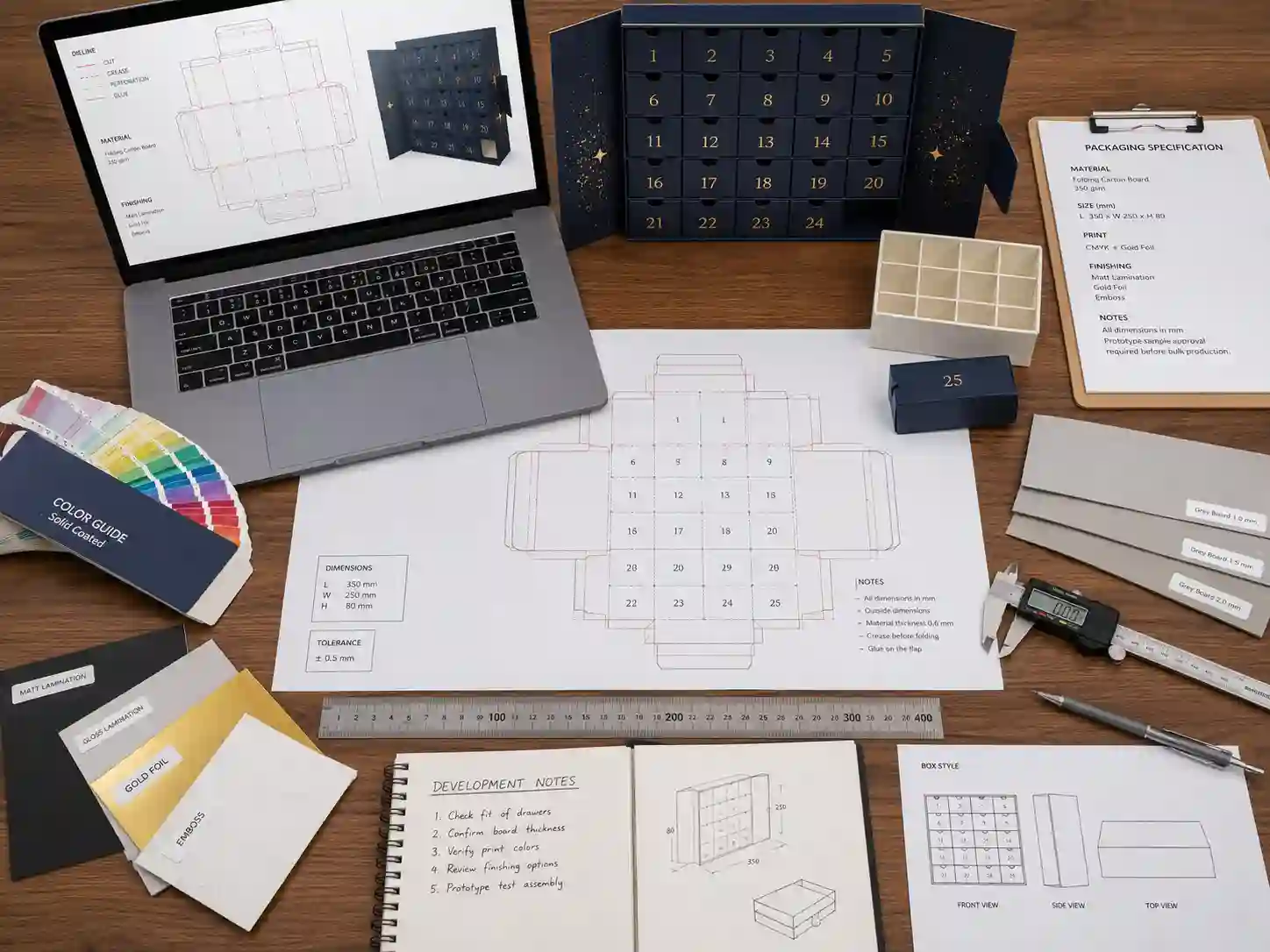
Lamination protects the printed surface and changes the hand feel of the box. Matte lamination is widely used for premium cosmetic packaging because it reduces glare and gives a refined appearance. Gloss lamination can make colors appear brighter. Soft-touch lamination creates a smooth, velvet-like feel, often used for higher-end beauty gift sets.
Buyers should confirm whether lamination is needed on the outer cover only, on drawers, or across all printed components. This affects quotation and production time.
Foil Stamping for Logo and Accent Details
Foil stamping can highlight brand names, numbers, borders, patterns, or decorative accents. Gold, silver, rose gold, holographic, and custom foil tones are common for cosmetic advent calendar boxes.
For best results, foil areas should not be too thin or too close to fold lines. The artwork file should clearly mark the foil layer, and the supplier should check whether the foil area is suitable for the selected paper and structure.
Embossing and Debossing
Embossing raises part of the design, while debossing presses it inward. These finishes can add a tactile effect to logos, icons, numbers, and decorative patterns. They are often combined with foil stamping for premium cosmetic packaging.
For B2B projects, buyers should ask whether an embossing mold is needed and whether the mold cost is included in the quotation. Mold cost may be a separate item, especially for new custom designs.
Spot UV for Contrast and Detail
Spot UV adds a glossy effect to selected areas. It works well on matte laminated surfaces, where the contrast between matte and gloss can make logos, patterns, or calendar numbers stand out.
Spot UV artwork should be provided as a separate layer. Buyers should avoid extremely small text or very fine lines if the finish needs to stay clean during production.
Artwork Checks Before Sampling
Artwork problems are one of the most common reasons for sample delays. Before sending artwork to a factory, buyers should check dieline alignment, bleed, color mode, fonts, image resolution, finish layers, barcode area, product claims, and legal text.
A practical artwork checklist for cosmetic advent calendar boxes includes:
- Outer box size and dieline confirmed.
- Drawer, door, tray, or insert layout confirmed.
- All fonts outlined or packaged.
- CMYK and Pantone colors clearly marked.
- Foil, embossing, debossing, and spot UV layers separated.
- Bleed added to all printed edges.
- Calendar numbers checked for order and position.
- Barcode, warning text, ingredient references, or product labels checked by the brand team.
- Sample approval process and final sign-off contact confirmed.
If the project uses FSC-certified materials, buyers can review official information from the Forest Stewardship Council. For quality management expectations, some buyers also reference ISO 9001 quality management when discussing supplier systems and inspection control.
Sample Development Process for Cosmetic Advent Calendar Boxes
Sample development helps confirm structure, insert fit, printing, finishes, and assembly before bulk production. For cosmetic advent calendar boxes, a white sample may be used first to test structure and product fit. A printed sample can then be used to check color, artwork, lamination, foil stamping, embossing, spot UV, and overall presentation.
White Sample
A white sample focuses on structure. It is useful for checking size, opening method, drawer movement, door tearing, insert fit, and product placement. It is usually faster and more cost-effective than a full printed sample.
Printed Sample
A printed sample helps the buyer review the full packaging appearance. It is useful for confirming color, logo position, surface finish, paper texture, and user experience. For premium cosmetic calendars, a printed sample is often the most important approval step before mass production.
Pre-Production Sample
A pre-production sample is closer to the final bulk production standard. It should use the approved material, printing method, finish, insert, and assembly method. This sample can become the reference standard for quality inspection.
Buyers who need step-by-step planning can review more advent calendar box buying guides to prepare structure details, artwork files, and quote information before starting a custom project.
MOQ, Lead Time, and Bulk Production Factors
The MOQ for cosmetic advent calendar boxes depends on structure, size, material, printing method, finish, and assembly complexity. A simple folding structure may have a lower starting quantity than a rigid drawer-style calendar with multiple finishes and custom inserts.
Lead time also depends on the approval speed. If artwork files are complete and the sample is approved quickly, production can move forward more smoothly. If artwork, product dimensions, or insert details change after sampling, the timeline may need to be adjusted.
Factors That Affect Lead Time
- Number of components, such as drawers, trays, sleeves, doors, inserts, and outer cartons.
- Printing complexity, including CMYK, Pantone, and double-sided printing.
- Finishing requirements, such as foil stamping, embossing, debossing, spot UV, and soft-touch lamination.
- Insert material and fit testing.
- Sample revision rounds.
- Assembly method and packing requirements.
- Export carton, pallet, and shipping mark requirements.
For larger seasonal retail projects, buyers should not wait until the last moment to confirm packaging. Cosmetic advent calendar boxes usually require more coordination than standard single-product boxes because there are multiple SKUs, multiple compartments, and more approval points.
Quality Control for Cosmetic Advent Calendar Packaging
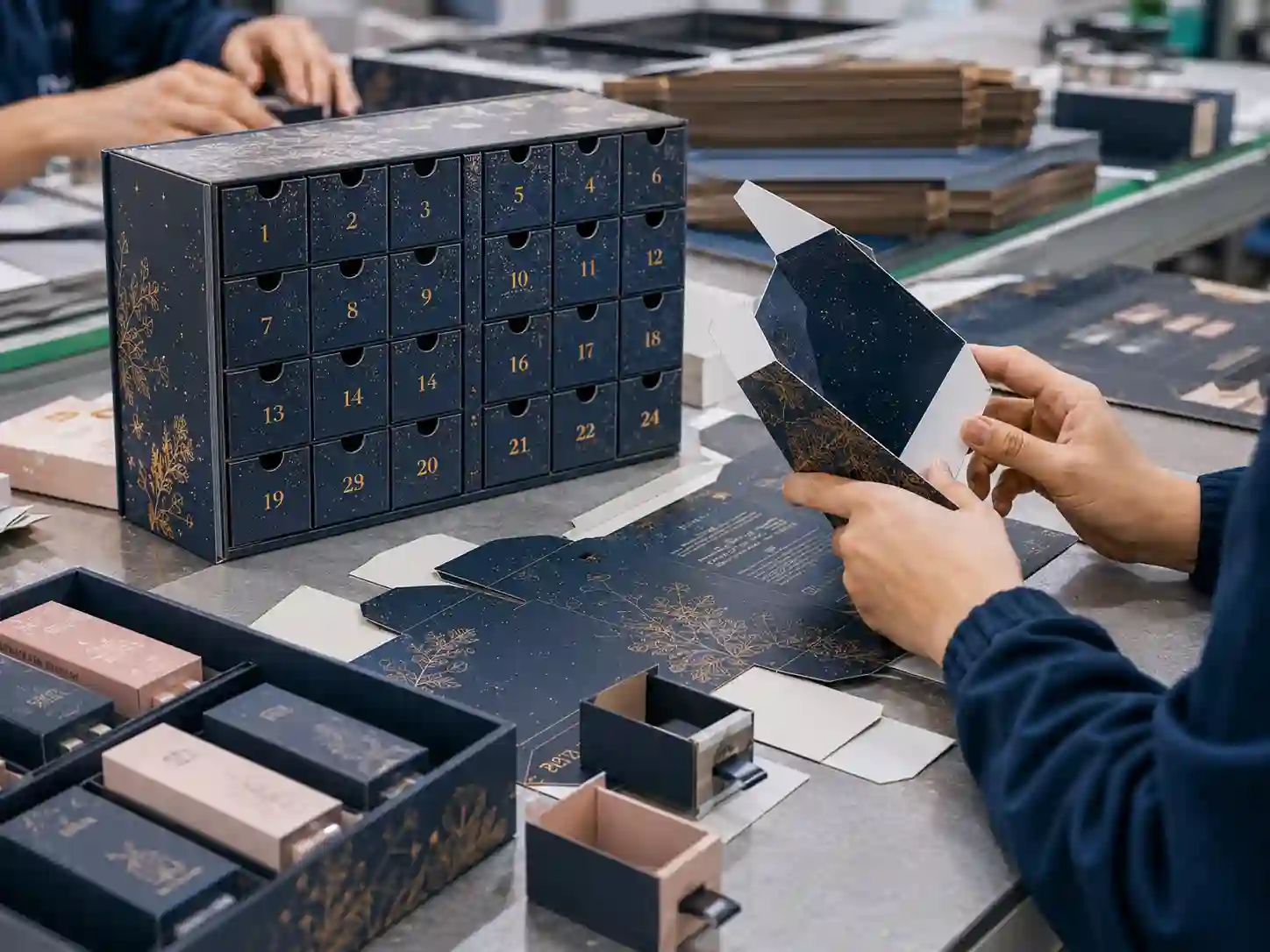
Quality control should cover both appearance and structure. A cosmetic calendar box may pass visual inspection but still fail if drawers are tight, doors tear poorly, inserts do not hold products, or the box is difficult to assemble.
Key QC Points
- Outer dimensions and compartment dimensions.
- Printing color consistency against approved proof.
- Logo placement, calendar number order, and text accuracy.
- Lamination surface, scratches, bubbles, glue marks, and edge quality.
- Foil stamping, embossing, and spot UV registration.
- Drawer movement, door opening, magnet position, and ribbon fixing.
- Insert fit and product movement control.
- Carton packing, shipping marks, and export protection.
As a Giftpackpro packaging factory, Giftpackpro pays attention to structure development, material selection, printing checks, sample approval, production inspection, and export packing details for custom seasonal paper packaging projects.
Export Packing and Shipping Considerations
Export packing should protect the finished boxes during storage, handling, and transportation. Cosmetic advent calendar boxes may be shipped flat, semi-assembled, or fully assembled depending on the structure and buyer’s packing plan.
Flat packing can reduce shipping volume, but it may require more labor at the buyer’s side. Fully assembled packing can save retail preparation time, but it increases carton volume and may need stronger outer protection. The best option depends on order quantity, labor cost, retail schedule, and product packing plan.
Information to Confirm for Export Packing
- Flat packed, semi-assembled, or fully assembled delivery.
- Number of pieces per master carton.
- Carton size and estimated gross weight.
- Pallet requirements, if needed.
- Shipping marks, barcode labels, and carton labels.
- Moisture protection or corner protection requirements.
- Inspection standard before shipment.
How to Prepare a Quote Request
A clear quote request saves time and reduces back-and-forth communication. For cosmetic advent calendar boxes, buyers should prepare product information, packaging goals, artwork requirements, finish expectations, and order details before asking for pricing.
Useful quote information includes:
- Target box style, such as drawer, door-opening, book-style, or folding carton structure.
- Overall box size or target retail shelf size.
- Product list with size, weight, and quantity for each item.
- Insert preference, such as paperboard, EVA, foam, molded pulp, or custom divider.
- Printing requirements, including CMYK, Pantone, or both.
- Finishing requirements, such as matte lamination, foil stamping, embossing, debossing, or spot UV.
- Sample requirement and target approval date.
- Bulk order quantity and expected delivery date.
- Export packing method and destination country.
When this information is ready, buyers can request a custom quote with fewer revisions. The supplier can then evaluate structure, material, printing, finishing, insert, sampling, production, and export packing more accurately.
Final Thoughts for Cosmetic Brands and Retail Buyers
Cosmetic advent calendar boxes should be planned as a complete packaging system, not only as a printed outer box. The structure must fit the product mix, the insert must hold each item securely, the artwork must be print-ready, and the finish choices must match the brand’s retail position.
For B2B buyers, the most practical approach is to confirm the product list first, choose the structure second, then move into artwork, color proofing, sample approval, production, QC, and export packing. This process helps reduce delays and keeps the final packaging closer to the approved design.
Giftpackpro supports custom seasonal paper packaging projects from structure planning to sample development and bulk production. Buyers can review available custom advent calendar box services, compare custom advent calendar box products, read more advent calendar box buying guides, or request a custom quote for a specific cosmetic calendar project.


