Choosing between CMYK and Pantone printing affects color accuracy, sample approval, bulk production control, and final shelf presentation. For B2B buyers ordering custom seasonal packaging, the decision is not only about color preference. It also affects artwork setup, proofing, quality inspection, insert matching, and production cost.
This guide explains CMYK vs Pantone advent calendar boxes from a production and quality control point of view. It is written for overseas brands, wholesalers, gift companies, retail buyers, and purchasing teams preparing custom advent calendar box projects for bulk production.
What CMYK and Pantone Mean in Advent Calendar Box Printing
CMYK printing uses four process colors: cyan, magenta, yellow, and black. These inks are printed in tiny dot patterns to create full-color images, gradients, product illustrations, and photographic artwork. It is widely used for seasonal packaging because it supports rich visual designs and efficient mass production.
Pantone printing uses pre-defined spot colors. A Pantone color is usually mixed as a specific ink formula and printed as a separate color. It is useful when a brand needs a more consistent logo color, corporate color, or premium design element across different batches and packaging formats.
For many custom advent calendar projects, buyers do not need to choose only one method. A common solution is CMYK for the main artwork and Pantone spot color for the logo, key brand color, metallic-style accent, or important visual panel.
Why Printing Choice Matters for Custom Advent Calendar Boxes
An advent calendar box is more complex than a flat card or simple folding carton. It may include drawers, doors, trays, inner dividers, rigid board, printed wrap paper, laminated surfaces, and multiple visible panels. Small color differences can become more noticeable when several parts are assembled together.
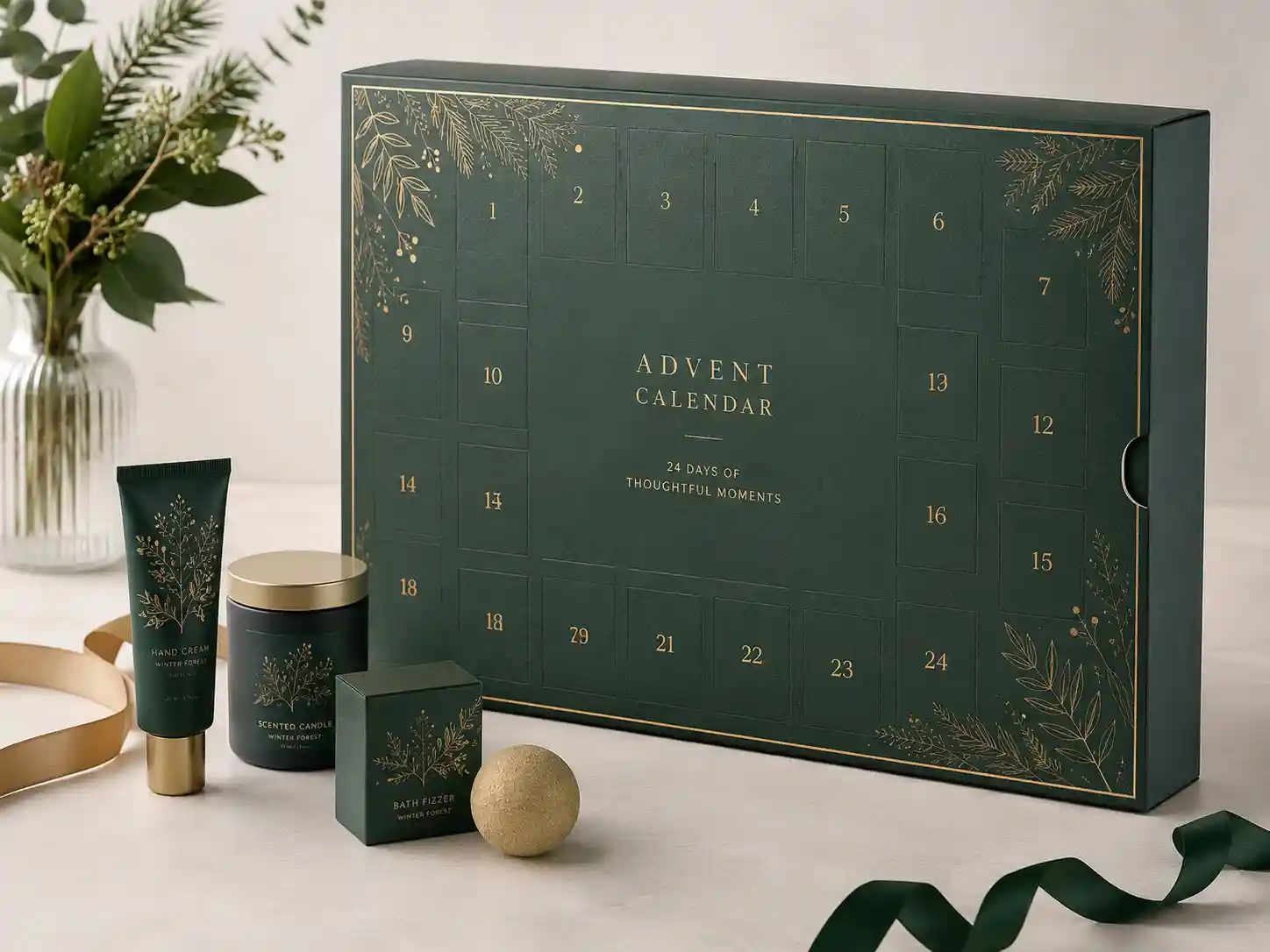
For example, a drawer-front calendar box may have 24 or 25 small printed drawers. If the color is not controlled properly, drawer panels may look slightly different from the outer frame. A book-style calendar box may also show color variation between the cover, spine, inner spread, and insert area.
That is why printing decisions should be discussed during the structure and artwork stage, not after the sample is already approved. Giftpackpro supports buyers through custom advent calendar box services that include structure planning, artwork checking, sampling, production inspection, and export packing coordination.
CMYK vs Pantone Advent Calendar Boxes: Practical Comparison
| Item | CMYK Printing | Pantone Printing | B2B Buyer Notes |
|---|---|---|---|
| Best use | Full-color artwork, patterns, gradients, product images | Brand logos, fixed corporate colors, solid color blocks | Use CMYK for visual richness and Pantone for strict brand color control. |
| Color consistency | Good, but may vary slightly by material, lamination, and press setting | Usually stronger consistency for specific solid colors | Always approve a printed sample before bulk production. |
| Cost impact | Efficient for standard full-color printing | May add cost when extra spot colors are required | Confirm color requirements before requesting quotation. |
| Artwork complexity | Suitable for detailed seasonal graphics and lifestyle visuals | Better for clean brand elements and controlled color areas | Mixed printing can be a balanced option for retail packaging. |
| QC focus | Dot gain, image sharpness, gradient smoothness, color balance | Spot color match, ink density, logo accuracy, registration | Inspection should compare bulk output with the approved sample. |
When CMYK Is the Better Choice
CMYK is often the practical choice for advent calendar boxes with colorful seasonal artwork, product category illustrations, gift set visuals, or retail campaign graphics. If the box design includes multiple colors, soft shadows, patterns, or lifestyle images, CMYK is usually more flexible.
Example: Beauty Advent Calendar Packaging
A cosmetics brand may want soft gradients, floral patterns, product silhouettes, and decorative background details. CMYK can reproduce these effects efficiently on printed wrap paper, drawer fronts, and outer panels. In this case, the buyer should pay attention to skin-tone style colors, pastel color shifts, and matte lamination effects.
Example: Snack or Candy Advent Calendar Box
A snack calendar may need bright colors, illustrated product icons, and playful seasonal artwork. CMYK helps create a rich retail look without preparing many separate spot colors. However, buyers should still check whether important brand colors need Pantone support.
If you are still comparing structures and printable areas, reviewing custom advent calendar box products can help your team understand how artwork changes between drawer style, door style, rigid style, and folding style calendar boxes.
When Pantone Is the Better Choice
Pantone is useful when the buyer has a strict brand color standard. This is common for established retail brands, beauty companies, corporate gift suppliers, and promotional campaigns where packaging must match other branded materials.
Example: Logo Color Control
If a brand logo must remain the same across paper bags, gift boxes, counter displays, inserts, and advent calendar packaging, Pantone printing may be the safer choice for the logo area. CMYK can be close, but a spot color is often easier to control for solid brand colors.
Example: Premium Minimalist Packaging
Some advent calendar boxes use a simple design: one background color, one logo, and limited decoration. In this case, Pantone can create a clean and stable appearance, especially for solid color panels. Buyers should still consider board material, lamination, and surface texture because they can change how the final color appears.
Combining CMYK and Pantone for Better Production Control
Many B2B projects use both methods. The main packaging artwork may be printed in CMYK, while the logo or key brand color uses Pantone. This gives the buyer visual flexibility without sacrificing important brand consistency.
For example, a 24-drawer advent calendar box can use CMYK for the decorative outer scene and Pantone for the brand logo on the top header. A rigid book-style advent calendar can use CMYK for the inner pattern and Pantone for the cover logo or campaign color.
When requesting a quote, buyers should clearly state whether Pantone spot colors are required. If not stated early, the factory may quote based on standard CMYK printing, and the price or lead time may need to be adjusted later.
Artwork Preparation Before Production
Good printing starts before the press is running. Artwork files should be checked carefully during the pre-production stage. For advent calendar boxes, the artwork must match the dieline, drawer layout, folding lines, glue areas, spine direction, and insert structure.
Artwork Checks Buyers Should Prepare
Before sending files to Giftpackpro, prepare editable artwork files when possible. Include CMYK settings, Pantone color codes, logo files, fonts or outlined text, dieline references, and any special finishing instructions such as matte lamination, gloss lamination, foil stamping, embossing, or spot UV.
Buyers should also mark which colors are critical. Not every color needs strict control. A logo color, campaign color, or large solid background may need closer checking than small decorative artwork.
For international buyers, it is also useful to confirm whether the product category has special requirements, such as recycling marks, importer information, country-specific labels, or FSC-related claims. Buyers can check official responsible sourcing information from FSC when using certified paper materials or making FSC-related packaging claims.
Printed Sample Approval: What to Check
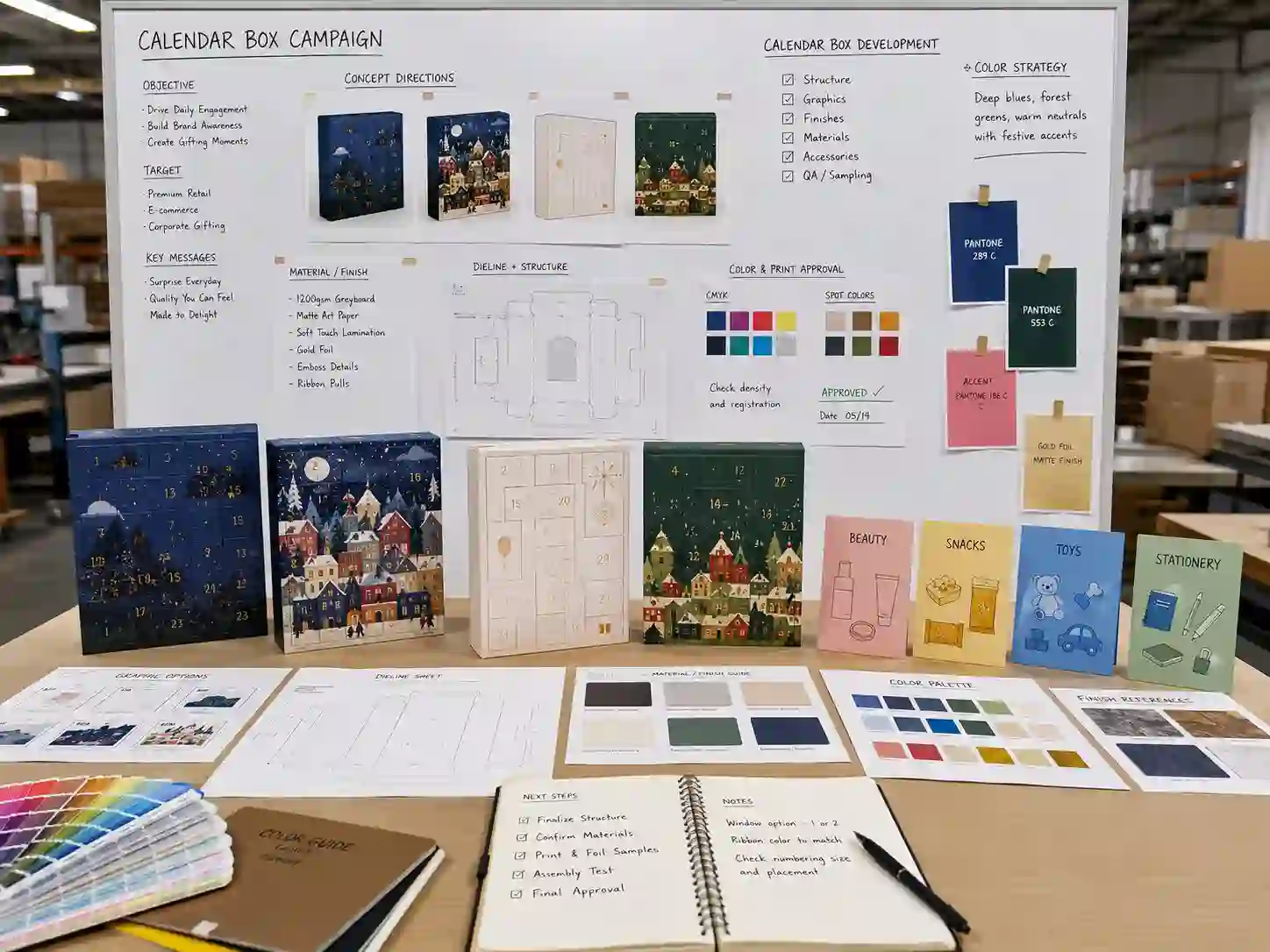
The printed sample is the most important reference before bulk production. It should not be reviewed only as a nice-looking box. It should be checked as a production standard.
Color Review
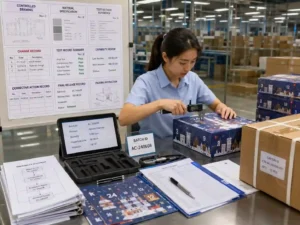
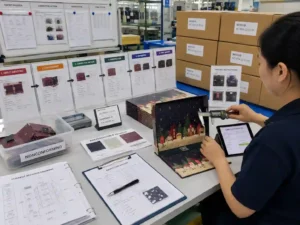
Compare the printed sample with the approved artwork and any brand color reference. Check under neutral lighting. For CMYK printing, look for image sharpness, gradient smoothness, and unwanted color cast. For Pantone printing, compare the spot color area with the requested Pantone reference as closely as possible.
Structure Review
Check whether the printed panels align with the structure. On advent calendar boxes, artwork may cross folding edges, drawer openings, door cuts, or rigid board corners. Misalignment can affect the premium look of the final product.
Insert Fit Review
Insert fit is especially important for calendar boxes with cosmetics, candy, small toys, candles, stationery, or mixed gift items. The insert should hold products securely without making the box difficult to assemble or open. If the insert is too tight, workers may damage printed panels during assembly. If it is too loose, products may move during export shipping.
Buyers can use the advent calendar box buying guides section to plan structure, material, printing, and production questions before approving samples.
Bulk Production Steps for Custom Advent Calendar Boxes
After sample approval, the production process usually moves through material preparation, printing, surface finishing, mounting, die cutting, assembly, insert fitting, inspection, packing, and export carton preparation. Each step can affect the final appearance and durability.
1. Material Preparation
Paper, greyboard, corrugated board, printed paper, and insert materials must match the approved specification. If the material changes, the printing result may also change. A matte paper surface may absorb ink differently from coated paper, and lamination can make colors look darker or glossier.
2. Printing and Color Control
During printing, the factory checks color density, registration, ink coverage, and print clarity. For CMYK vs Pantone advent calendar boxes, the inspection focus is slightly different. CMYK requires balance across four process colors, while Pantone requires accurate spot color control.
3. Surface Finishing
Matte lamination, gloss lamination, soft-touch film, foil stamping, embossing, debossing, and spot UV can change the final appearance. Buyers should not approve printing without considering finishing. A Pantone color may look different after matte lamination, and CMYK artwork may appear more muted under some films.
4. Die Cutting and Creasing
Accurate die cutting is critical for doors, drawers, windows, inserts, and folding panels. Poor cutting can cause rough edges, weak corners, or poor drawer movement. Creasing must also be controlled so the paper does not crack when folded.
5. Assembly and Insert Placement
Assembly workers must follow a clear standard. Drawer boxes need smooth sliding. Door-style calendars need clean opening lines. Rigid calendar boxes need straight edges and tight wrapping. Insert trays must be positioned correctly so the products fit without pressure damage.
Giftpackpro provides custom advent calendar boxes manufacturer support for B2B buyers who need structure development, printed samples, bulk production, and packaging coordination from one supplier.
Quality Control Points for Printing and Assembly
Quality control should not happen only at the end. It should be built into each production stage. For custom advent calendar boxes, printing accuracy and structural consistency are equally important.
Printing QC Checklist
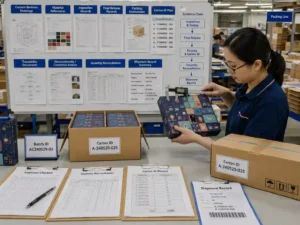
Printing inspection should compare bulk sheets with the approved sample. The team should check color consistency, print registration, text sharpness, barcode clarity if used, logo position, ink spots, scratches, and surface defects. For Pantone areas, the inspection should focus on solid color stability and brand color match.
Assembly QC Checklist
Assembly inspection should check drawer movement, door opening, panel alignment, glue strength, corner strength, insert position, product cavity size, and finished box appearance. A box may pass printing QC but still fail assembly QC if the structure is not controlled.
Durability Checks
Durability matters because advent calendar boxes often include many compartments and may be shipped internationally. The finished box should be checked for compression resistance, corner strength, drawer pull strength, insert stability, and carton packing protection.
For quality management language and general system standards, buyers can review official information from ISO 9001 quality management. Packaging buyers can use this as a reference when discussing factory quality systems, inspection procedures, and production traceability.
Export Packing Control for Advent Calendar Boxes
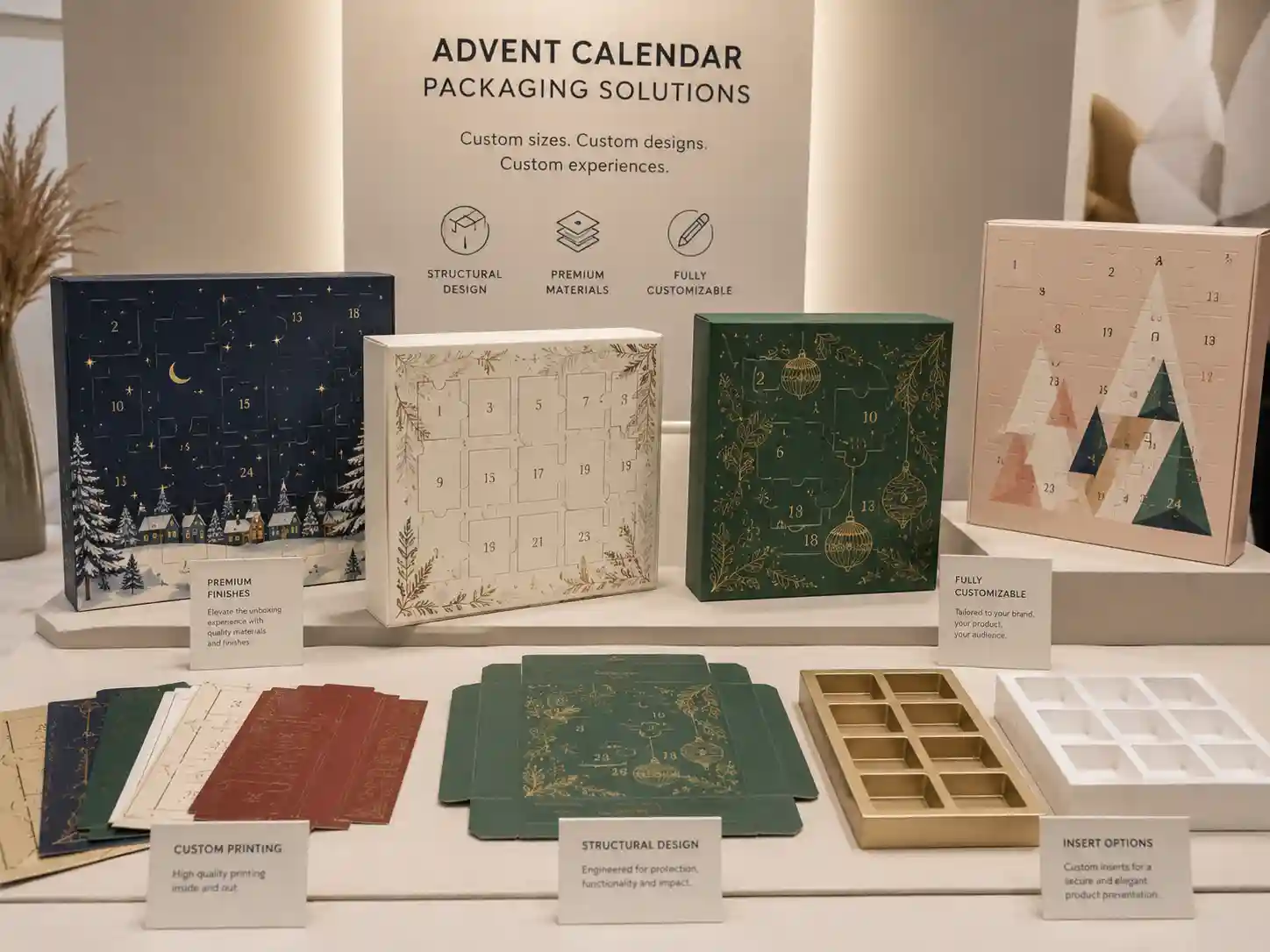
Export packing is part of product quality. A well-printed calendar box can still arrive damaged if carton packing is weak. For rigid advent calendar boxes, the factory should consider corner protection, carton strength, packing direction, moisture protection, and pallet requirements if needed.
For boxes with drawers or inserts, buyers should confirm whether the boxes are shipped assembled, flat-packed, or semi-assembled. The packing method affects carton size, freight cost, assembly labor, and damage risk.
Giftpackpro usually discusses export packing during quotation and sampling because the packing method can affect both landed cost and product safety. Buyers can learn more about the factory background through the Giftpackpro packaging factory page.
Quote Preparation Advice for B2B Buyers
A clear RFQ helps the supplier quote faster and more accurately. For CMYK vs Pantone advent calendar boxes, the printing information should be included together with structure, quantity, size, material, inserts, and finishing details.
Information to Send Before Quotation
Send the target box style, size, product quantity per box, product dimensions, estimated order quantity, destination country, expected delivery date, artwork status, printing method, Pantone color codes if required, surface finishing, insert material, and packing preference.
If the artwork is not ready, send a reference design direction and explain the brand color requirements. The supplier can still estimate structure, material, MOQ, sample cost, and lead time, but the final price may change after artwork and finishing are confirmed.
Questions to Ask the Supplier
Ask whether the quote includes printed samples, blank structure samples, Pantone spot colors, lamination, insert development, assembly labor, export cartons, and inspection. Also confirm whether the MOQ changes when adding special printing or finishing.
For buyers preparing a new seasonal launch, it is better to start with a structure sample, then printed sample, then pre-production confirmation. This reduces the risk of changing structure or artwork after bulk production starts.
Final Recommendation: Choose Printing Based on Risk, Not Only Appearance
CMYK is suitable for colorful artwork, product visuals, and flexible seasonal designs. Pantone is useful for strict brand colors, clean logos, and solid color areas that need better consistency. Many custom advent calendar box projects use both methods to balance visual impact and brand control.
The best choice depends on the artwork, structure, insert design, quantity, finishing, and quality standard. Buyers should confirm printing requirements before sampling, review the printed sample carefully, and use the approved sample as the production reference.
If your team is preparing a custom advent calendar packaging project, Giftpackpro can help check structure, inserts, artwork, printing, sampling, MOQ, lead time, production control, and export packing. You can request a custom quote with your artwork, product size, order quantity, and required printing method.