
Quick answer: Beauty advent calendar boxes are custom seasonal packaging solutions used to present multiple cosmetic, skincare, fragrance, makeup, or beauty gift SKUs in one retail-ready set. For B2B buyers, the main decisions are structure, insert material, product fit, artwork proofing, MOQ, finishing, labor, QC, export packing, and quotation details. The safest buying process is to confirm product dimensions first, choose a box structure that matches retail value and assembly budget, test inserts with real samples, approve a pre-production sample, and prepare a clear RFQ before mass production.
For overseas brands, wholesalers, gift companies, retail buyers, Amazon sellers, and purchasing teams, beauty advent calendar boxes are not just decorative gift packaging. They are multi-SKU packaging systems. A single project may include compact palettes, lipstick tubes, mini bottles, jars, brushes, sachets, fragrance vials, or promotional gift items. Each item affects insert design, carton strength, packing method, labor time, and final cost.
Giftpackpro works as a custom advent calendar boxes manufacturer for buyers who need factory-side support on structure, inserts, printing, samples, bulk production, and export packing. This guide explains how to plan custom beauty advent calendar packaging before requesting a quotation.
What should buyers understand before choosing beauty advent calendar boxes?
Buyers should understand that beauty advent calendar boxes combine packaging design, product engineering, manual assembly, printing control, and export logistics. The final unit cost is affected by much more than box size.
A beauty gift set calendar often contains many small products in different shapes and weights. A lipstick tube may be narrow and tall, a compact palette may be flat but fragile, and a mini glass bottle may need anti-movement protection. The packaging supplier must design the outer structure, tray layout, compartments, door opening, inserts, and packing method around the actual products.
Quotable B2B statement: The earlier a buyer confirms product dimensions, weights, and loading sequence, the easier it is to control the cost, sampling time, and defect risk of beauty advent calendar boxes.
Before choosing a supplier or requesting samples, buyers should prepare basic information such as target retail channel, number of compartments, product list, approximate box size, expected order quantity, artwork status, delivery country, and preferred structure. For more planning support, buyers can review advent calendar box buying guides before sending an RFQ.
Which box structure is best for a beauty gift set calendar?
The best structure depends on retail positioning, product weight, MOQ, assembly budget, and presentation requirements. Rigid boxes offer a premium feel, folding cartons are more cost-efficient for lighter sets, drawer boxes create a high-end unboxing experience, and door-opening boxes are practical for classic calendar layouts.
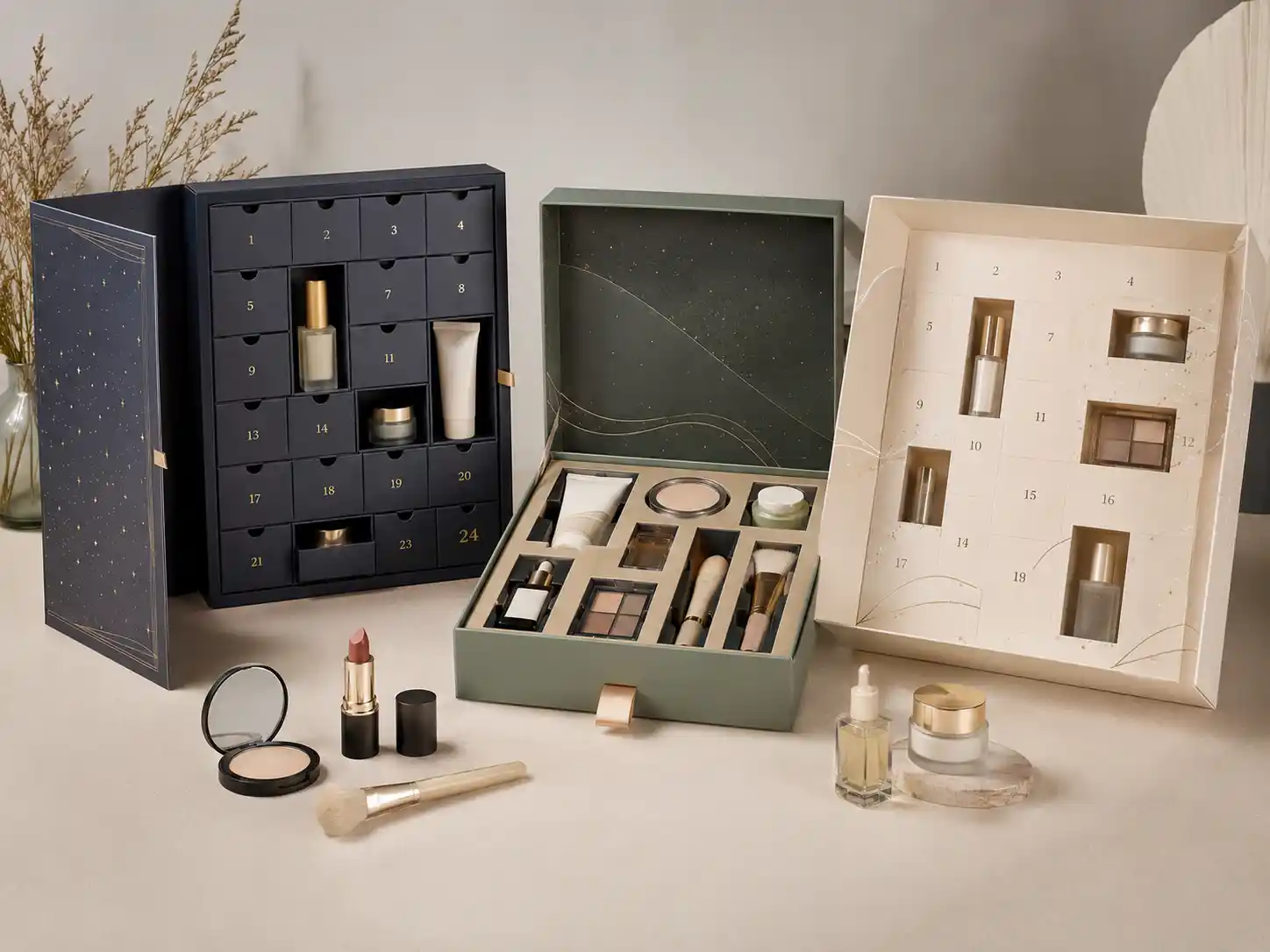
Rigid box: when should buyers choose it?
A rigid box is suitable when the buyer needs a premium retail gift set, stronger shelf presence, and better protection for mixed beauty SKUs. It is often made with greyboard wrapped by printed paper and can support foil stamping, embossing, matte lamination, spot UV, and other premium finishes.
Rigid beauty advent calendar boxes usually cost more because they require thicker board, more wrapping material, more handwork, and longer assembly time. They are a good option for influencer seeding kits, department store promotions, premium e-commerce gift sets, and limited seasonal campaigns where perceived value matters.
Folding carton: when is it more cost-effective?
A folding carton calendar is usually better for lighter products, larger production runs, and campaigns where cost control is more important than rigid luxury presentation. It can be shipped flat in some designs, which may reduce storage and freight volume before assembly.
However, folding carton structures may not be suitable for heavy glass bottles, large palettes, or premium gift sets that require strong structure. Buyers should ask the supplier to check paperboard thickness, locking method, insert support, and compression strength before choosing this option.
Drawer box or door-opening box: which creates better product access?
A drawer box creates a premium opening experience and works well when beauty products are arranged in tiers or rows. A door-opening box is useful when each product should be hidden behind a numbered panel or individual compartment.
Drawer boxes may require tighter tolerance control because the drawer must slide smoothly after printing, wrapping, and packing. Door-opening boxes require accurate die-cutting so doors open cleanly without tearing or revealing the product too early.
| Structure option | Best for | Main cost drivers | Buyer risk to check |
|---|---|---|---|
| Rigid box | Premium beauty gift sets, influencer kits, retail campaigns | Greyboard thickness, wrapping paper, manual assembly, finishing | High unit cost if size, insert, and finishing are over-specified |
| Folding carton | Lightweight sets, cost-sensitive campaigns, larger volumes | Paperboard grade, printing area, die-cutting, insert design | Insufficient strength for fragile palettes or mini bottles |
| Drawer box | Luxury presentation, layered product reveal, gift sets | Board thickness, drawer fitting, wrapping labor, pull ribbon or handle | Drawer too tight or loose after mass production tolerance changes |
| Door-opening box | Classic numbered calendar layout and retail display | Dieline complexity, die-cutting, insert matching, printing registration | Doors tearing, weak perforation, or product visibility before opening |
Buyer tip: Do not choose the most expensive structure automatically. A well-designed folding carton with a strong insert can sometimes perform better than an oversized rigid box with poor product fit.
How do inserts affect product protection and final cost?
Inserts are one of the most important cost and quality decisions for beauty advent calendar boxes. The insert controls product position, opening experience, breakage risk, assembly speed, and how premium the gift set looks after the buyer opens each compartment.
Beauty products are rarely uniform. A calendar may include tubes, palettes, brushes, glass mini bottles, jars, masks, sachets, and accessories. Each SKU needs a different cavity size and removal allowance. If the cavity is too tight, workers may damage the product during assembly. If it is too loose, items may move during shipping and create noise, scratches, or breakage.
Paper insert, PET tray, EVA insert, foam, or molded pulp?
The right insert depends on product fragility, budget, sustainability requirements, visual presentation, and tolerance needs. Paper inserts are widely used for cost control and recyclability. PET trays provide accurate molded cavities and clear product positioning. EVA and foam provide stronger cushioning for fragile or premium items. Molded pulp can support eco-positioning but requires early testing for surface finish and fit.
| Insert type | Advantages | Limitations | Common beauty application |
|---|---|---|---|
| Paper insert | Cost-effective, printable, lightweight, easier to recycle | Less cushioning for glass or heavy items | Lipstick tubes, brushes, sachets, light jars |
| PET tray | Accurate product cavities, neat presentation, good for repeat SKUs | Tooling or forming setup may affect MOQ and cost | Mini bottles, tubes, jars, compact items |
| EVA insert | Premium look, good cushioning, precise fit | Higher material cost and less ideal for low-budget campaigns | Fragile palettes, glass bottles, luxury samples |
| Foam insert | Strong protection and flexible cushioning | May not match eco-focused packaging goals | Glass vials, fragile compacts, delicate gift items |
| Molded pulp insert | Eco-positioning, molded support, natural texture | Surface and tolerance need testing before approval | Skincare jars, bottles, gift accessories |
Factory tip: Insert testing should use real filled products, not only empty bottles or 3D drawings. Product weight changes how the insert performs during drop, vibration, and carton stacking.
What printing and finishing choices matter for beauty calendars?
Printing and finishing choices affect brand consistency, retail appeal, approval time, and defect risk. For beauty gift sets, buyers should pay special attention to CMYK output, Pantone color matching, lamination, foil stamping, embossing, spot UV, and color consistency across different printed parts.
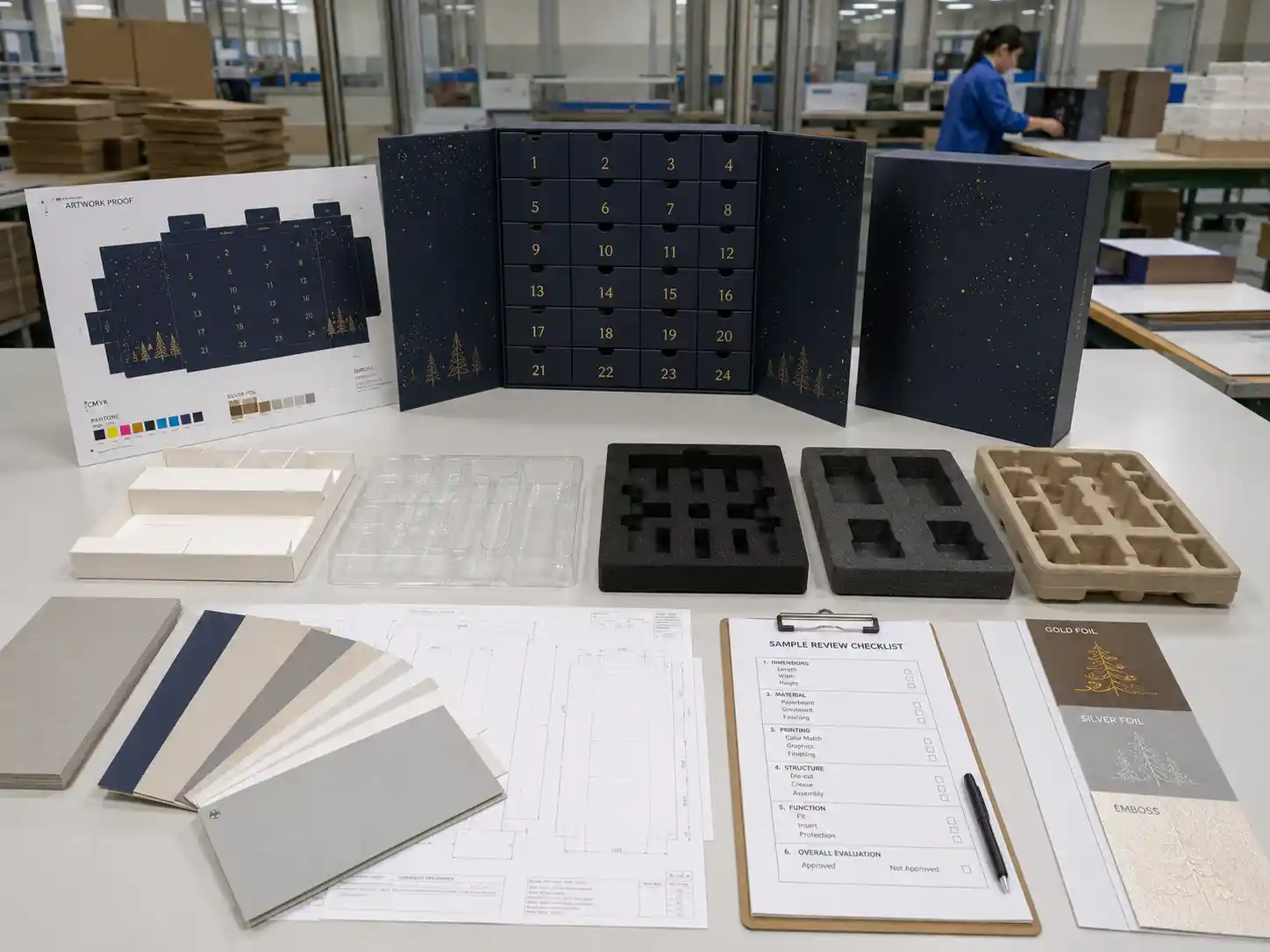
Beauty packaging often has strict visual expectations. A soft nude color, metallic accent, seasonal pattern, or premium matte surface may look different on coated paper, uncoated paper, greyboard-wrapped paper, or folding carton stock. Buyers should confirm artwork proofing requirements before mass production.
How should buyers control color consistency?
Buyers should provide clear artwork files, Pantone references when needed, and approved color proof samples. For repeat orders, the previous approved sample should be available for factory comparison.
CMYK printing is suitable for full-color graphics and seasonal artwork. Pantone color is useful when a specific brand color must be controlled more tightly. However, exact color appearance still depends on paper type, lamination, ink absorption, and lighting conditions.
QC tip: Approve color under consistent lighting and keep a signed sample for mass production comparison. A photo on a phone screen should not be the only approval reference for beauty advent calendar boxes.
Which finishes increase cost and production risk?
Foil stamping, embossing, debossing, spot UV, matte lamination, and gloss lamination can improve perceived value, but each adds production steps, setup cost, and inspection points. The more finishes used on one box, the more important sample approval becomes.
Foil stamping requires accurate positioning, especially on small text or fine lines. Embossing needs suitable paper and enough area to show the raised effect. Spot UV should be checked for registration accuracy. Matte lamination can create a premium surface but may show scratches if export packing is not planned properly.
How do MOQ and cost planning work for beauty advent calendar boxes?
MOQ and unit cost depend on structure, materials, printing, insert type, tooling, labor, packing method, and order quantity. A low unit price is difficult to judge without knowing the complete specification.
Buyers often ask for a price before confirming the product list, box size, insert material, artwork, and shipping method. This usually leads to inaccurate quotations. A reliable supplier will ask for missing details because custom advent calendar boxes have many variable cost points.
What are the main cost drivers?
The largest cost drivers usually include box size, board thickness, printed paper area, insert complexity, number of compartments, finishing process, manual assembly time, packing requirements, and export carton volume. Heavy or fragile beauty products also increase the need for stronger inserts and protective packing.
- Material cost: paperboard, greyboard, wrapping paper, inner trays, EVA, foam, PET, molded pulp, ribbons, magnets, labels, and protective materials.
- Printing cost: CMYK printing, Pantone ink, proofing, plate setup, coating, and color control.
- Finishing cost: foil stamping, embossing, debossing, spot UV, matte lamination, gloss lamination, and special textures.
- Labor cost: hand assembly, drawer fitting, product loading, insert placement, door testing, and final packing.
- Tooling cost: dieline, cutting die, molded tray tooling, foil stamping die, embossing die, or special fixtures.
- Logistics cost: export carton size, pallet loading, protective packing, shipping marks, and destination requirements.
Quotable B2B statement: In beauty calendar packaging, cost control is not only about reducing material thickness; it is about matching structure, insert, finishing, and packing to the real product risk.
How can buyers reduce cost without weakening the packaging?
Buyers can reduce cost by standardizing product cavity sizes, simplifying the insert layout, limiting the number of special finishes, choosing the right board thickness, and confirming the product list before sampling. Changing product dimensions after dieline approval can create extra tooling, sample, and labor costs.
A practical cost-control method is to separate “must-have” features from “nice-to-have” features. For example, a buyer may keep a rigid drawer box and EVA insert for fragile palettes but reduce cost by using one foil area instead of foil on every door.
What sample approval process should buyers follow?
Buyers should approve a prototype or pre-production sample before mass production. The sample should confirm structure, dimensions, insert fit, printing, finishing, product loading, opening experience, and export packing assumptions.
The sample stage is where many future problems are prevented. A dieline may look correct on screen, but the real product may still be too tight, too loose, too heavy, or difficult to remove. Beauty items with caps, pumps, mirrors, powders, or glass containers should be physically tested.
Practical sample approval checklist
- Confirm all product dimensions, weights, and loading directions.
- Check whether each SKU can be inserted and removed without damage.
- Test fragile palettes, pressed powders, mini glass bottles, and tubes for movement.
- Review the dieline, door position, drawer fit, compartment numbering, and opening sequence.
- Approve paperboard, greyboard, insert material, lamination, and finishing samples.
- Compare CMYK and Pantone color output with approved artwork or color references.
- Check foil stamping, embossing, spot UV, and lamination for alignment and surface defects.
- Confirm carton packing quantity, export carton strength, and shipping mark layout.
- Keep a signed pre-production sample for QC comparison during mass production.
For buyers who need structured development support, Giftpackpro’s custom advent calendar box services can help with sample planning, dieline review, insert discussion, and production preparation.
How should buyers compare suppliers for custom beauty calendar packaging?
Buyers should compare suppliers by engineering support, sample accuracy, insert experience, communication quality, QC process, export packing knowledge, and quotation transparency. The cheapest initial price may not be the lowest total project cost.
A supplier that understands beauty packaging should ask detailed questions about product size, mixed SKU layout, fragile items, retail display, finishing expectations, carton packing, and delivery schedule. If a supplier quotes without asking for specifications, the buyer should treat the price as an estimate, not a production-ready quotation.
Decision guide: choose the supplier based on project risk
| Buyer situation | Recommended supplier capability | Reason |
|---|---|---|
| Premium retail beauty calendar with fragile palettes | Rigid box and EVA or foam insert experience | Requires strong structure, precise insert fit, and careful QC |
| Cost-sensitive promotional beauty set | Folding carton and paper insert optimization | Needs material efficiency and fast assembly control |
| Mixed skincare, makeup, and mini bottle set | Custom insert engineering and sample testing | Different SKU shapes create movement and tolerance risks |
| Large overseas retail order | Export packing, pallet loading, and inspection process | Bulk production must survive handling, warehousing, and shipment |
| Strict brand color requirement | Printing proof and Pantone control experience | Color consistency affects retail presentation and approval speed |
Buyers can also review custom advent calendar box products to compare structures and applications before deciding which packaging type fits their beauty campaign.
What QC checks are important before export packing?
QC should check structure, appearance, printing, finishing, insert fit, assembly accuracy, carton packing, and shipping marks before export. For beauty gift set calendars, product protection and presentation must be inspected together.
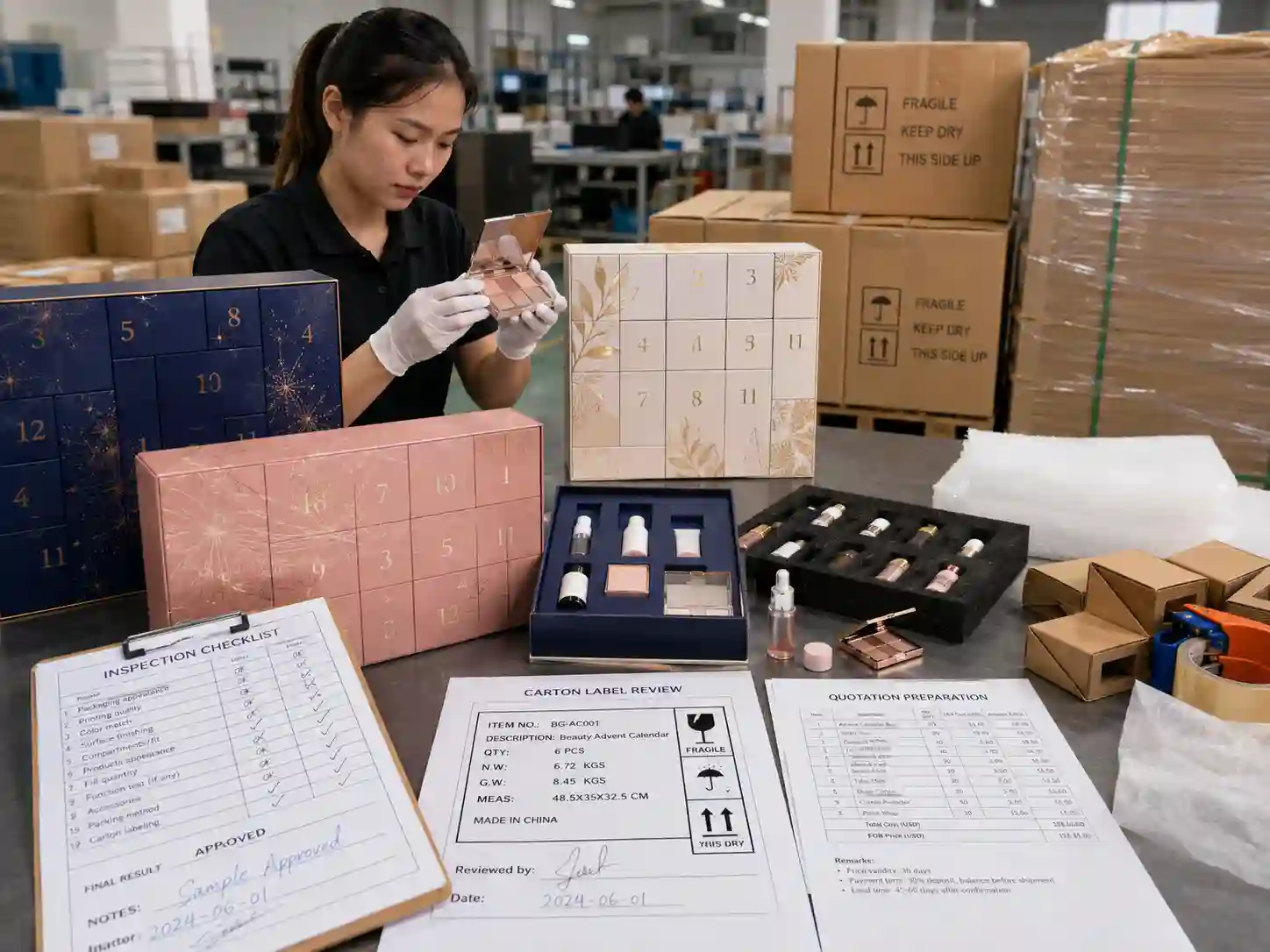
Common QC points include color variation, surface scratches, glue marks, foil defects, embossing misalignment, drawer tightness, door tearing, insert movement, wrong compartment sequence, weak carton packing, and unclear shipping marks. These issues can create returns, rework, or retail display problems.
What should final inspection include?
- Outer box size, structure, board thickness, and opening function.
- Printing color, text accuracy, barcode area, and artwork placement.
- Foil stamping, embossing, spot UV, lamination, and surface cleanliness.
- Insert position, cavity fit, product loading order, and removal space.
- Fragile product protection for palettes, powders, glass vials, and mini bottles.
- Carton quantity, inner protection, corner protectors, pallet plan, and carton label review.
- Shipping marks, PO number, item number, destination information, and customer-required labels.
For packaging transport testing, buyers may refer to official guidance from the International Safe Transit Association. If paper sourcing claims are important, buyers can verify forest-related claims through the Forest Stewardship Council and request supplier documentation where applicable.
QC tip: For export orders, the approved sample should be available on the production floor and during final inspection. QC teams need a physical reference for color, structure, insert fit, and finishing, not only PDF artwork.
How should buyers plan export packing for beauty gift set calendars?
Export packing should protect both the product and the retail appearance of the calendar box. A beautiful box can still fail commercially if corners crush, surfaces scratch, doors open, or products shift during international shipping.
Beauty advent calendar boxes may require tissue paper, polybag protection, corner protectors, inner cartons, master export cartons, pallet wrap, and clear shipping marks. The carton must balance protection and freight efficiency. Oversized cartons increase shipping cost, while weak cartons increase damage risk.
Buyers should confirm whether the calendars are shipped empty, pre-filled, flat-packed, or assembled. Filled calendars need stronger inserts and more careful carton packing because product weight affects drop and compression performance.
What information should buyers prepare before requesting a quotation?
Buyers should prepare a clear RFQ package before asking for a quotation. The more complete the RFQ, the more accurate the cost, MOQ, sample lead time, mass production schedule, and export packing plan will be.
Quotation preparation checklist
- Target quantity or estimated MOQ range.
- Number of calendar days or compartments.
- Product list with dimensions, weights, and photos.
- Fragile item notes, such as glass bottles, palettes, mirrors, powders, or pumps.
- Preferred structure: rigid box, folding carton, drawer box, door-opening box, or custom format.
- Preferred insert: paper insert, PET tray, EVA insert, foam, molded pulp, or supplier recommendation.
- Artwork files, dieline status, CMYK or Pantone requirements, and finishing expectations.
- Sample requirement: white sample, digital printed sample, prototype, or pre-production sample.
- Export packing needs, carton label requirements, pallet requirements, and shipping destination.
- Expected delivery date, retail launch schedule, and approval timeline.
Buyer tip: A quotation for beauty advent calendar boxes should show what is included and excluded. Ask whether the price includes sample cost, tooling, insert, finishing, packing, export cartons, palletizing, and any special labeling requirements.
What common mistakes should buyers avoid?
Buyers should avoid confirming design before product dimensions are final, choosing inserts without real product testing, approving color only from screen images, and comparing supplier prices without matching specifications.
- Mistake 1: Sending only a reference photo. A reference image helps style discussion, but it is not enough for quotation or production.
- Mistake 2: Ignoring mixed SKU tolerance. Small differences in bottle caps, palette thickness, or tube diameter can affect insert fit.
- Mistake 3: Overusing premium finishes. Too many finishing effects increase cost, lead time, and defect risk.
- Mistake 4: Skipping the pre-production sample. Bulk production without a signed sample increases the risk of disputes.
- Mistake 5: Comparing only unit price. A cheaper box may have weaker board, loose inserts, poor packing, or unclear QC standards.
- Mistake 6: Planning export packing too late. Carton size, pallet loading, and shipping marks should be discussed before final production.
FAQ: Beauty advent calendar boxes for B2B buyers
What affects the MOQ of beauty advent calendar boxes?
MOQ is affected by structure, paper material, printing setup, insert type, tooling, finishing, and production efficiency. A simple folding carton calendar may have a different MOQ from a rigid drawer calendar with EVA inserts and foil stamping.
Can one calendar box hold many different beauty product sizes?
Yes, but the insert must be designed around the actual product dimensions and weights. Mixed SKU calendars need careful cavity planning, loading tests, and movement checks before mass production.
Should buyers choose paper inserts or plastic trays?
Paper inserts are suitable for cost control and eco-positioning, while PET trays can provide more precise cavities for certain product shapes. Fragile palettes, glass bottles, and luxury samples may require EVA or foam depending on the protection target.
How long does sampling take?
Sampling time depends on structure complexity, artwork readiness, insert tooling, printing proofing, and finishing. Buyers should allow extra time for revisions if product dimensions, artwork, or insert requirements are not final.
What should be checked before mass production starts?
Before mass production, buyers should approve the dieline, structure, insert fit, color proof, finishing, material, carton packing, and signed pre-production sample. The approved sample should become the QC reference.
How can buyers make the quotation more accurate?
Buyers can make the quotation more accurate by sending product dimensions, weights, product photos, target quantity, structure preference, insert preference, artwork files, finishing requirements, packing needs, and delivery schedule.
How can Giftpackpro help with beauty advent calendar boxes?
Giftpackpro helps B2B buyers develop beauty advent calendar boxes from structure planning to sample approval, mass production, QC, and export packing. The goal is to make the packaging practical for mixed beauty SKUs, attractive for retail presentation, and realistic for MOQ, cost, and delivery planning.
Before you request a custom quote, prepare your product list, target quantity, preferred structure, insert requirements, artwork files, delivery country, and expected launch date. Buyers who want to understand factory capability can also learn more about the Giftpackpro packaging factory.
Beauty advent calendar boxes work best when buyers treat them as engineered seasonal packaging, not only printed gift boxes. With clear specifications, real product testing, approved samples, and export-ready packing, brands and purchasing teams can reduce cost risk while improving retail presentation and product protection.


