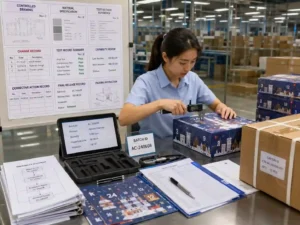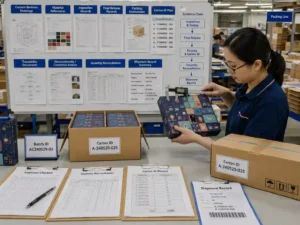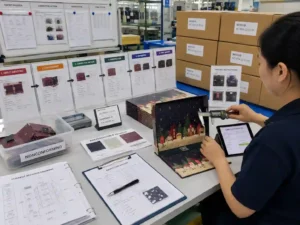
Quick answer: An insert retention drop vibration test checks whether a product remains correctly positioned inside its cavity after simulated transport stress. The process normally combines loaded sample inspection, drop or vibration exposure, dimensional checks, and removal evaluation. The goal is not only to prevent movement, but also to confirm that retention points, cavity geometry, and product access remain balanced after handling conditions.
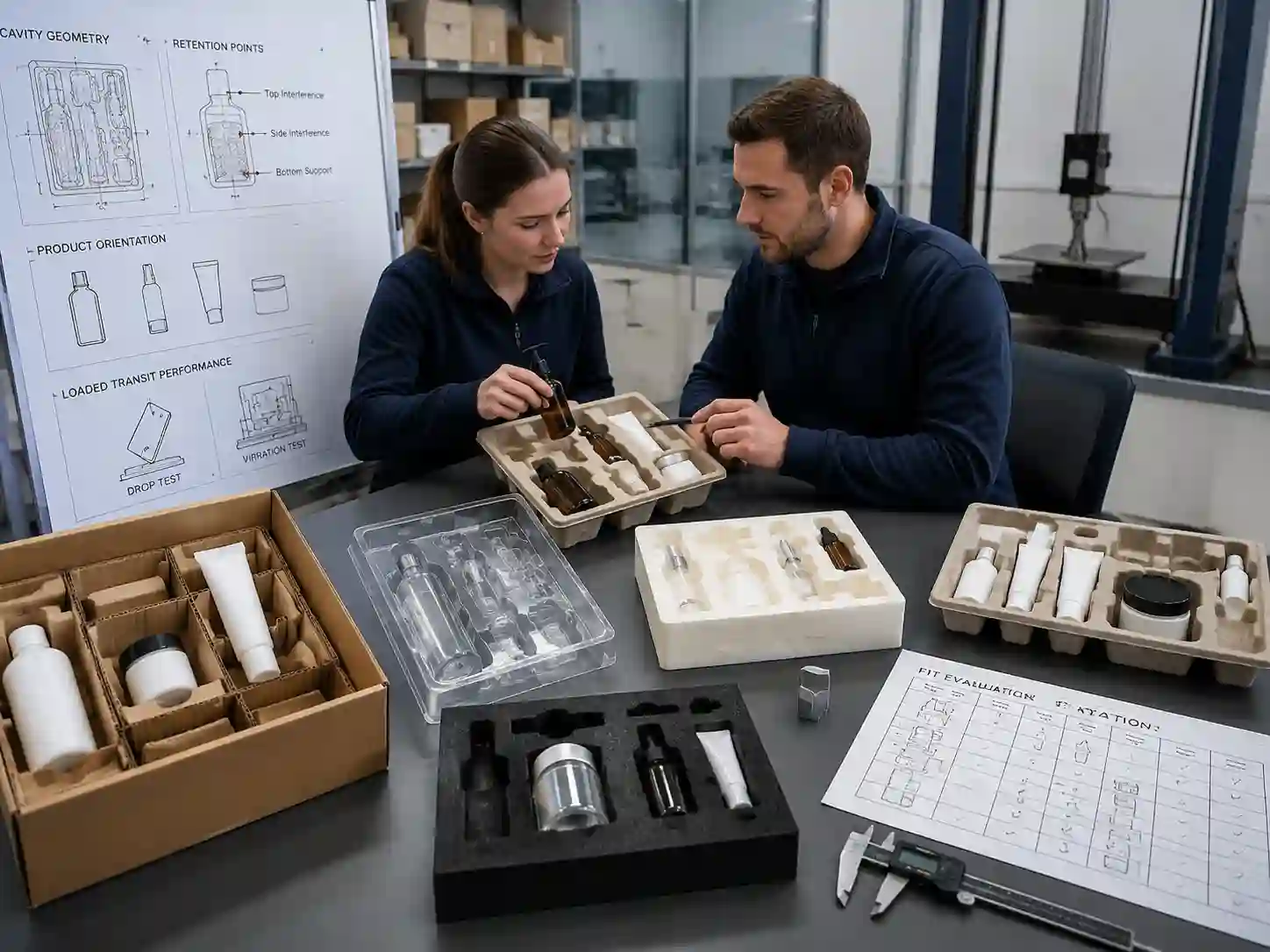
Why should insert retention be tested after drop and vibration?
Insert retention should be tested after drop and vibration because a product that fits correctly during assembly may shift, rotate, loosen, or create stress points during transportation. Static fit checks only confirm the initial condition; transit testing evaluates whether the insert continues to control product movement.
For advent calendar packaging and other multi-compartment formats, the key checks are product position, cavity stability, contact areas, and whether the insert structure still allows practical removal after stress exposure.
What does an insert retention drop vibration test evaluate?
An insert retention test evaluates how well the cavity design maintains product orientation and protection under movement. The specific test method depends on product weight, fragility, packaging structure, and expected distribution conditions.
| Retention area | What to check | Evidence to record |
|---|---|---|
| Cavity geometry | Whether the product remains centered and supported | Dimension drawings, cavity measurements, loaded samples |
| Retention points | Whether contact areas hold the product without excessive pressure | Photos, inspection notes, fit evaluation records |
| Product orientation | Whether bottles, jars, tubes, or vials rotate or lean | Before-and-after comparison records |
| Removal access | Whether the product can still be removed without damage | Manual removal checks and approval comments |
How do you prepare samples for an insert retention drop vibration test?
Samples should represent the final packaging relationship rather than only the empty insert. A useful test setup includes the actual insert material, product dimensions, packaging structure, and loading method expected during production.
- Confirm the product dimensions, weight, and orientation requirements from approved drawings or product samples.
- Load products into the insert cavities using the intended packing method.
- Check initial fit, retention pressure, clearance, and removal access before testing.
- Record the starting condition with measurements and inspection images.
The starting records are important because they allow the team to separate test damage from original design conditions. Approved samples, measurement sheets, and fit-test records provide traceability during supplier reviews.
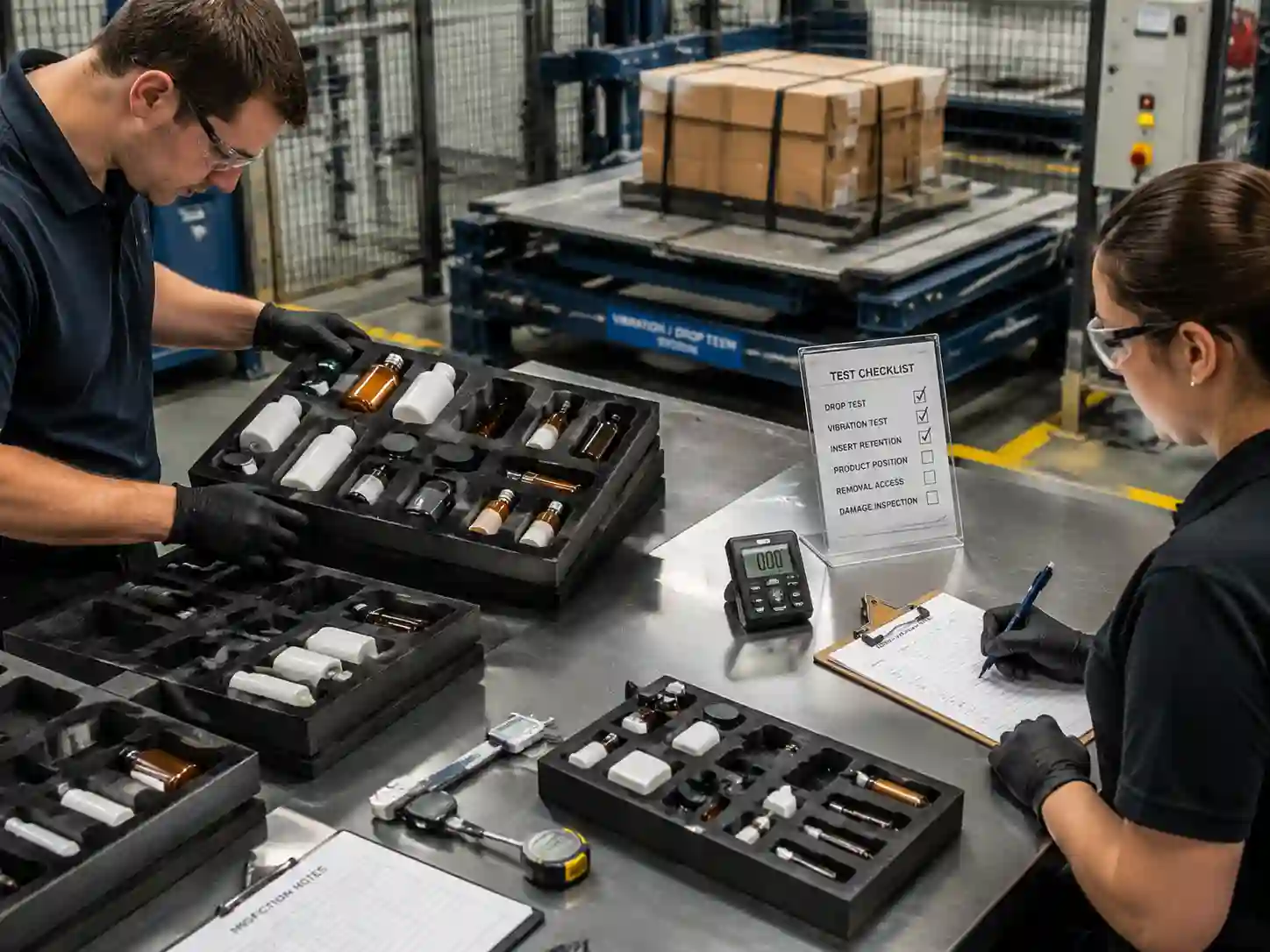
How should drop testing and vibration testing be performed?
Drop and vibration testing should follow a defined project test method rather than an informal handling check. The exact test levels and sequence vary depending on product sensitivity, distribution conditions, and buyer requirements.
A practical evaluation sequence usually includes:
- Inspect the loaded insert before stress testing.
- Apply the planned drop or vibration exposure.
- Inspect whether products have shifted, rotated, loosened, or damaged the insert.
- Measure important clearances again if movement is detected.
- Confirm whether products can still be removed correctly.
What retention problems can appear after transport simulation?
Common problems after testing are usually related to the balance between holding force and accessibility. A cavity that is too loose may allow product movement, while a cavity that is too tight may create loading difficulty or product damage risk.
| Problem found | Possible design cause | Recommended review |
|---|---|---|
| Product rotation | Cavity shape does not control the product profile | Review orientation features and contact points |
| Product movement | Excess clearance or insufficient retention | Check cavity dimensions and tolerance allowance |
| Surface marks | High-pressure contact areas | Review material selection and support locations |
| Difficult removal | Retention designed without access consideration | Evaluate finger access and extraction force |
How do you document insert retention test results?
Test results should be supported by measurable records instead of only visual approval. Useful documentation includes product samples, cavity drawings, test setup details, inspection photos, measurement results, and approval comments.
Supplier and buyer teams can use these records to confirm whether a design change improves retention or creates a new issue. For example, changing cavity depth may improve stability but may also affect product visibility or removal access.
What should buyers approve before final insert production?
Buyers should approve the tested insert configuration, loaded sample condition, and acceptance criteria before moving forward. The approved condition should clearly define product orientation, retention expectations, and any limits for movement or visible damage.
The final approval decision is project-dependent. Fragile glass products, flexible packaging, heavier containers, and premium presentation requirements may require different retention priorities compared with lightweight products.

FAQ: Is a normal fit check enough without drop and vibration testing?
No. A normal fit check confirms initial compatibility, but it does not show how the insert performs after movement, impact, or repeated vibration. Transit-related issues may only appear after the package experiences handling stress.
FAQ: Does stronger retention always create better packaging performance?
No. Retention must be balanced with loading efficiency, removal access, product protection, and presentation requirements. Excessive holding force can make packing difficult or increase product contact pressure.
FAQ: What information helps create a reliable retention test?
Useful inputs include product dimensions, product weight, center of gravity considerations, packaging orientation, insert material, approved samples, and expected handling conditions.
Giftpackpro supports custom advent calendar packaging development with structured insert evaluation and packaging engineering review. Learn more about custom advent calendar box products, explore custom advent calendar box services, or request a custom quote for a project-specific packaging discussion.