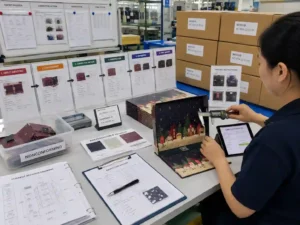
Quick answer: Effective foil embossed box transit protection starts by preventing decorated surfaces from rubbing, flexing, or carrying concentrated loads inside the master carton. Use smooth non-abrasive surface barriers, controlled carton clearance, suitable corner and edge protection, and a pallet pattern that does not transfer excessive compression through embossed areas. Confirm the system with packed-product trials, transport-relevant testing, and pre-shipment inspection rather than approving the finished box and export carton separately.
Why are foil and embossed surfaces vulnerable during export packing?
Foil and embossed surfaces can be damaged even when the structural box remains intact. Repeated vibration, carton movement, concentrated pressure, and contact with rough protective materials can create rubbing, flattening, scuffing, or visible marking on decorated faces.
The risk depends on the actual construction. A large foil-stamped panel behaves differently from a small foil logo, while a deeply embossed pattern may create raised areas that receive load before the surrounding surface does. Wrapped rigid boxes, folding cartons, and assembled drawer calendars can also require different protection arrangements.
Before packing is approved, the team should identify the decorated faces, raised areas, corners, edges, and other surfaces that must remain cosmetically acceptable after transportation.

What should a foil embossed box transit protection system include?
A practical protection system normally combines surface separation, movement control, edge protection, carton strength, and pallet-load management. No single protective material should be expected to solve all five risks.
How should decorated surfaces be separated?
Finished foil or embossed faces should not repeatedly rub against adjacent boxes, exposed corrugated surfaces, or abrasive packing materials. A smooth protective sleeve, bag, tissue, interleaving sheet, or other approved non-abrasive barrier can create separation.
The material should be evaluated against the actual finish. Check whether it leaves impressions, transfers particles, traps debris, sticks under humidity, or creates friction marks during repeated movement.
A simple verification method is to pack production-representative samples exactly as proposed, apply controlled handling or vibration exposure, and inspect the same decorated areas before and after the trial under consistent lighting.
How much clearance should be left inside the master carton?
Clearance should be sufficient for loading and protective materials but limited enough to prevent repeated internal movement. Excessive void space allows finished calendars to accelerate and contact neighboring units or carton walls during handling.
Do not reduce void simply by forcing more calendars into the carton. Excessive compression can transfer pressure into raised embossing, foil areas, drawer fronts, corners, or wrapped edges.
The packing drawing should therefore define product orientation, units per carton, protective-material positions, internal arrangement, and relevant carton dimensions. These details can then be checked against an actual packed carton.
Where should corner and edge protectors be positioned?
Corner and edge protection should transfer handling and stacking forces through structurally suitable areas instead of concentrating them on decorative faces. Protectors are particularly useful where rigid-box corners or exposed edges can contact the master carton.
The exact material and thickness are project-dependent. Verify the arrangement by inspecting contact points in a fully packed carton rather than specifying protection from drawings alone.
How should master cartons be designed around foil and embossing?
The master carton should restrain the packed units while keeping direct load and abrasion away from sensitive surfaces. Carton dimensions, board construction, pack orientation, separators, and gross weight should be reviewed as one system.
| Transit risk | Possible packaging response | What to verify |
|---|---|---|
| Foil rubbing | Smooth sleeve or interleaving barrier | No abrasive contact or visible marking after handling |
| Embossing compression | Clearance and load distribution around raised areas | Raised detail remains visually and dimensionally acceptable |
| Internal movement | Controlled carton fit, spacers or suitable void reduction | Units cannot migrate significantly during transport simulation |
| Corner impact | Corner or edge protection | Impact load does not transfer directly to decorated faces |
| Stacking pressure | Suitable carton construction and pallet pattern | Cartons remain stable without excessive localized compression |
| Humidity exposure | Project-appropriate wrapping and moisture-control strategy | Materials and finishes remain acceptable under expected conditions |
Carton specifications should be based on the packed product rather than the empty calendar dimensions alone. Protective sleeves, corner pieces, separators, and required clearance all change the final internal space requirement.
How does the pallet pattern affect foil and embossed surfaces?
A stable pallet pattern reduces carton movement and helps distribute stacking forces consistently. Poor pallet geometry can allow cartons to overhang, shift, deform, or carry uneven loads that eventually reach the decorated boxes inside.
Review cartons per layer, layer orientation, pallet footprint, total stack arrangement, stretch-wrap application, and any required top or edge protection. Avoid assuming that tighter stretch wrapping is automatically safer: excessive localized restraint can deform outer cartons and transfer compression inward.
The pallet drawing should identify carton orientation and layer pattern. A packed pallet trial can then confirm that cartons remain aligned and that the load path is compatible with the product structure.
How should drop and vibration risks be checked?
Drop and vibration risks should be evaluated using packed production-representative samples because surface damage often comes from repeated small movements rather than one obvious carton failure.
For example, imagine a rigid advent calendar with a large metallic foil panel and raised embossed lettering. The master carton initially appears tight enough, but several millimeters of uncontrolled clearance allow neighboring calendars to move repeatedly during vibration. The export carton may remain undamaged while faint horizontal rub marks develop across the foil.
The corrective action could involve changing the surface barrier, reducing uncontrolled clearance, modifying orientation, adding appropriate restraint, or combining these measures. The revised configuration should then be checked again rather than assuming that one material change has solved the problem.

How should humidity be considered during export packing?
Humidity should be treated as a project-specific risk because paperboard, wrapped surfaces, adhesives, protective materials, and decorative finishes can respond differently to changing storage and transport environments.
Packaging teams should review the expected route, storage conditions, container exposure, packing material behavior, and destination environment. Where humidity control is considered necessary, the proposed solution should be compatible with the finished box and supported by an agreed packing specification.
Avoid adding moisture-control materials or sealed barriers without evaluating their interaction with the actual packaging system. The objective is to manage exposure without creating condensation, marking, odor, contamination, or other unintended problems.
What should be checked before foil and embossed boxes are released for shipment?
Pre-shipment inspection should confirm that the approved protection arrangement is consistently applied in production. Inspectors should compare actual packed cartons against the approved packing drawing, reference sample, carton specification, and relevant test or trial records.
- Confirm the correct box orientation and quantity per master carton.
- Check that foil and embossed faces are clean before protective materials are applied.
- Verify that sleeves, interleaving sheets, corner protectors, and spacers are in their approved positions.
- Check for exposed corrugated edges or other abrasive contact against decorated surfaces.
- Confirm internal clearance and restraint against the approved packing configuration.
- Measure relevant master-carton dimensions and verify packed gross weight where required by the project specification.
- Inspect representative finished units for foil scuffing, embossing flattening, scratches, dents, or pressure marks.
- Verify carton orientation, pallet pattern, stretch wrapping, and edge or top protection.
- Confirm required carton identification and shipping marks against approved shipping instructions.
- Retain inspection records and photos that identify the checked packing configuration.
This separates a verifiable production fact—such as whether the approved interlayer was installed—from a project-dependent recommendation, such as which protective material should originally have been selected.

What evidence should buyers approve before shipment?
Buyer approval should focus on the defined packing configuration and evidence that it has been reproduced, not merely on photographs of closed cartons. Useful evidence can include packing drawings, packed-sample photographs, carton dimensions, gross-weight records, pallet diagrams, inspection results, and agreed transit-test documentation where applicable.
For complex finishes, identify the critical decorated areas on the approved reference or drawing. This gives the supplier and inspector specific locations to examine instead of relying on a general instruction such as “protect the foil.”
Changes to carton quantity, product orientation, protective material, carton dimensions, or pallet pattern should be reviewed when they could alter surface contact or load distribution. The appropriate level of re-verification depends on the significance of the change.
For related structural and packing options, buyers can review custom advent calendar box products and additional advent calendar box buying guides.
Does destination assembly change the protection method?
Yes. Flat-packed components and fully assembled calendars create different contact points, pack densities, and handling stages, so the surface-protection plan should reflect the actual shipping configuration.
If final assembly occurs at the destination, determine when protective sheets or sleeves should be removed and how decorated components will be handled during unpacking and assembly. A transit system that protects a foil panel inside the master carton can still fail if workers stack unprotected panels face-to-face after unpacking.
Destination instructions should therefore identify any protection that must remain in place until a particular assembly stage and any sensitive surfaces that require controlled handling.
What is the most reliable way to prevent cosmetic transit damage?
The most reliable approach is to engineer protection around the complete packed load: decorated surface, individual box, master carton, and pallet. Surface barriers prevent abrasion, controlled clearance limits movement, structural protection manages impacts and compression, and pallet planning stabilizes the shipment.
Most importantly, verify the final configuration using representative packed units and documented inspection criteria. A visually acceptable sample before packing does not demonstrate that the same foil and embossing will remain acceptable after export handling.
FAQs about protecting foil and embossed boxes during export
Should foil surfaces touch tissue or protective paper directly?
Only after the proposed material has been checked with the actual finish. Paper texture, coatings, particles, pressure, and movement can affect different foil surfaces differently, so direct-contact materials should be approved through representative trials.
Can bubble wrap be placed directly against embossed packaging?
It should not be assumed to be suitable for every project. Under pressure or prolonged storage, some protective materials can create surface impressions or uneven loading. Test the actual contact arrangement before approving it for production packing.
Should shipping marks identify cartons containing sensitive finishes?
Shipping marks should follow the project’s logistics and handling requirements. When special orientation or handling instructions are necessary, they should be defined in the approved shipping specification and verified during packing rather than added informally at dispatch.
When should the export packing configuration be rechecked?
Recheck it when changes could affect contact, clearance, compression, or load distribution—for example, a different protective material, carton quantity, product orientation, carton size, or pallet pattern. The extent of repeat verification should match the risk created by the change.
If your project uses foil stamping, embossing, or other sensitive decorative surfaces, share the finished box structure, packed dimensions, shipping configuration, and protection requirements with Giftpackpro through request a custom quote so the export packing arrangement can be reviewed against the actual calendar design.