
Quick answer: Effective drawer movement export carton protection starts by controlling movement at the finished-calendar level, not by simply filling empty space in the master carton. Drawers should remain seated during handling, vibration, carton drops, pallet movement, and changes in orientation. The packing method should combine appropriate drawer restraint, controlled carton clearance, protective pads or sleeves where needed, and a stable master-carton loading pattern. The final configuration should be verified with packed samples and documented before shipment.

Why do advent calendar drawers move inside master cartons?
Drawers usually move because transportation forces are transferred through the master carton to the finished calendar, while the drawer itself still has enough freedom to slide, bounce, or work outward. A carton that looks tightly packed when stationary can therefore still allow internal movement during distribution.
The first step is to distinguish two different problems: movement of the complete calendar inside the master carton and movement of individual drawers inside the calendar. Reducing master-carton void can control the first problem, but it does not automatically solve the second.
Risk depends on the calendar structure, drawer orientation, drawer fit, product weight, internal insert design, carton loading direction, protective materials, distribution route, and expected handling conditions. Heavy products inside loosely retained drawers generally require more attention than lightweight empty drawers.
How should drawer movement export carton protection be designed?
The packing configuration should create a controlled load path while preventing individual drawers from gaining enough travel to open, strike surrounding structures, or damage their contents. The appropriate restraint method is project-dependent and should be confirmed on the actual finished structure.
Should the drawers themselves be restrained?
Yes, when drawer friction and the calendar’s normal closure geometry cannot reliably keep them seated under the intended shipping conditions. Restraint should hold the drawers closed without marking printed surfaces or permanently deforming the structure.
Possible approaches include a protective sleeve around the complete calendar, removable paper bands, controlled wrapping, fitted protective sheets, or a structural outer cover that physically blocks drawer travel. The selection depends on how the calendar is constructed and how it must appear when unpacked.
A restraint method should be evaluated for more than holding force. Check whether it:
- keeps all drawers in their intended positions;
- avoids scuffing, pressure marks, adhesive residue, or crushed edges;
- can be applied consistently during packing;
- remains effective after repeated handling and vibration;
- can be removed at destination without damaging the calendar; and
- matches any destination assembly or retail preparation requirements.
How much master-carton void should be allowed?
Clearance should be sufficient for practical packing and protective materials but should not permit uncontrolled movement. There is no universal clearance value because calendar dimensions, carton tolerances, protection thickness, board stiffness, and packing orientation vary.
Instead of specifying an arbitrary gap, packaging engineers can measure the finished protected calendar and build the carton dimensions from the actual packing configuration. Trial cartons should then be loaded to confirm whether units can shift laterally, vertically, or longitudinally.
Where clearance is necessary, use engineered pads, dividers, corner protection, interlayers, or other appropriate materials to control movement. Loose filler should not be treated as a substitute for a repeatable packing design.
Which protection method fits different movement risks?
The correct method depends on where movement originates. The following table can be used as a packing-review framework rather than as a fixed specification.
| Observed risk | Possible control | Verification point |
|---|---|---|
| Individual drawers slide outward | Sleeve, band, wrap, outer cover, or other drawer restraint | Check drawer position before and after handling tests |
| Complete calendar shifts in carton | Reduce clearance or add fitted pads/dividers | Measure packed clearance and inspect unit movement |
| Calendar corners receive impact loads | Corner or edge protection | Inspect corners, wrapped surfaces, and structural joints |
| Units rub against each other | Interlayer sheets, sleeves, separators, or individual protection | Inspect printed and finished surfaces after trial handling |
| Stacking compresses the calendar | Review orientation, carton strength, spacing, and pallet loading | Inspect drawer alignment and panel deformation after loading |
| Humidity changes fit or stiffness | Review materials, wrapping, carton exposure, and storage conditions | Recheck drawer operation and structural condition under relevant conditions |
How should the master-carton packing orientation be selected?
Orientation should minimize the direction in which transport forces can encourage drawers to open while maintaining acceptable protection and pallet efficiency. The most space-efficient orientation is not automatically the safest one.
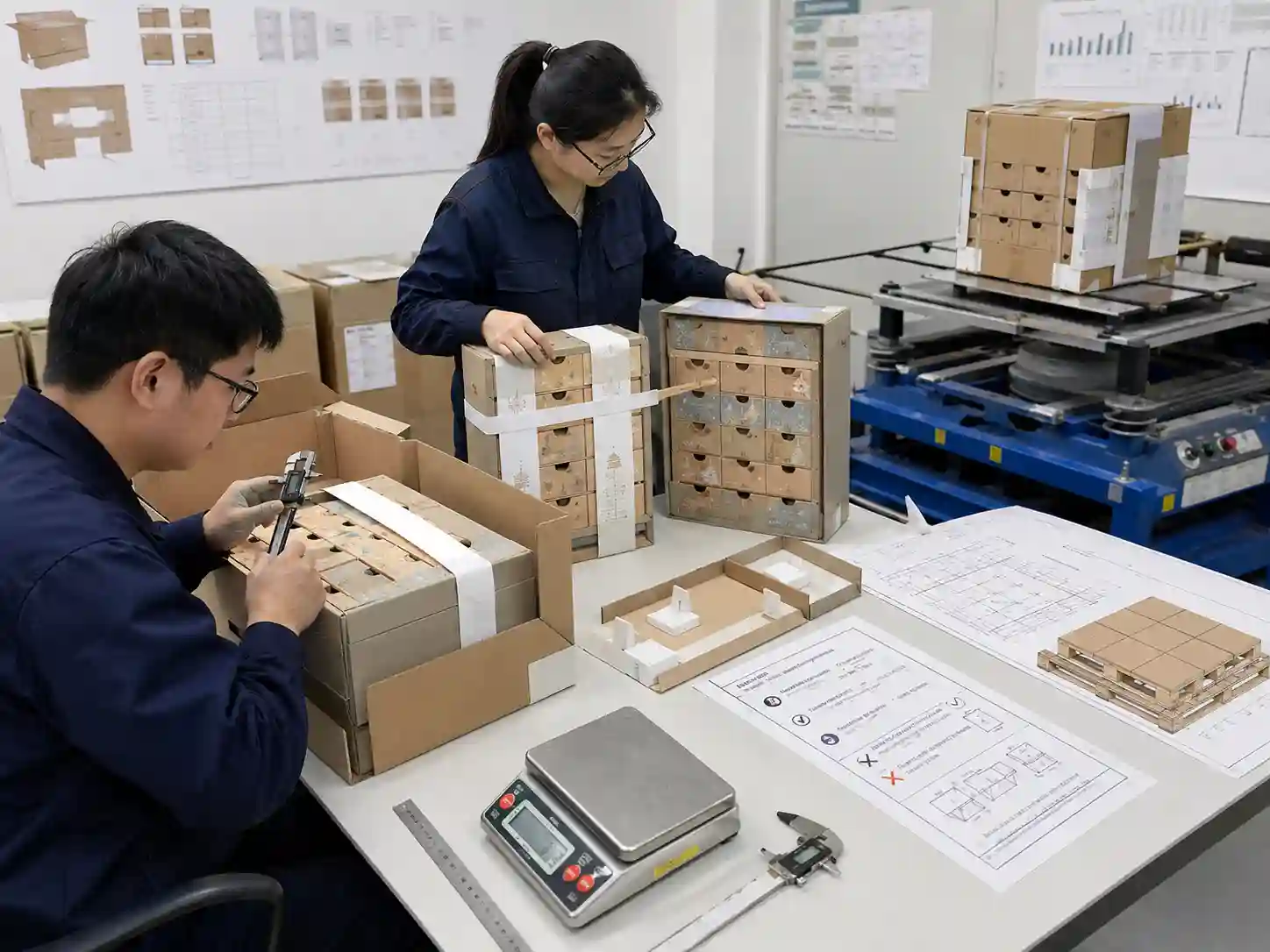
Packaging teams should physically compare plausible orientations using finished calendars with their intended products or representative loads. Record the calendar orientation, units per carton, protection layout, internal carton dimensions, external carton dimensions, and packed gross weight for each candidate configuration.
For example, an orientation may achieve excellent carton utilization but place loaded drawers in a direction where repeated vibration encourages them to migrate outward. A second configuration may use slightly more protection or carton volume but provide a more stable load path. That trade-off should be decided from packing trials and distribution requirements rather than carton utilization alone.
How do pallet patterns affect drawer movement?
A stable master carton can still experience damaging forces if the pallet configuration allows cartons to shift, overhang, distort, or receive uneven compression. Drawer protection therefore needs to remain compatible with the selected pallet pattern.
Check the proposed carton footprint against the pallet dimensions and planned stacking arrangement. Review whether cartons are fully supported, whether column or interlocked stacking is appropriate for the project, and whether stretch wrapping or other unit-load controls can stabilize the pallet without crushing cartons.
Important pallet checks include:
- cartons per pallet layer and number of layers;
- carton overhang or unsupported edges;
- stack alignment;
- expected compression on lower cartons;
- pallet restraint and stretch-wrap application;
- movement between cartons during handling; and
- compatibility with warehouse and container loading.
These are project-dependent decisions. The approved pallet plan should match the carton and protection configuration that was actually evaluated, rather than being created separately after packing specifications are finalized.
How should drop and vibration risks be checked?
Use a documented test method appropriate to the distribution objective and inspect the drawers immediately after testing. The purpose is not merely to determine whether the master carton remains closed; it is to determine whether the packed calendar still performs and appears as required.
What should be inspected after a transit trial?
Open the tested carton carefully and record the position of the calendars before rearranging anything. This makes it easier to identify the direction and source of movement.
Check for:
- drawers that have moved outward or changed position;
- products displaced inside drawers;
- drawer fronts rubbing against surrounding panels;
- damaged pull tabs, ribbons, or other projecting components;
- scuffed or compressed printed surfaces;
- crushed corners or distorted outer structures;
- changes in drawer opening or closing behavior; and
- movement or collapse of protective materials.
Photographs, before-and-after measurements, packing diagrams, and test records provide more useful evidence than a simple statement that the carton “passed.” If a failure occurs, identify whether it originated from drawer restraint, product loading, protective clearance, master-carton design, or pallet configuration before changing the specification.
Can humidity increase drawer movement risk?
Yes, environmental conditions can change the dimensional behavior and stiffness of paper-based components, so a packing configuration should not assume that drawer fit remains identical throughout storage and transportation. The magnitude of any change depends on the materials, construction, exposure, and route.
This does not mean adding arbitrary moisture protection to every shipment. Instead, projects with meaningful humidity exposure should evaluate whether changes in board or wrapped structures could affect drawer friction, panel shape, restraint performance, or carton compression.
Buyers can ask suppliers how the approved packing configuration addresses the expected distribution environment and what evidence supports the decision. Relevant evidence may include material specifications, conditioning or transit-test records where applicable, and inspection results from representative packed samples.
What should be verified before shipment?
Production cartons should be checked against the approved packing specification rather than relying only on a prototype created earlier in the project. This confirms that drawer restraint and carton protection have been maintained during bulk packing.
A focused pre-shipment checklist can include:
- Confirm the correct calendar version and drawer configuration.
- Verify that drawers are fully seated before restraint is applied.
- Check that the approved restraint method is present and correctly positioned.
- Confirm protective sleeves, pads, dividers, interlayers, and corner protectors against the packing diagram.
- Verify the quantity and orientation of calendars in each master carton.
- Measure representative finished master-carton dimensions.
- Check representative packed gross weights against approved shipping records.
- Confirm that excessive internal movement is not present.
- Inspect representative calendars for pressure marks, rubbing, or drawer displacement.
- Confirm carton IDs and generic shipping marks against the shipping specification.
- Verify that the production pallet pattern matches the approved plan.
- Retain inspection records and photographs needed for shipment approval.

What evidence should buyers approve for the packing method?
Buyers should approve measurable packing details and representative evidence, not just a photograph of a closed carton. The goal is to make the chosen protection method repeatable in production and verifiable before release.
Useful approval records can include the master-carton drawing, packing orientation diagram, protection-material layout, pack quantity, finished carton dimensions, gross-weight record, pallet pattern, representative packing photographs, transit-test method and results when required, and any destination unpacking or assembly instructions.
These records separate three different types of information. Finished dimensions, actual pack quantities, measured weights, and inspection results are verifiable facts. Protection thickness, restraint style, pallet arrangement, and test scope are project-dependent engineering decisions. Acceptance of appearance, unpacking method, and allowable movement should be recorded as buyer approvals where those requirements affect the finished delivery.
For related structural and packing development, review custom advent calendar box services or browse custom advent calendar box products. Broader technical topics are available in the advent calendar box buying guides.
FAQs about preventing drawer movement in master cartons
Is reducing carton void enough to stop drawers moving?
No. Reduced master-carton void can stop the complete calendar from shifting, but individual drawers may still move inside the calendar. Both levels of movement need to be evaluated separately.
Should adhesive tape be placed directly over drawers?
Only if the specific material, surface finish, removal method, and appearance requirements have been evaluated and approved. Direct adhesive contact can introduce residue, marking, coating damage, or inconsistent removal, so non-contact restraint methods may be preferable for some structures.
Should drawer movement be checked with products loaded?
Where the shipped calendar contains products, representative loaded testing is more informative because product mass and distribution can change drawer behavior and impact forces. The test load should reflect the configuration being evaluated rather than an unrelated empty sample.
When should the packing specification be revised?
Re-evaluate it when a change can affect movement or protection, such as a different product weight, drawer geometry, structural material, carton size, packing orientation, protective material, or pallet pattern. Record the revised configuration so production does not continue using an obsolete packing method.
For a project-specific review of calendar structure, drawer restraint, master-carton configuration, and shipping requirements, request a custom quote from Giftpackpro.


