
Quick answer: Effective pallet stacking crush prevention starts by keeping vertical pallet loads on the master-carton structure rather than on unsupported calendar boxes. Use cartons with suitable compression strength, minimize internal voids, align cartons in a stable pallet pattern, control pallet height and overhang, and verify the packed configuration under representative storage and transport conditions. Large calendar boxes need particular attention because wide panels, empty internal spaces, humidity and repeated handling can reduce stacking stability.
Why Do Large Calendar Boxes Crush on Lower Pallet Layers?
Lower pallet layers crush when the combined load above them exceeds the effective compression resistance of the packed master cartons. The problem is influenced by more than carton board grade: carton dimensions, internal support, pallet alignment, humidity, storage duration and handling all affect the actual load path.
A large advent calendar can create a difficult shipping configuration because its footprint may be wide while the finished paperboard structure contains drawers, cavities or other unsupported areas. If the master carton allows excessive movement or its strongest edges are not vertically aligned, upper-layer weight can produce panel bowing, corner collapse or progressive carton deformation.
The first engineering question should therefore be: where does the vertical load travel from the top of the pallet to the pallet deck?

What Should Be Checked for Pallet Stacking Crush Prevention?
Check the complete packed system rather than approving the calendar box, master carton and pallet independently. The production packing arrangement should create repeatable vertical support from one carton layer to the next.
| Check | What to Look For | Why It Matters |
|---|---|---|
| Master-carton dimensions | Consistent external dimensions without bulging | Irregular cartons create uneven vertical loading |
| Internal void | No large unsupported spaces allowing products to shift | Movement can distort carton walls and load paths |
| Carton orientation | Approved orientation maintained on every layer | Different orientations can have different stacking behavior |
| Layer alignment | Carton corners and load-bearing edges positioned consistently | Misalignment concentrates load on weaker panels |
| Pallet overhang | Cartons remain within the intended pallet footprint | Unsupported edges are more vulnerable to compression and handling damage |
| Pallet deck | Flat, sufficiently supported contact surface | Deck gaps or damaged boards can create local pressure points |
| Stretch wrapping | Stable load without excessive inward compression | Containment should not deform carton walls |
| Moisture exposure | Storage and transport environment considered | Elevated humidity can affect corrugated packaging performance |
How Should the Master Carton Carry the Pallet Load?
The master carton should be designed so its principal load-bearing walls and corners remain vertically supported through the pallet. Large unsupported side panels should not become the primary structures carrying upper-layer weight.
For a large calendar, this normally requires checking the packed carton rather than relying only on nominal board specifications. Engineers should document the calendar orientation, units per carton, internal protection, carton dimensions and closure method because changing any of these can change the finished carton’s behavior.
Corner protectors or fitted spacers may help control movement where appropriate, but they should not automatically be treated as structural columns. Their actual contribution depends on material, geometry, position and how they contact the product and carton.
Why Is Internal Void Reduction Important?
Excessive void allows calendars to shift and can leave broad carton panels without internal restraint. Reducing unnecessary clearance helps maintain carton geometry during stacking and vibration.
This does not mean making the carton excessively tight. A carton that compresses decorative surfaces, corners or projecting structures during packing creates a different damage risk. The correct clearance is project-dependent and should be established through drawings, packed prototypes and physical evaluation.
Which Pallet Pattern Reduces Crushing Risk?
The preferred pallet pattern keeps cartons fully supported by the pallet and transfers vertical loads predictably between layers. A pattern chosen only to maximize cartons per pallet can be unsuitable if it introduces overhang, weak edge positions or poorly supported columns.
Column stacking can provide direct vertical alignment when carton edges are positioned consistently. Interlocked patterns may improve some forms of load stability but can also interrupt direct vertical alignment between carton walls. Neither approach should be declared universally superior without considering the specific carton and distribution environment.
Prepare a pallet drawing showing:
- cartons per layer;
- number of layers;
- carton orientation;
- pallet dimensions;
- permitted overhang, normally controlled to the approved specification;
- layer sheets or other stabilizing materials when specified;
- corner or edge protection where required;
- stretch-wrap arrangement; and
- final pallet height and estimated gross load.
The approved drawing should match the configuration used for production packing. Warehouse teams should not change carton orientation or add extra layers simply because unused vertical space remains.

How Much Weight Can the Lower Cartons Safely Carry?
Do not determine safe pallet height from carton gross weight alone. The decision should consider the packed carton’s verified compression performance and the reductions expected from storage time, humidity, handling and real pallet conditions.
A simple planning calculation can identify the nominal load above a bottom carton. For example, if each vertically aligned carton weighs 12 kg and there are six layers, a bottom carton has approximately 60 kg of carton load above it before considering load distribution and dynamic effects. That number is useful for engineering review, but it is not itself proof that the configuration is safe.
Actual acceptance should be based on the project’s defined packaging specification and appropriate verification method. Buyers can request records identifying the tested carton construction, packed configuration, conditioning assumptions, pallet pattern and acceptance criteria so that a result can be traced to the production specification.
How Do Humidity and Storage Time Change the Decision?
Corrugated packaging should not be evaluated as though its performance remains identical under every environment. Moisture exposure and prolonged loading can reduce the safety margin available to lower pallet layers.
This matters when packed calendars may spend extended periods in a factory warehouse, container, distribution center or destination warehouse. The relevant route and storage conditions vary by project, so packaging teams should document the expected distribution environment rather than apply an unsupported universal correction factor.
Where humidity is a significant risk, the project review may consider corrugated material selection, moisture exposure during storage, container loading practices and whether additional environmental protection is justified. These decisions should be agreed against the actual shipping route and product requirements.
Can Stretch Wrap Prevent Carton Crushing?
Stretch wrap improves unit-load containment, but it cannot compensate for an inadequately supported master carton. Excessive wrap tension can actually pull upper carton walls inward or distort exposed corners.
The wrapping specification should therefore control both pallet stability and carton deformation. Corner boards or other load-stabilizing components can be evaluated when needed, especially on tall loads, but their function and placement should be documented rather than improvised during final packing.
What Does a Typical Transit-Risk Example Look Like?
Consider a wide multi-drawer calendar packed several units per master carton. The pallet appears stable when first assembled, but the cartons contain excess lateral clearance and the pallet pattern leaves some carton edges partly unsupported.
During storage, the lower cartons remain under sustained vertical load. Subsequent forklift movement and transport vibration allow the calendars inside to shift slightly. The master-carton sidewalls begin to bow, the pallet loses its original geometry, and the bottom layers show corner deformation.
The corrective approach is not simply to add more stretch wrap. Packaging engineers would review carton fit, internal void, board and carton construction, pallet support, layer alignment and pallet height. A revised packed configuration should then be evaluated before approval.
How Should the Packing Configuration Be Verified Before Shipment?
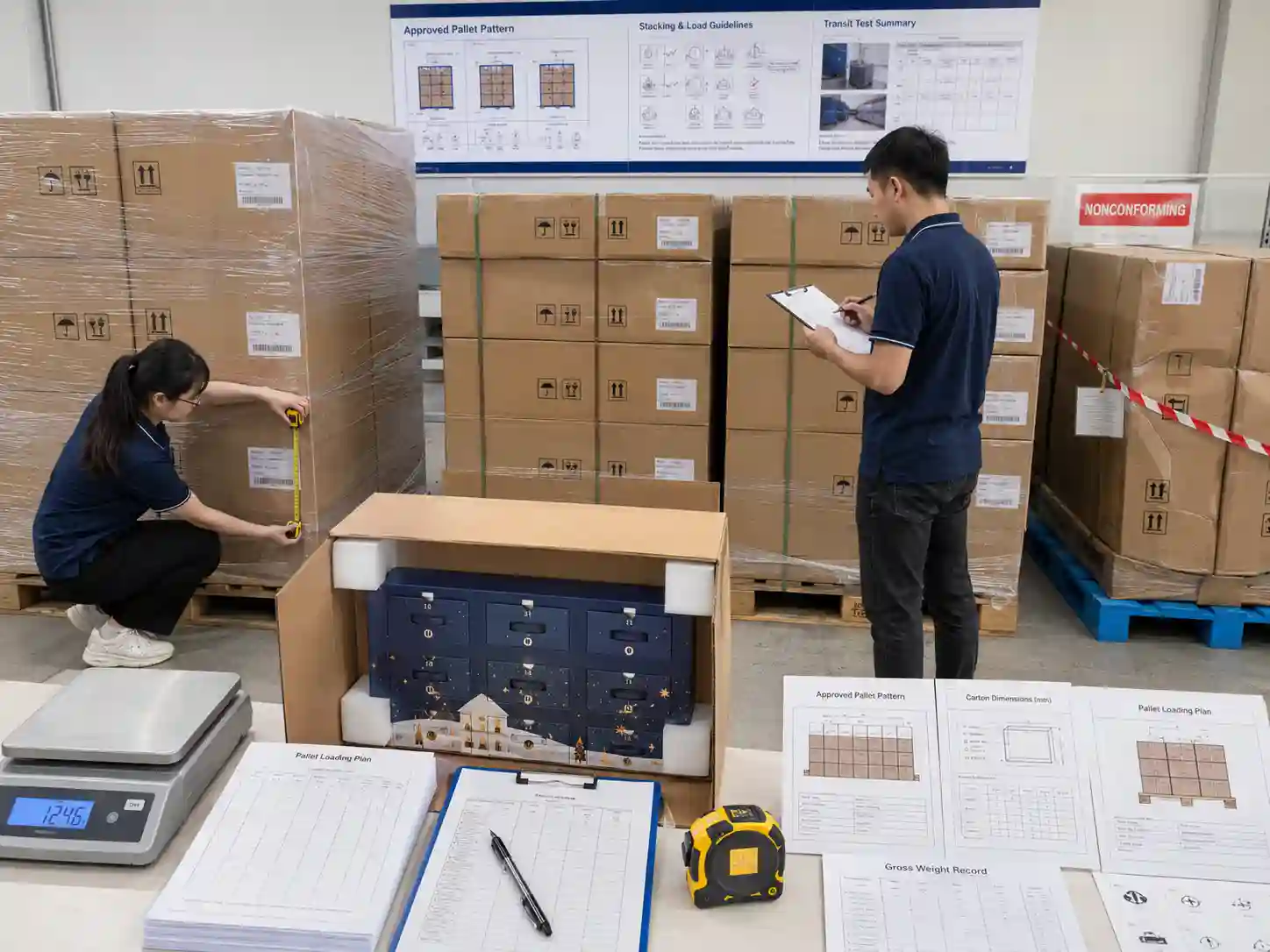
Verification should confirm that production pallets match the configuration that was engineered and approved. QC staff should check representative master cartons and completed pallets against controlled packing documents.
- Confirm the production master-carton specification matches the approved construction and dimensions.
- Measure representative packed cartons for unexpected bulging or dimensional variation.
- Confirm units per carton and calendar orientation.
- Check internal protection, spacers and corner protectors against the approved packing drawing.
- Record representative carton gross weights.
- Verify cartons per pallet layer and total number of layers.
- Check for pallet overhang, unsupported corners or damaged pallet boards.
- Inspect lower layers for bowing, compression or corner deformation.
- Verify stretch-wrap and stabilization materials against the packing specification.
- Retain relevant inspection, packing and test records with the shipment documentation system.
What Evidence Should Buyers Approve?
Buyers should approve the defined production configuration rather than a general statement that the pallet is “export suitable.” The useful evidence is specific enough to reproduce and inspect the packing arrangement.
Depending on the project, the approval package may include master-carton drawings, material specifications, packed dimensions and weights, pallet-pattern drawings, packing photographs, relevant test documentation and inspection records. The responsible parties should also identify which changes require renewed review.
For example, increasing units per carton, changing carton dimensions, reducing internal protection or adding pallet layers can alter compression loads. These changes should not automatically inherit an earlier packing approval.
Giftpackpro’s custom advent calendar box services can be used to coordinate structural packaging requirements with the finished calendar format. Buyers evaluating different constructions can also review custom advent calendar box products before defining the final export configuration.
Frequently Asked Questions
Should large calendar master cartons be stacked to the container’s maximum available height?
No. Available container height does not determine a safe pallet height. The number of layers should be based on the packed carton’s verified stacking capability, pallet stability, handling constraints and expected distribution conditions.
Can layer sheets stop lower cartons from crushing?
Layer sheets can improve load distribution or pallet stability in some configurations, but they do not correct an under-specified master carton. Their effect depends on material stiffness, carton pattern and contact area and should be evaluated as part of the complete pallet.
Should carton compression checks use empty or packed master cartons?
The verification method should reflect the question being assessed. Material or empty-carton data can support engineering decisions, but packed-system evaluation is important when the calendar, void space, internal protection or carton deformation materially affects real stacking behavior.
When should the pallet design be reviewed again?
Review it when a change affects carton dimensions, packed weight, units per carton, internal protection, carton construction, pallet pattern or layer count. These variables can change the load experienced by lower cartons even when the finished calendar artwork remains unchanged.
How Should You Finalize a Crush-Resistant Pallet Plan?
Start with the actual packed calendar, define a master carton that maintains its geometry, create a fully supported pallet pattern and establish a layer count with an appropriate verified margin for the intended distribution environment. Then make the approved configuration measurable through drawings, weights, dimensions, photographs and QC records.
If you are developing a large advent calendar and need the export packing configuration reviewed alongside the box structure, request a custom quote with your finished dimensions, estimated packed weight, destination and planned pallet requirements.