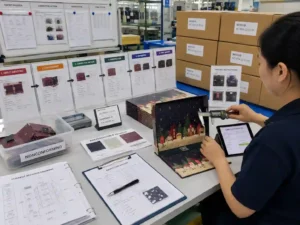
After paper wrapping and lamination, drawer clearance must account for the final compressed board thickness, surface friction, coating effect, and assembly tolerance. A drawer that fits before finishing may become tight after wrapping. The practical approach is to confirm finished dimensions through wrapped samples, measure actual gaps, and approve movement performance before final production.

How much advent calendar drawer clearance is needed after paper wrapping and lamination?
The required advent calendar drawer clearance depends on the drawer construction, wrapped board thickness, lamination type, drawer depth, and required opening feel. There is no universal clearance value because different structures create different friction and alignment conditions.
In structural packaging development, clearance is normally decided from the finished assembly rather than the unwrapped paperboard size. Engineers review the drawer, sleeve, wrapped panels, edges, and contact points after all surface materials are applied.
Why does paper wrapping and lamination change drawer movement?
Paper wrapping and lamination add material layers that affect both dimensions and surface behavior. Even small thickness changes can reduce the available sliding space between the drawer and outer structure.
- Added thickness: Wrapped paper covers board edges and corners, increasing the finished part size.
- Surface friction: Some laminations create smoother or more resistant sliding surfaces.
- Edge build-up: Folded paper layers at corners can create localized tight areas.
- Humidity influence: Paper materials can expand or contract depending on storage and production conditions.
These factors should be checked on finished samples, not estimated only from artwork files or flat material specifications.
What measurements should be checked before approving drawer clearance?
The key measurements are the final drawer dimensions, sleeve opening dimensions, gap distribution, and movement performance after complete finishing.
| Check item | Purpose | Approval evidence |
|---|---|---|
| Drawer outer dimensions | Confirm final size after wrapping and lamination | Measurement sheet with finished sample data |
| Sleeve or housing inner dimensions | Verify available movement space | Engineering drawing comparison |
| Side and top clearance | Prevent rubbing and sticking | Gap measurement records |
| Opening and closing movement | Confirm user operation performance | Sample inspection notes |
How do engineers test drawer clearance on finished samples?
The most reliable method is testing a fully finished prototype that uses the same board structure, wrapping process, and lamination specification planned for production.
- Measure the drawer and outer sleeve after finishing.
- Check contact points along side panels, corners, and drawer edges.
- Open and close the drawer repeatedly to observe friction or resistance.
- Record areas where adjustment may be required.
- Update structural drawings before final approval.
Inspection records, dimension drawings, and approved samples create traceable evidence for supplier and buyer alignment.
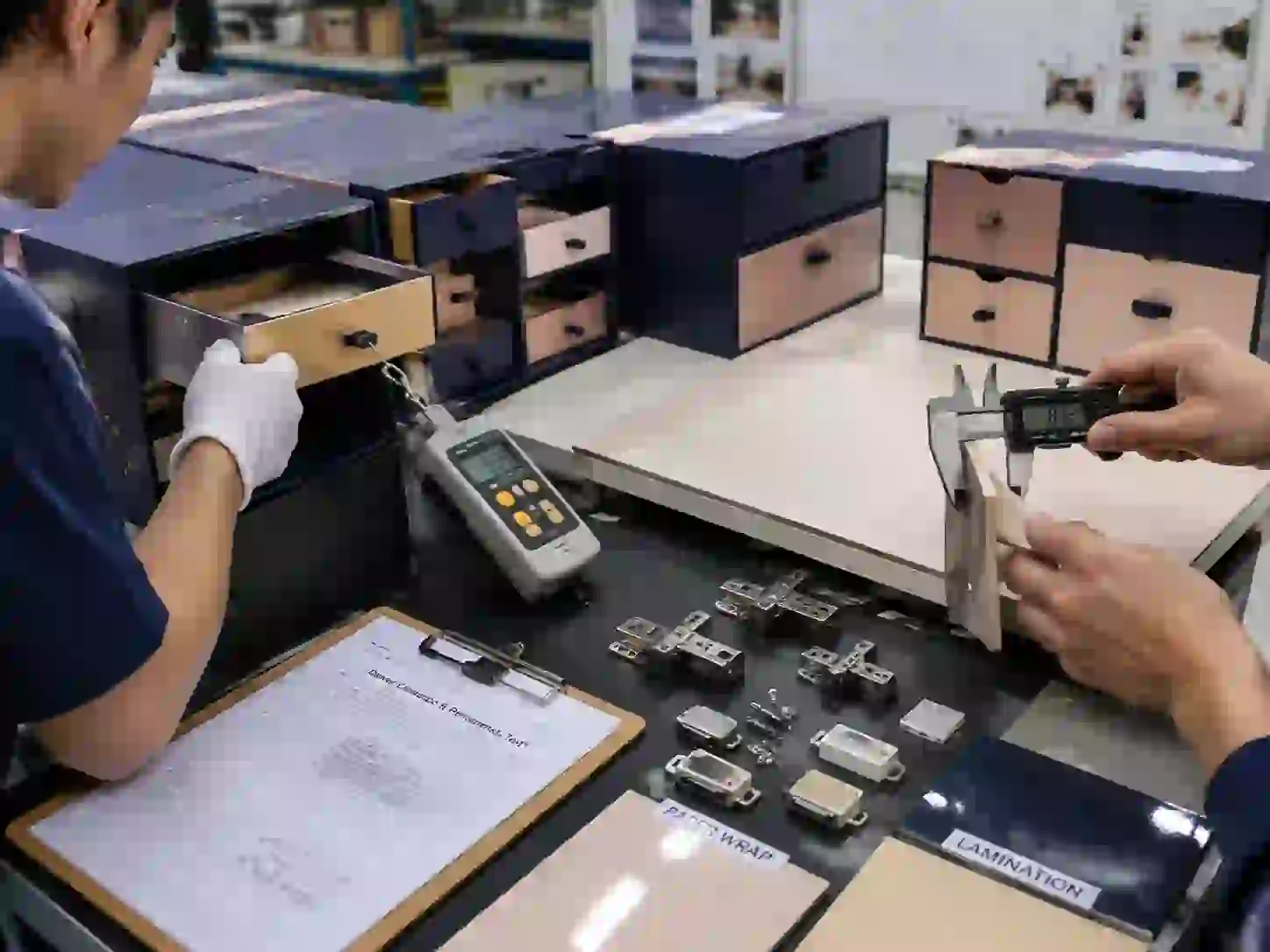
Which structural factors affect the required clearance?
Drawer clearance varies according to the complete structure. A shallow drawer, deep drawer, heavy product load, or magnetic closure system may require different adjustments.
- Drawer size: Larger drawers usually require more control of parallel alignment.
- Product weight: Heavy contents can increase friction during movement.
- Insert pressure: Tight inserts may push against drawer walls.
- Magnet placement: Magnetic closures must align without forcing the drawer position.
- Hinge or door interaction: Multi-part structures need enough space to avoid panel interference.
What problems happen when drawer clearance is too small?
Insufficient clearance can create both quality issues and assembly problems during production.
- Drawer surfaces may scratch or show friction marks.
- Workers may need extra force during assembly.
- Finished products may not open smoothly during inspection.
- Panels may deform because of repeated pressure.
- Buyers may reject samples because the opening performance does not match expectations.
What problems happen when drawer clearance is too large?
Excessive clearance can reduce the premium feel of the packaging and affect structural stability.
- The drawer may move sideways inside the sleeve.
- Products inside may shift if internal support is reduced.
- The structure may appear loose during handling.
- Magnetic or hinged components may not align correctly.
How can buyers approve drawer clearance before mass production?
Buyers should separate confirmed facts, project recommendations, and final approvals during development.
Verifiable facts
- Finished sample dimensions.
- Material thickness records.
- Engineering drawings.
- Inspection measurements.
Project-dependent recommendations
- Preferred drawer movement feel.
- Allowance for product weight and insert pressure.
- Adjustment approach for different finishing materials.
Buyer approvals
- Final prototype acceptance.
- Approved structural drawings.
- Confirmed finishing specifications.
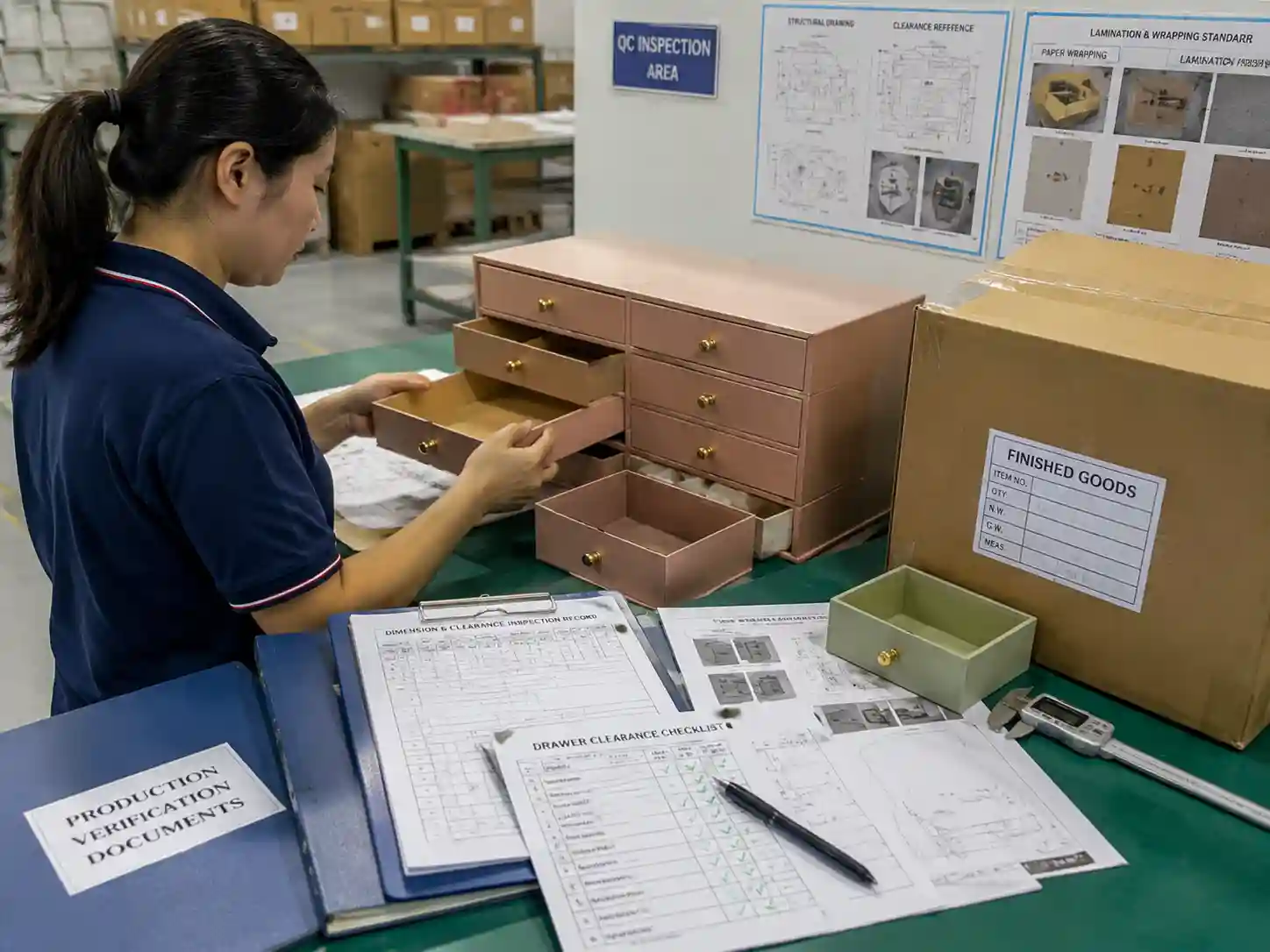
Drawer clearance failure-mode checklist
| Potential issue | Possible cause | Recommended check |
|---|---|---|
| Drawer sticks after finishing | Wrapping thickness or friction increase | Measure finished clearance and sliding points |
| Drawer feels loose | Excessive gap allowance | Check alignment and movement stability |
| Corner interference | Paper fold build-up | Inspect finished corners and edges |
| Assembly variation | Production tolerance differences | Compare samples with approved drawings |
Frequently asked questions about drawer clearance
Can drawer clearance be decided from the CAD drawing alone?
No. CAD drawings define intended dimensions, but finished wrapped and laminated samples are needed to confirm actual movement performance.
Does thicker lamination always require more clearance?
Not always. The effect depends on where the lamination is applied, edge construction, material compression, and the drawer structure.
Should clearance be checked before or after inserting products?
Both conditions may be reviewed. Empty drawer movement confirms structural fit, while loaded testing verifies performance under actual use conditions.
Giftpackpro supports custom structural packaging development through custom advent calendar box services, including design review, sample evaluation, and production preparation. For projects requiring specific drawer, door, hinge, or magnetic structure requirements, request a custom quote with your packaging drawings and product details.