Quick answer: Material certificate product page links should connect a material claim to evidence whose scope, material identity, issuer, date, revision, and applicability can be checked. A certificate should not appear as an unexplained badge or imply that every custom configuration is covered. For advent calendar packaging, the product page should identify what the document relates to, provide controlled access to appropriate evidence, and distinguish general supplier capability from evidence applicable to the buyer’s actual specification.
What should material certificate product page links actually prove?
A certificate link should help a buyer answer a specific question: does this document support the material claim being made on this product page? The link itself is not proof unless the underlying document can be connected to the material, specification, supplier, or production scope involved.
For a custom advent calendar, one finished pack can contain several materially different components: printed paper, rigid board, corrugated material, coatings, adhesives, magnets, ribbons, molded components, or other accessories. Evidence applicable to one component should not automatically be presented as evidence for the entire finished product.
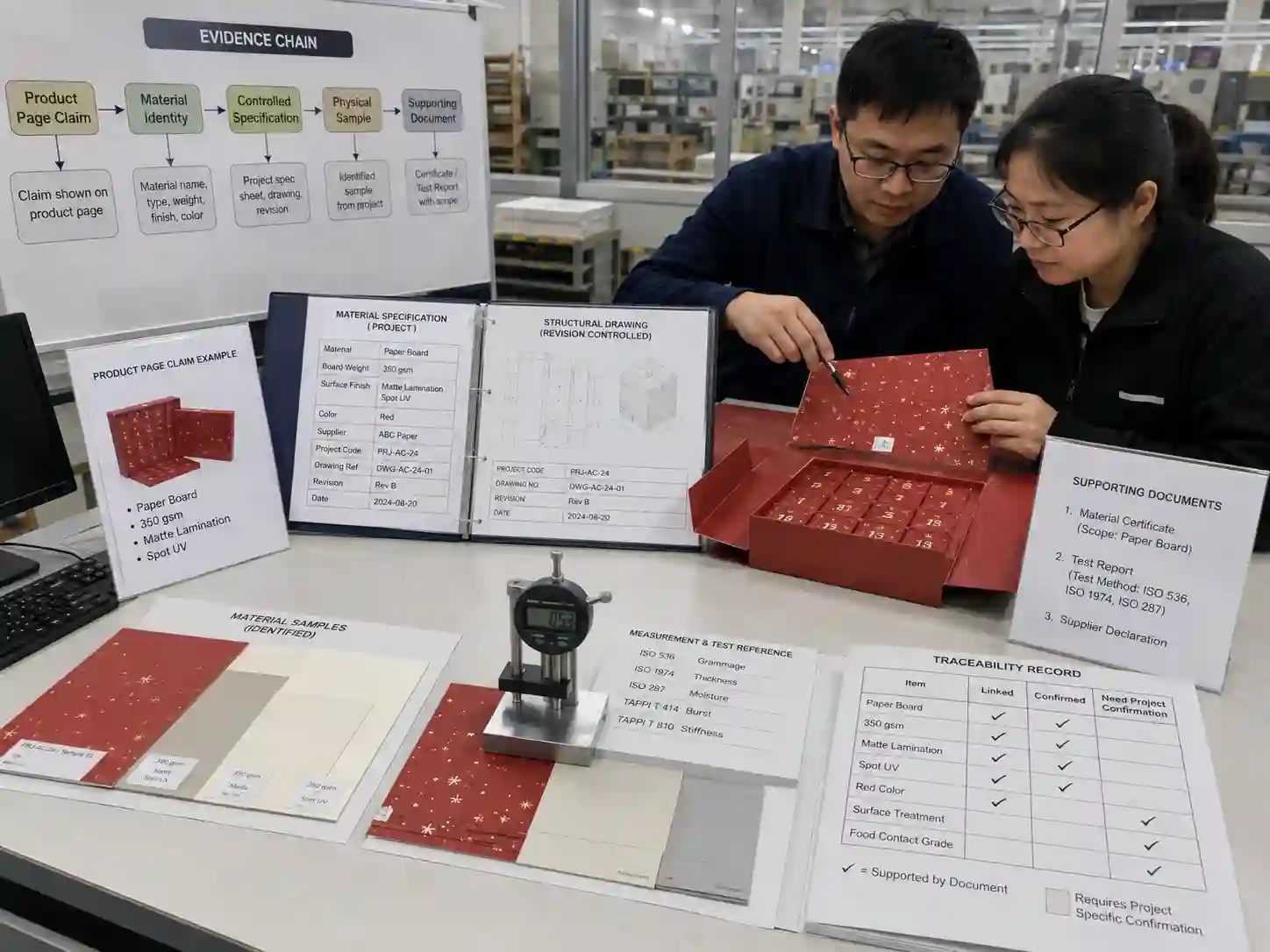
A useful evidence path therefore connects:
- the claim shown on the product page;
- the material or component to which that claim applies;
- the relevant specification, grade, or controlled material reference;
- the certificate, declaration, or test document supporting the claim;
- the document date, revision, validity, or other status information where applicable; and
- the project records needed to confirm that the specified material was actually used.

How should a supplier structure material certificate product page links?
The strongest structure is claim-to-evidence rather than page-to-document. Each important material statement should make clear what evidence is available and what that evidence covers before the buyer relies on it.
Should the link sit next to the material claim?
Yes, where practical. Evidence is easier to evaluate when the link or evidence reference appears close to the statement it supports rather than being buried in a general downloads page.
For example, a product page describing a particular paper or board option can provide an evidence reference beside that material description. The accompanying text should identify whether the document relates to a material grade, a material manufacturer, a supplier capability, a test sample, or another defined scope.
If the page covers many custom configurations, it may be more accurate to link to an evidence summary explaining available documentation rather than implying that one certificate covers every configuration.
What information should accompany the certificate link?
The buyer should be able to understand the document before opening it. At minimum, the page should provide enough context to identify the evidence and its intended scope.
| Evidence field | What the buyer should be able to determine | Why it matters |
|---|---|---|
| Document type | Certificate, test report, declaration, specification, or other record | Different documents support different types of claims |
| Material or component | The paper, board, coating, accessory, or other item covered | Prevents evidence for one component being applied to another |
| Issuer or source | Who issued or supplied the document | Allows source verification |
| Document identity | Reference number, revision, or other controlled identifier where available | Helps prevent confusion between document versions |
| Date or status | Issue date, revision date, validity information, or applicable period where relevant | Helps buyers identify obsolete or superseded evidence |
| Scope | Exactly what material, facility, sample, process, or organization is covered | Prevents overstatement |
| Project applicability | Whether the document is general evidence or confirmed for the buyer’s specification | Separates capability evidence from order-specific verification |
How can buyers verify that a certificate applies to the actual advent calendar?
Buyers should trace the certificate beyond the webpage to the approved material specification and production records. A valid-looking document can still be irrelevant if the production material cannot be connected to it.
A practical verification sequence is:
- Identify the exact claim made on the product page.
- Open the linked evidence and identify its stated scope.
- Check the material name, grade, specification, supplier reference, or other identifiers available in the document.
- Compare those identifiers with the project material specification or approved sample records.
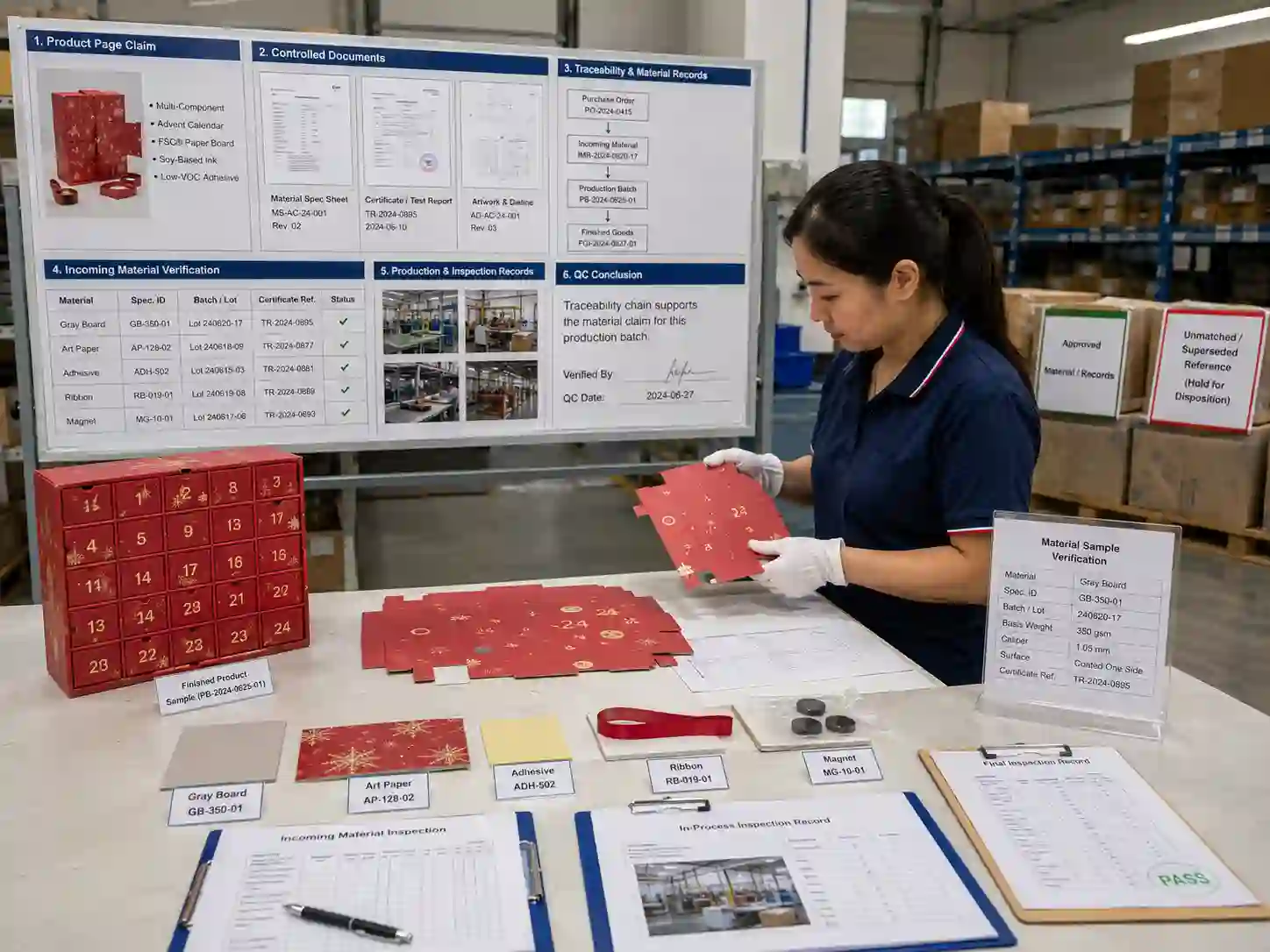
- Check whether purchasing, receiving, production, or traceability records identify the material actually used.
- Confirm that substitutions or revisions have not broken the evidence chain.
- Record any project-specific requirement that still needs buyer approval.
This process matters particularly for customized packaging because a product webpage normally represents a manufacturing capability or product family rather than one permanently fixed bill of materials.
What is the difference between a strong and weak certificate link?
A strong link preserves context and traceability. A weak link displays evidence without showing why it applies to the claim or product configuration.
| Weak documentation | Stronger documentation |
|---|---|
| A certificate icon with no explanation | A defined material claim accompanied by the relevant evidence type and scope |
| An unidentified PDF called “certificate” | A document identified by type, material, date, and controlled reference where available |
| Evidence for paper presented as if it covers the complete calendar | The page states which component or material the evidence covers |
| An old document with no status information | The applicable date, revision, validity, or review status is visible where relevant |
| A generic document presented as order-specific proof | General capability evidence is clearly separated from project-specific confirmation |
| No connection to production records | Material specifications and traceability records can be checked during project verification |
Which claims require project-specific verification?
Any claim that depends on the final material selection, construction, source, production batch, market requirement, or buyer specification may require project-specific verification. Public product-page evidence should not replace that approval process.
For example, a supplier may maintain documents showing that certain material options are available. That is a verifiable capability statement when supported by appropriate records. Whether the same evidence applies to a particular advent calendar depends on the material specification ultimately approved and used for that project.
Three categories should remain distinct:
- Verifiable facts: document identity, issuer, stated scope, material reference, dates, test method where applicable, and other information visible in controlled records.
- Project-dependent recommendations: which materials or evidence packages may be appropriate for a particular construction, destination, customer requirement, or intended claim.
- Buyer approvals: the final material specification, acceptable evidence, approved sample, substitutions, and any contractual documentation requirements.
What risks should suppliers avoid when publishing certificate links?
The main risk is creating a broader claim than the evidence supports. Suppliers should also control obsolete documents, ambiguous scope, broken traceability, and confidential information.
Can one certificate be reused across several product pages?
Only when its scope genuinely supports the claims made on those pages. Reusing the same document merely because several products use similar materials can create misleading associations.
Each page should independently state what the evidence covers. If applicability changes with the selected material or construction, that limitation should be visible.
What happens when a material or document changes?
The evidence relationship should be reviewed whenever a relevant material specification, source, document revision, or product-page claim changes. Otherwise, a technically functional link can point to evidence that is no longer applicable.
Document control does not require publishing every internal record. It does require a method for identifying which public evidence is current and which project records support the actual production specification.
Should every complete certificate be publicly downloadable?
Not necessarily. Public access should balance useful verification with confidentiality, document-owner restrictions, and project-specific information.
A product page can provide a controlled evidence summary and make appropriate documents available during qualification or project review. Sensitive customer details, commercial information, unrelated test data, or confidential supplier information should not be exposed merely to make the page appear more transparent.
What should buyers check before accepting linked material evidence?
Buyers should check relevance rather than document quantity. Several certificates with unclear applicability are less useful than a smaller evidence set that can be traced to the specified materials.
- Does the webpage state exactly what material claim is being supported?
- Can the linked document be identified by type and source?
- Is its scope visible and relevant to the stated material?
- Are dates, revisions, validity details, or status information available where relevant?
- Does the document identify a material, sample, facility, organization, or other defined subject?
- Can that subject be connected to the project’s material specification?
- Can purchasing, incoming inspection, production, or traceability records confirm the material used?
- Are substitutions controlled rather than silently treated as equivalent?
- Are general capability claims separated from project-specific evidence?
- Is final applicability subject to the required buyer approval?
For buyers reviewing custom advent calendar box products, this evidence structure provides a useful starting point, but project documentation should still be checked against the actual construction and approved specification.
How should certificate evidence fit into supplier capability review?
Certificate links should be one part of a broader evidence chain, not a substitute for supplier verification. The useful question is whether the supplier can connect public claims to controlled specifications and then connect those specifications to real production records.
During capability review, buyers can examine material specification sheets, revision-controlled drawings where relevant, approved samples, incoming material records, inspection documents, dated production evidence, traceability information, and corrective-action records. These records help establish whether document control continues beyond the website.
Information about the Giftpackpro packaging factory can provide general supplier context, while material and documentation requirements for an actual order should be established through project-specific review.
What should the final product-page evidence structure look like?
The final structure should let a buyer move from claim to evidence to applicability without guessing. Keep the public presentation concise, while maintaining deeper controlled records for project verification.
A practical sequence is: product claim → identified material/component → evidence summary → controlled document → stated scope → project specification → production traceability → buyer approval where required.
This approach makes certificate links useful for procurement and quality review without suggesting that a generic document automatically certifies every custom advent calendar configuration.
FAQ: Do material certificates prove that the documented material was used in my order?
Not by themselves. The certificate establishes information within its stated scope; order-level verification normally requires a connection to the approved material specification and relevant purchasing, receiving, production, or traceability records.
FAQ: Should a product page show certificate expiry or revision information?
It should show applicable status information when that information is relevant to interpreting the evidence. Buyers should also check the underlying document rather than relying solely on a webpage summary.
FAQ: What if a custom project uses a different material from the product-page example?
The supplier should reassess the evidence rather than automatically carrying the existing claim forward. The new material specification and supporting documentation should be reviewed before the relevant claim is approved for the project.
For a specific advent calendar project, request a custom quote and include the material claims, documentation requirements, and buyer approval criteria that need to be verified.