Quick answer: A multi density eva insert is needed when one insert must protect products with different sensitivity levels, weights, shapes, or contact requirements. Instead of using one EVA hardness throughout, engineers combine softer and firmer zones to balance cushioning, retention force, removal access, and transit stability. The decision depends on product dimensions, cavity geometry, handling requirements, and validation samples rather than appearance alone.
What is a multi density EVA insert and why is it used?
A multi density eva insert combines EVA foam areas with different hardness or compression characteristics inside one custom insert structure. The purpose is to create different support behaviors for specific product contact points.
A single-density EVA insert may work well for uniform products, but mixed product sets often create conflicting requirements. For example, a heavier glass container may need stronger support while a delicate cosmetic tube may need softer contact surfaces.
Engineers typically evaluate multiple density zones when the packaging design requires:
- different products sharing one insert layout;
- high-risk contact areas requiring additional cushioning;
- strong retention without making products difficult to remove;
- stable positioning during transportation and handling.
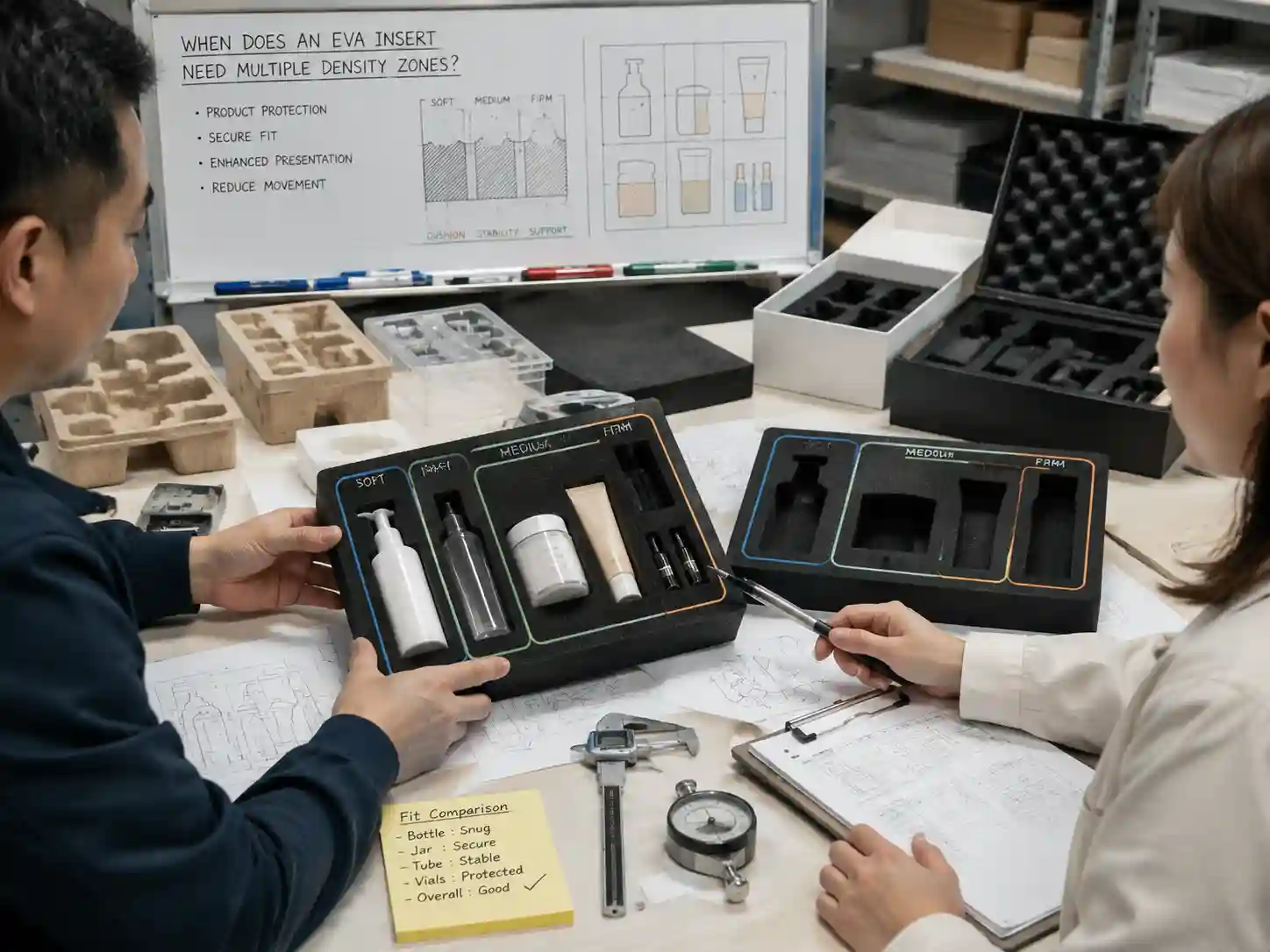
When does an EVA insert need multiple density zones?
A multi density eva insert is usually considered when product weight, shape, or handling requirements cannot be balanced with one foam density. The decision should be based on measured product conditions and prototype evaluation.
Does product weight difference require multiple EVA densities?
Large differences in product weight are one common reason for using multiple density zones. Heavy items can compress softer EVA excessively, while lightweight products may not receive enough support from very firm foam.
For example, an advent calendar containing glass bottles, jars, and smaller tubes may require different support levels. A firmer zone can stabilize heavier items, while a softer zone can protect surfaces or improve removal comfort.
Do fragile surfaces require softer EVA contact zones?
Yes. Products with sensitive finishes, coated surfaces, or delicate components may require softer EVA contact areas to reduce pressure marks and abrasion risks.
However, softer foam alone does not always improve protection. If the cavity does not control movement, the product may still shift during transportation. Density selection must work together with cavity geometry and retention features.
How do engineers decide the density zones in an EVA insert?
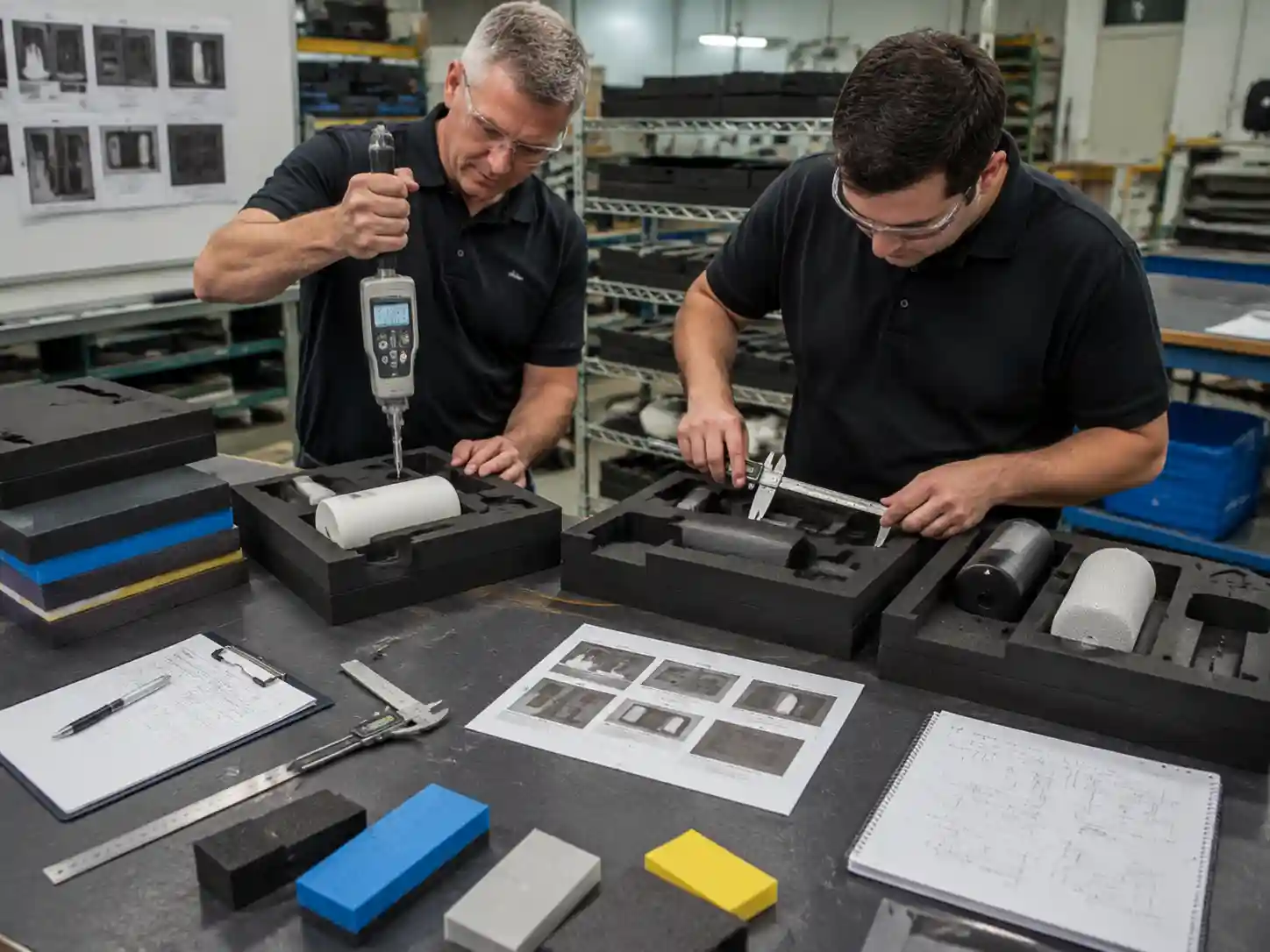
Engineers normally define density zones by mapping where support, cushioning, and retention are required. The decision is confirmed through drawings, prototypes, measurements, and fit testing.
- Measure the product: Record height, diameter, weight, center of gravity, protruding parts, and contact surfaces.
- Define retention areas: Identify where the product needs stronger holding force and where removal access is required.
- Select foam behavior: Compare softer and firmer EVA options based on compression and recovery characteristics.
- Create cavity samples: Produce trial inserts to check fit, orientation, and product handling.
- Review approval evidence: Use measurement sheets, fit-test records, and sample approval notes before production decisions.
How do different EVA density zones affect retention and removal?
The density arrangement directly influences how securely products stay in position and how easily users can remove them.
| Density zone approach | Typical function | Design consideration |
|---|---|---|
| Firm EVA support zone | Controls movement and supports heavier products | Avoid excessive holding force that prevents removal |
| Soft EVA contact zone | Provides cushioning around sensitive surfaces | Confirm compression does not allow product movement |
| Medium EVA transition zone | Balances support between different areas | Check cavity stability during handling |
The correct balance depends on product geometry. A cavity that holds a cylindrical bottle may need different support compared with a flat cosmetic compact or irregular-shaped item.
What checks should be completed before approving a multi density EVA insert?
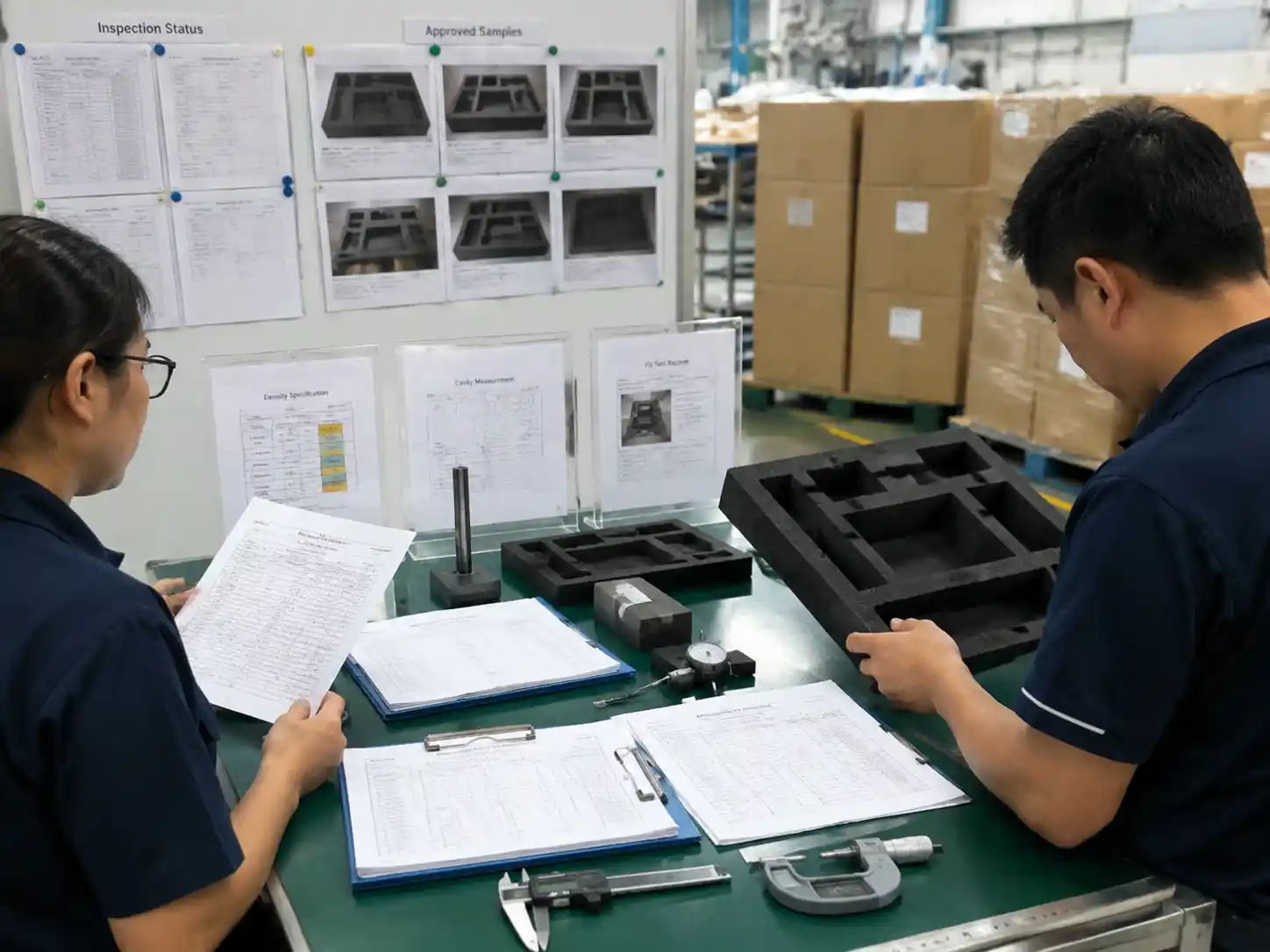
Approval should rely on physical samples and documented checks rather than visual inspection only. Important evaluations include:
- Cavity fit check: Confirm products sit at the intended depth and orientation.
- Removal test: Verify products can be taken out without excessive pulling force.
- Retention review: Check that products remain stable when the package is moved.
- Surface protection check: Inspect whether EVA contact areas create marks or pressure points.
- Assembly review: Confirm the insert fits correctly inside the final box structure.
For complex seasonal gift packaging projects, these records help buyers compare approved samples with later production output. Giftpackpro supports custom packaging development through custom advent calendar box services and can coordinate insert structure discussions during project development.
What risks occur when a single EVA density is used incorrectly?
Using one EVA density for all products can create design compromises. The most common risks include poor retention, difficult product removal, excessive compression, or unnecessary material cost.
- Soft EVA throughout the insert may allow heavier products to move.
- Firm EVA throughout the insert may create difficult removal and uncomfortable handling.
- Incorrect cavity support may increase stress on product surfaces.
- Mixed product sets may require different support strategies that one density cannot provide.
The correct solution is not always multiple densities. Some projects can use a single EVA type with optimized cavity geometry. Multiple density zones should be selected only when the performance difference can be verified through samples and testing.
How should buyers approve a multi density EVA insert design?
Buyers should approve the insert based on physical evidence, including cavity drawings, material samples, loaded prototypes, and inspection records.
Recommended approval documents include:
- approved cavity layout drawings;
- EVA material and density specifications;
- product loading photographs or fit-test records;
- dimensional inspection notes;
- final sample approval records.
These documents create a clear reference between design intent and manufacturing execution. For packaging projects requiring custom structures, buyers can review custom advent calendar box products or advent calendar box buying guides for related design considerations.
FAQ: Is a multi density EVA insert always better than single density foam?
No. Multiple density zones are useful only when different product areas require different support behavior. A well-designed single-density insert may be sufficient for uniform products.
FAQ: Can EVA density zones be combined with other insert materials?
Yes. Some packaging structures combine EVA with paperboard, PET, foam, or molded-pulp components when different functions are required, such as structural support and product cushioning.
FAQ: What information should buyers provide before EVA insert design?
Buyers should provide product dimensions, weights, orientation requirements, surface sensitivity details, and intended packaging configuration. These inputs help determine whether multiple density zones are necessary.
Need a custom insert evaluation for your seasonal packaging project? request a custom quote and provide your product details for engineering review.