Quick answer: Useful packaging defect corrective action evidence should connect a specific defect to an identified product, requirement, production batch, containment action, root-cause investigation, corrective action, verification result, and final disposition. Buyers should be able to trace what failed, how the supplier measured or confirmed the failure, which goods were affected, what was changed, and what evidence justified releasing corrected production. Photos alone are rarely enough.

What should packaging defect corrective action evidence contain?
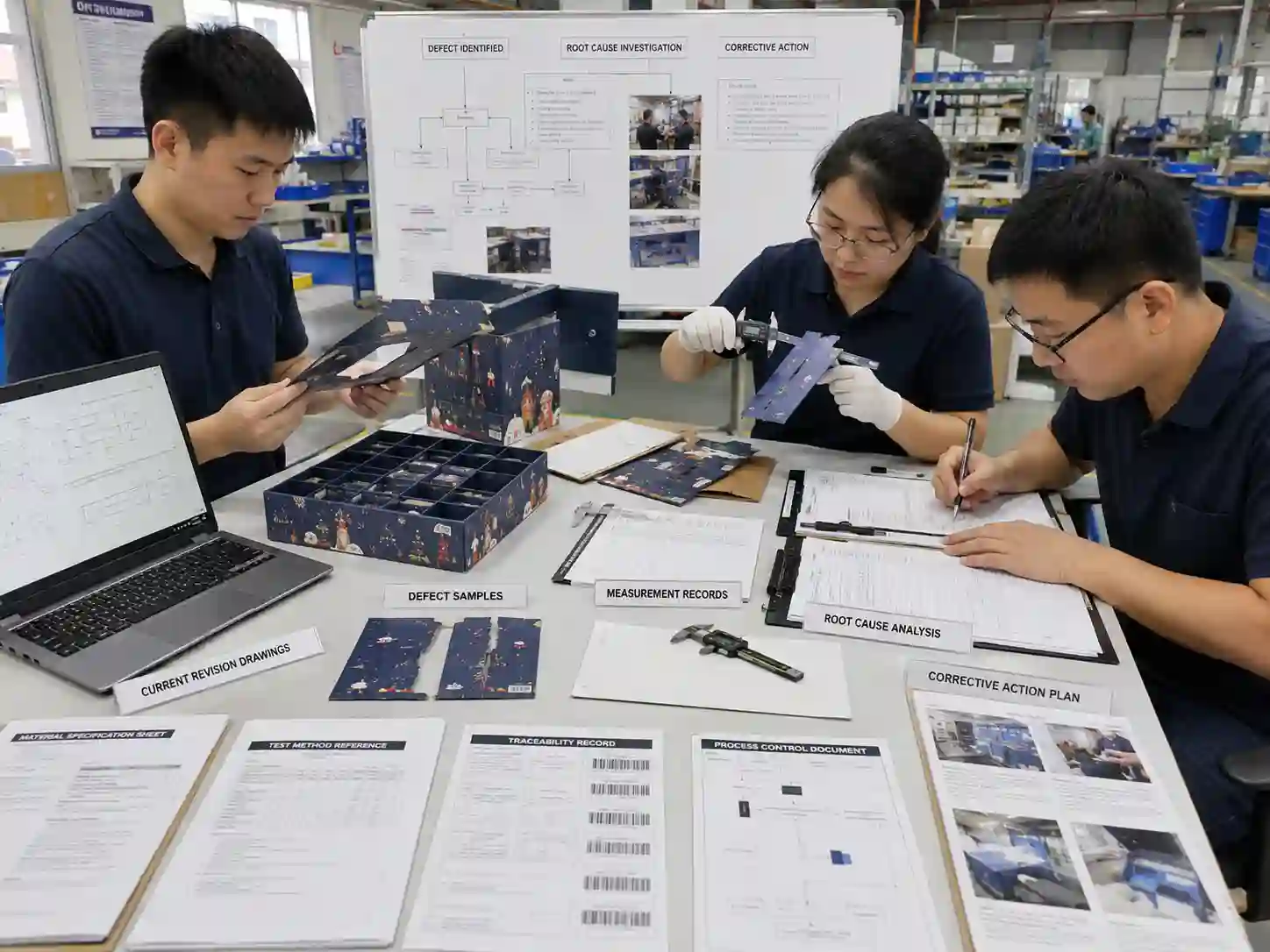
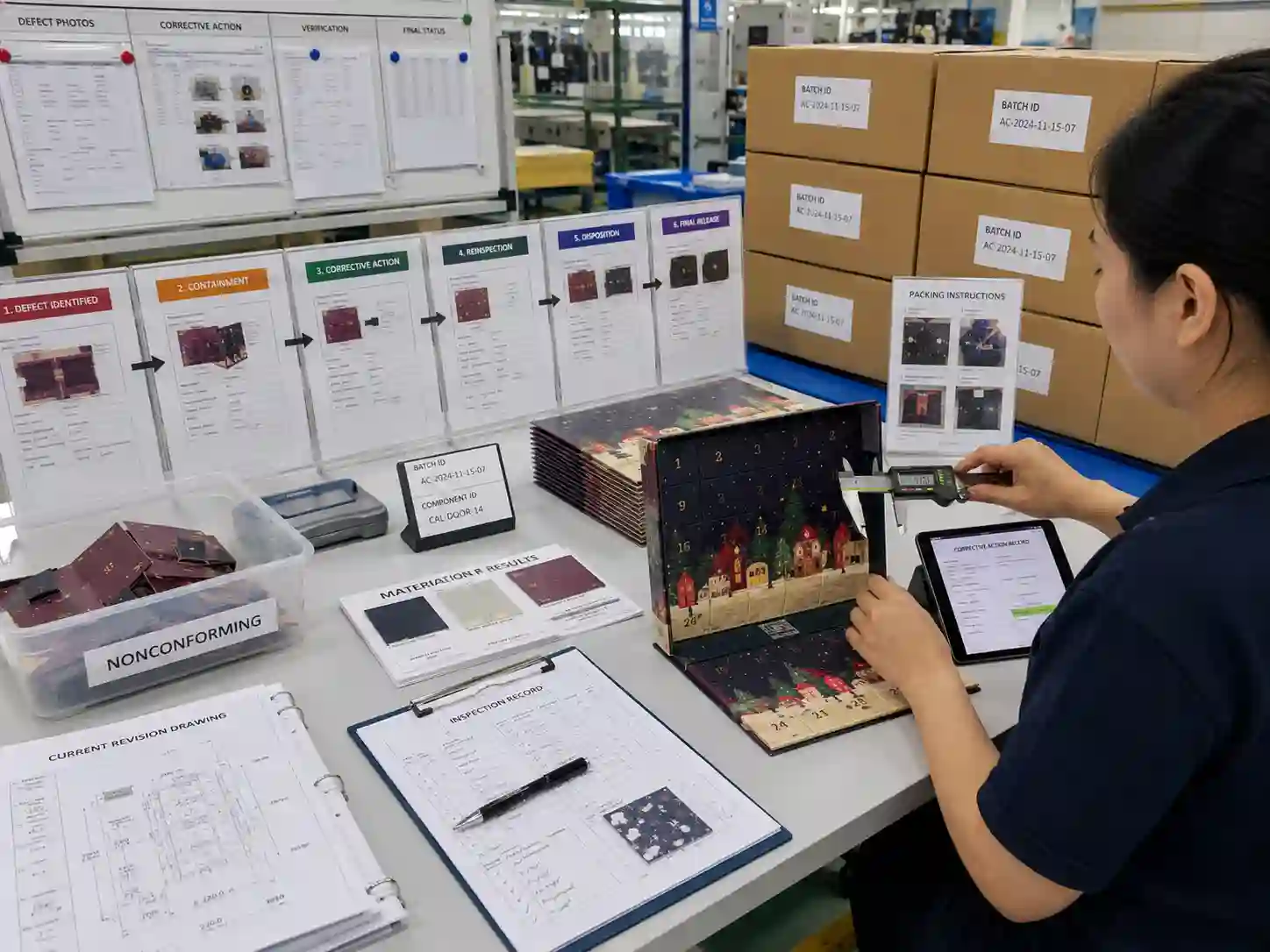
A complete record should create an evidence chain from the controlled requirement to the defect and then to verified correction. It should allow a buyer or quality reviewer to reconstruct the event without relying on an undocumented explanation from the supplier.
For multi-component packaging such as advent calendar boxes, this is particularly important because a defect may originate in printed paper, greyboard, inserts, doors, trays, adhesives, magnets, ribbons, assembly operations, or packing rather than in the finished box as a whole.
| Evidence | What it should establish | Buyer verification |
|---|---|---|
| Defect identification | What failed and where it occurred | Check that the description identifies the component, feature, location, and defect type. |
| Controlled requirement | What the product was supposed to meet | Compare the record with the applicable drawing revision, specification, approved sample, or inspection requirement. |
| Measurement or inspection result | Objective evidence of the nonconformity | Check dimensions, observations, test method, inspection date, and equipment where applicable. |
| Traceability | Which materials, components, batches, or cartons may be affected | Match identifiers across production, inspection, rework, and packing records. |
| Containment | How potentially affected goods were controlled | Look for segregation, inspection scope, hold status, or other documented controls. |
| Root cause | Why the defect occurred | Check whether evidence supports the stated cause rather than merely restating the symptom. |
| Corrective action | What changed to address the cause | Identify the process, tooling, material, instruction, training, or control that was changed. |
| Verification and disposition | Whether the action worked and what happened to affected goods | Review reinspection or test results and the documented disposition before release. |
How should the supplier record the original packaging defect?
The defect record should describe an observable condition and connect it to the applicable requirement. Statements such as “box quality poor” or “assembly problem” are too vague to support meaningful corrective action.
A stronger record might identify a door position outside the drawing tolerance, adhesive contamination on a defined surface, board thickness inconsistent with the controlled material specification, or a component that failed a documented functional inspection.
Where measurements are relevant, the record should retain the actual result rather than only “pass” or “fail.” Depending on the defect, useful evidence can include dimensions, material identification, test results, inspection quantities, defect counts, photographs, drawing references, and sample or batch identities.
Dated photographs can help establish what inspectors observed, but photographs should support rather than replace measurable requirements. A photo showing a misaligned component becomes more useful when it is linked to the affected batch, inspection record, and current drawing or approved specification.
How should the defect be connected to drawings and specifications?
The supplier should reference the controlled requirement that was in force when the defect occurred. This prevents an important ambiguity: whether production actually failed a requirement or whether the requirement itself was unclear or had changed.
Relevant references may include revision-controlled structural drawings, material specification sheets, approved samples, workmanship criteria, inspection instructions, packing requirements, or an agreed test method.
Buyers should verify revision identity carefully. A measurement compared with an obsolete drawing does not provide reliable evidence about current production.
What varies by packaging project?
The appropriate acceptance criteria are project-dependent. Dimensional tolerances, appearance limits, functional checks, material requirements, inspection levels, and test methods should come from the applicable project documents rather than from an assumed universal standard.
Where a requirement requires buyer approval rather than objective supplier verification, the record should say so. For example, a borderline cosmetic appearance may require an approved reference sample or explicit buyer disposition instead of an internal supplier decision.
How should affected production be traced and contained?
A corrective-action record is much stronger when the supplier can define the potentially affected population. Traceability should connect the defect to relevant materials, components, work stages, inspection records, production identities, and packed goods as far as the project’s traceability system allows.
For example, if an assembly problem is discovered during final inspection, the investigation should determine whether it is limited to one work period or component batch or could affect a wider production quantity. The supplier should document the basis for that decision.
Containment records can then show which goods were placed on hold, segregated, screened, reworked, rejected, or otherwise controlled. If already packed cartons are involved, carton or packing identities can help demonstrate that suspect and released goods were not mixed.
How should root cause and corrective action be documented?
The root-cause section should explain why the nonconformity happened, while the corrective-action section should show what was changed to address that cause. Simply recording “operator error” followed by “operator reminded” often provides little evidence that recurrence risk has been controlled.
The investigation method should be proportionate to the problem. A complex recurring structural failure may require deeper analysis than an isolated, clearly explained handling error.
Depending on the verified cause, corrective action could involve an updated work instruction, tooling adjustment, revised process parameter, material control, fixture change, inspection checkpoint, maintenance action, or another documented process control. The record should identify what was actually implemented and, where relevant, its effective date or production applicability.
What does strong versus weak documentation look like?
| Weak documentation | Stronger documentation |
|---|---|
| “Door alignment problem.” | Identifies the affected door or component, production identity, inspection result, and applicable drawing requirement. |
| One undated defect photo. | Dated photos linked to the inspection record and identifiable production or sample reference. |
| “Operator mistake.” | Evidence identifies the process condition or control failure that allowed the defect to occur. |
| “Problem fixed.” | Specific corrective action is recorded with evidence of implementation. |
| “Rechecked OK.” | Reinspection scope, method, results, identity, date, and disposition are documented. |
| No connection to packing. | Released production can be connected to relevant final inspection and packing identities. |
How should a supplier prove that corrective action worked?
The supplier should verify effectiveness using evidence appropriate to the original failure. The verification should test the corrected condition rather than merely confirm that someone completed the corrective-action form.
If the original defect was dimensional, verification may require new measurements. If it involved material identity, the supplier may need to verify the corrected material against the controlled specification. A functional failure may require repeating the applicable functional check or test.
Records should distinguish three separate decisions: the corrective action was implemented, affected goods were properly dispositioned, and production met the applicable release requirements. These decisions are related but are not interchangeable.
What should buyers check before accepting corrective-action evidence?
Buyers should test whether the record is internally consistent from beginning to end. The strongest documentation lets the reviewer follow the same component or production identity through detection, containment, investigation, correction, verification, and release.
- Is the defect described specifically enough to reproduce the inspection decision?
- Is the current drawing, specification, sample, or test requirement identified?
- Are actual measurements or inspection findings retained where relevant?
- Can the affected material, component, sample, or production batch be identified?
- Does the containment scope have a documented basis?
- Does root-cause evidence explain why the defect occurred?
- Does the corrective action address that cause rather than only the visible symptom?
- Was the correction verified using an appropriate measurement, inspection, or test?
- Is the disposition of nonconforming or reworked goods recorded?
- Can approved production be connected to final inspection and packing records where required?
Missing links matter. A detailed root-cause report with no batch traceability may leave the buyer uncertain about which goods were affected. Excellent photographs without specification references may show an appearance difference without proving nonconformity. Rework records without subsequent inspection evidence do not establish that the reworked goods met release requirements.
Which records are facts, project-dependent requirements, or buyer approvals?
Separating these categories prevents a corrective-action file from presenting assumptions as verified conclusions. The distinction is especially useful when suppliers and buyers are reviewing complex packaging remotely.
Verifiable facts include recorded measurements, drawing revisions, material identities, inspection results, dated production evidence, batch references, documented actions, and reinspection results.
Project-dependent requirements include tolerance limits, inspection scope, sampling method, test method, cosmetic acceptance criteria, traceability depth, and the evidence required for release. These should be defined by the relevant project documents.
Buyer approvals may be necessary when disposition changes an approved requirement, when a deviation is proposed, or when subjective appearance must be accepted against an agreed reference. Supplier documentation should not silently convert such decisions into internal approvals.
How can corrective-action records help evaluate supplier capability?
Corrective-action records can show whether a supplier has a disciplined method for connecting requirements, physical production, inspection findings, traceability, investigation, correction, and release. Buyers should evaluate the evidence chain rather than judge capability from polished report formatting alone.
A useful capability review can therefore ask the supplier to demonstrate a redacted or generic example of how a defect moves through its control process. The objective is not to collect confidential information from another customer’s order, but to understand whether the supplier’s documentation system preserves the identities and evidence needed for verification.
Buyers reviewing a broader sourcing decision can also compare this evidence with information about the Giftpackpro packaging factory and relevant custom advent calendar box services. For related procurement and quality topics, see the advent calendar box buying guides.
What are the most common gaps in packaging corrective-action records?
The most important gaps are usually broken connections in the evidence chain. Common examples include obsolete specification references, unidentified photos, missing batch identities, unsupported root-cause statements, undocumented rework, and release decisions without verification results.
Another warning sign is a corrective-action report that becomes more detailed after the investigation but never defines the original defect objectively. If reviewers cannot establish exactly what failed, they cannot reliably judge whether the proposed action corrected it.
FAQs about packaging defect and corrective-action evidence
Should every packaging defect require a full corrective-action report?
Not necessarily. The required response should depend on the defect’s significance, recurrence, affected scope, contractual requirements, and project quality plan. Suppliers should still retain enough inspection and disposition evidence to show how identified nonconforming goods were controlled.
Are photos sufficient evidence that a packaging defect was corrected?
Usually not by themselves. Photos are valuable for visible conditions, but dimensional, material, functional, or traceability claims normally require the corresponding measurement, specification, test, inspection, or production record.
Should buyers approve supplier corrective actions?
Only where the project requires buyer approval. Suppliers can investigate and implement internal process controls, while deviations from approved specifications, samples, or other buyer-controlled requirements may require explicit authorization before affected goods are released.
Should corrective-action evidence extend to final packing?
It should when packing identity is necessary to prove that corrected and released goods are separated from suspect production. The required traceability depth varies by project, but buyers should be able to understand how the final release decision relates to the goods being shipped.
For a custom packaging project where defect controls, traceability evidence, inspection requirements, and approval responsibilities need to be defined before production, request a custom quote and provide the applicable drawings, specifications, product requirements, and quality expectations for review.