
Quick answer: Good packaging material specification documentation should connect the approved material requirement to a controlled specification, identifiable samples, measurement or test records, production batches, and final inspection evidence. Board thickness should not appear as an isolated number. Buyers should be able to see what material was specified, how thickness was measured, which revision applies, what was actually used in production, and which deviations required approval.

What should packaging material specification documentation contain?
A useful material record should define the material precisely enough for purchasing, production, QC, and the buyer to identify the same requirement. It should also distinguish supplier-verifiable facts from characteristics that remain project-dependent.
For paperboard, rigid-board components, liners, printed paper, and related paper packaging materials, the controlled specification may include:
- material or board type;
- nominal thickness and applicable tolerance or acceptance criteria;
- basis weight or grammage where it is relevant to the specified material;
- grade, construction, surface, coating, or finish where applicable;
- component or location where the material is used;
- approved drawing, BOM, or specification revision;
- supplier or internal material reference;
- measurement or verification method;
- sample, lot, batch, or production reference where traceability is required;
- date and approval status.
Not every project requires every field. The important principle is that a buyer should not have to infer which board a thickness value describes or whether that value applies to the current construction.
How should a supplier document board thickness?
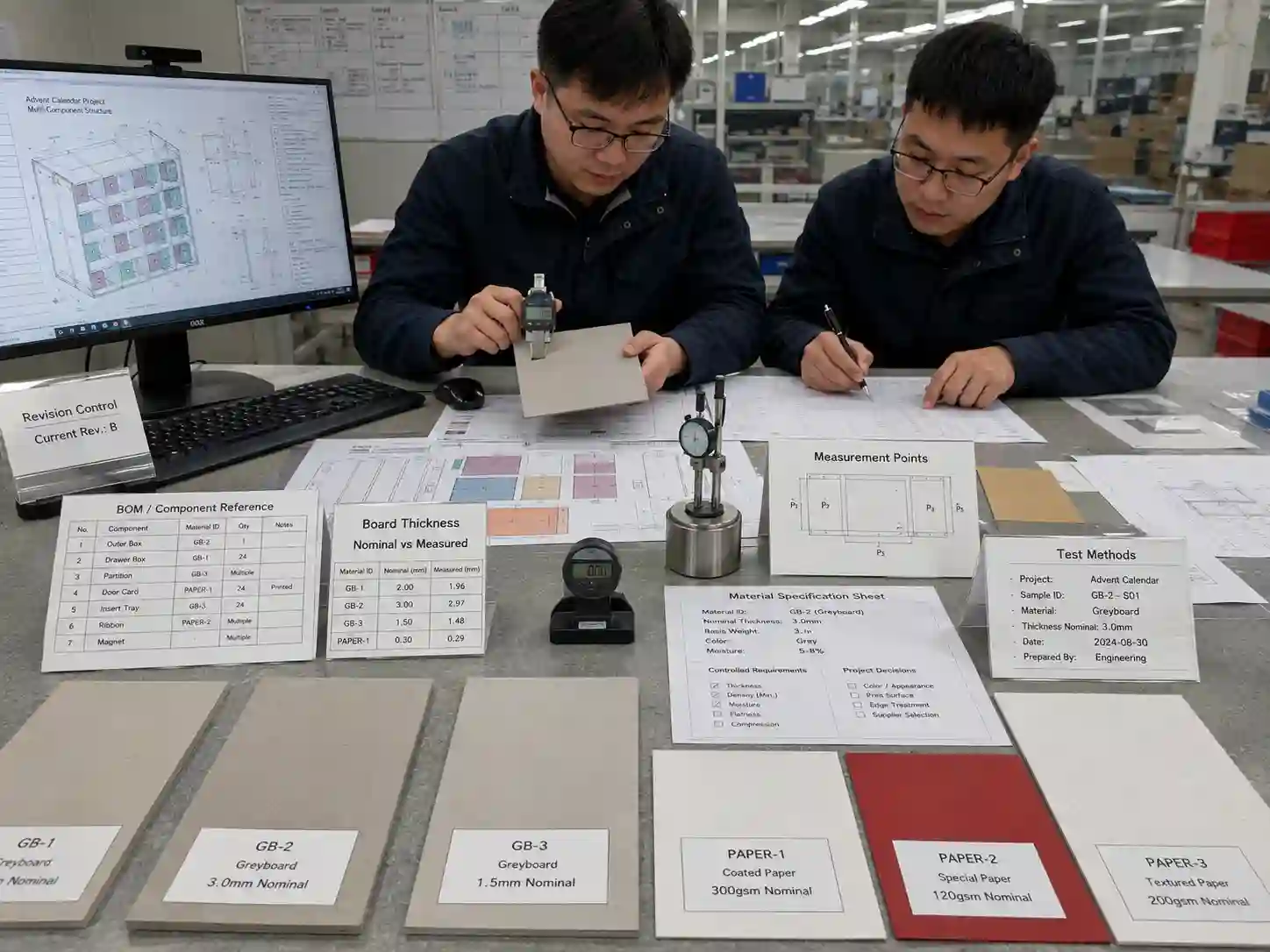
Board thickness should be recorded as a controlled requirement and supported by measurements from identifiable material or packaging components. The record should state where the measurement was taken and which method or instrument was used.
A specification stating only “2 mm board” is weak evidence because it does not identify the component, revision, measurement method, tolerance, or actual production result.
A stronger record links the nominal requirement to the physical product. For example, the documentation can identify the board used for a rigid-box wall, the relevant drawing revision, the approved nominal thickness, the measurement method, the sample or batch inspected, and the recorded results.
Should nominal thickness and measured thickness be kept separate?
Yes. Nominal thickness is the controlled requirement; measured thickness is evidence from a particular material sample, production lot, or finished component. Treating them as the same field makes it difficult to identify variation or nonconformity.
Where tolerances apply, they should be defined through the applicable specification, drawing, approved standard, or project acceptance record rather than assumed from a generic statement.
What evidence should support the material specification?
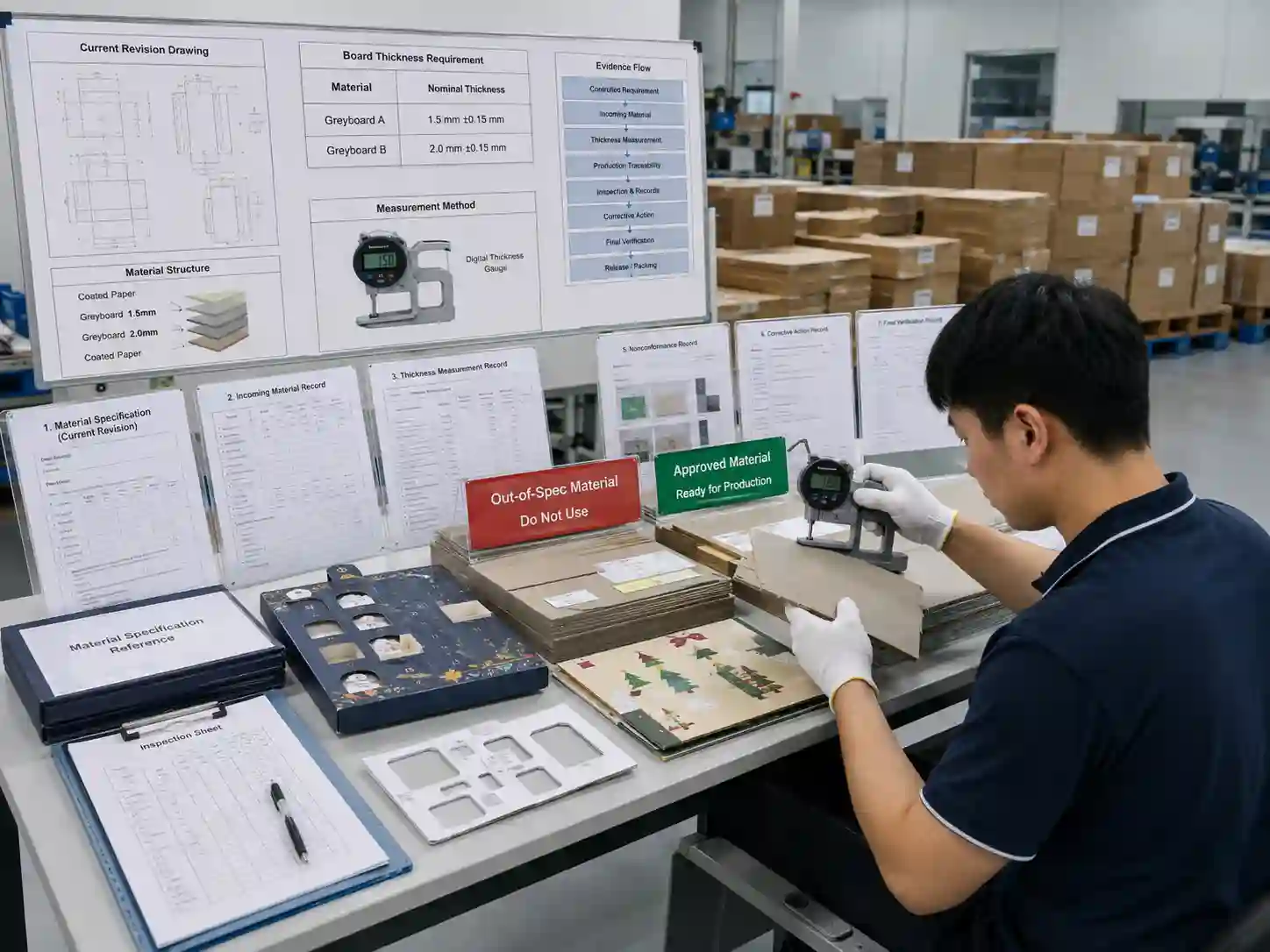
The strongest documentation creates an evidence chain from requirement to production. A material specification sheet alone defines what should be used, but additional records help demonstrate what was actually sampled, received, manufactured, and inspected.
| Evidence | What it should establish | Buyer check |
|---|---|---|
| Controlled material specification | Required board or paper characteristics | Confirm material reference and current revision |
| Structural drawing or BOM | Where the specified material is used | Match component references across documents |
| Approved physical sample | Reference construction accepted for the project | Confirm sample identity and approval status |
| Thickness measurement record | Actual measured values for identified material or components | Check instrument, locations, date, and sample or lot identity |
| Incoming-material record | Material received for production | Trace the received material to the specified reference |
| Production or QC record | Material or construction checked during manufacturing | Confirm records correspond to the production batch |
| Nonconformity and corrective-action record | How an identified material deviation was controlled | Check disposition and verification after correction |
Certificates or supplier test documents can provide additional evidence when relevant, but their scope should be checked. A document for a general material family does not automatically prove that the material used for a particular order has the same specification or traceability.
How should drawings, samples, and material records be linked?
Use common identifiers and revision control. The drawing, material specification, sample record, BOM, inspection record, and production evidence should make it possible to determine that they refer to the same approved construction.
This becomes especially important for multi-component packaging. An advent calendar may use different board or paper specifications for an outer shell, internal walls, drawers, doors, dividers, printed wraps, or other components. A single statement such as “made from 2 mm board” can therefore be misleading if the construction uses several materials.
A controlled drawing can identify each relevant component, while the material specification or BOM assigns the required material to that component. Inspection records can then reference the same component identifiers.
How should specification revisions be controlled?
Every material-changing revision should be identifiable so production and QC do not rely on superseded requirements. The current approved revision should be distinguishable from earlier versions.
If engineering changes a board grade or thickness after testing or sample review, the affected drawing, specification, BOM, sample status, and inspection criteria should be reviewed together. Dated records help establish when the change became effective.
Buyers should approve changes that alter an agreed material requirement, appearance, structure, product fit, or other contractually controlled characteristic. Internal supplier updates that do not change approved requirements may follow the supplier’s own document-control process.
What does strong versus weak board documentation look like?
Strong documentation is specific, traceable, revision-controlled, and supported by physical verification. Weak documentation relies on descriptions that cannot easily be connected to the material actually used.
| Weak documentation | Stronger documentation |
|---|---|
| “Thick greyboard” | Controlled material reference linked to the applicable component and drawing revision |
| “2 mm” in an email | Nominal thickness recorded in the approved specification with defined acceptance criteria |
| Unidentified caliper photograph | Dated measurement record linked to an identified sample, lot, or production batch |
| Material report with unclear scope | Supporting document whose material identity and applicability can be checked |
| Old sample used informally | Identified approved sample with revision and approval status |
| Material changed without documented review | Revision record showing the change, affected documents, approval, and verification |
How can buyers verify the specification before relying on it?
Buyers should test whether the supplier’s records form a continuous evidence chain rather than reviewing documents independently. Start with the approved requirement and work forward to the physical sample or production evidence.
- Identify the material requirement on the current drawing, specification, or BOM.
- Confirm which packaging component the requirement applies to.
- Check the nominal thickness and any approved acceptance criteria.
- Match the material reference to the approved sample or other controlled reference.
- Review how thickness or other relevant characteristics are measured.
- Check that measurement records identify the sample, lot, batch, or inspection stage where required.
- Confirm production and QC records use the correct revision.
- Review any material deviations, concessions, rework, substitutions, or corrective actions.
- Confirm buyer approval where a change affects an agreed specification.
This review can be incorporated into a broader supplier capability assessment. Buyers evaluating a new source can also review the Giftpackpro packaging factory and relevant custom advent calendar box services before requesting project-specific evidence.
Which facts are verifiable, and which requirements vary by project?
Separate measured or documented facts from engineering decisions. This prevents supplier evidence from being interpreted as a universal material recommendation.
Verifiable facts can include the stated material reference, drawing revision, nominal specification, actual recorded measurements, inspection date, sample identity, batch reference, and documented disposition of a nonconformity.
Project-dependent requirements include the appropriate board construction, thickness, tolerances, inspection frequency, measurement locations, test methods, and the amount of traceability required. These depend on the packaging structure, product load, manufacturing process, appearance requirements, and agreed quality controls.
Buyer approvals should cover characteristics defined as approval points in the project, particularly changes to an agreed board specification, material construction, visible finish, or other requirement that could affect the approved packaging.
What material-documentation risks should buyers watch for?
The main risk is a break between the stated specification and the material actually used. A supplier can have detailed paperwork while still lacking evidence that the documents correspond to the current project and production batch.
Warning signs include conflicting thickness values, missing revision numbers, generic material descriptions, measurement photos without identifiers, test records with unclear applicability, specifications that cannot be connected to drawings, and substitutions that appear only in production records.
Another risk is relying on thickness alone. Two materials with a similar measured thickness are not necessarily interchangeable. Grade, density, construction, surface characteristics, converting behavior, and other properties may matter depending on the packaging design.
When a discrepancy is found, the supplier should record the nonconformity, identify affected material or production, document the disposition or corrective action, and provide verification where required. Silent substitution is not an acceptable substitute for controlled change management.
What records should be retained after approval?
Retain enough controlled evidence to reconstruct what specification was approved and what material was associated with the relevant production. The exact retention period and document set should be agreed according to project and quality requirements.
A practical project file may contain the approved specification and drawing revision, BOM or material references, approved sample identity, relevant measurement or inspection records, material traceability information, documented changes, buyer approvals, and significant nonconformity or corrective-action records.
For further supplier-verification topics, see the advent calendar box buying guides.
FAQ: Is board thickness alone enough to specify packaging material?
No. Thickness describes only one characteristic. The specification should identify the material sufficiently for the project, which may require grade, construction, basis weight, surface, component use, or other controlled characteristics in addition to thickness.
FAQ: Should every production sheet contain all material specifications?
Not necessarily. A controlled document system can reference specifications rather than duplicate them everywhere. The critical requirement is that production and inspection personnel can identify the applicable current specification without ambiguity.
FAQ: What should happen if measured board thickness is outside the approved requirement?
The result should be handled according to the project’s nonconformity process rather than automatically accepted or rejected without context. The affected material should be identified, the applicable acceptance criteria confirmed, and any disposition, corrective action, concession, or buyer approval documented as required.
FAQ: Can a supplier change board thickness after sample approval?
Not without controlled review when thickness forms part of the approved specification. The supplier should document the proposed change, identify affected drawings and specifications, evaluate its impact, and obtain the required approval before treating the revised construction as the production reference.
For a project-specific review of board specifications, drawings, samples, and material requirements, request a custom quote and provide the construction details that need to be evaluated.


