
Quick answer: Before approving a supplier, buyers should request advent calendar factory capability evidence that connects claimed capabilities to identifiable production records. Useful evidence includes controlled drawings, material specifications, relevant production photos, inspection and test records, traceability references, corrective-action examples, packing records, and comparable project documentation. The objective is not to collect the largest document package. It is to verify that the supplier can control the specific structures, materials, assembly steps, quality risks, and documentation required for the proposed calendar.
What factory capability evidence should buyers request?
Request evidence that shows how the factory converts an approved specification into controlled production and verifies the finished result. Capability statements such as “experienced with complex gift boxes” are much weaker than records tied to identifiable products, revisions, materials, inspections, and production stages.
A useful capability review normally covers engineering control, material control, manufacturing, inspection, traceability, corrective action, and packing. The exact depth should depend on the structure and risks of the proposed advent calendar.

| Capability area | Evidence to request | What the buyer should verify |
|---|---|---|
| Structural engineering | Revision-controlled drawings, specifications, sample references | The records describe structures comparable to the proposed calendar and identify the applicable revision. |
| Material control | Material specification sheets, incoming records, material identities, relevant supporting documents | Materials can be connected to controlled specifications rather than described only with generic names. |
| Production control | Dated production photos, work instructions, process records, sample or batch references | The evidence represents actual controlled production and not an unrelated showroom sample. |
| Inspection and testing | Inspection sheets, measurement records, test methods, acceptance criteria | Results identify what was checked, how it was checked, and which requirement applied. |
| Traceability | Job, lot, batch, sample, revision, or inspection references | Records from different stages can be connected to the same identifiable production context. |
| Corrective action | Nonconformity records, cause analysis, correction and verification records | The supplier can document a problem through disposition, correction, and verification. |
| Packing control | Packing instructions, carton specifications, packed-unit photos, inspection records | The production configuration is connected to the applicable packing requirement. |
How should buyers verify advent calendar factory capability evidence?
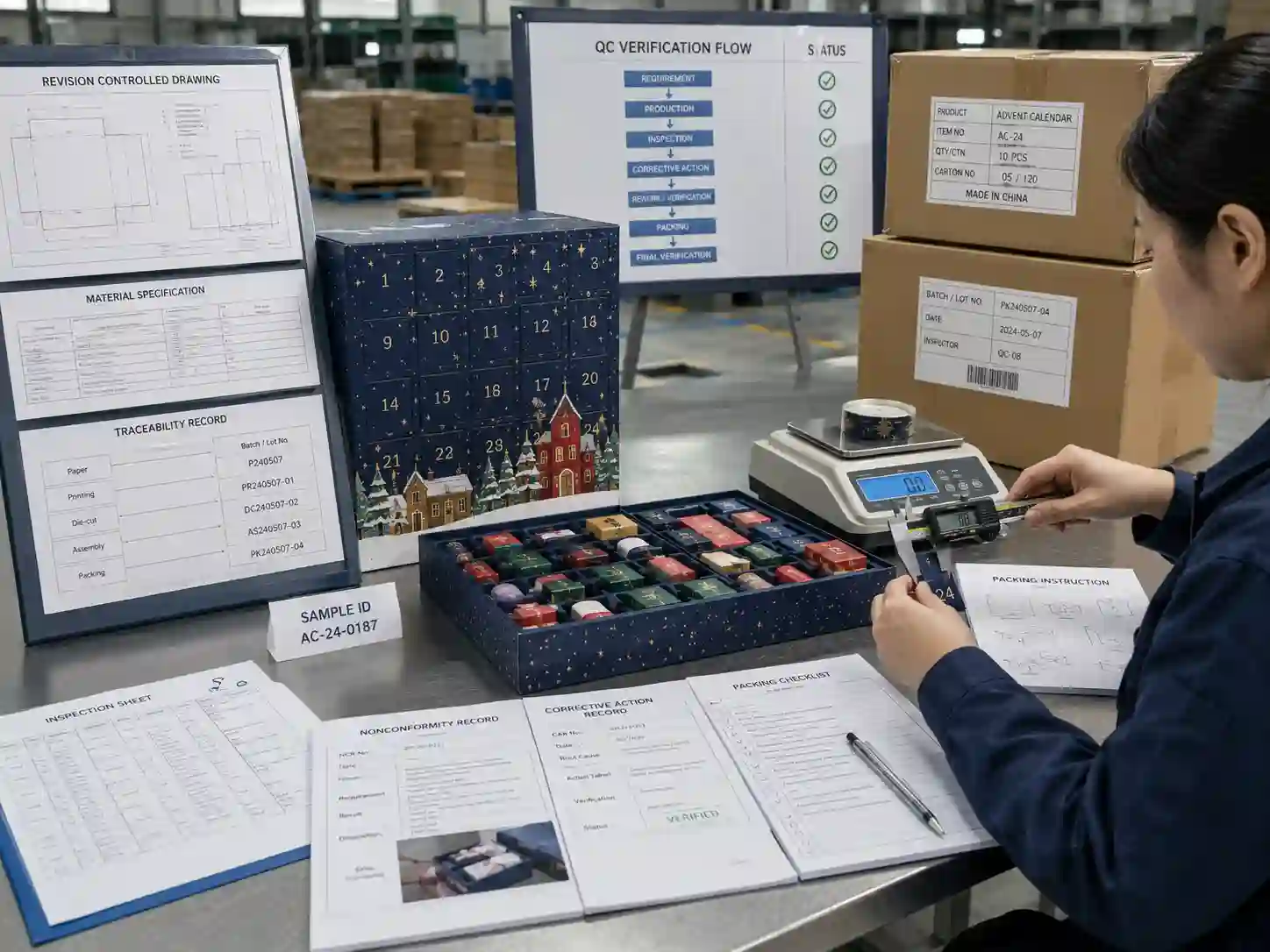
Verify relationships between documents rather than reviewing each file independently. Strong evidence creates a traceable chain from requirement to physical product, inspection result, and production record.
For example, a drawing may identify a board grade and critical dimensions. A corresponding material specification should define the material, while incoming records identify what entered production. Inspection records should then reference the relevant product or batch and document actual measurements against controlled requirements.
Check whether document dates, revision identifiers, product references, sample identities, and production records are mutually consistent. A collection of professional-looking documents provides limited assurance if there is no way to establish which product or production event they describe.
How can buyers separate verified facts from supplier claims?
Treat a statement as verified only to the extent supported by identifiable evidence. A photograph can demonstrate that equipment, components, or a production activity existed at a particular documented stage, but it does not automatically prove capacity, repeatability, ownership of equipment, or conformity with your project.
Similarly, a test report may establish a recorded result for the identified sample and test conditions. Buyers should not automatically extend that result to different structures, materials, production lots, or specifications.
What capability details remain project-dependent?
Actual production suitability remains project-dependent even when a supplier has strong historical evidence. Calendar dimensions, compartment count, board construction, inserts, closures, surface finishes, product loading, assembly sequence, inspection criteria, and packing configuration can change the required controls.
Historical evidence therefore supports a capability decision; it does not replace approval of the current project’s specifications and samples.
What production records provide useful capability evidence?
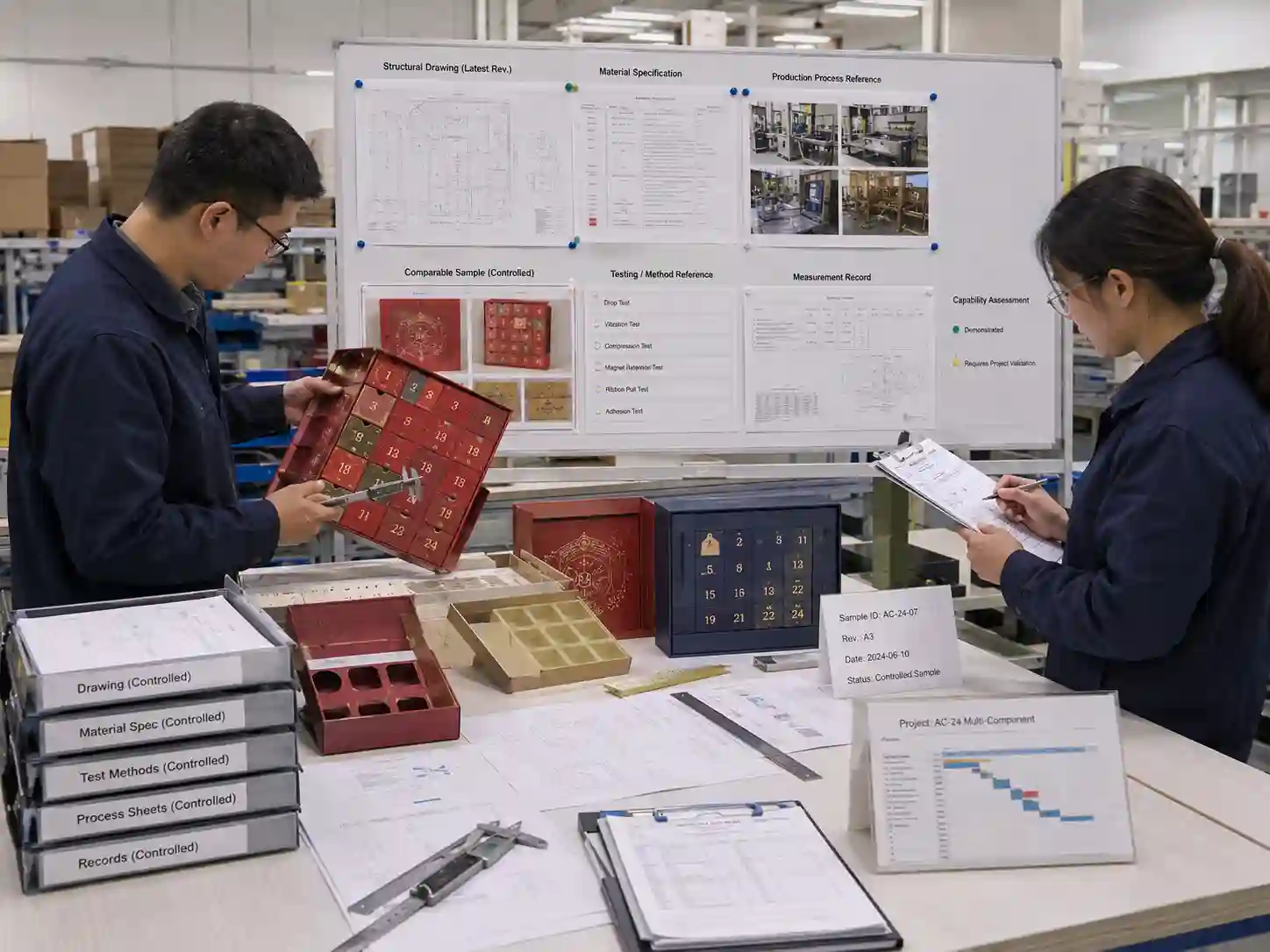
The strongest production records show that the factory has controlled comparable multi-component work through defined manufacturing stages. Buyers should look for records with enough context to determine what was being produced and which specification applied.
Depending on the project, useful records can include dated process photographs, work instructions, first-piece records, dimensional inspection sheets, assembly checks, material references, production identities, and finished-product inspection records.
When reviewing photographs, look for visible relationships between the product, production stage, job identification, and accompanying records. A folder of undated factory photographs is weaker evidence because the buyer cannot establish project relevance or chronology.
What should test and inspection records prove?
Test and inspection records should demonstrate that the supplier can define a requirement, use an appropriate checking method, record an actual result, and determine conformity. A pass/fail statement without the underlying requirement or measurement method is difficult to verify.
For dimensional controls, useful evidence may identify the measurement point, nominal requirement, applicable tolerance, instrument or method, recorded result, date, and product identity. Functional checks should similarly define what function was evaluated and the applicable acceptance criterion.
Not every calendar requires the same tests. Buyers should distinguish historical evidence of testing capability from the project-specific test plan that still needs to be agreed before production.
Why do material specifications and traceability matter?
Material evidence helps establish whether the factory can control what actually enters production. Buyers should request examples showing how specified paper, board, inserts, adhesives, magnets, ribbons, or other relevant components are identified and linked to purchasing, incoming control, or production records.
A material name alone is usually insufficient. A more useful record identifies a specification, grade, reference, revision, supplier material identity, or another controlled characteristic that allows the material to be distinguished from alternatives.
Where certificates or test documents are relevant, verify their scope and material reference before treating them as supporting evidence. The existence of a certificate does not by itself establish that it applies to the material used in a particular project.
What does strong versus weak capability documentation look like?
| Weak documentation | Stronger documentation |
|---|---|
| Generic claim that the factory has advent calendar experience | Comparable project record with identifiable structure, revision, production stage, and inspection evidence |
| Undated photographs of finished boxes | Dated production evidence connected to a job, sample, batch, or controlled record |
| Material described only as “greyboard” or “paper” | Material identity connected to a controlled specification and relevant incoming or production record |
| Inspection sheet marked only “PASS” | Defined requirement, measurement or check method, actual result, identity, and disposition |
| Test report supplied without explaining applicability | Report scope and sample or material reference checked against the capability claim |
| Photos of cartons ready for shipment | Packing specification and records connected to an identified product configuration |
Should buyers request corrective-action evidence?
Yes, when production risk justifies it. A completed corrective-action example can show whether the supplier records nonconformities systematically instead of simply replacing defective pieces without investigating the process.
Useful evidence can show the original problem, affected product or batch, containment, cause analysis, corrective action, responsibility, and subsequent verification. Sensitive customer information can be redacted without destroying the record’s process value.
Do not judge capability solely by whether historical defects exist. Complex manufacturing can produce nonconformities; the more useful question is whether problems are identified, contained, investigated, corrected, and verified through controlled records.
How much case-study evidence is credible?
A credible case study should contain enough technical context to support the capability being claimed. Finished-product beauty shots alone mainly demonstrate appearance; they provide little evidence about engineering control, production repeatability, inspection, or traceability.
For capability approval, a more useful case record might combine an identified structure, controlled drawing or specification reference, production-stage evidence, inspection data, a documented challenge, and the resulting verification. Commercially sensitive details can remain confidential.
Buyers can review additional advent calendar box buying guides when evaluating evidence for specific production or quality risks.
What should buyers check before approving the supplier?
Complete the capability review by checking whether the evidence supports the requirements of the proposed project, rather than approving the factory based on presentation quality or general experience.
- Define the capabilities that are critical to the proposed calendar structure.
- Request controlled evidence for those capabilities rather than a generic factory profile.
- Check document identities, revisions, dates, sample references, and production references.
- Confirm that drawings, materials, physical samples, inspection records, and production evidence can be connected.
- Review whether inspection records contain measurable requirements and actual results where applicable.
- Check the scope and applicability of supporting test or material documents.
- Review at least one relevant nonconformity or corrective-action example when quality risk warrants it.
- Verify that packing evidence corresponds to an identified product and packing specification where packing control is relevant.
- Record which conclusions are verified facts and which remain assumptions requiring current-project confirmation.
- Document buyer approvals separately from supplier-generated evidence.
Who should approve factory capability?
Approval should reflect the functions affected by the project’s risks. Procurement may assess commercial and supplier-control factors, while packaging engineering or product teams review technical suitability and quality personnel evaluate inspection, testing, traceability, and corrective-action controls.
The final approval should identify unresolved conditions. For example, historical records may verify experience with multi-component rigid packaging while the proposed product loading, a new material combination, or a critical functional dimension still requires project-specific validation.
Buyers considering Giftpackpro can review the Giftpackpro packaging factory and custom advent calendar box services before defining the evidence required for a particular project.
What should buyers avoid treating as proof of capability?
A factory presentation, equipment list, certificate collection, sample room, or finished-product gallery can support an initial review, but none should automatically be treated as proof that the proposed calendar can be produced under controlled conditions.
Also avoid interpreting one successful historical project as a guarantee of future performance. Capability evidence establishes what can reasonably be verified from previous or current records; project approval must still define the applicable specification, acceptance requirements, samples, and buyer decisions.
FAQs about advent calendar supplier capability evidence
Is a factory audit enough to approve an advent calendar supplier?
Not necessarily. An audit can provide useful information about systems and facilities, but buyers should still verify evidence relevant to the specific manufacturing, material, inspection, traceability, and packing controls required by their calendar.
Can suppliers redact customer information from capability records?
Yes. Customer names, artwork, commercial data, and other confidential details can be removed provided the remaining evidence still shows the process, document relationships, dates, identities, measurements, or other facts needed for verification.
How recent should factory capability evidence be?
There is no universal age limit. Buyers should consider whether the evidence still represents the supplier’s current equipment, personnel, processes, materials, subcontracting arrangements, and control systems. Older examples may require additional current evidence.
Should buyers approve capability before approving the production specification?
Factory capability and project approval are separate decisions. Capability evidence can support supplier selection, while the actual calendar still requires project-specific specifications, samples, acceptance criteria, and buyer approvals before those requirements can govern production.
For a project-specific capability review, request a custom quote and identify the structure, materials, products, critical quality requirements, and evidence you need the supplier to substantiate.


