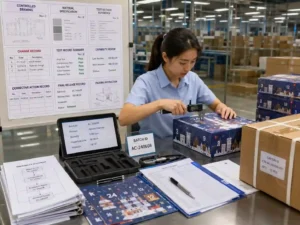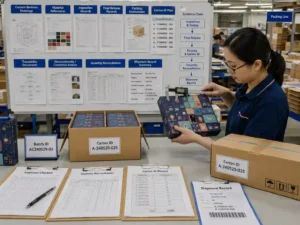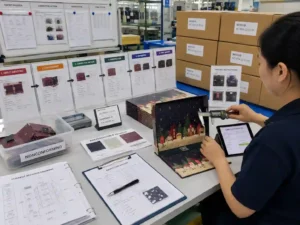
Quick answer: Designing compartments for makeup brushes with different lengths requires measuring each brush profile, defining support points, and balancing protection with product presentation. Packaging engineers usually create cavity layouts based on brush length, handle diameter, brush head size, and orientation requirements. The final design is verified through loaded samples, fit measurements, and approval records to ensure brushes remain secure without damaging finishes or reducing visibility.
Why do makeup brush compartment lengths need separate planning?
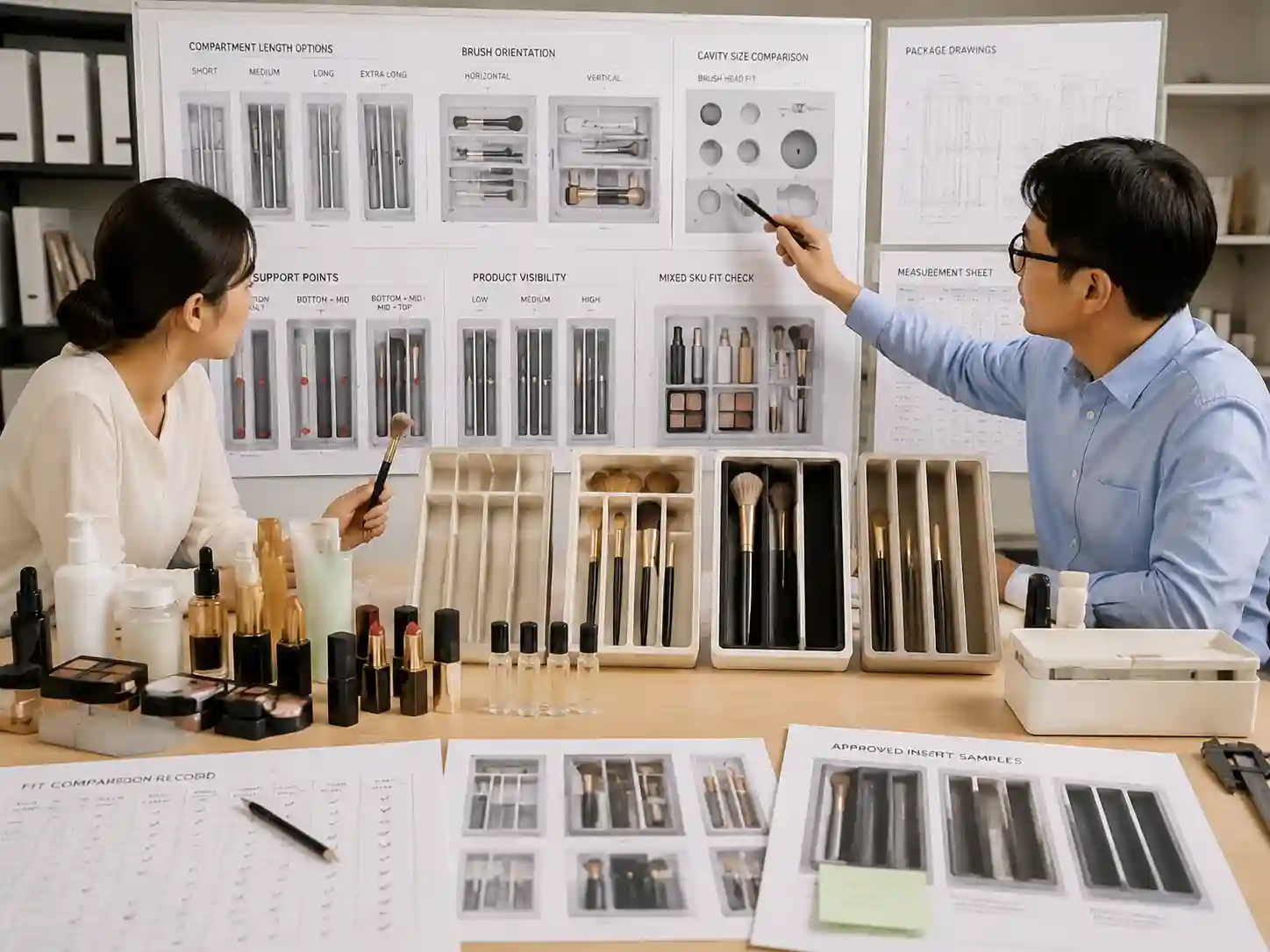
Makeup brushes with different lengths cannot always share the same cavity design because their handles, ferrules, and brush heads create different support requirements. A short precision brush may need shallow positioning, while a longer face brush may require additional depth and anti-movement support.
For seasonal beauty packaging, advent calendar boxes, and mixed-SKU sets, the compartment layout should consider:
- Overall brush length and usable cavity depth.
- Handle diameter and shape variation.
- Brush head width, softness, and compression sensitivity.
- Product orientation and customer visibility after opening.
- Protection from friction, movement, and contact with other items.
These decisions are typically confirmed through structural drawings, prototype inserts, and loaded product checks rather than relying only on theoretical dimensions.
How do you measure different makeup brushes before designing compartments?
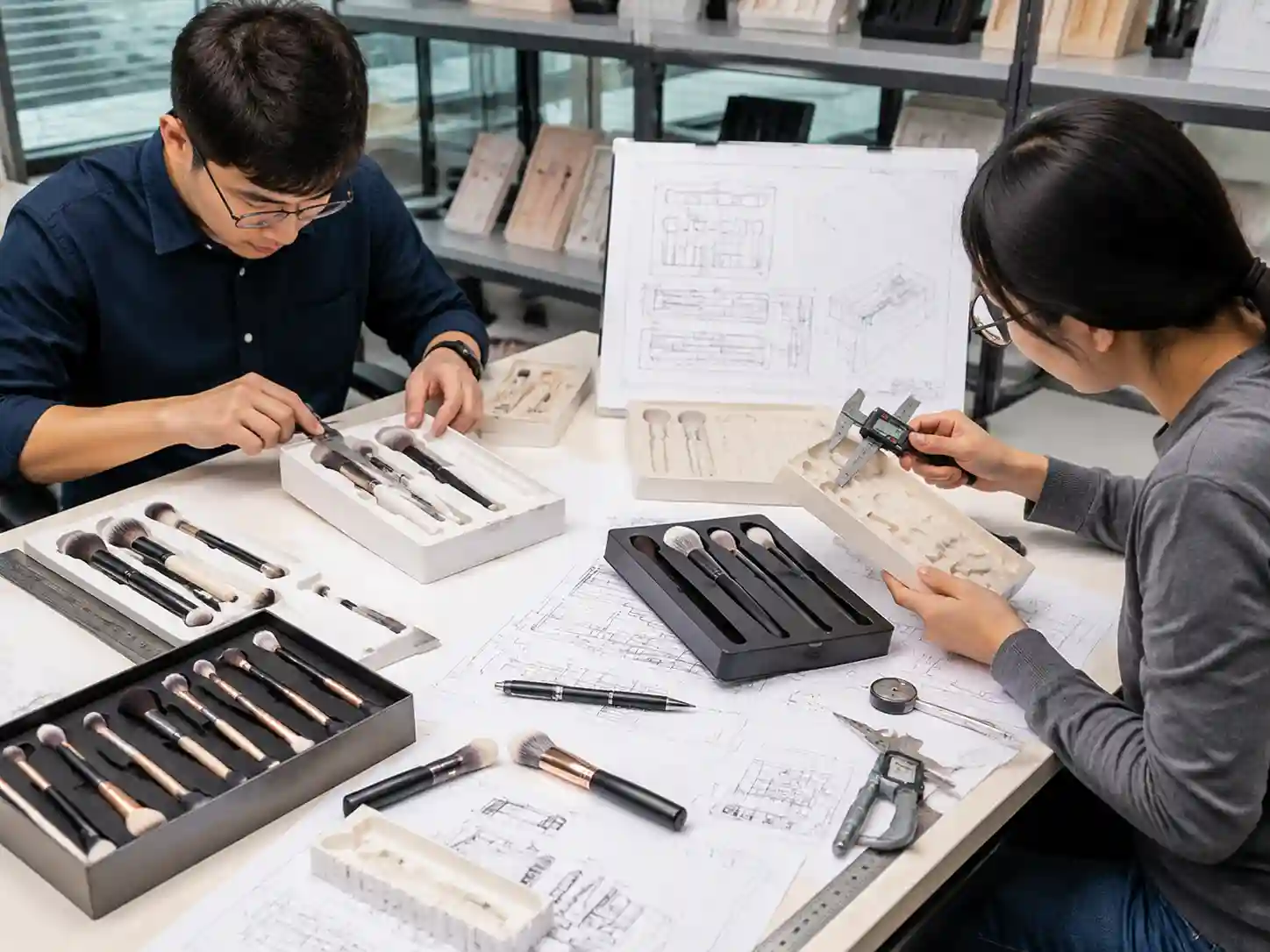
The first step is creating a measurement reference for every brush type included in the package. Engineers normally record the external dimensions that affect cavity design and product protection.
| Measurement | Why it matters | Verification method |
|---|---|---|
| Total brush length | Determines cavity depth and orientation | Ruler or digital measurement record |
| Handle diameter | Controls retention and movement | Caliper measurement |
| Brush head size | Prevents compression or deformation | Profile measurement and sample review |
| Surface finish | Helps avoid scratches or cosmetic damage | Visual inspection during fit testing |
Project requirements vary depending on whether brushes are packed alone, combined with skincare bottles, fragrance containers, or other beauty products. Mixed layouts often require more detailed cavity planning because each product affects available space.
How are compartment layouts created for brushes with different lengths?
Packaging engineers usually create a cavity map that assigns each brush a suitable position. The goal is not simply to make compartments large enough, but to control movement while maintaining efficient use of space.
Should longer brushes always receive deeper compartments?
Usually, longer brushes require deeper or better-supported cavities, but depth alone does not solve movement problems. A long brush may still shift if the handle is unsupported or if the cavity is oversized.
Common design considerations include:
- Support points near the handle and ferrule area.
- Clearance around brush heads to avoid pressure marks.
- Orientation that keeps visible product arrangement consistent.
- Spacing between brushes and nearby products.
How do engineers balance protection and presentation?
A compartment must hold the brush securely while allowing the customer to see and remove the product easily. Excessive tightness can create extraction problems, while excessive clearance can cause movement during handling.
For beauty packaging projects, teams commonly review:
- Brush alignment after loading.
- Contact points between product and insert.
- Visible arrangement inside the box.
- Potential scuffing against neighboring components.
What fit tests confirm makeup brush compartment lengths?
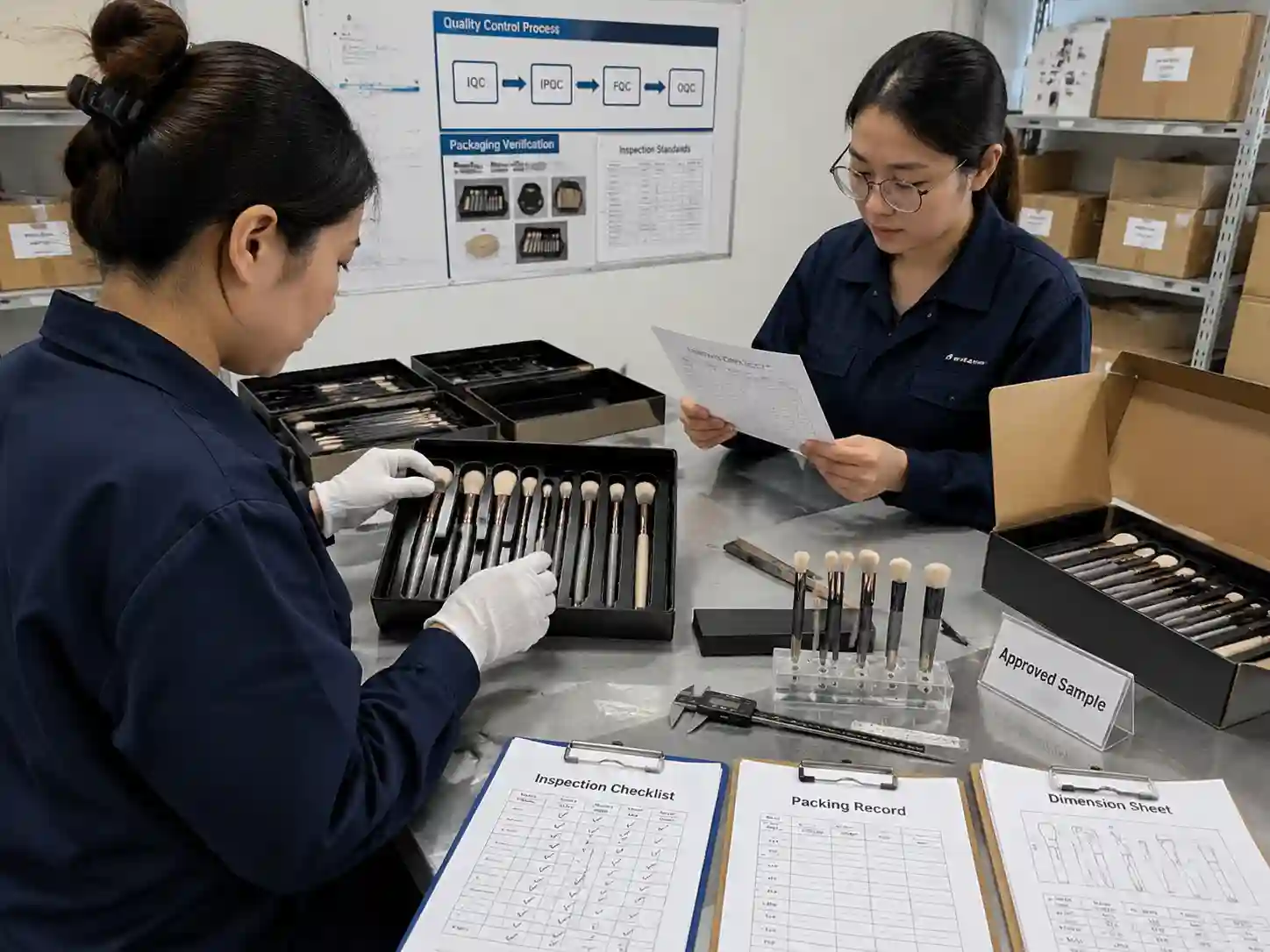
A practical fit test uses real production-intent brushes rather than only digital models. The sample should be loaded in the same orientation expected for production review.
- Place each brush into its assigned cavity.
- Check seating depth and product alignment.
- Measure remaining clearance around handles and brush heads.
- Review removal force and repositioning.
- Record any movement, contact marks, or appearance concerns.
A loaded-SKU checklist can include:
- Correct brush assigned to correct compartment.
- Brush head protected from compression.
- Handle supported without excessive pressure.
- Product orientation matches approved layout.
- Final dimensions match approved drawings.
What packaging risks should buyers review before approval?
The main risks are usually related to incorrect cavity sizing, product movement, and inconsistent loading instructions.
| Risk | Possible impact | Review evidence |
|---|---|---|
| Cavity too large | Brush movement or poor presentation | Loaded sample photos and measurements |
| Cavity too tight | Difficult removal or product pressure | Fit testing records |
| Incorrect orientation | Reduced visibility or mixed-SKU confusion | Approved layout drawings |
| Insufficient support | Damage during handling | Inspection notes and sample approval records |
Verified facts in packaging development include product dimensions, measured samples, and approved structural drawings. Project-dependent recommendations include cavity allowance, insert material selection, and final orientation because these vary by brush construction and packaging format.
Buyer approvals should focus on the actual loaded condition, not only empty insert samples. Approval records should clearly show the agreed product arrangement, measurement references, and any accepted design limitations.
How does Giftpackpro approach mixed beauty product compartment planning?
For custom advent calendar boxes and seasonal paper gift packaging, Giftpackpro supports compartment planning by focusing on product fit, protection, and presentation requirements. Brush layouts are typically reviewed together with other beauty items such as pumps, droppers, bottles, tubes, palettes, and fragrance containers when mixed-SKU packaging is required.
Related packaging development resources include custom advent calendar box services, custom advent calendar box products, and additional advent calendar box buying guides.
FAQs
Can different makeup brushes share one compartment size?
They can in some cases, but only when length, diameter, and movement requirements are compatible. Mixed brush sizes often need separate support considerations.
Should brush compartments be designed before final product samples are available?
Initial layouts can be developed from specifications, but final approval should use representative or production-intent samples to confirm real fit.
What records help confirm a compartment design is approved?
Useful records include dimension sheets, structural drawings, loaded sample photos, fit-check notes, and approved layout references.
For a custom beauty packaging project requiring different makeup brush compartment lengths, contact request a custom quote to discuss product fit requirements and packaging development needs.