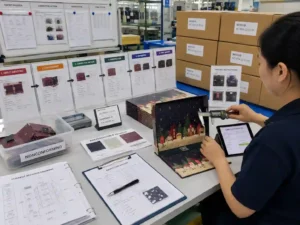
Ship ready advent calendar packaging is designed to function as both the retail product package and the shipping package. The process requires balancing shelf presentation, structural protection, parcel requirements, product dimensions, and fulfillment handling. A successful design is verified through drawings, measurements, prototypes, packing reviews, and inspection records before production decisions are approved.

What makes ship ready advent calendar packaging different from standard retail packaging?
Ship ready packaging must survive normal fulfillment handling without relying on a separate outer mailer or shipping box. The package structure, materials, closure method, and external surfaces all need to be considered as part of the delivery system.
Standard retail packaging often focuses mainly on shelf appearance. A ship ready calendar must also account for parcel movement, stacking pressure, label placement, handling contact points, and customer opening experience.
Which design areas require the most attention?
- Outer structure: Panels, corners, doors, drawers, and closures should resist deformation during handling.
- Surface protection: Printed, coated, foil, or textured areas need protection from abrasion and impact.
- Shipping dimensions: Final package size must fit the intended fulfillment channel and parcel restrictions.
- Opening experience: The package should remain attractive after transportation and arrive ready for customer use.
How do you plan the structure before creating ship ready packaging?
The design starts with defining the shipping environment and the finished calendar dimensions. Packaging engineers normally review the product size, weight, handling requirements, and expected distribution route before selecting the structural approach.
| Design factor | What should be reviewed | How it can be verified |
|---|---|---|
| Package dimensions | Length, width, height, and clearance around the product | Technical drawings and physical measurements |
| Structural protection | Corner strength, panel support, closure stability | Prototype inspection and handling evaluation |
| Parcel compatibility | Shipping size limits, label area, carton handling requirements | Fulfillment review and dimension records |
| Customer opening | Access method, appearance after transport, product visibility | Sample opening review |

How do you reduce shipping risk without adding a mailer?
Reducing shipping risk depends on controlling movement, impact exposure, and weak structural points inside the calendar package. The goal is not simply to make the package stronger, but to create a controlled structure that uses material efficiently.
Common engineering checks include:
- Reviewing whether internal components can shift during transportation.
- Checking whether doors, drawers, or compartments create pressure points.
- Measuring unused space that could allow movement or crushing.
- Confirming that the outer surface can tolerate normal handling contact.
Project recommendations vary depending on calendar size, product weight, material selection, distribution method, and retailer or marketplace requirements. These decisions should be confirmed through approved drawings and physical samples rather than assumptions.
How do you verify that a calendar can ship without an additional mailer?
Verification combines engineering review, sample evaluation, and production control records. Buyers typically approve the final approach using measurable evidence instead of visual judgment alone.
- Structural drawings showing final dimensions and component relationships.
- Prototype samples reviewed for fit, movement, and appearance.
- Measurement records confirming finished package size.
- Packing instructions showing approved orientation and handling method.
- Inspection records confirming production follows the approved design.
What should buyers check before approving a ship ready calendar design?
Buyers should confirm that the package meets both retail presentation needs and fulfillment requirements before production approval.
| Approval area | Buyer question |
|---|---|
| Retail readiness | Does the package maintain the intended shelf appearance after transport? |
| Shipping efficiency | Are the finished dimensions suitable for the planned parcel or distribution method? |
| Protection | Are vulnerable areas supported against impact, compression, and surface damage? |
| Documentation | Are drawings, measurements, and approval records available for reference? |

How does fulfillment planning affect calendar packaging design?
Fulfillment requirements influence package dimensions, labeling space, handling methods, and final presentation. A calendar designed for direct shipment may require different decisions from one packed into a larger retail carton system.
Important considerations include:
- Available barcode and shipping label areas.
- Protection of finished surfaces during warehouse handling.
- Compatibility with picking, packing, and return processes.
- Consistency between product listing information and physical package dimensions.
What information should be approved before production begins?
The final approval package should clearly define the accepted version of the calendar structure and shipping configuration.
- Approved structural drawings.
- Confirmed product dimensions and weight information.
- Reviewed physical samples.
- Approved packing orientation and handling instructions.
- Recorded buyer approvals and revision status.
Giftpackpro supports commercial buyers with custom advent calendar packaging development, from structural planning to finished packaging review. Explore custom advent calendar box services or review custom advent calendar box products for packaging options. To discuss a project requirement, request a custom quote.
FAQs
Can every advent calendar be designed without an additional mailer?
No. Suitability depends on the calendar size, weight, structure, surface finish, shipping route, and fulfillment requirements. Some projects may still require additional protection.
Does ship ready packaging mean the package is stronger than normal retail packaging?
Not necessarily. It means the packaging has been designed and verified for its intended shipping conditions while maintaining retail presentation requirements.
What evidence shows that a calendar design is ready for direct shipment?
Evidence usually includes approved drawings, measured samples, packing reviews, inspection records, and documented approval decisions.