
Quick answer: Corner protectors can increase the effective packed length, width, or height of an advent calendar, depending on their thickness, profile, and placement. That change can require a larger master carton and may alter units per carton or cartons per pallet. For reliable corner protector carton dimensions, measure the finished calendar with its approved protectors installed, then validate carton clearance, pallet layout, gross weight, and movement risk using the actual packing configuration rather than nominal box dimensions alone.
Why do corner protectors change master carton dimensions?
Corner protectors add material around selected edges or corners, so the protected calendar may occupy a larger packing envelope than the unprotected finished box. Even a relatively small dimensional increase can matter when several calendars are packed tightly in one master carton.
The effect depends on the protector design. A folded paperboard corner, molded pulp component, foam profile, corrugated pad, or edge protector can add thickness in different directions. Some protection sits mainly outside the corner; other designs wrap around two or three faces and increase multiple dimensions.
For this reason, carton drawings should distinguish between the finished calendar dimensions and the protected packing dimensions. Purchasing and logistics teams should not calculate master cartons from the calendar’s external size alone when corner protection is part of the approved export pack.

How should corner protector carton dimensions be calculated?
Measure the complete protected unit rather than simply adding a theoretical protector thickness to a drawing. Compression, folds, overlaps, sleeves, and protector positioning can make the real packed dimensions different from a simple calculation.
What should be measured first?
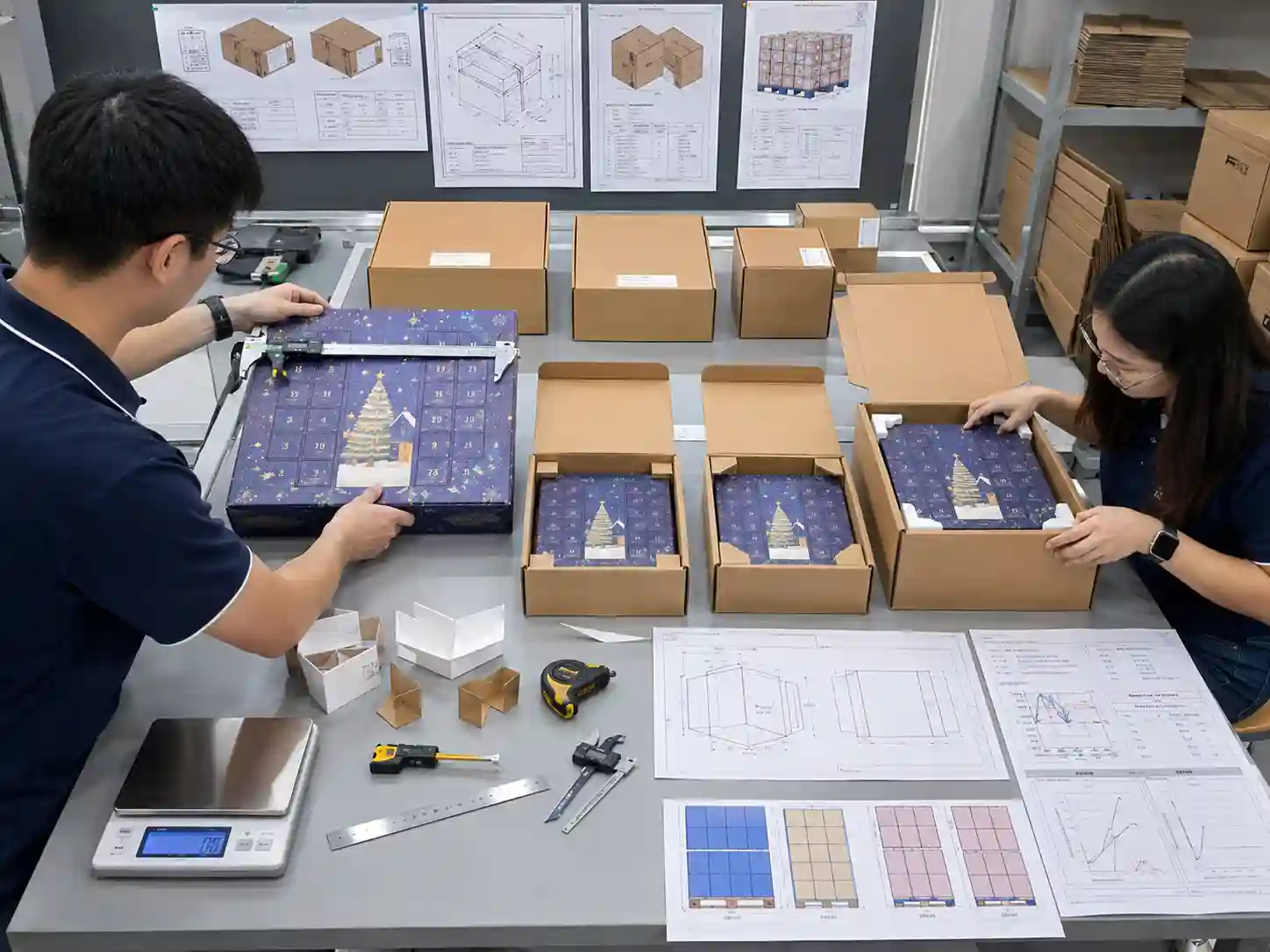
Start with an approved production-representative calendar and install the corner protectors exactly as they will be used during packing. Add any sleeve, tissue, polybag, interlayer, or other individual protection that affects the packing envelope.
- Measure the finished calendar without transit protection.
- Install all approved corner protectors in their specified positions.
- Add any individual wrapping or sleeve used in the final pack.
- Measure the maximum protected length, width, and height.
- Arrange the required number of protected units in the proposed carton orientation.
- Measure the resulting pack block and determine appropriate carton clearance.
- Confirm the proposed internal carton dimensions against an actual packing trial.
Record both internal and external master carton dimensions because the external dimensions are relevant to pallet utilization, warehouse space, freight planning, and shipping documentation.
How can a small protector increase reduce packing efficiency?
A small dimensional increase does not automatically create a major logistics penalty, but it can cross a packing threshold. The important question is whether the protected configuration still fits the intended carton and pallet pattern.
| Change caused by protection | Possible packing effect | What to verify |
|---|---|---|
| Greater protected length | Longer master carton or fewer units in one orientation | Internal carton length and pallet overhang |
| Greater protected width | Wider carton or changed side-by-side arrangement | Cartons per pallet layer |
| Greater protected height | Taller carton or reduced stacking efficiency | Total pallet height and load stability |
| Irregular corner profile | Unused pockets of space inside the carton | Void distribution and unit movement |
| Thicker protection on several units | Cumulative dimensional increase | Actual packed block dimensions |
This cumulative effect is especially important when calendars are arranged in rows. A protector that adds only a limited amount to one unit may create a more significant difference across several protected units packed side by side.
Should the existing carton be enlarged to accommodate protectors?
Not automatically. First determine whether the current carton has usable clearance and whether the protected units can be packed without excessive compression, deformation, or difficult assembly.
A carton that is too tight can defeat the purpose of the protector. Packing operators may crush or displace protectors while closing the carton, and pressure can be transferred to rigid-box corners, drawer structures, decorative surfaces, or projecting features.
However, simply making the carton larger is also not an ideal solution. Excessive clearance can allow the calendars to accelerate and move during handling or vibration. That may increase edge impact, rubbing, or repeated contact between the product and protective components.
The preferred carton size is therefore project-dependent: it should provide enough clearance for consistent packing while limiting uncontrolled movement.
How do corner protectors affect pallet patterns?
If the protectors require a larger master carton, the pallet pattern should be recalculated using the revised external carton dimensions. Do not assume that a previously approved cartons-per-layer arrangement remains valid.
Check the number of cartons per layer, pallet footprint, overhang or under-utilization, layer orientation, total pallet height, and expected load stability. A few millimeters of carton growth can be irrelevant in one pallet pattern but enough to prevent an intended arrangement in another.
A practical comparison is to prepare pallet-layout drawings for the original and protected carton sizes. This makes the logistics trade-off visible before bulk packing begins.
Is reducing protector thickness always more efficient?
No. A thinner protector is useful only if it still performs the required protective function. Packing efficiency should not be optimized by removing material without considering the actual transit risk.
Protector selection should reflect vulnerable corner geometry, calendar weight, master-carton orientation, expected handling, internal movement, stacking conditions, and the approved transit-protection method. Where performance is uncertain, compare representative configurations through controlled packing and handling or appropriate transit-test methods.
How should void space be controlled after adding corner protectors?
Evaluate void space again after the protectors are installed. Protectors change both the outside dimensions of the unit and the way adjacent calendars contact each other inside the carton.
Some configurations reduce useful clearance by filling corner spaces. Others create irregular gaps between units. The engineering objective is not necessarily zero void; it is controlled clearance that supports repeatable packing without allowing damaging movement.
During a packing trial, check whether units can shift longitudinally, laterally, or vertically. Also check whether the protectors stay seated after the carton is closed and after representative handling.
What transit risks should be compared against the efficiency gain?
The main trade-off is between additional packing volume and reduced exposure of vulnerable corners and edges. The correct balance varies with the calendar structure and distribution route.
What does a practical transit-risk comparison look like?
Consider a rigid multi-drawer calendar whose exposed corners can receive direct loads when packed closely against the master-carton wall. Adding fitted corner protectors increases the protected footprint enough that the original carton becomes difficult to close.
Keeping the original carton may create compression at the protected corners. Increasing the carton excessively may create movement during vibration. The engineering response is to trial a revised carton with controlled clearance, measure the completed pack, and compare movement and corner condition after representative handling or the specified transit evaluation.
This creates evidence for the decision rather than assuming either the smallest carton or the thickest protector is automatically preferable.
Do humidity and storage conditions affect the dimensional decision?
They can, particularly when paper-based or corrugated protection is used. Material condition may influence fit, stiffness, and dimensional consistency, so an extremely tight packing specification can become difficult to maintain when materials or environmental conditions vary.
Projects with humidity exposure concerns should define appropriate material and packing requirements and verify them under conditions relevant to the intended distribution route. Avoid treating a single prototype measurement as proof that every production carton will pack identically.
What should be approved before production packing starts?
Buyers should approve the complete packing configuration, not the corner protector as an isolated component. The approval record should connect the protector specification with the calendar orientation, pack quantity, master-carton dimensions, and pallet plan.
Useful approval evidence can include:
- corner protector material, profile, thickness, and placement drawing;
- finished protected-unit dimensions;
- master-carton internal and external dimensions;
- units per master carton and packing orientation;
- carton gross-weight record where required;
- photographs or diagrams of the approved packing sequence;
- pallet pattern and total planned pallet height;
- relevant handling or transit-test records where specified;
- approved shipping-mark location and carton identification.
These records help prevent a common production problem: approving one protection method during development but packing bulk production with different protector placement, carton clearance, or orientation.
What should be checked before shipment?
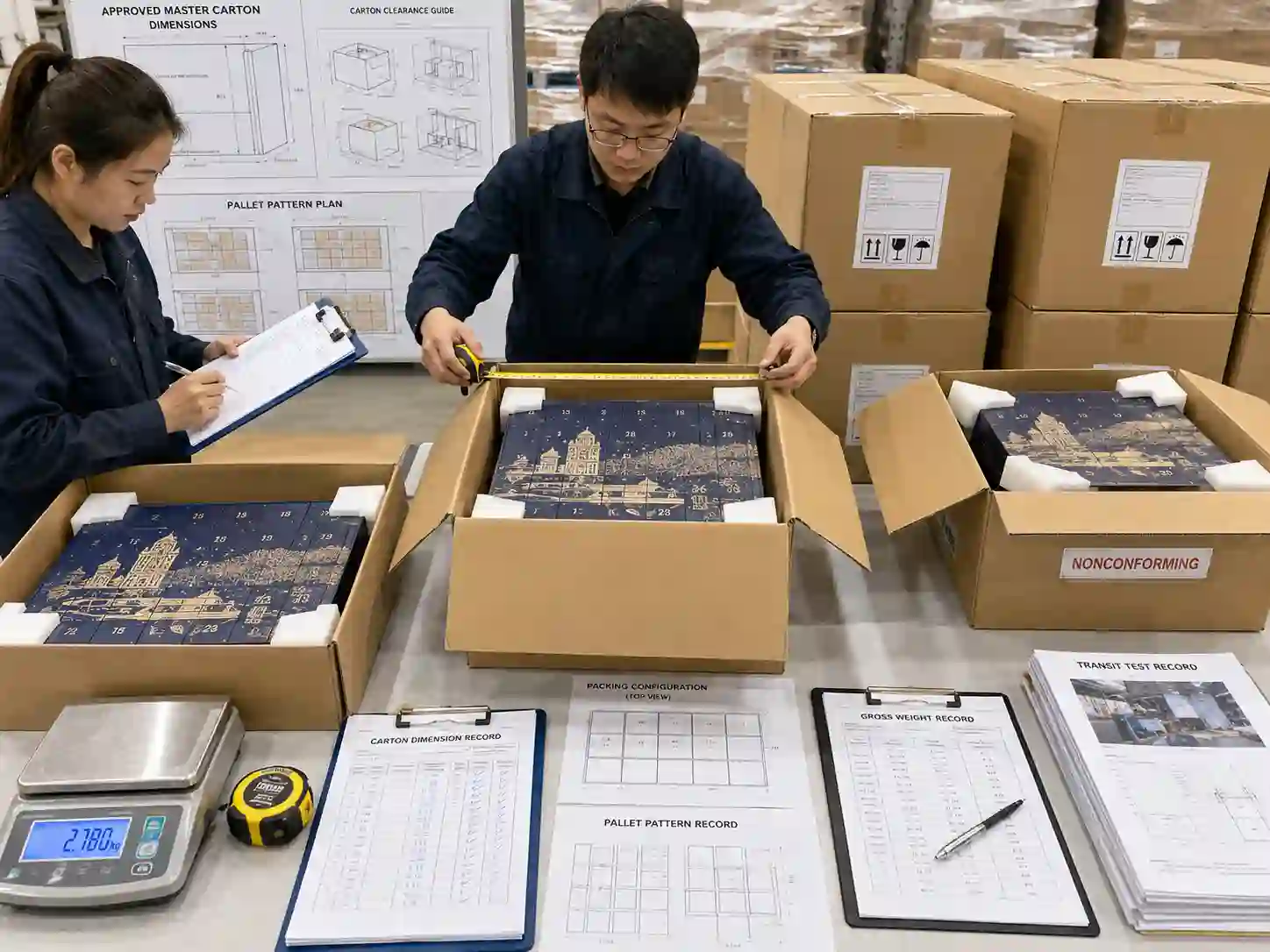
Pre-shipment verification should confirm that production cartons match the approved protected packing configuration. Measurements should be taken from representative packed cartons rather than relying only on supplier drawings.
- Confirm the correct corner protector type and placement.
- Check that protectors remain seated during normal carton closure.
- Measure representative external master-carton dimensions.
- Verify pack quantity and calendar orientation.
- Check for excessive compression or uncontrolled internal movement.
- Confirm representative carton gross weight against the approved record.
- Verify that the production carton dimensions still match the pallet plan.
- Check shipping marks and carton identification against approved instructions.
- Inspect representative calendars for corner damage, scuffing, pressure marks, or protector displacement.
- Record deviations and obtain approval before accepting a changed packing configuration.
Who should approve changes that affect carton or pallet efficiency?
Changes that alter the protected dimensions should be reviewed by the parties responsible for packaging and logistics before implementation. A supplier should not independently reduce protection or change pack quantity merely to recover carton efficiency.
Packaging engineering should confirm fit and protection. Logistics or freight planning should check carton and pallet consequences. Purchasing or sourcing teams should ensure the approved configuration is reflected in supplier instructions, while the buyer should approve material changes or packing changes where required by the project.
If a corner protector revision changes the carton size, units per carton, pallet pattern, or destination unpacking method, those dependent records should also be updated.
What information should you send a supplier for an accurate packing proposal?
Provide the finished calendar dimensions and weight together with the required protection concept, proposed pack quantity, shipment method, pallet constraints, and any destination assembly or unpacking requirements. The supplier can then develop the carton around the complete protected pack rather than an incomplete nominal dimension.
For custom projects, Giftpackpro’s custom advent calendar box services can be reviewed alongside representative custom advent calendar box products when defining the physical calendar and its export-packing requirements.
FAQs about corner protectors and carton efficiency
Can corner protectors be added after the master carton has already been designed?
They can be evaluated, but the carton should be rechecked. If the original clearance is insufficient, adding protectors late can cause compression, difficult packing, dimensional growth, or a reduction in units per carton.
Should carton dimensions be based on CAD calculations or physical samples?
Use drawings for planning, but verify final dimensions with production-representative protected samples. Physical packing trials reveal protector compression, folding behavior, tolerances, and actual clearance that nominal CAD dimensions may not fully represent.
Can changing the protector affect destination assembly?
Yes. If calendars are unpacked, filled, labeled, or assembled at destination, protector removal and repacking sequence may matter. Confirm whether protectors must be reusable, easily removable, or maintained until a later assembly stage before freezing the export pack.
How do you make the final corner-protector decision?
Freeze the decision only after the protected-unit dimensions, master-carton fit, internal movement, pallet pattern, and production packing method have been checked together. The most efficient configuration is not simply the smallest carton; it is the smallest practical packing system that maintains the approved protection and can be reproduced consistently in production.
For a project-specific carton and protection review, request a custom quote with your calendar dimensions, weight, proposed pack quantity, protection requirements, and pallet constraints.


