
Quick answer: Each advent calendar should be individually packed when its finished surface, structure, or destination handling needs protection that the master carton alone cannot reliably provide. For polybag tissue sleeve packing selection, use a polybag mainly for moisture, dust, and handling isolation; tissue for light surface separation and low-bulk scuff protection; and a fitted paper or protective sleeve when stronger abrasion control or structural containment is needed. The final choice should be verified against surface finish, carton fit, transit movement, humidity exposure, and destination unpacking requirements.
What should determine whether you use a polybag, tissue, or sleeve?
The decision should start with the specific damage mechanism you are trying to control. Do not add individual wrapping simply because it is a familiar packing convention.
Review the finished calendar together with its master-carton configuration. Important questions include whether decorated faces can rub against corrugated board, whether drawers or doors can move, whether dust or humidity exposure matters, and how tightly the units are packed.
| Packing option | Best suited to | Main protection role | Points to verify |
|---|---|---|---|
| Polybag | Calendars needing dust or moisture isolation | Environmental and handling barrier | Bag fit, trapped moisture, sealing method, surface compatibility, destination disposal requirements |
| Tissue | Lightly decorated or sensitive surfaces with limited rubbing risk | Low-bulk surface separation | Coverage, movement, abrasion resistance, transfer or marking risk |
| Protective sleeve | Premium surfaces, exposed edges, drawers, or units requiring more controlled containment | Abrasion protection and physical containment | Fit, insertion force, edge contact, compression, removal method |
| No individual wrap | Robust surfaces in a well-controlled carton configuration | Reduces unnecessary material and packing steps | Corrugated contact, movement, dust, humidity and destination handling |

When is a polybag the better choice?
A polybag is usually considered when dust, moisture exposure, handling contamination, or separation from the master carton is a greater concern than cushioning. It can create a continuous barrier around the calendar without adding much thickness.
This can be useful when cartons may pass through humid warehouses, container environments, or multiple handling stages. However, a polybag should not automatically be treated as a complete humidity-control system. The actual protection depends on the bag material, closure, packing environment, exposure duration, and whether moisture is already present when the unit is sealed.
What should be checked before approving a polybag?
Confirm that the bag fits without creating excessive loose material or concentrated pressure on corners. A poorly fitted bag can wrinkle against sensitive surfaces or interfere with efficient master-carton loading.
- Check the bag against representative finished surfaces for marking, blocking, or unwanted contact.
- Confirm the sealing or closure method does not damage the calendar.
- Measure the packed unit rather than relying only on the unwrapped box dimensions.
- Check whether trapped air changes carton utilization or compression behavior.
- Confirm destination unpacking and material-disposal requirements with the buyer.
For calendars with delicate foil, coatings, or embossed areas, barrier protection alone may not prevent abrasion. Surface-contact risks may require an additional non-abrasive layer or a different individual-packing method.
When should tissue be used instead?
Tissue is appropriate when the main requirement is lightweight separation between the finished calendar and surrounding packing materials. It is particularly useful when only modest surface protection is required and adding significant packing thickness would reduce carton efficiency.
Tissue can help prevent direct contact with corrugated surfaces, neighboring calendars, or other protective materials. Its effectiveness, however, depends on whether it remains in position during handling and vibration.
When is tissue not enough?
Tissue is not a substitute for restraint when units can slide significantly inside the master carton. Repeated movement can shift, tear, or compress the paper until decorated surfaces are exposed.
If a transit-risk review shows substantial unit-to-unit or unit-to-carton movement, correct the carton clearance, divider, spacer, or protection system rather than simply adding more tissue.
For projects using foil, embossing, soft-touch surfaces, or other sensitive finishes, test the proposed tissue against representative production-method surfaces. Visual inspection after controlled rubbing, packing trials, or appropriate transit simulation provides better evidence than assuming that all tissue grades behave the same way.
When is a fitted sleeve the stronger option?
A fitted sleeve is useful when the calendar requires more controlled surface coverage or containment than loose tissue provides. Depending on its design, it can protect large decorated faces, exposed edges, doors, or drawers while keeping the protection consistently positioned.
A sleeve may also be useful where destination teams need to remove individual protection efficiently before retail assembly or product loading.
The sleeve should not be so tight that installation creates scratches, compresses raised decoration, bows panels, or forces drawers inward. Conversely, an excessively loose sleeve can move during transit and lose much of its protective value.
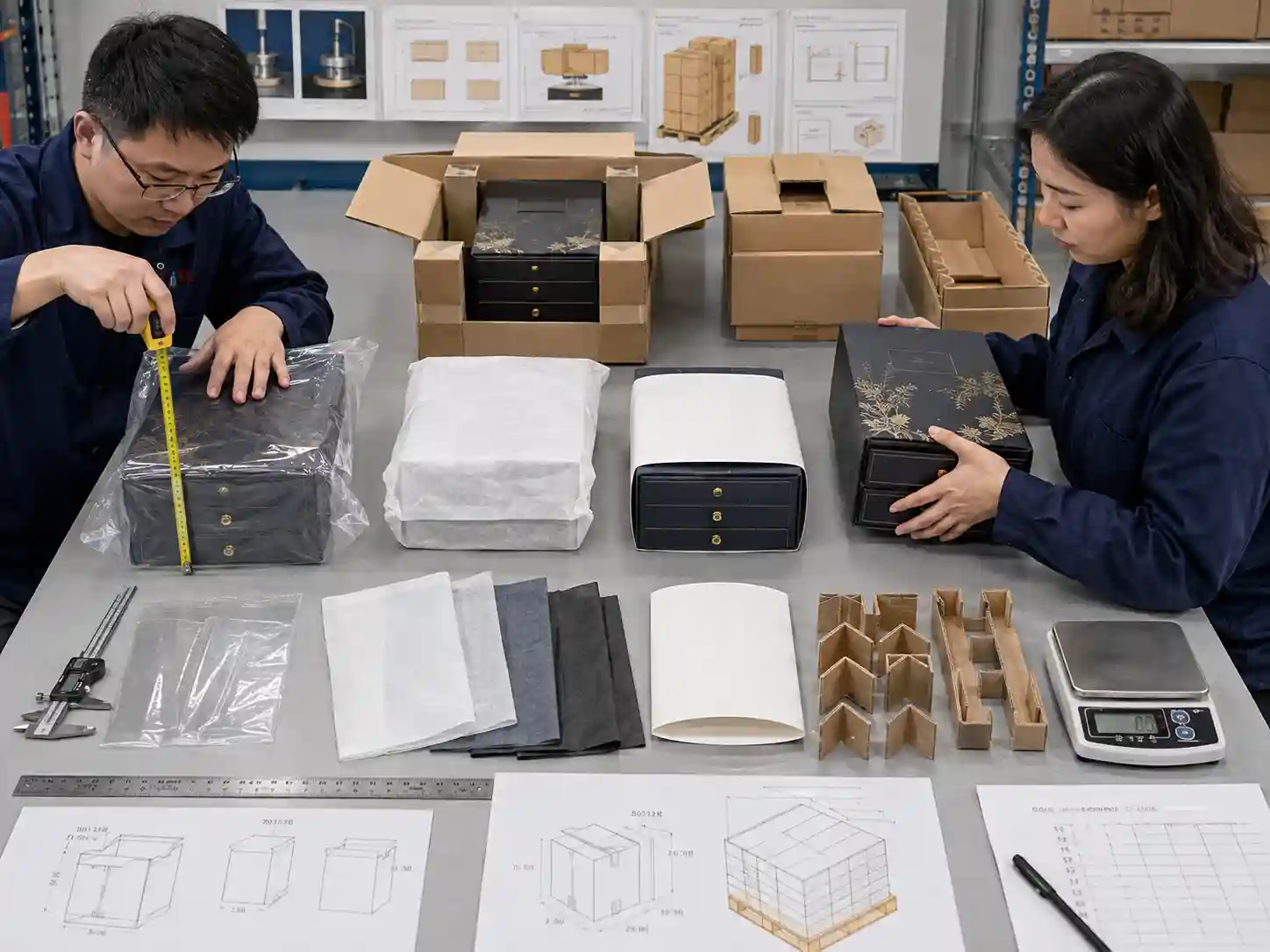
How does master-carton fit affect polybag tissue sleeve packing selection?
Individual wrapping and master-carton engineering should be reviewed together because every protective layer changes the effective packed dimensions. Even a small thickness increase can matter when several calendars are packed in one carton.
Measure a representative unit after its proposed polybag, tissue, or sleeve has been applied. Then verify pack quantity, internal clearance, orientation, corner protection, and void space using the actual packed condition.
Can extra protection create a new transit risk?
Yes. A protection method can solve one problem while creating another if it changes carton fit or load distribution.
For example, assume several calendars fit correctly in a trial master carton without individual sleeves. Adding a thicker sleeve may increase the packed dimensions enough to create excessive compression against decorated panels. Increasing the carton size without recalculating the layout could then create additional void space, allowing units to move during vibration or handling.
The correct response is to recheck the complete packing configuration rather than evaluating the sleeve independently.
How should humidity and moisture risk affect the decision?
Humidity risk should be assessed from the expected logistics route and packing conditions rather than from a general assumption that export shipments always require plastic protection. Different routes, storage periods, climates, container conditions, and destination warehouses create different exposure profiles.
A polybag can provide more environmental separation than open tissue or a paper sleeve, but the packing team should also consider whether the product is dry and conditioned before enclosure. Sealing moisture inside a barrier can undermine the intended protection.
Where humidity is a material project risk, buyers and suppliers should define the required protection method and verification approach in the approved packing specification.
How should pallet patterns and carton movement be considered?
Palletization affects the forces reaching individual calendars, so individual protection should be checked within the intended carton and pallet configuration. Carton compression, vibration, repeated handling, and unsupported voids can all change how surfaces interact.
Review the pallet pattern for overhang, carton orientation, stack height, stretch-wrap stability, and load paths. Individual tissue or sleeves cannot compensate for a poorly supported pallet load or excessive movement inside the master carton.
| Observed risk | Individual packing response | Carton or pallet check |
|---|---|---|
| Corrugated rubbing against printed face | Tissue, sleeve, or suitable barrier | Reduce movement and verify carton clearance |
| Dust or environmental contamination | Consider polybag | Check carton closure and storage conditions |
| Foil or embossed faces rubbing together | Non-abrasive separation or fitted protection | Check orientation and compression |
| Calendar sliding inside carton | Individual wrap alone is insufficient | Correct void space, spacers, or carton dimensions |
| Unstable pallet load | No individual wrap solves the root problem | Review pallet pattern and load containment |
What should be verified before approving the packing method?
Approval should be based on representative packed samples and documented checks. The buyer should be able to see what material is used, how it is applied, and how the resulting unit fits into the approved master carton.
- Confirm the finished calendar surface and structure being protected.
- Identify the specific risk: dust, moisture, rubbing, scratching, movement, edge damage, or containment.
- Pack representative units using the proposed polybag, tissue, or sleeve.
- Measure the protected unit and confirm master-carton internal fit and pack quantity.
- Check contact points between units, corrugated walls, dividers, and corner protectors.
- Inspect sensitive printing, foil, embossing, coatings, doors, and drawers after packing trials.
- Where transit risk justifies it, evaluate the complete packed configuration using an agreed handling, vibration, compression, or drop-test method appropriate to the project.
- Record the approved material, dimensions, wrapping method, orientation, quantity per carton, and relevant packing photographs or drawings.
- Confirm destination teams can remove the protection without damaging the calendar.

What evidence should purchasing and logistics teams request?
Useful evidence should demonstrate the actual packing configuration rather than simply state that protective wrapping will be used. This makes production verification and shipment approval more objective.
Relevant records can include packing drawings, material specifications, packed-unit dimensions, master-carton dimensions, gross-weight records, carton orientation diagrams, pallet patterns, packing photographs, inspection records, and applicable transit-test documentation.
Production QC can then compare packed cartons with the approved reference. Checks should cover protection placement, quantity per carton, orientation, dimensions, weight where specified, carton identification, and shipping marks.
For broader structural and packaging options, review custom advent calendar box services and custom advent calendar box products.
Who should approve the final individual-packing specification?
The supplier can recommend a packing configuration based on the calendar structure and expected logistics risks, but project-specific commercial requirements should be approved by the buyer. This is especially important when the choice affects material restrictions, destination assembly, unpacking labor, sustainability requirements, or pallet utilization.
The approved specification should clearly distinguish verifiable facts—such as packed dimensions and protection placement—from project-dependent recommendations such as whether additional humidity isolation is necessary.
FAQs about polybags, tissue, and sleeves
Does every advent calendar need individual wrapping?
No. A robust calendar packed in a clean, correctly sized master carton may not require individual wrapping. The decision should be based on identifiable transit, surface, contamination, or destination-handling risks.
Can tissue and a polybag be used together?
They can when separate risks justify both layers, such as sensitive surface contact plus environmental isolation. The combined configuration still needs to be checked for surface compatibility, packed dimensions, carton fit, and unnecessary material use.
Should the packing material be selected before the master carton?
The two should be developed together. The final wrapped dimensions affect master-carton clearance, pack quantity, void space, gross dimensions, and potentially the pallet pattern.
How can buyers confirm production uses the approved protection?
Define the material and application method in the approved packing specification, then compare production cartons with reference photographs, drawings, dimensions, packing records, and inspection results. Any material or configuration change should be reviewed before shipment.
For help evaluating an individual-protection method together with the master-carton configuration for a specific advent calendar, request a custom quote from Giftpackpro.


