
Quick answer: Flat pack vs assembled carton utilization should be compared using the complete shipping configuration, not product dimensions alone. Flat-packed structures usually reduce shipped volume because structural parts can be nested or stacked, while assembled calendars occupy their finished three-dimensional space. However, the better option depends on master-carton fill, protective materials, pallet utilization, transit risk, humidity exposure, and whether controlled assembly is practical at the destination.
What should you measure when comparing flat-pack and assembled carton utilization?
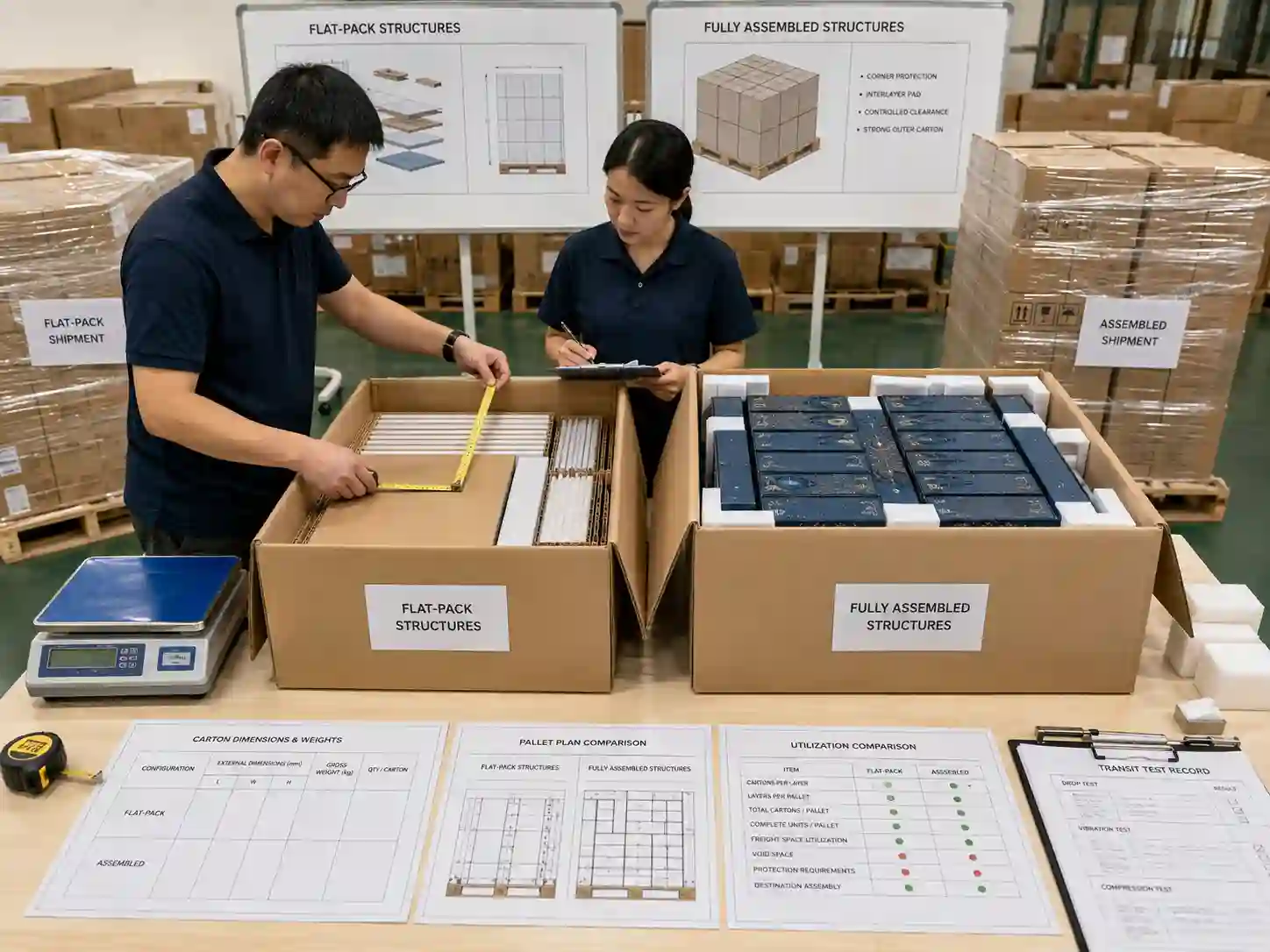
Compare the actual packed master-carton dimensions, quantity per carton, gross weight, pallet pattern, and protection requirements for both configurations. A comparison based only on the dimensions of one calendar can give a misleading result.
For each packing method, prepare a trial carton using production-representative components and the intended protective materials. Record:
- external master-carton length, width, and height;
- number of complete calendar sets per carton;
- gross carton weight;
- type and thickness of corner, edge, interlayer, or surface protection;
- unused internal space and whether that space can be reduced safely;
- cartons per pallet layer and number of layers;
- total units per pallet;
- finished pallet height and stability; and
- any destination assembly or repacking requirement.
Use finished external carton dimensions for freight and pallet calculations because internal dimensions do not represent the space occupied during transportation.
How do you calculate carton utilization for each structure?
A useful starting point is to compare the packed product volume with the usable internal volume of the master carton. The calculation should then be checked against the physical trial pack because protective components and irregular geometry can make a theoretical result unrealistic.
For example, carton utilization can be expressed as:
Carton utilization (%) = total packed product or component volume ÷ usable internal carton volume × 100
This percentage is useful for identifying excessive void space, but it should not be treated as the only decision criterion. A tightly packed carton can still be unsuitable if pressure is transferred into wrapped edges, drawer fronts, perforated doors, magnets, ribbons, or other vulnerable features.
Why can flat-pack structures achieve higher utilization?
Flat-packed components can often be stacked, nested, or grouped so that less air is transported between structural elements. The actual improvement depends on the construction and how much protection is required between decorated surfaces.
A flat-pack trial should therefore include all components needed to make complete units. Do not compare a stack of main boards against a finished assembled calendar while excluding drawers, sleeves, dividers, hardware, or protective sheets.
Why can assembled structures still be the better shipping configuration?
Assembled structures may use more carton and pallet volume, but they remove or reduce destination assembly operations. They can also provide better control over final geometry when assembly quality is difficult to reproduce after shipment.
This matters for structures where drawer alignment, door operation, squareness, magnetic closure, or wrapped-edge appearance depends on controlled factory assembly.
The purchasing and logistics decision should therefore compare freight-space efficiency against the operational consequences of moving assembly downstream.
How should you compare master cartons and pallet patterns?
Build a carton-and-pallet comparison for both configurations before approving either method. Small differences in master-carton dimensions can change the number of cartons that fit on each pallet layer and may outweigh an apparently better carton-fill percentage.
| Comparison item | Flat-pack structure | Assembled structure |
|---|---|---|
| Master-carton dimensions | Measure trial carton externally | Measure trial carton externally |
| Complete sets per carton | Count all component sets | Count finished calendars |
| Void space | Check gaps between stacks and bundles | Check gaps around finished structures |
| Protection | Interleaving, edge protection, bundle restraint as required | Corner, face, edge, and movement protection as required |
| Cartons per pallet layer | Verify using actual external footprint | Verify using actual external footprint |
| Units per pallet | Cartons per pallet × sets per carton | Cartons per pallet × units per carton |
| Destination work | Assembly, inspection, and possible repacking | Usually less structural assembly |
| Main risk to verify | Surface damage, component mix-up, assembly variation | Crushing, movement, corner damage, dimensional shipping volume |
A pallet drawing should show carton orientation, cartons per layer, layer count, total pallet height, and any restrictions on overhang. The selected pattern should then be checked physically where practical rather than approved from spreadsheet calculations alone.
How does void reduction affect the comparison?
Void reduction is valuable only when it does not introduce damaging compression or friction. The goal is a stable packing configuration with controlled clearance, not simply the smallest possible carton.
For assembled calendars, excessive clearance can allow the product to move repeatedly during handling and vibration. Reducing that space may require revised carton dimensions, corner protection, pads, or another restraint method.
For flat-packed structures, the concern is different. Dense stacks may improve utilization while increasing rubbing, edge pressure, or scuffing between printed and finished surfaces. Interlayer sheets or protective wrapping can increase the required volume and should be included in the utilization calculation.
How do transit risks change the flat-pack versus assembled decision?
The two configurations expose the product to different failure modes. Compare them through representative packing trials and an appropriate transit-test plan rather than assuming the configuration with less volume is automatically safer.
What happens during drop and vibration exposure?
An assembled structure can transfer impact through corners, panels, drawers, partitions, and other already-fixed elements. A flat pack may avoid some finished-structure deformation but can experience stack movement, edge impacts, abrasion, or component displacement.
Consider a project where the flat-pack option reduces carton height substantially. If vibration allows decorated panels to slide against each other, additional interleaving and restraint may be required. The revised protective configuration should then be measured again because its utilization will differ from the original calculation.
Likewise, if an assembled carton shows corner crushing or internal movement during a representative handling test, changing the corner protection or carton dimensions can alter the final pallet pattern.

Why should humidity exposure be considered?
Paperboard and corrugated packaging can respond to changes in moisture conditions, so the packing configuration should account for the expected logistics environment. The practical concern is whether changes in material condition affect carton strength, panel flatness, dimensional fit, or stacking performance.
The required controls vary by material combination, route, storage conditions, shipment duration, and packaging design. Buyers should ask suppliers to document the approved packing specification rather than assume one humidity-control method is appropriate for every project.
When does destination assembly offset the freight-space advantage?
Flat packing is only advantageous when the destination can assemble the structure consistently and economically enough for the project. Assembly requirements should therefore be evaluated alongside carton and pallet utilization before approval.
Check whether destination operations require fixtures, trained labor, adhesives, alignment references, component sequencing, functional inspection, or additional packing materials. Also define responsibility for detecting and correcting assembly defects.
For a complex advent calendar, a meaningful comparison can therefore include two separate figures: logistics utilization before arrival and the operational requirement after arrival.
Teams evaluating alternative constructions can discuss structural and packing requirements through custom advent calendar box services before freezing the shipping configuration.
What evidence should buyers request before approving the packing method?
Request measurable evidence for both alternatives whenever the shipping configuration materially affects freight space or product risk. Buyer approval should be based on the agreed packed configuration, not an informal statement that one method “saves space.”
Useful evidence includes:
- packing drawings showing component orientation and quantity;
- actual internal and external master-carton measurements;
- photos of representative trial packs before and after closing;
- gross-weight records;
- carton and pallet pattern calculations;
- finished pallet dimensions;
- protection-material specification;
- relevant transit-test method and results when testing is required;
- destination assembly instructions for flat-packed structures; and
- revision-controlled approval records identifying the final packing method.
These documents separate verifiable facts—such as dimensions, quantities, weights, and pallet patterns—from project-dependent recommendations such as protection level or assembly location. The buyer can then approve the trade-off based on the actual distribution plan.

What should be checked before shipment?
Production cartons should be verified against the approved packing specification before shipment. This confirms that the utilization and pallet calculations made during development still represent the production configuration.
- Confirm the approved flat-pack or assembled configuration is being used.
- Verify the number of complete units or component sets per carton.
- Measure finished external master-carton dimensions.
- Check gross carton weight against the approved packing record.
- Confirm protective materials, orientation, and internal restraint.
- Check shipping marks and carton identification against the approved requirements.
- Verify cartons per pallet layer, layer count, and total pallet configuration.
- Check that production changes have not introduced additional void space.
- Confirm any required destination assembly documents accompany the approved configuration.
- Record deviations and obtain approval before changing the packing method.
How should you make the final flat-pack vs assembled carton utilization decision?
Use a side-by-side trial that compares complete shipped units, not theoretical structure dimensions. The preferred option is the configuration that provides acceptable product protection and operational control while using carton and pallet space efficiently.
A practical decision sequence is:
- Prepare representative flat-pack and assembled packing samples.
- Measure actual carton dimensions, quantities, protection, and gross weights.
- Calculate carton utilization for both options.
- Develop pallet patterns using finished external carton dimensions.
- Compare units per pallet and unused pallet space.
- Evaluate drop, vibration, compression, abrasion, and humidity-related risks relevant to the project.
- Evaluate destination assembly requirements for the flat-pack option.
- Revise protection or carton dimensions where necessary and repeat the calculations.
- Record the selected configuration in the controlled packing specification.
- Verify production cartons against that specification before shipment release.
This method prevents a freight-volume saving from being approved without considering damage risk or downstream assembly, while also preventing an assembled structure from being accepted without examining avoidable shipping volume.
Frequently asked questions
Is flat packing always more space-efficient than shipping assembled calendars?
No. Flat packing often reduces product volume, but the final result depends on component nesting, protective layers, master-carton dimensions, carton quantity, and pallet pattern. Compare actual trial packs before making the decision.
Should carton utilization or pallet utilization have priority?
Both should be reviewed, but pallet utilization can reveal inefficiencies that carton-fill calculations miss. A well-filled carton with an unfavorable external footprint may produce substantial unused pallet area.
Should freight savings include destination assembly costs?
Yes, when flat packing transfers assembly work to the destination. The commercial decision should consider the additional assembly, inspection, handling, and possible repacking requirement separately from the physical carton-utilization calculation.
When should the approved carton configuration be rechecked?
Recheck it when structural dimensions, protective materials, pack quantity, carton specification, component configuration, or pallet requirements change. Production cartons should also be checked against the approved specification before shipment.
For a project-specific comparison, review structure dimensions, packing orientation, master-carton configuration, and pallet requirements before final approval. See custom advent calendar box products for relevant structural formats, or request a custom quote with your product and logistics requirements.