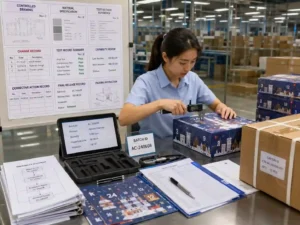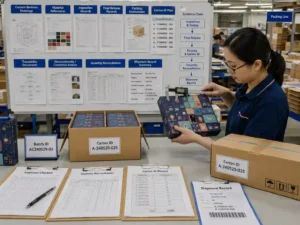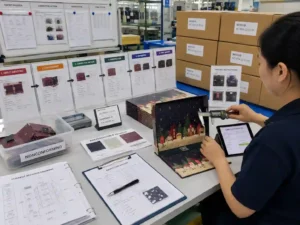
Quick answer: 100 percent functional inspection is justified when a functional failure has serious consequences, the defect can occur unpredictably across individual units, process capability is uncertain, or earlier inspections show that sampling may miss unacceptable failures. For multi-component advent calendar boxes, this can mean checking every critical drawer, door, closure, pull feature, or assembled unit. The decision should be based on defined risk, measurable acceptance criteria, inspection evidence, and an agreed release rule—not simply on a request for “extra QC.”
When is 100 percent functional inspection actually justified?
It is justified when the risk of allowing a functional defect to pass is greater than the cost and production impact of inspecting every affected unit. The strongest cases involve critical functions, unstable processes, known defects, or failures that are difficult to predict through sampling.
A 24-component advent calendar illustrates the issue clearly. A finished box may look acceptable externally while one drawer binds, one perforated door tears incorrectly, one magnet fails to close, or one pull tab detaches. If the failure can occur independently at individual positions, checking a small sample of finished calendars may not provide sufficient evidence about every shipped unit.
The inspection scope should still be specific. “100% inspection” should identify exactly what is checked, at which position, by what method, against which criterion, and at what production stage.
What conditions make full functional inspection more appropriate than sampling?
Full inspection becomes more appropriate as defect consequences increase and confidence in process consistency decreases. Quality teams should evaluate the function and process rather than automatically applying the same inspection level to every feature.
| Condition | Why It Matters | Possible Inspection Decision |
|---|---|---|
| Function is essential to product use | A failure makes a drawer, door, closure, or access feature unusable | Consider 100% inspection of the critical function |
| Defects appear randomly | Failures cannot be reliably associated with one predictable batch segment | Increase inspection coverage; full inspection may be justified |
| Process is newly established or changed | There is insufficient evidence that output remains consistently within requirements | Use temporary increased or 100% inspection until stability is demonstrated |
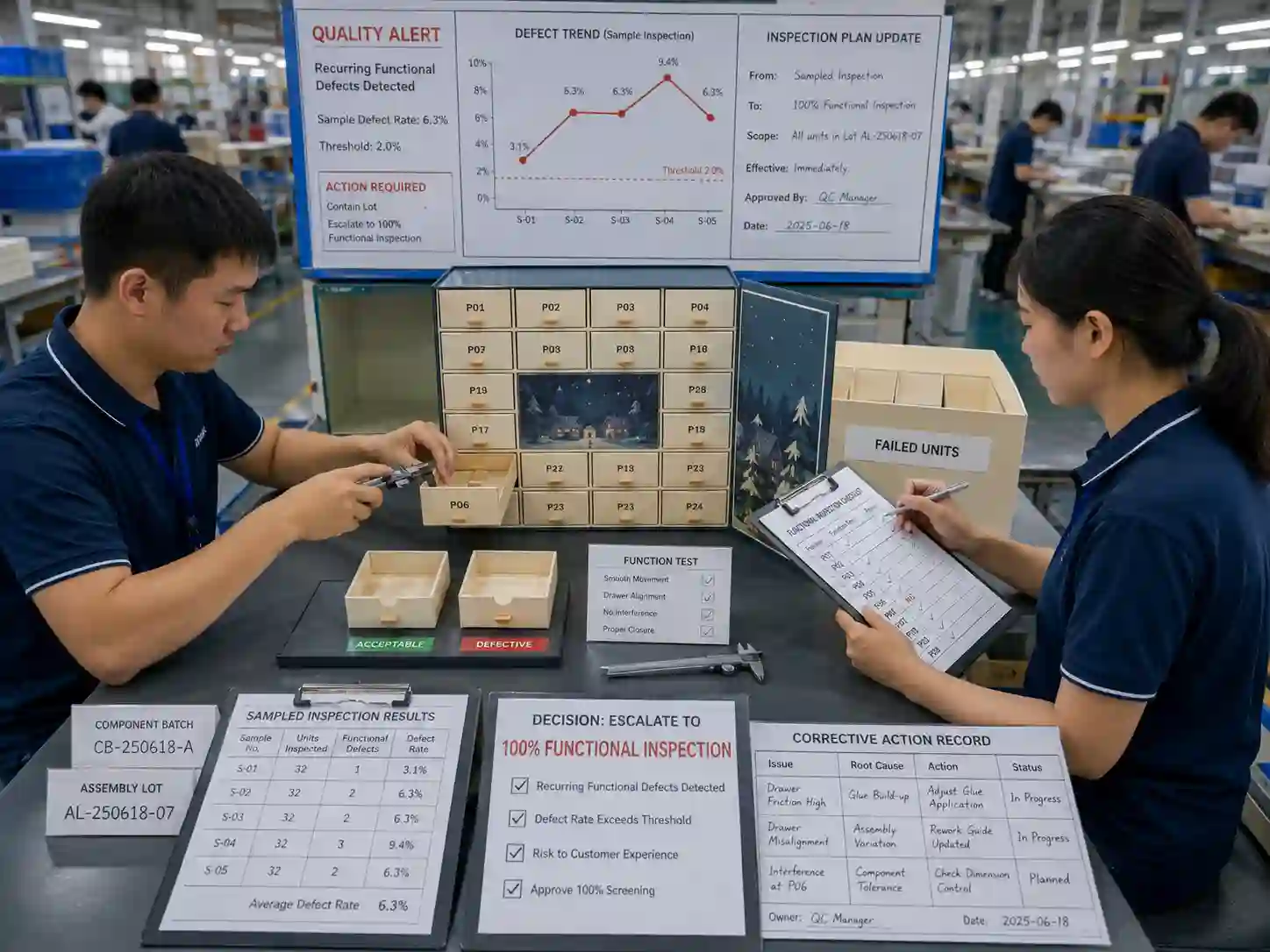
| In-process defects exceed the agreed threshold | Normal sampling no longer gives adequate confidence in the affected production | Contain the affected lot and consider 100% screening |
| Rework has been completed | Correction can introduce variation or leave individual failures unresolved | Inspect every reworked function when the risk requires it |
| Multiple positions have independent failure opportunities | A calendar can pass most positions but still contain one unusable component | Define position-level or unit-level full inspection where necessary |
These are decision factors rather than universal rules. The appropriate inspection level varies with structure, failure mode, production history, agreed specifications, inspection feasibility, and the buyer’s approved quality requirements.
Which advent calendar functions may justify checking every unit?
Functions that directly determine whether the customer can open, close, remove, return, or access a component deserve the closest review. Whether they require full inspection depends on their failure risk and process evidence.
- Drawer movement: binding, excessive friction, interference, or drawers that cannot be removed as intended.
- Perforated doors: incomplete perforation, uncontrolled tearing, premature opening, or inaccessible opening points.
- Magnetic closures: closures that do not engage because of position, polarity, assembly, or alignment problems.
- Ribbon and pull features: detached, trapped, incorrectly positioned, or unusable pull components.
- Product-loaded compartments: interference that prevents normal opening or closing after products are inserted.
- Multi-part alignment: structural displacement severe enough to prevent the intended movement of drawers, sleeves, doors, or lids.
Visual characteristics should not automatically be included in a functional 100% check. A project can require full functional testing of one feature while using an agreed sampling plan for dimensions or cosmetic workmanship.
How should a 100% functional check be defined?
Define the check as a repeatable test rather than an instruction such as “make sure it works.” Inspectors need a controlled method, acceptance criterion, defect response, and record format.
- Identify the function. Specify the drawer, door, magnet, ribbon, pull tab, lid, or other mechanism being controlled.
- Define the test action. State how the inspector opens, closes, pulls, inserts, removes, or cycles the feature.
- Set acceptance criteria. Use approved drawings, specifications, measurement limits, controlled samples, or documented functional requirements.
- Identify the inspection stage. Test as early as practical while still reproducing the conditions that determine final function.
- Define defect classification. State what constitutes pass, rework, rejection, or escalation.
- Record traceability. Connect results to the relevant component batch, assembly lot, production date or other controlled lot identifier.
- Control failed units. Physically segregate nonconforming products so they cannot return to acceptable production without authorization and reinspection.
For buyers developing complex structures, the approved drawing and functional reference sample should support the inspection instruction. Giftpackpro’s custom advent calendar box services can be referenced when discussing how structural requirements should be communicated before production.
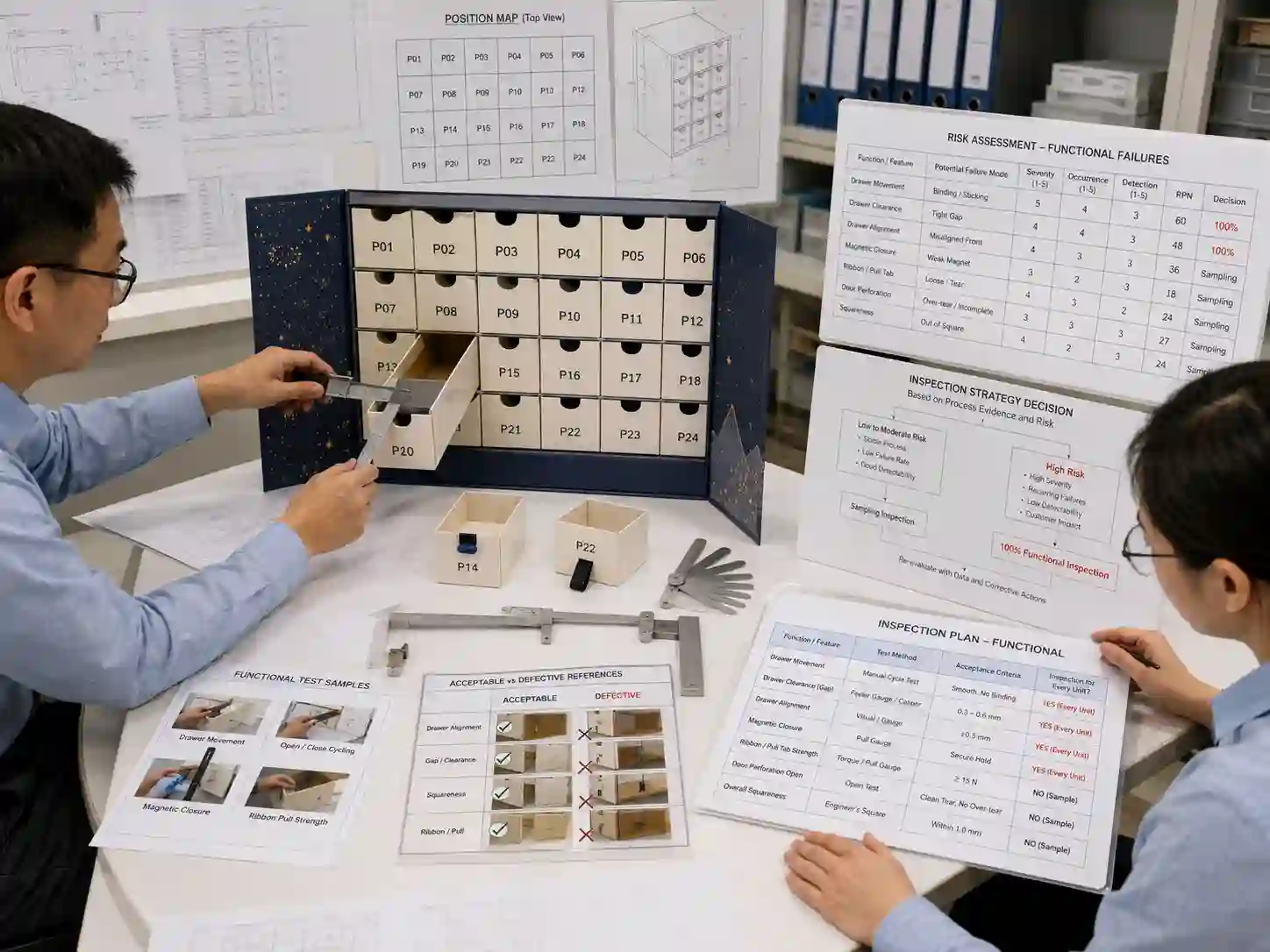
Should every position in a 24-component calendar be tested?
Not necessarily. A 100% unit inspection and a 100% position inspection are different requirements, and the inspection plan should state which one is needed.
For example, testing one selected drawer on every finished calendar provides 100% inspection of units but not of all drawer positions. Testing P01 through P24 on every calendar provides position-level full inspection and requires substantially more handling.
Position-level testing is more defensible when individual positions have different dimensions, components, artwork-related structures, loading conditions, or known failure histories. If positions share the same controlled construction and stable process, the project may support a different inspection strategy.
What should inspectors record during full inspection?
Records should prove what was inspected and what happened to failures. A check mark without lot identification, defect disposition, or reinspection evidence provides limited traceability.
| Record Field | Example of Useful Evidence |
|---|---|
| Assembly lot | Controlled production lot identifier |
| Position or feature | P07 drawer movement or magnetic lid closure |
| Inspection method | Open-close functional test against approved instruction |
| Result | Pass, fail, or defined defect code |
| Failure disposition | Segregated for rework, rejected, or escalated for review |
| Reinspection | Corrected feature retested and result recorded |
| Release status | Affected lot released only after required verification |
How should defects found during 100% inspection be controlled?
A failed unit should be contained immediately and linked to the relevant lot and defect record. Full inspection loses much of its value if failed and passed units can become mixed again.
A practical defect-control sequence is:
- Identify the failed unit and exact position or feature.
- Record the defect against the relevant production or assembly lot.
- Segregate the unit from passed production.
- Determine whether the defect is isolated or indicates a wider process problem.
- Correct the process before continuing uncontrolled production where necessary.
- Rework only under an approved correction method.
- Reinspect the corrected function using the original acceptance criterion.
- Record final disposition before release.
If repeated failures concentrate at one drawer position, assembly station, component batch, or time period, the inspection records become diagnostic evidence. They can help the quality team investigate tooling, dimensional variation, glue application, component orientation, handling, or assembly sequence rather than simply sorting finished products indefinitely.
Can 100% inspection replace process control?
No. Full inspection is a detection and containment control; it does not by itself make an unstable manufacturing process capable or consistent.
Repeated reliance on sorting can also introduce handling risks. Opening every drawer or operating every door adds labor and may create rubbing, fingerprints, tearing, deformation, or other damage if the test method is poorly designed.
Production teams should therefore use inspection findings to improve the source process. Relevant evidence can include dimensional records, first-article results, workstation checks, defect-location trends, component batch records, corrective-action reports, and reinspection results.
Buyers comparing structures can review representative configurations through custom advent calendar box products, but the actual functional inspection method should be based on the approved project specification rather than a generic product type.
When can inspection return from 100% to sampling?
Temporary 100% inspection can be reduced when objective evidence shows that the original risk has been controlled and the agreed release criteria permit a lower inspection level. The transition should be documented rather than based only on several apparently good units.
Useful evidence may include:
- the root cause of the functional defect has been identified;
- corrective action has been implemented at the relevant process;
- affected material or components have been contained;
- subsequent production demonstrates consistent conformance;
- inspection records show the failure mode is no longer recurring;
- required buyer or quality approval has been obtained before changing the inspection plan.
The required quantity or duration of evidence is project-dependent. It should be defined by the quality plan, risk level, production history, and agreed buyer-supplier requirements rather than presented as a universal number.
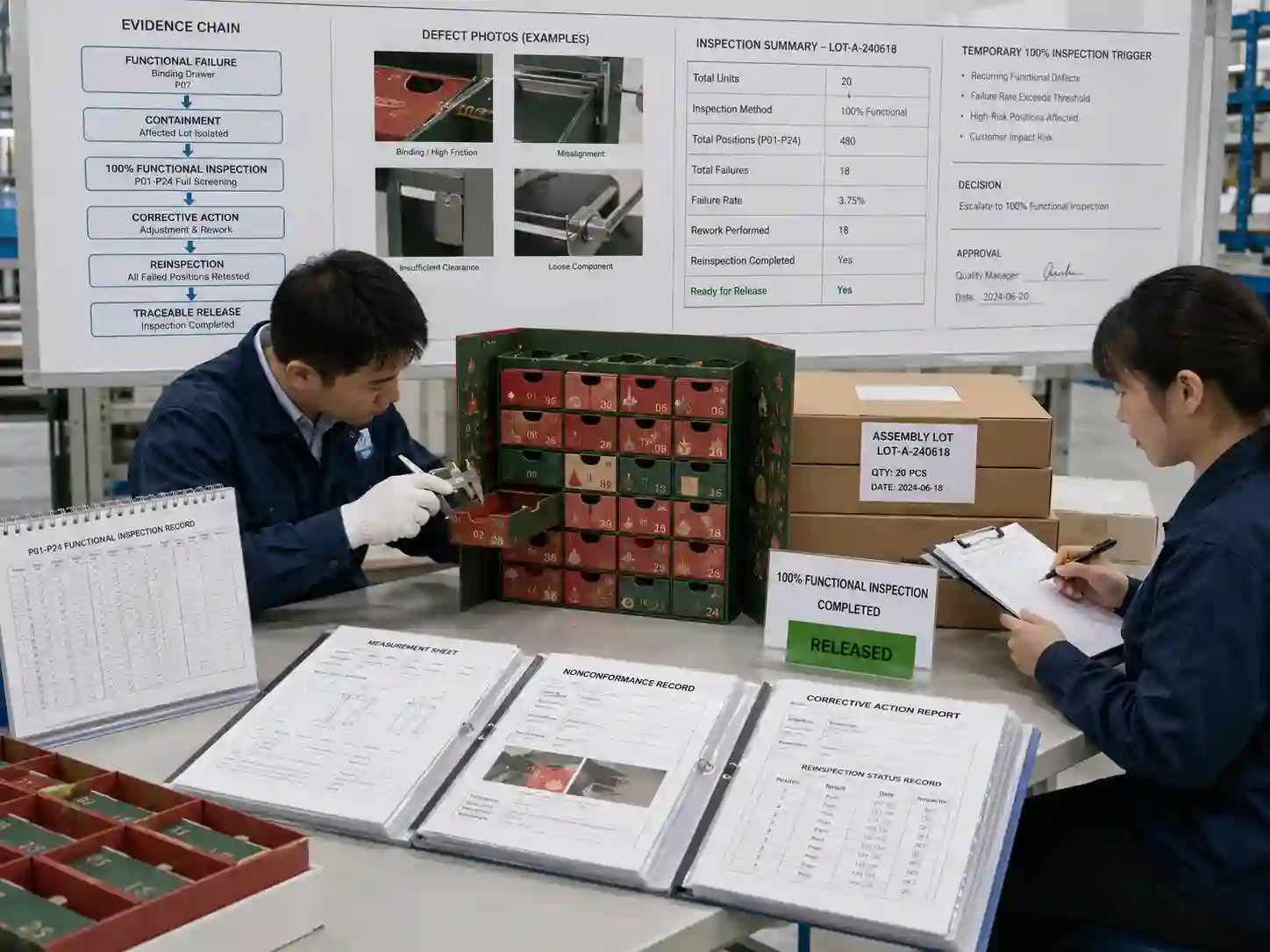
What should buyers approve before requiring full functional inspection?
Buyers should approve the requirement, test method, acceptance criteria, scope, records, and release conditions before production wherever possible. This prevents “100% inspection” from becoming an ambiguous instruction interpreted differently by purchasing, production, and QC teams.
The approval should distinguish verifiable requirements from project-specific decisions. Drawings, approved samples, inspection instructions, measurements, lot records, and test results provide objective evidence. Decisions about which functions require full inspection, how long enhanced inspection remains active, and when normal sampling can resume depend on the project’s risk and agreed quality plan.
For a new or unusually complex calendar, the key question is therefore not simply whether 100% inspection sounds safer. The useful question is whether a defined failure mode creates enough residual risk that every affected unit or position must be functionally verified before release.
FAQs about 100% functional inspection
Does 100% inspection mean every characteristic must be checked?
No. It can apply only to specified critical functions. For example, every magnetic closure could receive a functional test while cosmetic workmanship remains subject to a separate inspection method.
Is 100% inspection always better than statistical sampling?
No. Full inspection provides broader screening for the defined function but requires more labor and handling and still depends on a reliable test method. Stable, lower-risk processes may be appropriately controlled through defined sampling and process controls.
Should reworked advent calendar boxes receive full reinspection?
The affected function should be reinspected after rework, and full reinspection may be justified when the correction affects every unit or when individual rework quality cannot otherwise be reliably demonstrated. The required scope should be documented in the rework and quality instructions.
How can a buyer verify that 100% inspection was completed?
Request evidence appropriate to the project, such as inspection records, lot identifiers, defect quantities, position-level results where required, segregation records, corrective-action documentation, and reinspection status. These records should connect inspected production to the released lot rather than exist as generic QC paperwork.
If your advent calendar structure contains critical drawers, doors, closures, or other functional components, request a custom quote and provide the relevant drawings, functional requirements, and inspection expectations for project review.