
Quick answer: Packaging defect rework criteria should require rework when a defect causes the finished calendar box to fall outside an approved functional, dimensional, structural, visual, or assembly requirement. Typical triggers include binding drawers, unreliable closures, excessive gaps, loose components, damaged surfaces, incorrect assembly, or defects that could worsen during packing or distribution. The decision should be based on controlled drawings, approved samples, measurable limits, inspection records, and documented buyer requirements—not an inspector’s subjective preference.
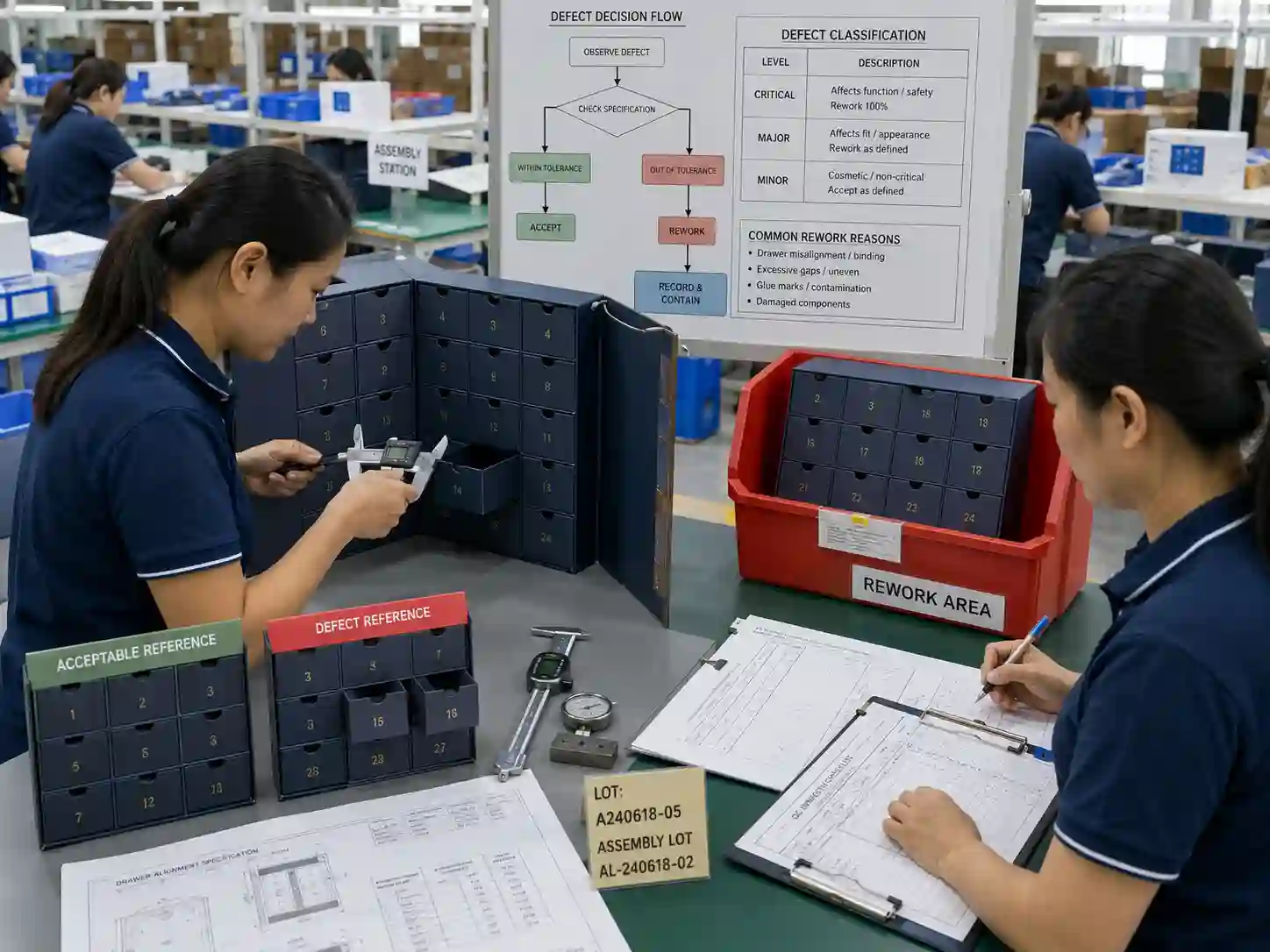
What defects should automatically trigger rework?
A defect should normally trigger rework when the inspected unit does not meet a defined requirement and the nonconformance can be corrected without creating another unacceptable condition. The strongest rework decisions are tied to measurable or observable evidence.
For an advent calendar box, this means inspectors should evaluate more than appearance. They should check whether drawers, doors, inserts, magnets, ribbons, wrapped panels, and other components perform as specified when assembled.
| Defect condition | Typical evidence | Likely disposition |
|---|---|---|
| Drawer binds, jams, or cannot be removed as intended | Functional test, clearance measurement, approved sample comparison | Rework if correction is feasible |
| Drawer or panel alignment exceeds approved tolerance | Caliper, feeler gauge, square, drawing | Rework |
| Magnet, ribbon, or pull tab is loose or incorrectly positioned | Functional inspection and position reference | Rework |
| Glue contamination affects a visible or functional area | Visual reference and approved workmanship standard | Rework where cleaning or replacement is controlled |
| Minor cosmetic variation within an approved limit | Golden sample or documented visual standard | Accept |
| Wrong component, artwork version, or assembly sequence | BOM, assembly record, approved artwork, lot identification | Rework or segregation pending investigation |
| Structural damage that cannot be reliably restored | Inspection against structural requirements | Reject rather than rework |
The exact limits are project-dependent. A premium rigid calendar with closely aligned drawers may require tighter cosmetic and dimensional controls than a simpler paperboard construction. Those limits should therefore be established before production rather than invented during final inspection.
How should packaging defect rework criteria be defined?
Rework criteria should convert approved product requirements into clear inspection decisions. Each important characteristic should identify what is checked, how it is checked, the acceptable condition, and what happens when the requirement is not met.
Useful controlled references can include structural drawings, approved production samples, component specifications, artwork approvals, measurement instructions, workmanship samples, inspection checklists, and buyer-approved tolerances.
Which defects need measurable limits?
Use measurable limits whenever a defect can be evaluated objectively. Drawer gaps, panel offset, squareness, component position, clearance, and overall dimensions are better controlled with defined measurement points than with descriptions such as “looks acceptable.”
For example, a drawing can identify exactly where a drawer gap is measured. Inspectors can then use the specified gauge or measurement method at the same location across sampled units. The recorded result provides evidence for acceptance or rework.
Which defects need controlled visual references?
Some workmanship characteristics cannot be efficiently reduced to one dimension. Surface scratches, wrapping marks, minor glue residue, print appearance, edge finishing, and similar conditions may require approved visual reference samples or photographs.
The reference should distinguish acceptable variation from a defect requiring correction. Lighting, viewing distance, inspection surface, and orientation may also need to be controlled when they materially affect the decision.
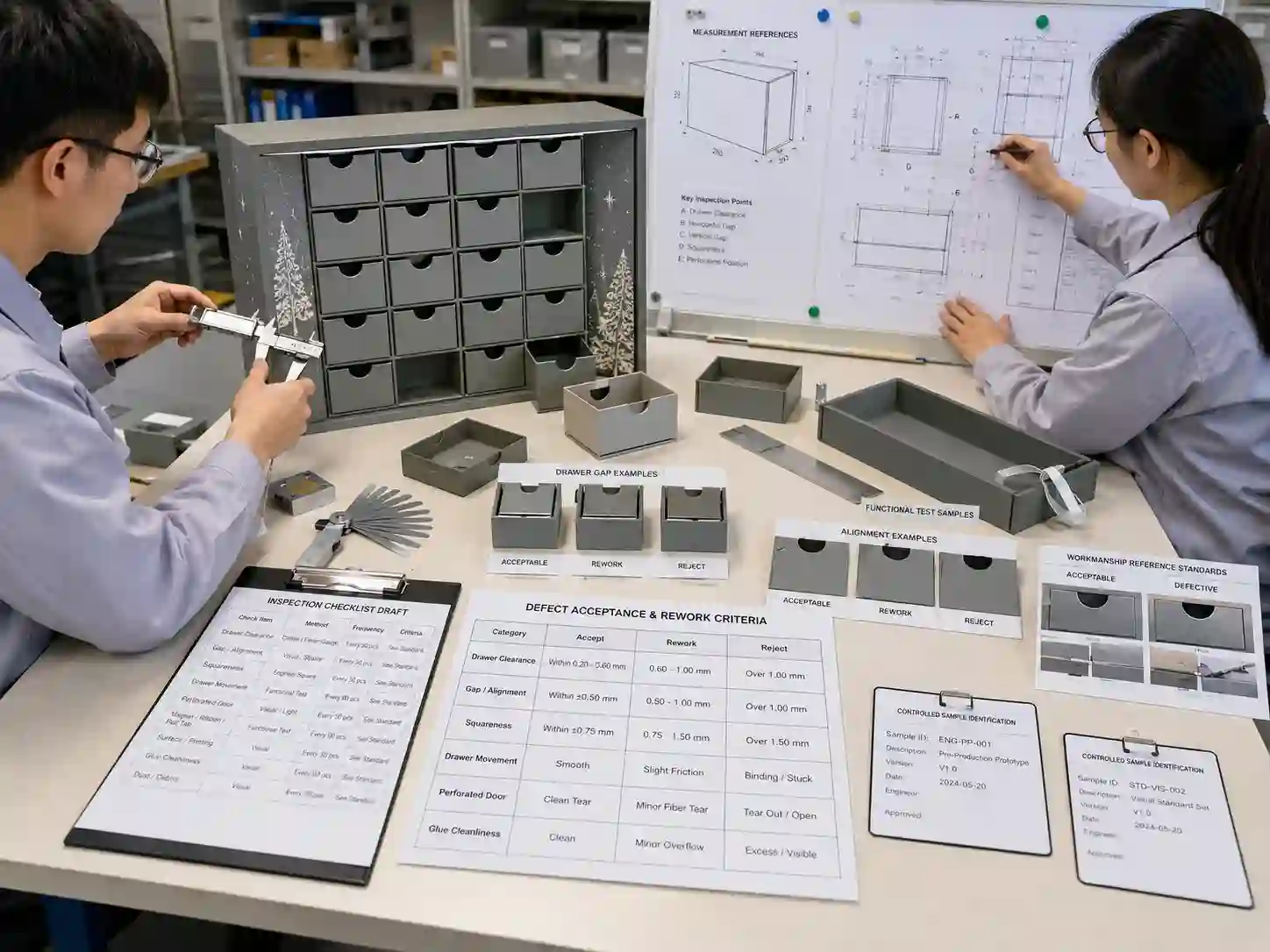
When should a functional defect require rework?
A functional defect should trigger rework when the box cannot perform an approved function consistently. This is especially important for advent calendar structures containing multiple drawers, perforated doors, closures, ribbons, pull tabs, or fitted components.
Examples include:
- A drawer that binds against the housing or neighboring drawer.
- A perforated door that tears outside its intended opening path during the approved test.
- A magnetic closure that does not align or remain closed as specified.
- A pull ribbon or tab that detaches during normal intended operation.
- An insert or compartment that no longer retains the intended product correctly.
- A warped panel that prevents the calendar from closing, standing, or aligning as approved.
Inspectors should reproduce the approved test method before assigning the defect. A single difficult drawer, for example, should be checked for debris, local deformation, incorrect assembly, dimensional interference, or another identifiable cause rather than immediately being classified from appearance alone.
When should cosmetic defects be accepted instead of reworked?
Cosmetic variation can be accepted when it remains inside the approved workmanship standard and does not affect function, structural integrity, required appearance, or another buyer-approved characteristic. Reworking acceptable variation can introduce unnecessary handling and new damage.
This distinction is particularly important for wrapped rigid boxes. Excessive handling intended to correct a very small visual variation can create scratches, crushed corners, adhesive marks, or surface contamination.
A practical cosmetic inspection checklist can ask:
- Is the condition visible under the specified inspection conditions?
- Does it exceed the approved reference sample or documented limit?
- Is it located on a primary visible surface or a concealed area?
- Does it affect fit, movement, closure, or structural performance?
- Is the condition repeated across the production lot?
- Can rework be performed without damaging adjacent surfaces or components?
Buyer approval is important where appearance is subjective. The supplier can measure and document the condition, but the commercial acceptance boundary for a critical visual feature should come from an approved specification or reference rather than an undocumented production-floor judgment.
When should a defect be rejected instead of reworked?
Rework is not appropriate when the proposed correction cannot reliably restore the approved requirement or when the repair could hide rather than eliminate the defect. In such cases, the unit or component should remain segregated until an authorized disposition is made.
Examples can include severely crushed rigid-board structures, torn wrapped surfaces that cannot be restored to the approved appearance, incorrect printed components that cannot be replaced safely, or structural damage that compromises the finished assembly.
A factory should also avoid uncontrolled repair methods. Adding adhesive, trimming components, forcing drawers into position, touching up printed surfaces, or replacing parts without recording the action can make the original defect harder to trace.
How should inspectors decide between accept, rework, and reject?
The decision should follow a controlled sequence: identify the observed condition, compare it with the applicable requirement, record the evidence, classify the defect, and assign an authorized disposition. This prevents different inspectors from applying different standards.
- Identify the defect. Record the component, position, defect type, and affected unit or sample.
- Check the controlled reference. Use the current drawing, approved sample, specification, inspection instruction, or workmanship limit.
- Measure or test where applicable. Record actual results rather than only writing “fail.”
- Determine the extent. Check whether the condition is isolated or appears across additional sampled units.
- Segregate affected material. Prevent nonconforming units from returning to normal production before disposition.
- Assign disposition. Accept, rework, reject, or hold for authorized review.
- Verify rework. Reinspect the corrected characteristic before release.
For complex custom structures, the inspection method should be established before mass production. Giftpackpro’s custom advent calendar box services can be used to discuss structural and production requirements that need to be translated into inspection controls.
How should reworked units be verified before release?
Reworked units should be reinspected against the same approved requirement that caused the original failure. Completing the repair itself is not evidence that the product now conforms.
If a binding drawer was caused by an incorrectly positioned component, for example, QC should verify both the corrected position and the resulting drawer movement. If excess adhesive was removed, the inspector should confirm that cleaning did not damage the wrapping, print, lamination, or nearby construction.
Depending on the defect, verification records may include:
- Original defect classification and location.
- Component or assembly lot identification.
- Quantity segregated and quantity reworked.
- Rework method or controlled instruction reference.
- Post-rework measurement or functional test result.
- Inspector identification and release status.

Why does traceability matter when deciding on rework?
Traceability determines whether a discovered defect is limited to one unit or potentially affects a larger production population. Component lots, assembly records, inspection results, and finished-carton identification can help QC define the correct containment scope.
For example, suppose inspection finds repeated drawer binding and the affected drawers can be traced to one component batch. QC can identify assemblies using that batch, segregate the relevant population, inspect the suspected characteristic, complete controlled rework where required, and record reinspection before release.
Without that link, the factory may need to expand containment because it cannot demonstrate which units are unaffected. Buyers evaluating a supplier can therefore review how production identification and quality records are maintained, in addition to reviewing finished samples. More information about manufacturing capabilities is available through the Giftpackpro packaging factory page.
What evidence should buyers approve before production?
Buyers should approve the requirements that materially affect commercial acceptance, while the factory should maintain the inspection evidence needed to verify those requirements. Responsibilities should be clear before production starts.
Verifiable production facts include measured dimensions, recorded test results, component identification, inspection quantities, defect locations, and rework status. These can be checked against drawings and QC records.
Project-dependent recommendations include measurement frequency, sampling locations, inspection fixtures, rework methods, and the amount of additional containment needed after a defect. These depend on construction, process capability, defect risk, and production conditions.
Buyer approvals should define subjective or commercially important boundaries such as critical visual appearance, approved reference samples, special functional expectations, and any project-specific tolerances that cannot be derived from the structural specification alone.
What should happen when the same rework defect keeps returning?
Repeated defects should trigger investigation beyond individual repair. If production repeatedly reworks the same drawer interference, panel alignment, glue contamination, or component-position problem, correcting finished units alone does not control the underlying process.
QC and production teams should compare defect records by workstation, component batch, assembly stage, tooling condition, operator process, or other relevant production variable. Corrective action should address the verified cause, followed by additional inspection to confirm that the change is effective.
FAQs about defect rework decisions
Should every visible packaging defect be reworked?
No. A visible condition within an approved workmanship limit can be accepted. Rework should be tied to a defined nonconformance because unnecessary handling can introduce additional cosmetic or structural damage.
Can an inspector decide a new tolerance during production?
Inspectors should apply approved requirements rather than create new acceptance limits independently. If a condition is not covered by the existing specification, it should be documented and escalated to the authorized engineering, quality, supplier, or buyer representative for disposition.
Does successful rework automatically release the product?
No. The corrected characteristic should be reinspected and its status recorded before the affected units return to conforming production. Where the repair could influence another characteristic, that secondary risk should also be checked.
When should buyers review rework records?
Review is particularly useful when defects are repeated, affect important functional characteristics, involve a significant contained population, or require buyer disposition. Records allow the buyer to verify what failed, what was corrected, and how conformity was confirmed.
For a custom project, review the construction, functional requirements, inspection references, and proposed defect controls before production. Explore custom advent calendar box products or request a custom quote to discuss the requirements that should be reflected in the production QC plan.