Quick answer: Embossing can weaken a small drawer front when the raised or recessed area removes too much board strength, concentrates stress near edges, overlaps fold lines, or affects adhesive layers. The risk depends on board construction, emboss depth, drawer size, artwork coverage, and handling requirements. The safest approach is to review emboss placement on engineering drawings, validate samples, and inspect finished drawer movement before production approval.
When can embossing weaken a small drawer front?
Embossing can weaken a small drawer front when the finish process creates excessive stress in a limited paperboard area. Small drawer fronts have less material surface to distribute pressure, so deep embossing, large patterns, or details close to corners can affect flatness and rigidity.
The risk is higher when embossing is combined with other finishing layers such as foil stamping, heavy lamination, or multiple coating processes. Each layer can change how the paper structure bends, holds shape, and responds during repeated drawer opening.
Why are small drawer fronts more sensitive than larger panels?
Small drawer fronts have limited structural area around the handle zone, edges, and corners. A large panel may absorb embossing pressure with minimal visible change, while a small drawer face can show bowing, distortion, or weakened edges.
Important risk areas include:
- Embossing placed close to drawer front edges or corners.
- Deep embossing across narrow sections of board.
- Emboss patterns crossing score lines, folds, or wrapped edges.
- High-contact areas where users repeatedly pull the drawer.
How should designers evaluate embossing small drawer fronts?
Designers should evaluate embossing small drawer fronts through a combination of artwork review, structural drawings, sample inspection, and handling checks. The emboss effect should be approved together with the drawer structure rather than treated as a separate decoration.
| Embossing condition | Possible risk | Recommended review |
|---|---|---|
| Deep emboss on a narrow drawer face | Local weakening or visible distortion | Check emboss depth and board response on samples |
| Embossing near edges | Corner deformation or reduced rigidity | Review distance from cut edges and wrapped areas |
| Embossing combined with foil | Registration or adhesion issues | Inspect foil transfer quality and surface consistency |
| Embossing across high-use areas | Surface wear during handling | Perform repeated opening and closing checks |
What checks confirm embossing will not damage drawer performance?
The most reliable confirmation comes from physical samples and documented inspections. Visual approval alone may not identify changes in stiffness, drawer alignment, or surface durability.
Useful verification steps include:
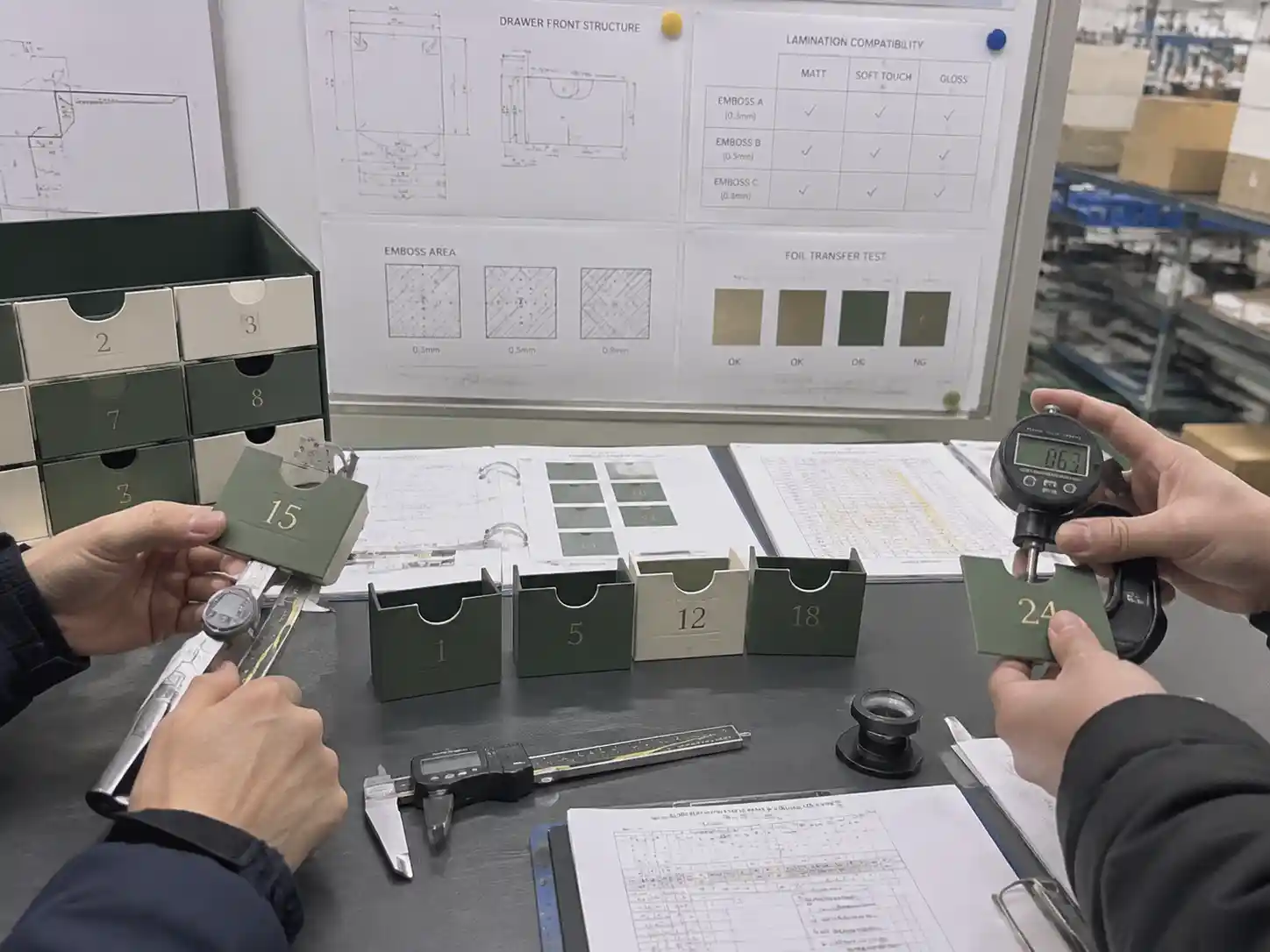
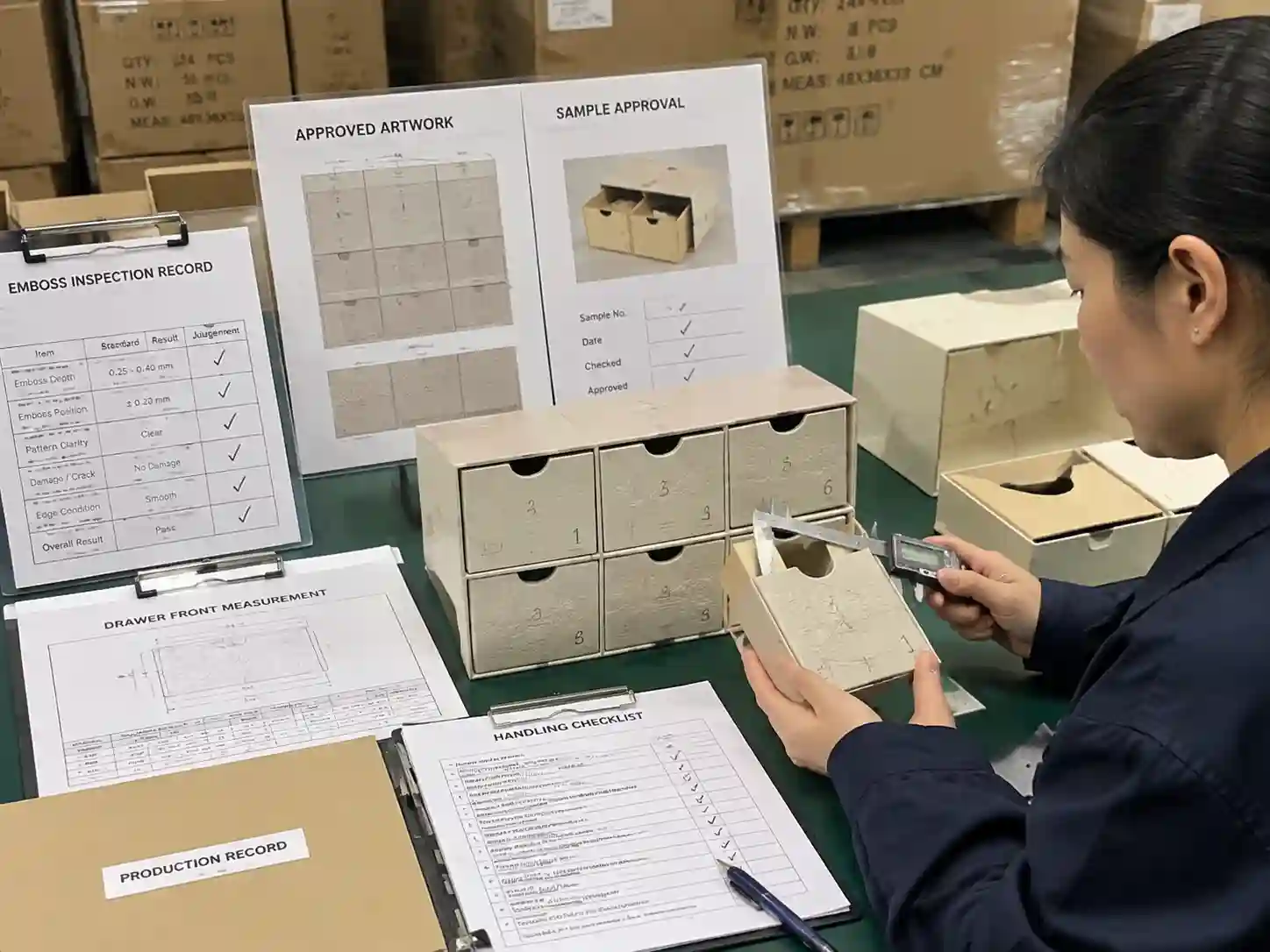
- Review engineering drawings: Confirm emboss areas do not conflict with score lines, folds, magnets, or structural reinforcement zones.
- Inspect embossed samples: Check whether the drawer front remains flat and whether edges maintain their shape after finishing.
- Test drawer operation: Open and close finished samples to identify resistance, rubbing, or front-panel movement.
- Record approval evidence: Keep approved artwork files, sample photos, finish specifications, and inspection notes for production reference.
Which finishing combinations create more embossing risk?
Risk depends on the complete finishing stack rather than embossing alone. A shallow emboss on a stable board may perform well, while a complex combination of effects may require additional review.
| Finish combination | Risk consideration | Buyer approval point |
|---|---|---|
| Emboss + foil stamping | Requires accurate registration and surface transfer control | Approve foil alignment and raised detail appearance |
| Emboss + lamination | Layer stiffness may affect folding and drawer movement | Confirm finished sample performance |
| Emboss + spot UV | Multiple surface effects can highlight uneven areas | Check visual consistency under normal lighting |
| Emboss + textured paper | Paper surface variation may affect detail definition | Approve the actual material and finish combination |
How does emboss depth and placement affect drawer strength?
Emboss depth and placement should be selected based on the drawer front size, board structure, and appearance requirements. There is no single emboss depth suitable for every packaging design.
Project-dependent factors include:
- The thickness and type of paperboard used for the drawer front.
- The size and density of the embossed artwork.
- Whether the drawer front is wrapped, coated, or laminated.
- The expected handling frequency during packing, display, and use.
A finish-selection example: a small premium drawer front with a metallic logo may only require a controlled shallow emboss around the logo area, while a larger decorative pattern covering most of the panel may require structural review before approval.
What evidence should buyers request before production?
Buyers should request evidence that connects the finishing decision with the final packaging performance. Useful records include approved artwork with emboss layers, engineering drawings showing finish placement, sample approval records, and inspection notes.
These documents help confirm that the embossing effect was evaluated together with drawer function, not only visual appearance.
FAQ: Can embossing make a drawer front bend?
Yes, embossing can contribute to bending or distortion if the process creates uneven stress across the panel. The likelihood depends on the emboss pattern, material construction, and finishing combination.
FAQ: Should embossing be avoided on small drawer fronts?
No. Embossing can be suitable for small drawer fronts when the design, material, and production process are reviewed together. The key is controlling placement, depth, and interaction with other finishes.
FAQ: How can quality teams check embossing durability?
Quality teams can inspect approved samples, compare finished drawers against engineering requirements, check surface condition, and document any movement or deformation during handling tests.
For custom seasonal packaging projects, Giftpackpro supports finish planning and structural review for custom advent calendar box products, helping teams evaluate decorative effects alongside practical performance.
Request a review for your packaging finish requirements through our request a custom quote service.