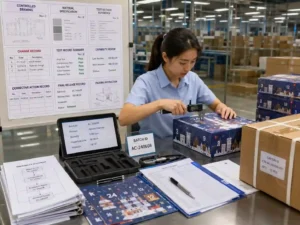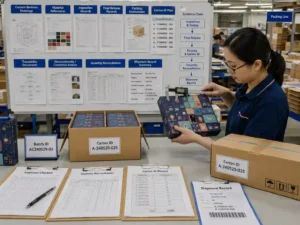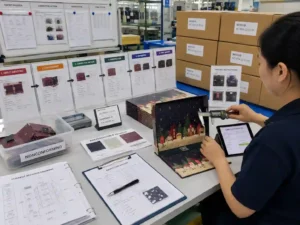
Quick answer: Combining embossing and foil successfully requires controlling artwork alignment, tooling accuracy, material response, and finishing sequence. The key is to define how foil areas and embossed details interact before production, then verify the result through approved samples, measurements, and inspection records. Fine details can be lost when foil coverage, emboss depth, paper structure, or registration tolerances are not considered together.
What Is the Main Challenge When Combining Embossing and Foil?
The main challenge is keeping foil placement and embossed relief aligned while maintaining clear details on the finished surface. Foil stamping adds a reflective layer, while embossing changes the paper surface height, so both processes must be planned as one finishing system.
For premium advent calendar boxes, the risk is usually not the individual finish process. The risk comes from interaction between processes. Small numbers, decorative lines, logos, door graphics, and fine patterns can appear uneven if the foil does not sit correctly over the embossed area.
How Does Foil Emboss Combination Registration Affect Detail Quality?
Foil emboss combination registration affects whether metallic details visually match the raised or recessed structure underneath. Registration must be controlled through artwork preparation, tooling references, sampling review, and production inspection.
Important control points include:
- Artwork separation: Foil layers and emboss areas should be clearly defined so production teams know which elements require alignment.
- Tooling coordination: Emboss plates and foil dies need matching reference points to reduce movement between processes.
- Material behaviour: Paperboard thickness, coating, lamination, and surface texture can influence how sharply details transfer.
- Sample approval: Physical samples should be reviewed under normal viewing conditions before production release.
What Production Steps Help Preserve Embossed Foil Details?
The most reliable approach is to control the finish from design review through final inspection rather than correcting problems after production.
-
Review the artwork structure.
Packaging teams should identify critical areas such as small text, thin foil lines, embossed borders, and alignment-sensitive graphics. These areas usually need tighter attention than larger decorative surfaces.
-
Check emboss depth and foil coverage together.
An emboss that is too shallow may not create enough visual separation, while excessive depth can distort foil placement or affect surface consistency.
-
Approve physical finishing samples.
Digital artwork cannot fully show foil reflection, emboss shadows, or surface interaction. A finished sample provides evidence of the actual appearance.
-
Verify production consistency.
Quality teams should compare approved samples with production output using inspection records, reference pieces, and documented acceptance points.
Which Finish Risks Should Buyers Review Before Production?
| Finish risk | Possible effect | Recommended check |
|---|---|---|
| Foil and emboss misregistration | Metallic details appear shifted from raised areas | Compare foil position against approved embossed samples |
| Fine detail loss | Small patterns or lettering become unclear | Review minimum detail size during artwork approval |
| Surface cracking after forming | Finish damage appears around folds or stress areas | Inspect folded samples and handling points |
| Poor adhesion | Foil may lift or reduce visual quality | Confirm material compatibility and finish performance |
How Should Adhesion and Durability Be Checked?
Foil and emboss quality is not only a visual issue. The finished surface must also remain stable during assembly, handling, and packing.
A practical adhesion review can include:
- Checking whether foil edges remain clean after handling.
- Reviewing whether laminated surfaces affect foil transfer quality.
- Inspecting embossed areas for cracking, flattening, or distortion.
- Comparing production samples against approved finish references.
What Evidence Should Be Included in a Finish Approval Record?
A reliable approval record should show how the finish decision was verified. Useful evidence includes approved artwork files, finish specifications, sample approval notes, inspection photographs, measurement references, and revision history.
These records help packaging designers, sourcing teams, and quality teams confirm that the selected combination of foil, embossing, spot UV, lamination, or specialty paper performs as intended.
Which Finish Combination Works Best for Different Packaging Goals?
The best combination depends on the visual effect, surface area, product handling requirements, and structural design of the package.
| Packaging goal | Possible approach | Key consideration |
|---|---|---|
| Premium metallic detail | Foil with controlled embossing | Maintain registration around important graphics |
| Tactile texture with subtle shine | Embossing with selective foil areas | Avoid overcrowding fine details |
| High contrast finish effects | Foil, emboss, and spot UV combination | Review surface compatibility during sampling |
FAQs About Combining Embossing and Foil
Can foil be applied directly over embossed areas?
Yes, but the result depends on tooling accuracy, material selection, and the complexity of the design. Detailed embossed foil effects usually require careful sample verification.
Why do small foil details disappear after embossing?
Small details can become unclear when emboss depth, foil coverage, or artwork scale is not balanced. Fine elements should be reviewed during the design and sampling stage.
Does lamination affect embossed foil results?
Lamination can influence surface feel, adhesion, and visual contrast. The effect depends on the laminate type, paper structure, and finishing sequence.
How Does Giftpackpro Support Embossed Foil Packaging Development?
Giftpackpro works with commercial packaging projects that require coordinated finishing decisions, including custom advent calendar box products and custom advent calendar box services. Finish choices are reviewed with attention to artwork, samples, surface effects, and production requirements.
For projects requiring combined embossing and foil effects, buyers can review packaging requirements through request a custom quote and discuss suitable finishing options before production approval.