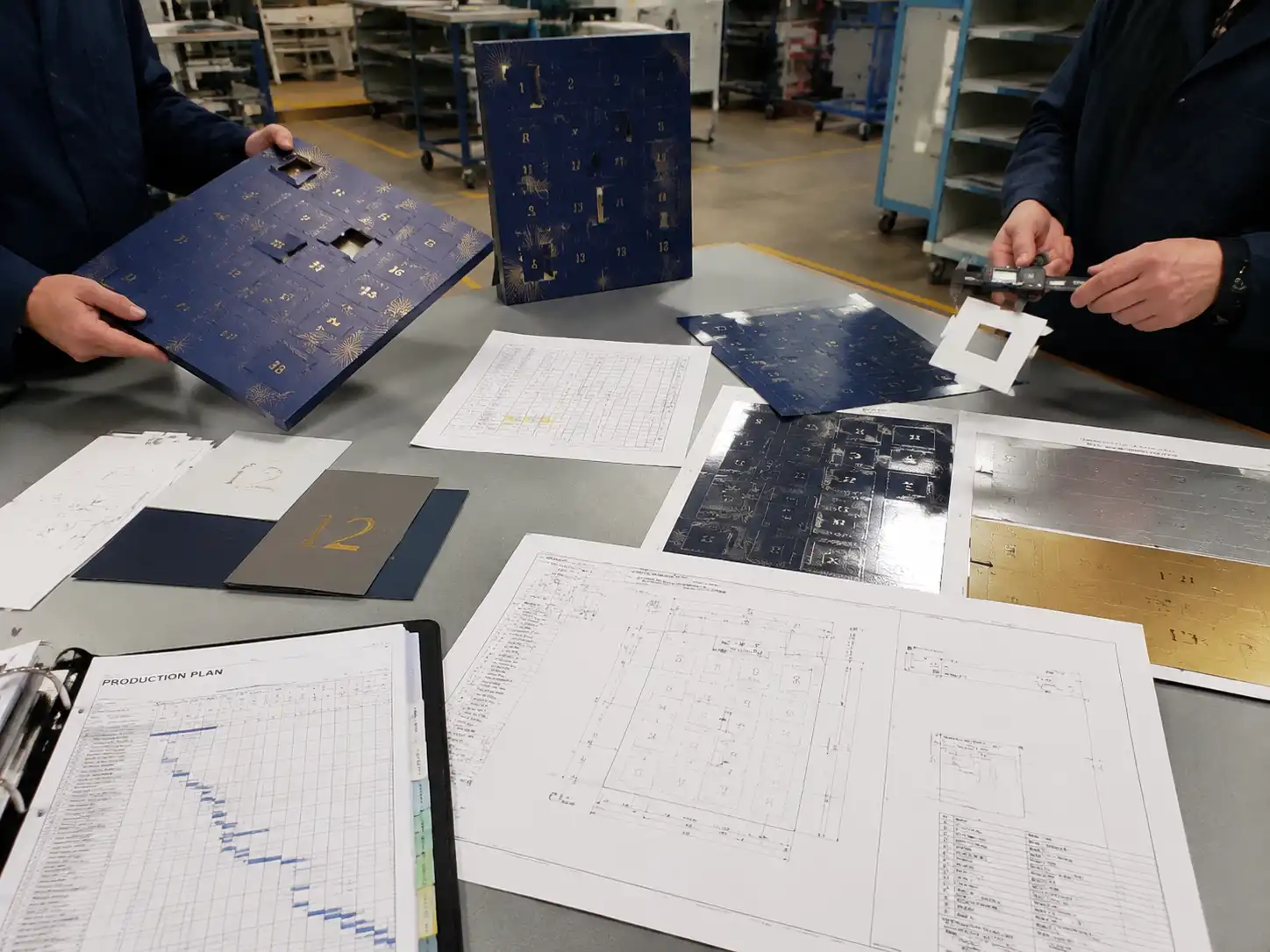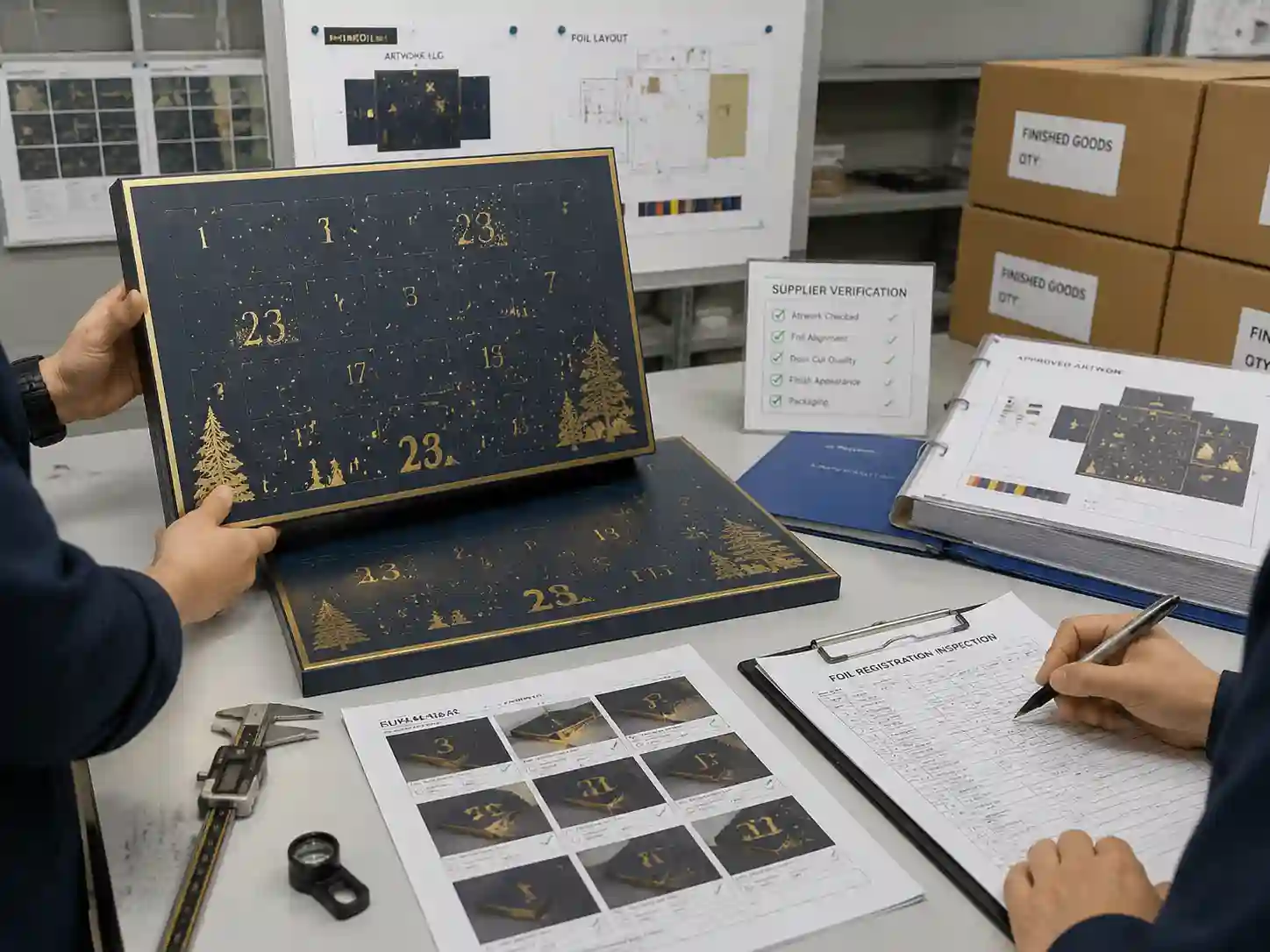
Quick answer: Foil registration around numbered advent calendar doors is controlled by aligning foil artwork, die-cut positions, and finishing layers before production release. The process requires accurate dielines, controlled foil positioning, proof approval, tooling checks, and inspection of samples around numbers and door openings. The main risks are foil shifting, cut-line interference, broken details, and inconsistent appearance between panels.
How do you control foil registration numbered doors on advent calendar packaging?
Foil registration numbered doors is controlled by treating the foil layer, printed artwork, and door-cut geometry as one coordinated production system. The key is confirming that the foil elements remain correctly positioned after folding, cutting, and finishing processes.
Important control points usually include:
- Approved artwork files with separate foil, print, emboss, and cut-line layers.
- Clear registration references between foil artwork and door positions.
- Production samples showing actual numbered doors after finishing and die cutting.
- Inspection records confirming alignment before full production release.
For complex seasonal packaging, Giftpackpro recommends validating finishing details during the structural and artwork approval stages through custom advent calendar box services rather than relying only on flat artwork previews.
Why do numbers and door cuts create foil registration risks?
Numbered doors create tighter registration requirements because the foil often sits close to perforations, windows, or die-cut edges. Small movement during printing, foil stamping, or cutting can make metallic details appear uneven.
| Risk area | Why it happens | Control method |
|---|---|---|
| Foil touching door cut lines | Artwork does not allow enough clearance between foil and cutting areas. | Review foil placement against the final dieline before approval. |
| Uneven number positioning | Registration variation between print, foil stamping, and die cutting stages. | Use production samples to verify the relationship between numbers and openings. |
| Broken foil details near folds | Finishing areas experience stress during folding or assembly. | Check finished samples after folding and handling. |
| Appearance variation between panels | Large layouts amplify small positioning differences. | Define acceptable visual alignment during buyer approval. |
What artwork preparation helps improve foil alignment?
Correct artwork preparation reduces registration problems by making each production layer measurable and reviewable. Foil areas should be clearly separated from CMYK artwork, spot colors, emboss areas, and structural cut lines.
A practical artwork review should include:
- A final dieline showing all numbered door positions.
- A dedicated foil layer with clearly identified stamping areas.
- Registration references between numbers, graphics, and door edges.
- Notes showing where foil should avoid perforations, folds, or high-stress areas.
These controls create a clearer approval record and reduce interpretation differences between artwork teams, suppliers, and production departments.
How are foil, embossing, and spot UV checked together?
Foil registration is not only a foil stamping issue. Other finishes such as embossing, spot UV, and lamination can affect the final visual relationship between numbered doors and decorative elements.
| Finish combination | Recommended review point |
|---|---|
| Foil + embossing | Confirm that raised areas do not distort foil alignment or reduce detail clarity. |
| Foil + spot UV | Check that glossy areas support the intended hierarchy without competing with numbers. |
| Foil + lamination | Verify that the selected surface treatment maintains appearance after finishing. |
| Foil + edge cuts | Inspect finished doors to confirm metallic details stay away from unwanted trimming. |
What inspection evidence should buyers request before production?
Buyers should verify foil registration through physical evidence rather than artwork screenshots alone. The most useful records are production samples, inspection notes, approved files, and measurement references.
Useful verification items include:
- Approved artwork revision showing foil and cut-line layers.
- Finished sample photos or physical samples with numbered doors opened and closed.
- Supplier inspection records identifying registration checks.
- Comments from approval teams confirming acceptable visual alignment.
The exact acceptable tolerance depends on the artwork complexity, foil size, door spacing, material surface, and production method. Final approval criteria should be agreed before mass production begins.
What is a practical foil registration approval checklist?
A simple checklist helps ensure decorative finishes remain functional after cutting and handling.
| Check | Approval question |
|---|---|
| Artwork layers | Are foil, emboss, UV, and cut-line layers clearly separated? |
| Door alignment | Do numbers remain visually centered after die cutting? |
| Opening function | Does the door open without damaging nearby foil details? |
| Surface durability | Does handling create visible scuffing or finish damage? |
| Final sample | Has the finished construction been reviewed before approval? |
How can suppliers reduce foil registration problems during production?
Suppliers reduce risk by controlling the sequence between printing, foil application, die cutting, and assembly. Registration should be checked at the stage where the final appearance can be judged, not only at an early printing stage.
For buyers comparing packaging options, reviewing a supplier’s approach to artwork control and finishing verification is often more useful than evaluating decoration alone. Giftpackpro provides custom advent calendar box products designed around coordinated printing, finishing, and structural requirements.
FAQs about foil registration around advent calendar doors
Can foil be placed directly next to numbered door cuts?
Yes, but the design requires careful review of spacing, cutting accuracy, and final sample appearance. Close placement increases the need for approval checks.
Does embossing affect foil registration?
It can. Embossing changes the surface profile, so combined foil and emboss effects should be checked on finished samples.
Why is a physical sample important for foil approval?
A physical sample shows the interaction between foil, cutting, folding, and handling conditions that cannot always be confirmed from digital artwork.
To review foil, embossing, and door-cut requirements for your next seasonal packaging project, request a custom quote with your artwork and finishing specifications.