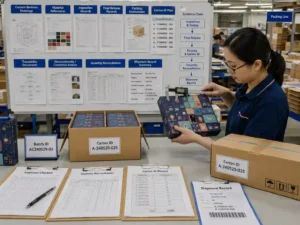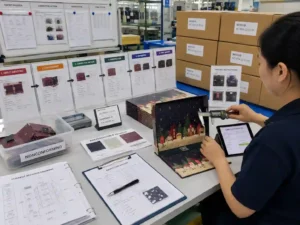
Quick answer: Preventing pattern mismatch across wrapped box edges starts during artwork preparation, not after printing. Successful wrapped box edge pattern alignment requires designing artwork around the structural dieline, allowing for wrapping and board thickness, verifying folds on physical samples, and confirming alignment during preflight, sampling, and production approval. Pattern continuity should always be checked on assembled samples rather than flat artwork alone.
Why do decorative patterns become misaligned after a box is wrapped?
Most pattern mismatches occur because artwork is evaluated as a flat sheet while the finished product is a three-dimensional structure. Once printed paper wraps around greyboard, fold radii, board thickness, trimming, and wrapping tolerances all influence where graphics finally appear.
Even artwork that aligns perfectly on-screen may shift visually after wrapping if these structural factors are not considered during design.
How should artwork be prepared for wrapped box edge pattern alignment?
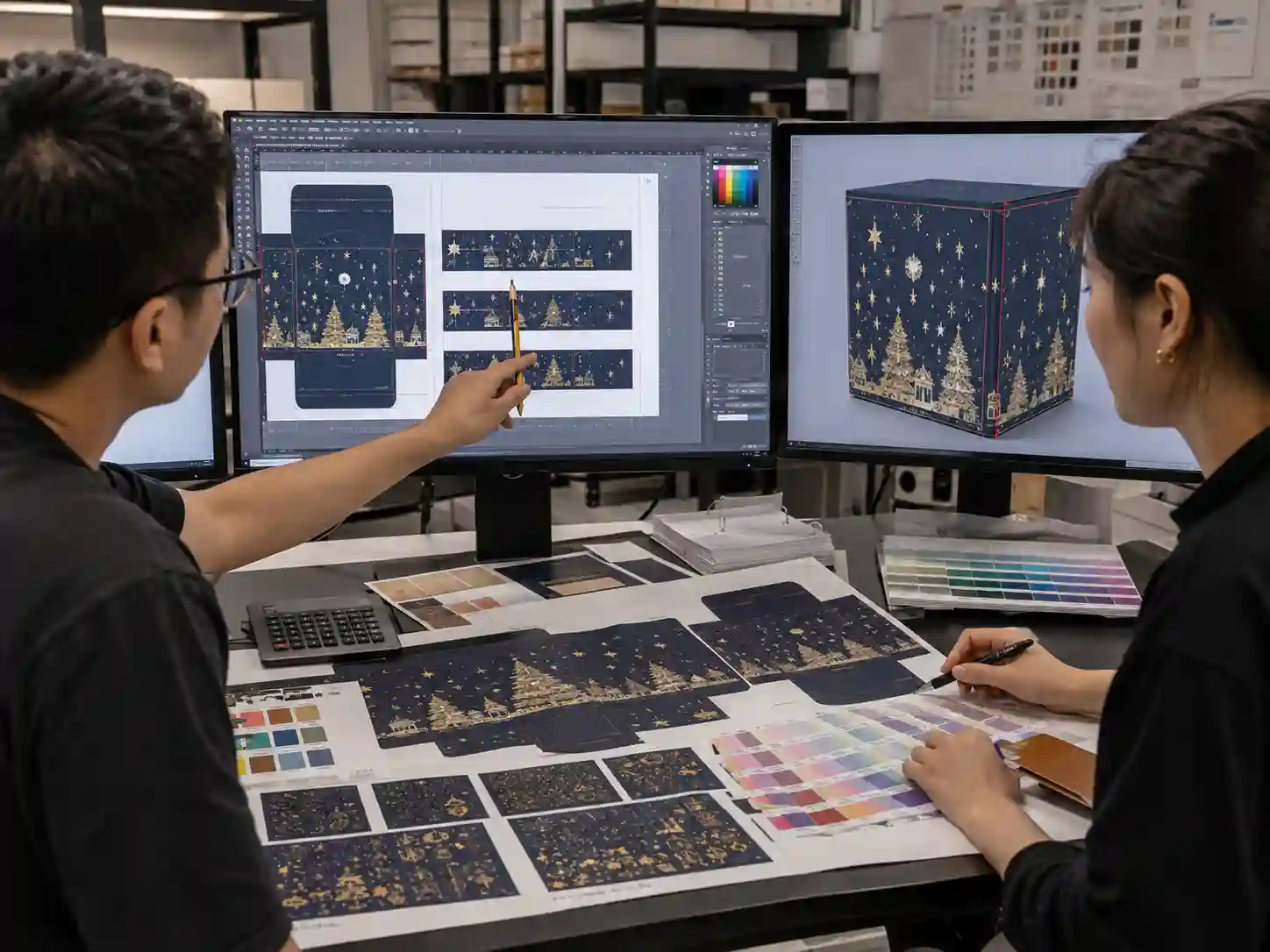
Artwork should always be built from the approved structural dieline rather than estimated dimensions. Designers should place repeating graphics only after confirming wrap allowances, fold positions, glue areas, and trimming zones.
- Build artwork on the final engineering dieline.
- Identify wrap edges and fold directions.
- Keep critical graphics away from fold radii where possible.
- Use repeat patterns that tolerate minor visual movement.
- Lock artwork layers before production approval.
For rigid advent calendar boxes, continuous stripes, geometric shapes, woodgrain, marble textures, and illustrated scenes generally require more planning than random textures or solid colors.
Which measurements affect edge alignment most?
Several engineering dimensions influence where a printed pattern finishes after wrapping.
| Factor | Why it matters | How to verify |
|---|---|---|
| Greyboard thickness | Changes wrap distance around corners | Engineering drawing |
| Wrap allowance | Determines where artwork folds underneath | Artwork dimensions |
| Fold radius | Shifts visible graphics around corners | Sample inspection |
| Trim position | Moves repeat patterns if inaccurate | Production proof |
| Paper stretch during wrapping | May slightly alter registration | Wrapped production sample |
Exact acceptable variation depends on the product design, board construction, paper material, and visual sensitivity of the printed pattern.
How should designers evaluate pattern continuity before printing?
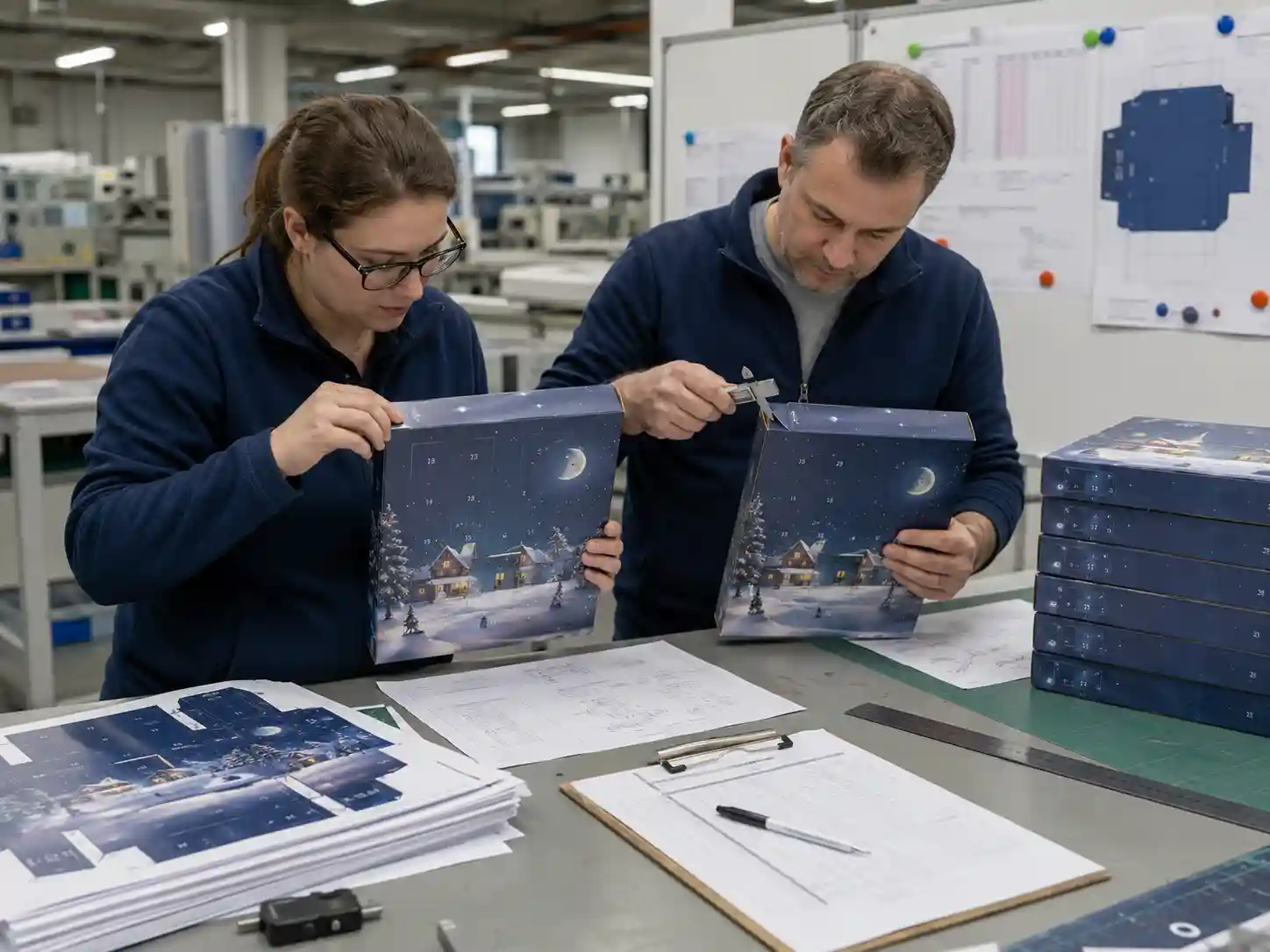
Digital artwork review is only the first step. Physical evaluation provides the most reliable evidence because it reflects the finished geometry of the wrapped box.
Many packaging teams assemble white samples or digitally printed mock-ups before approving final production artwork. Viewing corners under normal lighting quickly reveals whether stripes, illustrations, or repeating graphics appear continuous across adjacent panels.
Useful preflight checklist
| Checkpoint | Status |
|---|---|
| Approved structural dieline used | ✓ |
| Artwork positioned using wrap allowances | ✓ |
| Pattern checked across every external corner | ✓ |
| Glue areas confirmed | ✓ |
| Barcode isolated from decorative graphics | ✓ |
| Production sample reviewed after assembly | ✓ |
What artwork features create the highest alignment risk?
Some graphic styles reveal even small positional changes.
- Continuous horizontal stripes
- Checkerboard patterns
- Brick or tile graphics
- Woodgrain running across multiple panels
- Illustrations spanning several faces
- Thin borders close to wrapped edges
Designs using organic textures, gradients, or intentionally irregular artwork usually disguise small production variation more effectively.
How do prepress and engineering teams work together?
Pattern alignment should be reviewed jointly rather than by artwork teams alone. Engineering confirms structural dimensions, while prepress confirms graphic positioning.
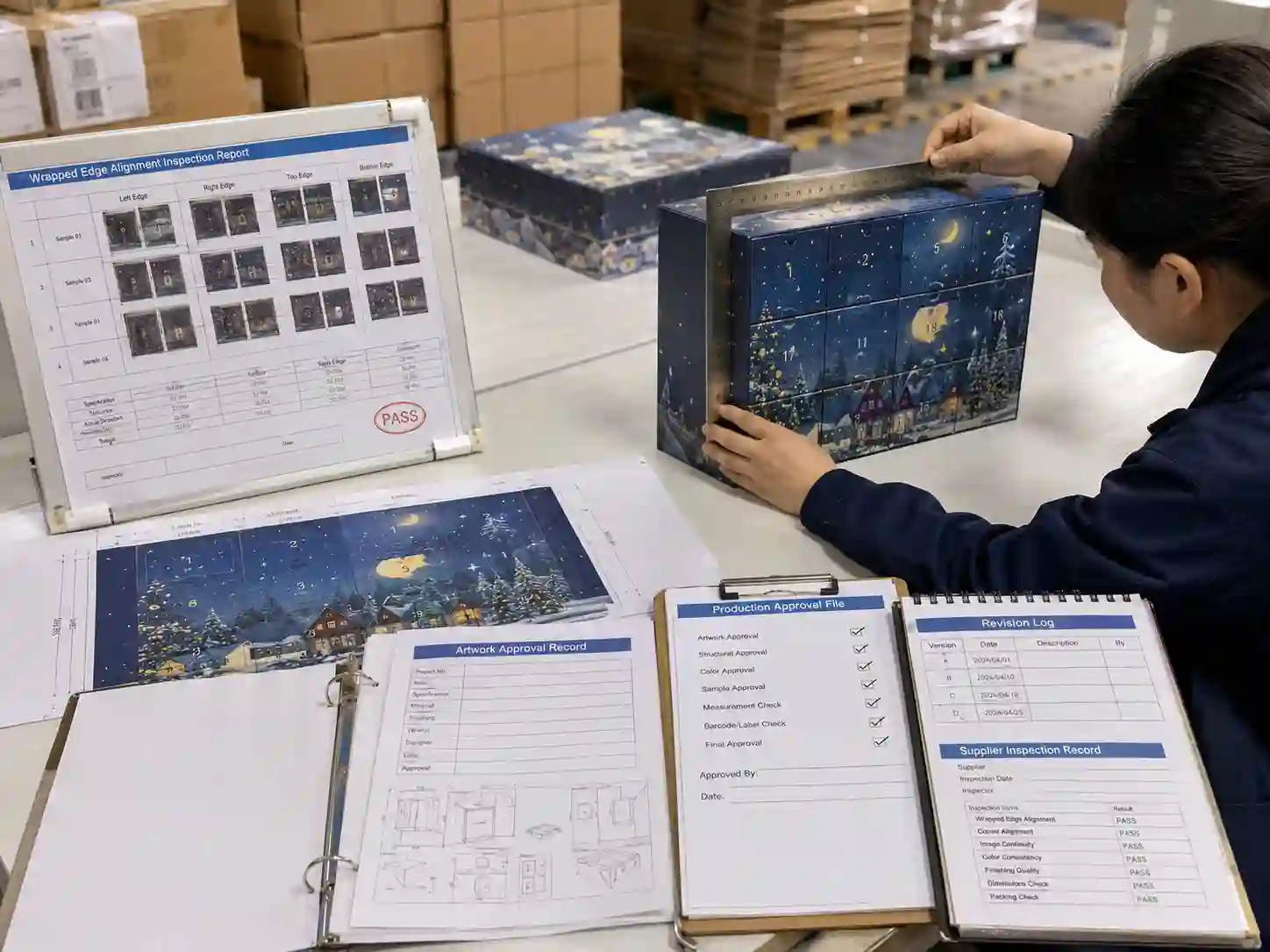
Typical review evidence includes:
- Approved dieline revision
- Layered artwork PDF
- Print-ready production file
- Color proof
- Wrapped sample photographs
- Engineering approval record
- Revision history
This documentation provides traceability if alignment questions arise later during sampling or production.
How can buyers approve pattern alignment objectively?
Instead of approving only flat PDFs, buyers should review assembled samples from multiple viewing angles. Approval criteria should identify which edges are visually important and which areas are hidden underneath the wrapped structure.
Example approval record
| Approval item | Evidence |
|---|---|
| Front-to-side pattern continuity | Assembled sample photos |
| Top panel alignment | Physical wrapped sample |
| Corner inspection | Engineering review notes |
| Artwork revision | Controlled file version |
| Final production release | Signed approval document |
Which requirements are verifiable, project-dependent, or buyer approvals?
Verifiable facts
- Structural dielines define folding geometry.
- Wrapped boxes change artwork position around board thickness.
- Physical samples reveal alignment more accurately than flat PDFs.
- Revision-controlled artwork reduces production errors.
Project-dependent recommendations
- Acceptable visual variation.
- Pattern placement strategy.
- Artwork compensation around corners.
- Choice of repeating graphic style.
Buyer approvals
- Approved production sample.
- Accepted artwork revision.
- Confirmed visual alignment standard.
- Final release documentation.
Frequently asked questions
Should patterns align perfectly on every edge?
Not always. Some wrapped structures intentionally terminate graphics beneath folds or glue flaps where continuity is not visible after assembly.
Can software alone guarantee correct alignment?
No. CAD artwork and digital visualization help, but assembled physical samples remain the most reliable verification method.
Should barcodes cross wrapped edges?
Generally no. Barcodes should remain on flat, uninterrupted surfaces to support reliable scanning and simplify production inspection.
When should alignment be checked during production?
Checks are typically performed during artwork approval, engineering sampling, first production setup, and final quality inspection using approved reference samples.
Related resources:
custom advent calendar box services,
custom advent calendar box products,
advent calendar box buying guides,
or request a custom quote.
When decorative artwork spans multiple wrapped panels, combining accurate structural drawings, controlled artwork revisions, physical sample inspections, and documented approvals provides the most reliable way to maintain consistent pattern continuity throughout production.