
A sleeve should be added to an advent calendar structure when the outer structure needs additional protection, alignment support, stacking stability, or a cleaner finished presentation. The decision depends on factors such as drawer movement, door alignment, hinge stress, magnet closure, panel rigidity, and handling conditions. Engineers usually confirm the need through drawings, prototypes, measurements, and assembly checks rather than adding a sleeve as a purely visual feature.

What Are the Main Reasons to Add a Sleeve to an Advent Calendar Structure?
A sleeve is mainly added when the calendar structure requires external reinforcement, improved positioning, or protection during handling. It is not required for every design and should be evaluated against the construction method.
Common reasons include:
- Improving structural stability: A sleeve can help hold the outer box shape when large panels, deep drawers, or heavy internal components create movement.
- Supporting alignment: Drawer fronts, opening doors, and book-style covers may benefit from a tighter outer frame that keeps components positioned correctly.
- Protecting finished surfaces: A sleeve can reduce direct contact with printed panels during storage, transport, and handling.
- Managing loose movement: Some structures require additional restraint when magnets, hinges, or moving parts create slight gaps after assembly.
How Do You Decide Whether an Advent Calendar Needs a Sleeve?
The decision should be based on structural checks rather than appearance alone. The engineering team should compare the calendar without a sleeve and with a sleeve concept using prototype samples.
Which Structural Areas Should Be Checked Before Adding a Sleeve?
The most important checks focus on moving parts and load-bearing areas that affect long-term performance.
| Structure Area | Check Required | Possible Sleeve Benefit |
|---|---|---|
| Drawer systems | Drawer travel, side clearance, front panel alignment | Helps maintain outer dimensions and reduce movement |
| Opening doors | Door position, hinge load, closing pressure | Provides additional holding support around the structure |
| Book-style covers | Cover flatness, spine strength, repeated opening | Improves protection and shape retention |
| Large panels | Panel bending, corner stability, surface protection | Creates an additional external support layer |
| Magnet closures | Magnet alignment and closing force | Helps maintain consistent closure positioning |
When Is a Sleeve Usually Recommended for an Advent Calendar Box?
A sleeve is often considered when the structure has higher mechanical demands or when the finished product requires stronger protection during handling.
- Large-format advent calendars with wide panels that may flex.
- Drawer calendars where repeated pulling creates movement between components.
- Door-opening designs where alignment affects closure performance.
- Premium rigid structures where surface protection is important.
- Calendars with multiple structural layers that need better positioning during assembly.
However, a sleeve may not be necessary when the existing structure already provides enough rigidity, the product weight is low, and handling conditions do not create additional stress.
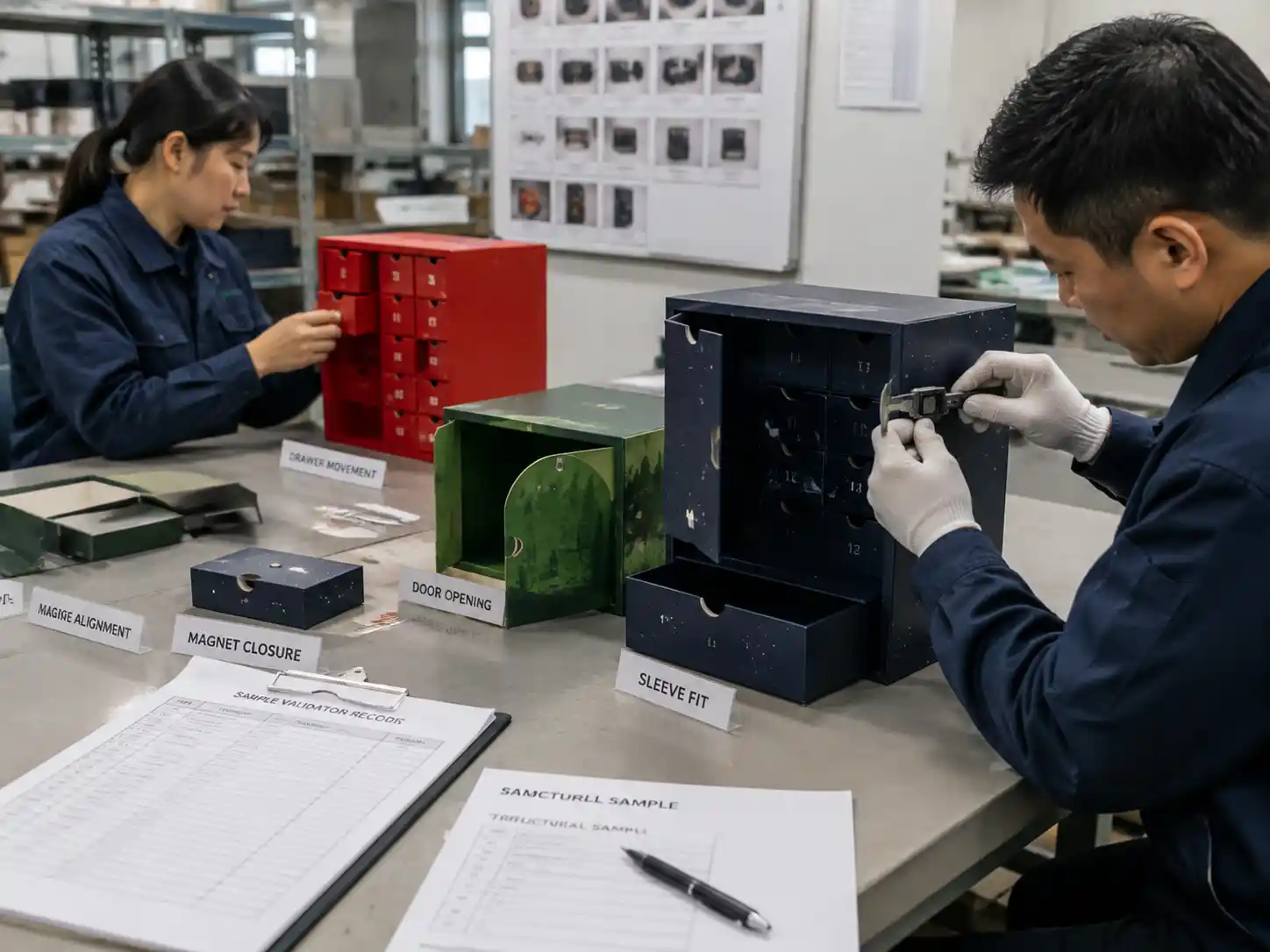
What Testing Confirms Whether a Sleeve Improves Performance?
A sleeve decision should be supported by physical checks using samples, measurements, and inspection records. The goal is to confirm that the sleeve improves performance without creating new assembly problems.
What Prototype Checks Should Be Completed?
- Fit measurement check: Measure the sleeve clearance around the assembled calendar to confirm it is secure without restricting movement.
- Opening and closing check: Test drawers, doors, hinges, and magnets after sleeve installation to verify smooth operation.
- Alignment inspection: Compare panel edges, corners, and closure positions before and after adding the sleeve.
- Handling simulation: Check whether the sleeve prevents shifting during normal movement and packaging operations.
- Approval record review: Keep updated drawings, sample photos, measurement notes, and approved structural specifications.
What Problems Can Happen If a Sleeve Is Added Incorrectly?
A sleeve can improve performance, but incorrect dimensions or material choices may introduce new issues.
- Tight fitting: Excessively small clearance may damage printed surfaces or make assembly difficult.
- Restricted movement: A sleeve that presses against drawers or doors can affect opening performance.
- Increased assembly complexity: Additional components may require revised production steps.
- Uneven support: Poor sleeve positioning may not effectively reinforce weak areas.
What Evidence Should Buyers Review Before Approving a Sleeve Structure?
Buyers should review technical evidence showing why the sleeve is required and how it affects the final structure.
- Updated structural drawings showing sleeve dimensions and positions.
- Prototype samples with sleeve installed.
- Measurement records for clearance and alignment.
- Inspection notes covering drawer, door, hinge, and magnet performance.
- Approval records confirming the final construction method.
These records separate verified structural decisions from project-dependent recommendations. The required sleeve design may vary depending on the calendar size, opening method, product weight, finishing requirements, and assembly process.

How Does Sleeve Design Fit Into Custom Advent Calendar Development?
A sleeve is one structural option within the wider development process for custom advent calendar box products. It should be evaluated together with the box construction, moving components, and production requirements.
For projects requiring structural review, sampling support, and customized construction solutions, Giftpackpro provides custom advent calendar box services for different calendar formats and paper packaging applications.
Frequently Asked Questions About Advent Calendar Sleeve Requirements
Does every rigid advent calendar need a sleeve?
No. A sleeve is only required when it provides a clear structural, protection, or handling benefit. Many rigid calendars can perform well without one when the main structure is sufficiently stable.
Can a sleeve replace internal structural reinforcement?
Not always. A sleeve supports the outer structure, but internal reinforcement, board selection, hinges, and inserts may still be required depending on the design.
Should sleeve dimensions be finalized before sampling?
Initial sleeve dimensions should be included in engineering drawings before sampling, but final approval should be based on physical prototype checks and assembly performance.
Need Help Evaluating an Advent Calendar Sleeve Structure?
For a custom structure review, share your calendar concept, drawings, and performance requirements with Giftpackpro through request a custom quote. A structured evaluation can help determine whether a sleeve is necessary for stability, protection, and reliable assembly.