
Large calendar panels can bow when the board structure, reinforcement method, hinge layout, or assembly process cannot support the panel size and applied forces. Preventing large calendar panel bowing requires balancing material stiffness, panel construction, opening movement, magnet placement, and production consistency. Engineers usually verify the design through drawings, prototypes, flatness measurements, opening tests, and inspection records before moving into production.
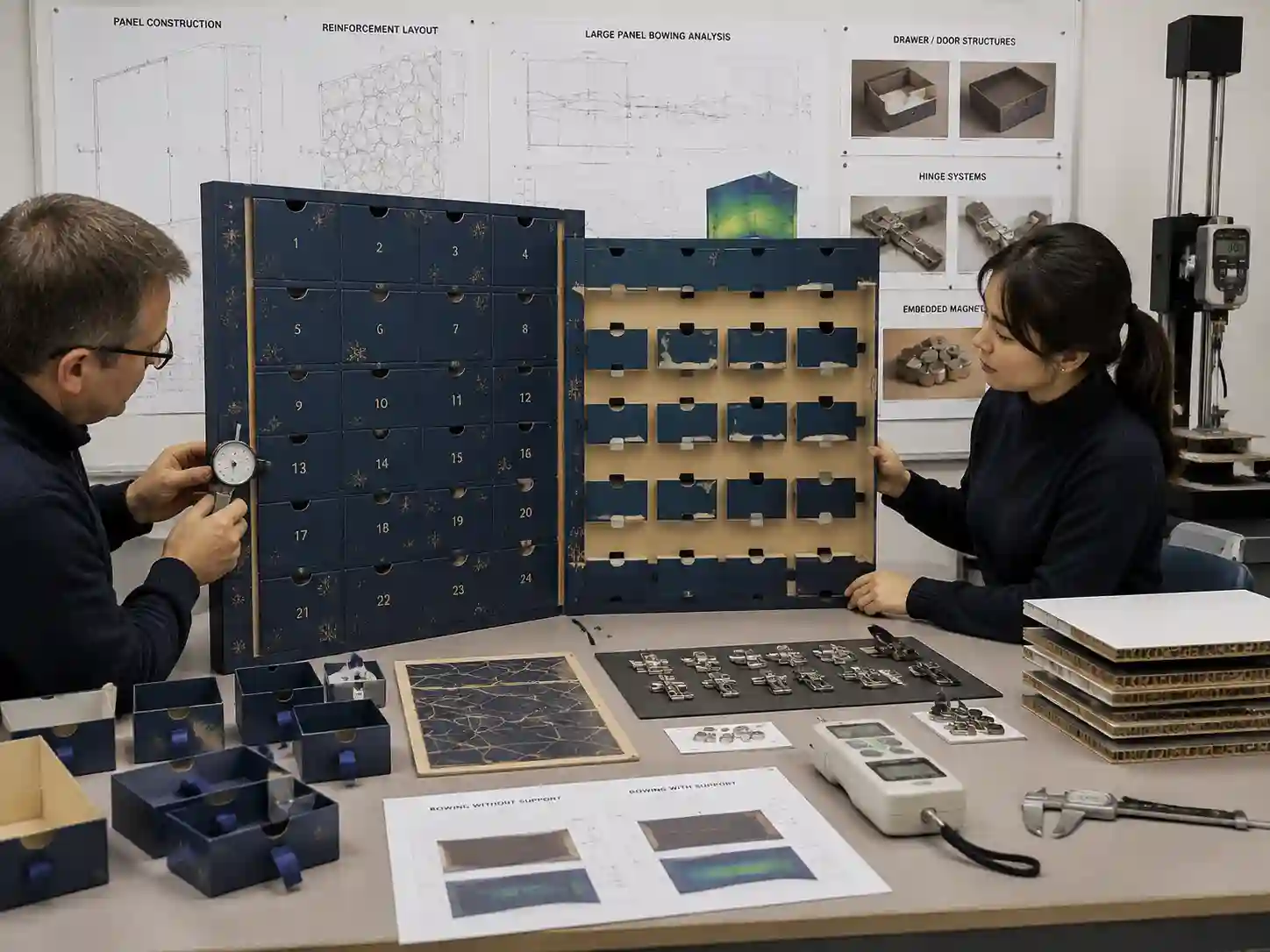
Why does large calendar panel bowing happen?
Large calendar panels usually bow because internal stress, insufficient support, or uneven loading causes the panel surface to deform. The main causes are related to board construction, moisture variation, decorative layers, opening forces, and product weight distribution.
- Insufficient panel stiffness: Large flat areas made from unsupported paperboard or thin structures may flex under their own weight.
- Uneven material tension: Printed sheets, laminations, or finishing layers can create different expansion rates across the panel.
- Heavy internal components: Drawers, doors, magnets, or inserts can transfer force into the surrounding panel.
- Weak connection areas: Hinges, folds, and glued joints can allow movement that gradually affects panel flatness.
How do you design a calendar panel to stay flat?
The first step is designing the panel structure around the expected size, load, and opening movement. Engineers should evaluate the panel as part of the complete calendar system rather than as a separate flat board.
Should the panel use reinforcement layers?
Yes, reinforcement layers are often used when a large panel needs additional rigidity. Common approaches include thicker greyboard construction, layered board assemblies, internal supports, or folded structural features that reduce unsupported spans.
How do hinges and doors affect panel stability?
Hinge locations and opening forces directly influence panel deformation. A door-opening calendar or book-style structure needs controlled hinge placement so repeated movement does not pull the main panel out of alignment.
| Design factor | Risk if ignored | Verification method |
|---|---|---|
| Panel size and unsupported area | Surface flexing or visible curvature | Flatness measurement on prototype samples |
| Board thickness and reinforcement | Low stiffness during handling | Structural drawing review and sample comparison |
| Hinge and folding position | Panel stress near opening areas | Repeated opening inspection |
| Magnet and closure force | Local pulling or panel distortion | Closure alignment and pull-force checks |
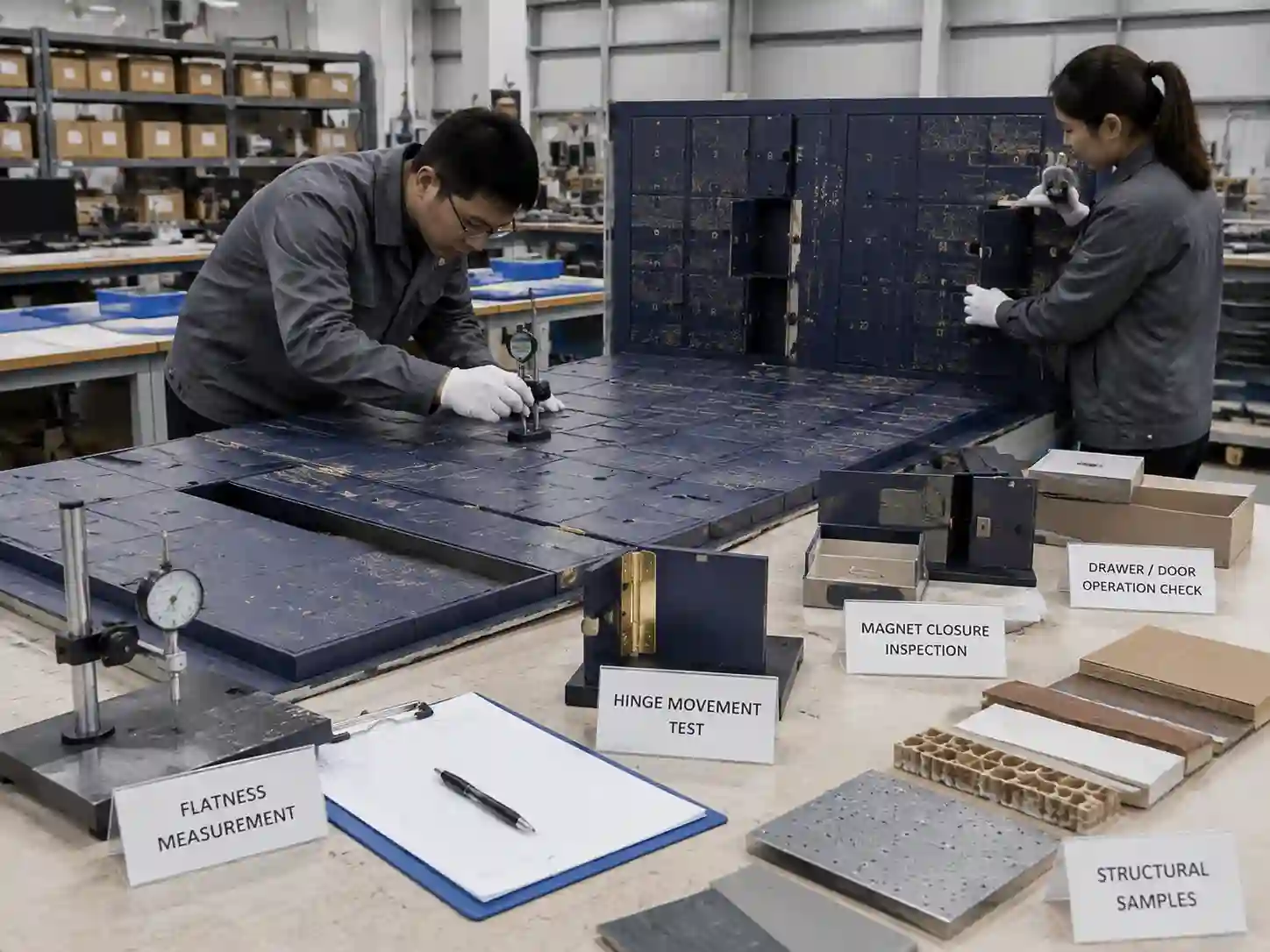
What tests verify large calendar panel stability?
Prototype testing should confirm that the panel remains stable under realistic handling conditions. The exact testing method varies by structure, but the goal is to identify deformation before mass production.
- Check panel flatness: Measure the closed and open positions to identify gaps, lifting edges, or surface waves.
- Inspect opening movement: Open and close doors, drawers, or hinged sections repeatedly to check whether movement transfers stress into the panel.
- Measure alignment: Confirm that magnets, doors, drawers, and decorative panels remain correctly positioned after handling.
- Review assembly consistency: Compare multiple samples to confirm that production tolerances do not create different panel conditions.
Which failure modes should buyers check before approval?
Buyers and engineering teams should review visible and structural failure risks before approving a final sample. A documented inspection process helps separate design issues from production variation.
- Panel corners lifting after assembly
- Large surfaces showing uneven curvature
- Doors or drawers changing alignment after repeated opening
- Magnet areas creating local deformation
- Glue joints allowing movement between layers
- Different samples showing inconsistent flatness
How can suppliers prove panel stability during production?
Supplier verification should be based on records and physical checks rather than appearance alone. Important evidence includes approved structural drawings, prototype comparison notes, measurement sheets, assembly inspection records, and final sample approvals.
For commercial packaging projects, buyers can review whether the approved structure, materials, and assembly methods are maintained during production. This creates traceability between engineering decisions and finished calendar boxes.
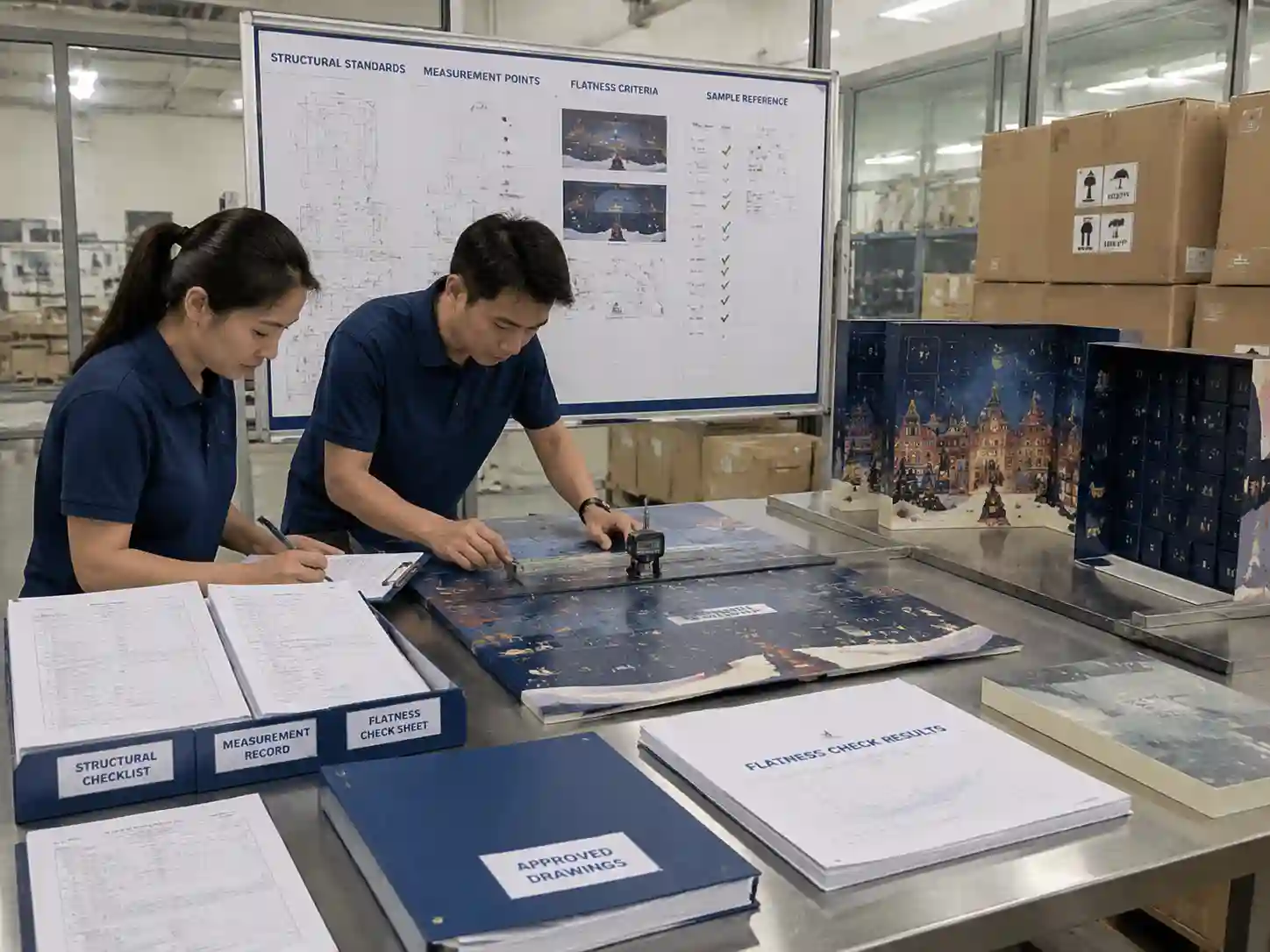
What information should be confirmed before final production?
Before production approval, the project team should confirm the panel dimensions, reinforcement approach, hinge or opening structure, magnet position, and acceptable flatness requirements. These decisions should be recorded in the approved specification and sample documentation.
Some requirements are measurable, such as panel dimensions, material thickness, and alignment. Other decisions depend on the project, including acceptable visual flatness, opening resistance, and the balance between structure, cost, and appearance.
FAQs About Preventing Large Calendar Panel Bowing
Can a larger advent calendar always be made flat by increasing board thickness?
No. Increasing thickness can improve stiffness, but panel design, reinforcement placement, hinge structure, and assembly accuracy also determine final stability.
Does finishing affect calendar panel flatness?
Yes. Decorative layers and surface treatments can influence material tension. The effect depends on the board combination, finishing method, and production process.
When should panel stability be checked?
Panel stability should be reviewed during structural design, prototype validation, and production inspection so problems can be corrected before shipment.
Giftpackpro supports custom advent calendar box development with structural evaluation, prototype review, and production verification. Explore our custom advent calendar box services or request a custom quote for your next packaging project.


