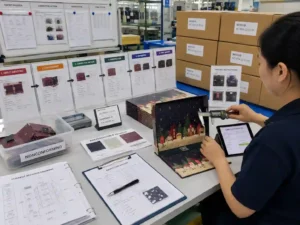
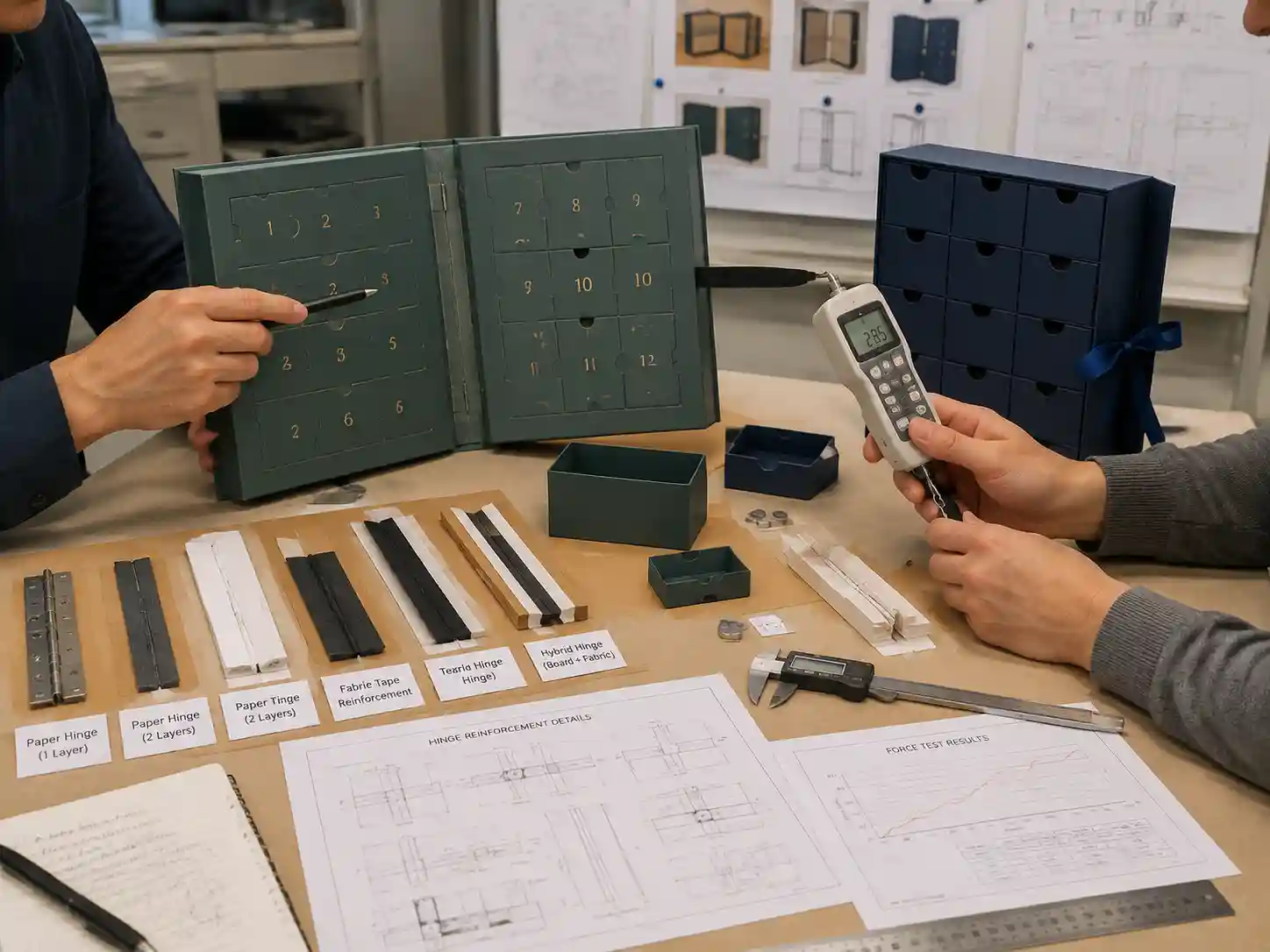
A book-style advent calendar hinge must balance repeated opening movement, cover weight, decorative layers, and long-term panel alignment. Effective book style box hinge reinforcement usually combines stronger hinge areas, controlled board construction, flexible connection methods, and prototype testing before production. The correct reinforcement method depends on the box size, opening frequency, cover weight, closure system, and expected handling conditions. Drawings, physical samples, measurements, and inspection records should confirm that the hinge design performs as intended.
Why Does a Book-Style Advent Calendar Hinge Need Reinforcement?
A book-style advent calendar hinge needs reinforcement because the spine area carries repeated bending stress every time the cover opens and closes. The hinge must maintain a smooth movement while preventing cracking, delamination, or cover misalignment.
Unlike a simple rigid box, a book-style structure usually has a connected front cover, back panel, and spine section. Additional factors such as magnetic closures, internal trays, drawers, and decorative finishing can increase stress around the hinge line.
How Does Book Style Box Hinge Reinforcement Work?
Book style box hinge reinforcement works by increasing strength around the folding area without making the hinge too stiff. The goal is controlled flexibility rather than maximum rigidity.
Which structural areas usually require reinforcement?
The main reinforcement areas normally include:
- Spine connection area: supports repeated bending and prevents cracking along the fold line.
- Cover attachment zones: reduce stress transfer between the cover and internal structure.
- Inner wrap and lining layers: improve surface stability and protect the hinge area.
- Magnet or closure zones: prevent excessive pulling force from affecting the spine.
The exact reinforcement method varies by board thickness, box dimensions, cover weight, and whether the calendar includes drawers, doors, or other moving parts.

What Materials and Design Methods Improve Hinge Durability?
The reinforcement approach should be selected during structural design, not added after production problems appear. Engineers typically review the board structure, hinge gap, wrapping material, and movement range together.
| Design Area | Common Decision | Verification Method |
|---|---|---|
| Spine structure | Adjust reinforcement layers, hinge spacing, or connection construction | Check drawings and open-close samples |
| Cover weight | Balance decorative panels, finishing layers, and internal loading | Measure loaded sample weight |
| Hinge flexibility | Maintain smooth folding movement without excessive looseness | Repeated opening inspection |
| Closure force | Control magnet or locking force near the hinge | Pull-force and alignment checks |
For commercial packaging projects, suppliers should confirm the chosen structure through approved drawings, prototype review records, and physical samples rather than relying only on theoretical calculations.
How Do You Test a Reinforced Advent Calendar Hinge Before Production?
A reinforced hinge should be tested through practical opening and handling simulations before mass production approval. The testing method should represent the expected product use.
What are the main hinge validation steps?
- Review structural drawings and confirm hinge construction details.
- Inspect prototype samples for spine alignment, folding movement, and surface cracking.
- Open and close the cover repeatedly to observe stress points.
- Check magnet closure force and whether closing pressure transfers into the hinge area.
- Measure final alignment of covers, panels, and internal components.
- Record inspection results and approve the final structure before production.
Test frequency and acceptance requirements are project-dependent. Buyers should define important approval points before production begins, especially when the calendar contains heavier inserts, drawers, or multiple opening components.
Which Hinge Failures Should Buyers Check During Sampling?
Most hinge problems can be identified during sampling if inspection focuses on movement, alignment, and material behavior.
Book-style advent calendar hinge failure checklist
- Spine surface cracking after repeated opening.
- Cover separation from the hinge connection area.
- Uneven closing caused by hinge deformation.
- Magnet force pulling the structure out of alignment.
- Loose movement caused by insufficient support.
- Decoration layers restricting normal hinge movement.
Inspection records should include sample photos, measurement notes, structural drawings, and approval comments so that production teams can reproduce the approved construction.

How Should Buyers Approve a Reinforced Hinge Structure?
Buyers should approve the hinge structure based on documented evidence rather than appearance alone. A visually attractive book-style calendar may still fail if the spine cannot handle repeated movement.
Useful approval evidence includes:
- Approved structural drawings showing hinge construction.
- Prototype samples with opening and closing checks.
- Measurement records for cover alignment and dimensions.
- Inspection reports showing identified risks and corrections.
- Supplier communication confirming final structural changes.
Giftpackpro supports custom advent calendar box development with structural evaluation, sampling coordination, and production documentation. Buyers can explore custom advent calendar box products or review custom advent calendar box services when planning a new structure.
FAQs About Book-Style Advent Calendar Hinge Reinforcement
Does a thicker board always create a stronger hinge?
No. A thicker board can improve stiffness, but the hinge area still needs correct flexibility. Excessive stiffness may increase stress at the fold connection.
Can magnets damage a book-style hinge?
Magnets do not usually damage the hinge directly, but excessive closing force or poor alignment can transfer additional stress into the spine area.
When should hinge reinforcement be decided?
Hinge reinforcement should be decided during structural design and prototype stages because late changes can affect dimensions, artwork placement, and assembly methods.
How Can Buyers Start a Book-Style Advent Calendar Structure Review?
A successful hinge design starts with clear product requirements, structural drawings, prototype checks, and documented approvals. For custom seasonal packaging projects, buyers can request a custom quote and provide the required structure details for evaluation.