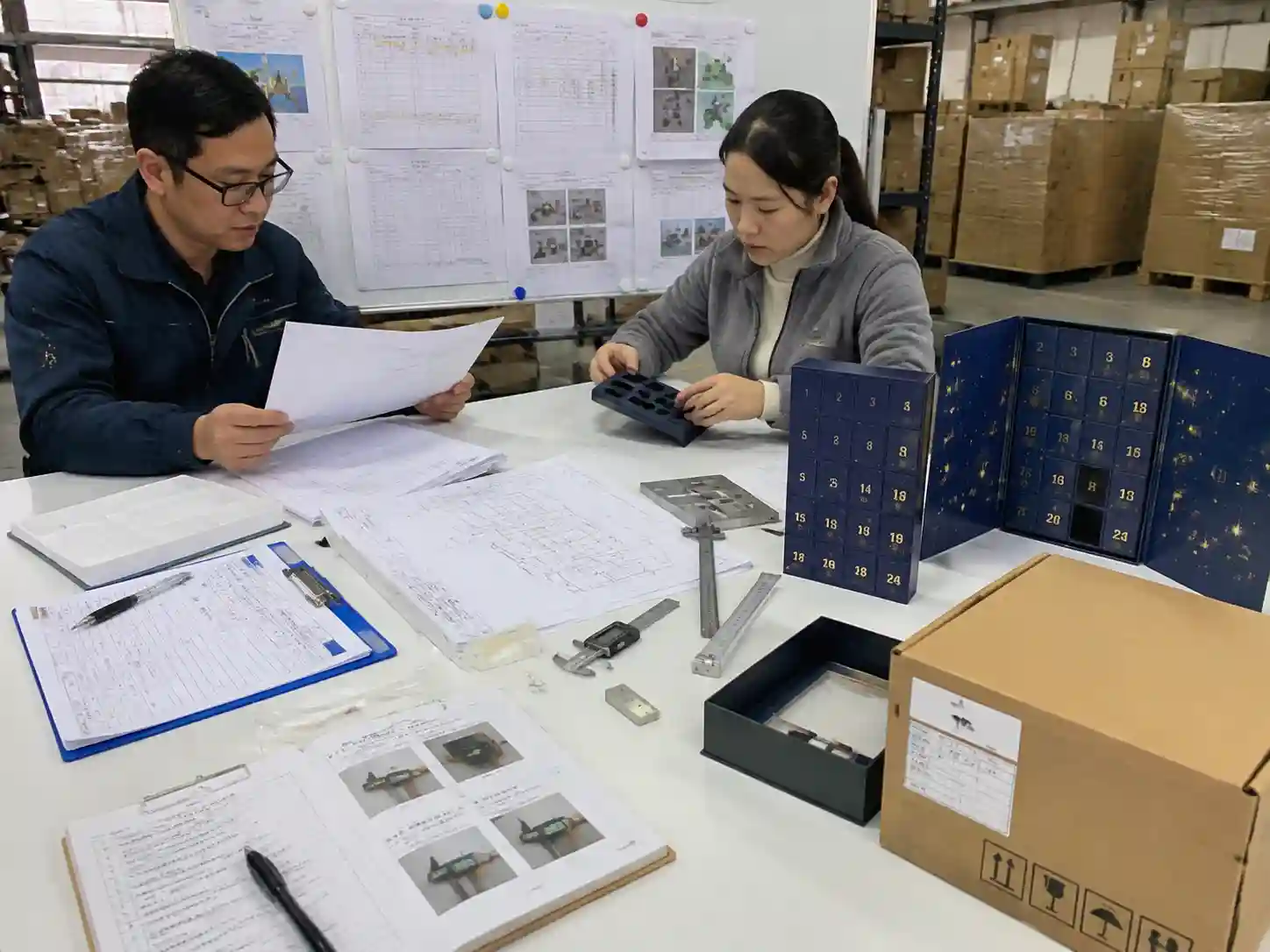
Quick answer: Preventing magnets from interfering with compartments or products requires controlled magnet positioning, spacing checks, and prototype validation. The magnet location should be selected based on door or drawer movement, product sensitivity, panel thickness, and closure strength requirements. During development, engineers verify magnet alignment, attraction distance, opening force, and possible contact with stored products through drawings, samples, and inspection records before production approval.
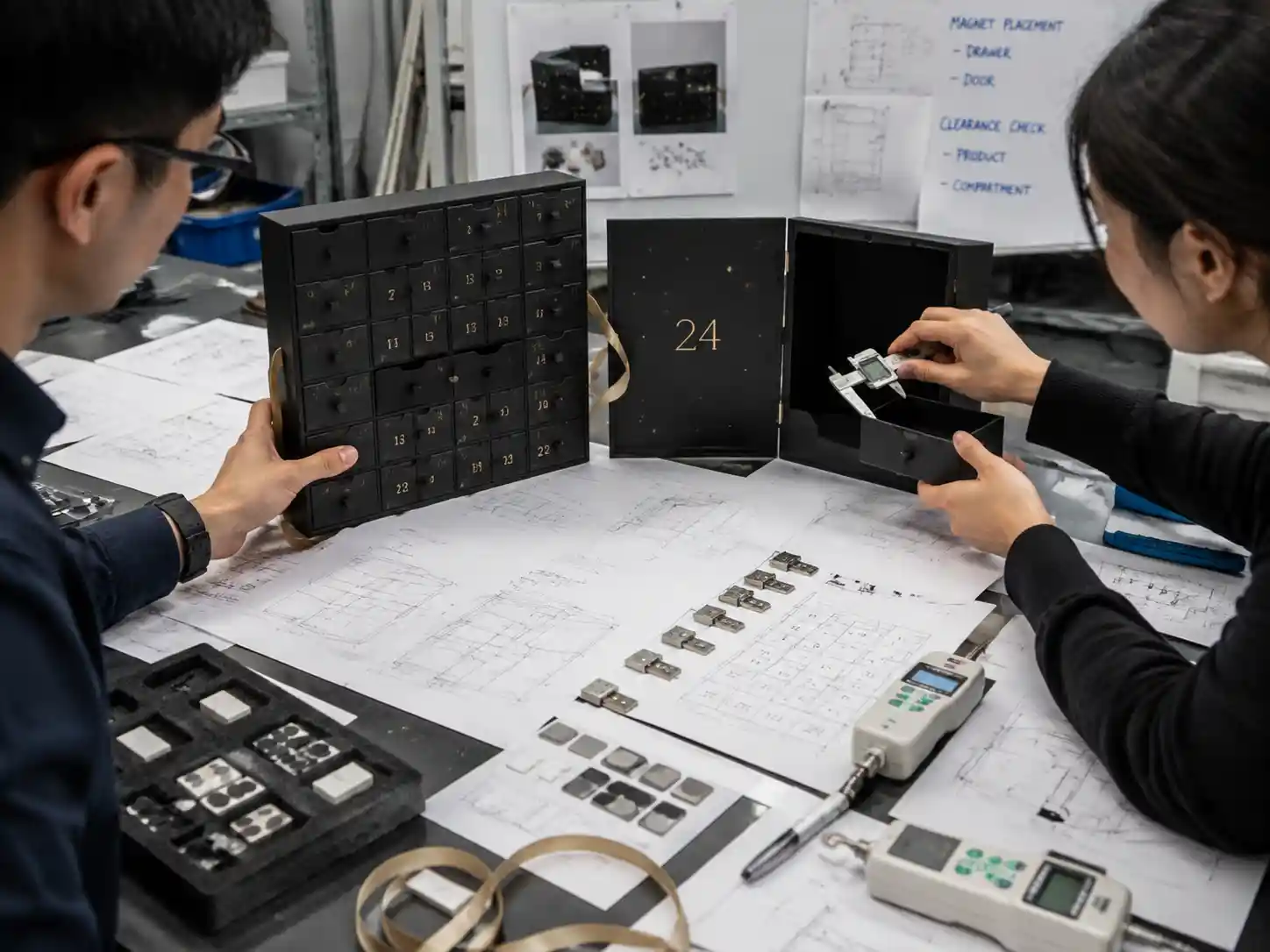
Why Is Advent Calendar Magnet Placement Important for Box Performance?
Advent calendar magnet placement affects more than closure strength. The position of magnets can influence compartment space, drawer movement, door alignment, product clearance, and the long-term stability of the structure.
Magnets are usually used to keep doors, lids, or folding panels closed during handling. However, incorrect positioning may create problems such as uneven closing pressure, reduced internal space, attraction toward metal components, or interference with product placement.
What factors determine magnet positioning?
The correct location depends on several structural conditions:
- Distance between the magnet and nearby compartments.
- Thickness and stiffness of the cover, panel, or door structure.
- Weight and dimensions of products stored inside.
- Required opening force for customer handling.
- Alignment accuracy between the magnet pair.
How Should Magnets Be Positioned Around Compartments and Products?
Magnets should be positioned in reinforced areas where they can provide stable closure without reducing usable compartment space or contacting the product area.
During structural design, engineers normally define magnet locations on drawings before making prototypes. The design should show magnet diameter, thickness, embedded position, polarity direction, and distance from nearby cavities.
| Design area | Recommended evaluation | Risk if ignored |
|---|---|---|
| Door or lid edge | Check alignment and closing pressure | Door may shift, gap, or close unevenly |
| Near compartments | Confirm magnet clearance from product cavities | Reduced space or product contact issues |
| Drawer front panel | Measure pull force and movement resistance | Drawer may open too easily or require excessive force |
| Layered paperboard structure | Verify reinforcement and magnet retention | Magnet position may weaken over time |
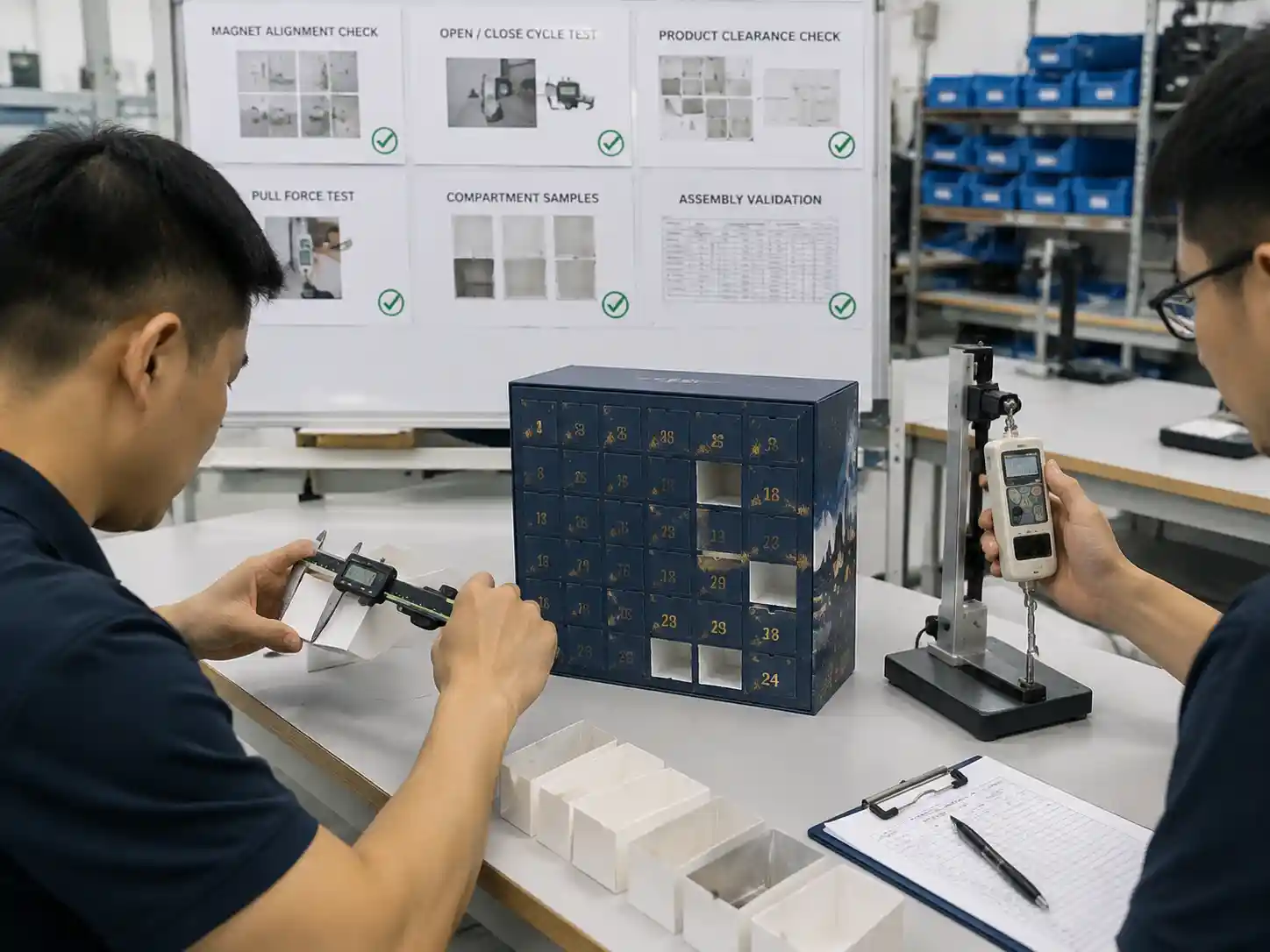
How Do You Test Whether Magnets Interfere With Products?
Magnet interference should be checked through prototype testing rather than only relying on drawings. Physical samples reveal issues caused by material compression, product variation, and assembly tolerance.
What are the main magnet validation steps?
- Review structural drawings: Confirm magnet locations, compartment layout, and product clearance zones.
- Build prototype samples: Install magnets using the intended material layers and assembly method.
- Check opening and closing movement: Test whether doors, drawers, and panels move smoothly without unexpected resistance.
- Measure closure force: Use pull-force tools to confirm the magnet provides sufficient holding strength without excessive attraction.
- Load representative products: Place products into compartments and verify that magnets do not affect placement or removal.
What Magnet-Related Failure Modes Should Buyers Check?
A structured failure review helps buyers identify potential issues before production. The following checklist can be used during sampling and approval.
- Magnet misalignment: The two magnetic components do not meet correctly, causing weak closure or panel movement.
- Insufficient clearance: Magnets are too close to product cavities or internal structures.
- Excessive magnetic strength: Strong attraction makes doors difficult to open or damages delicate structures during use.
- Weak retention: The magnet attachment area does not provide enough support within the paperboard construction.
- Assembly variation: Small position changes during production affect final alignment.
Which Magnet Checks Should Be Approved Before Mass Production?
Approval should be based on documented sample checks, not only visual confirmation. Buyers and suppliers should keep records showing that magnet performance matches the approved structure.
Useful approval evidence includes:
- Approved structural drawings showing magnet locations.
- Prototype photos with measured positions.
- Opening and closing test records.
- Product loading checks inside compartments.
- Inspection notes confirming final assembly conditions.
What Information Changes the Recommended Magnet Design?
Magnet design recommendations vary depending on the calendar structure and product application. A small paper drawer calendar and a large book-style calendar with heavy products may require different reinforcement and positioning methods.
Important project variables include product weight, compartment arrangement, number of opening points, paperboard construction, insert design, and required user interaction.
For custom structural development, Giftpackpro supports buyers through custom advent calendar box services, including structural review and sample evaluation. More examples of available formats can be explored through custom advent calendar box products.
FAQs About Advent Calendar Magnet Placement
Can magnets be placed directly beside product compartments?
They can be placed nearby if clearance, reinforcement, and product sensitivity are verified. The final position should be confirmed through prototype testing.
Do stronger magnets always improve a calendar box?
No. Higher magnetic strength may increase closure performance but can also make opening difficult or create stress on paperboard panels.
Should magnet positions be finalized before sampling?
Magnet locations should be defined in the structural design stage, then verified and adjusted if prototype testing identifies interference risks.
To review a custom advent calendar structure with controlled magnet placement, contact Giftpackpro through request a custom quote.