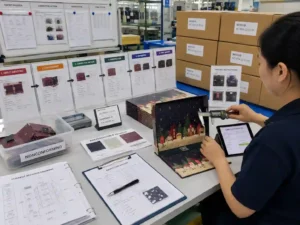
A drawer pull strength test verifies whether an advent calendar drawer can withstand repeated opening forces without tearing, loosening, misalignment, or structural failure. Before mass production, engineers typically evaluate the drawer front, ribbon or handle attachment, inner support layers, sliding resistance, and connection points through prototype testing and documented inspection. The goal is to confirm that the assembled structure performs consistently under expected handling conditions.
Why Should Drawer Pull Strength Be Tested Before Mass Production?
A drawer pull strength test helps identify weak structural points before large-volume manufacturing begins. Small failures at the drawer face, ribbon anchor, adhesive area, or internal reinforcement can affect the entire user experience and create quality issues during production.
The test is especially important for multi-drawer advent calendar structures because each drawer may be opened many times during handling, inspection, retail display, and final use. A design that looks stable in a sample review may still require reinforcement after pull-force evaluation.
What Parts Should Be Checked During a Drawer Pull Strength Test?
The test should evaluate the complete drawer system rather than only the pulling component. The drawer face, attachment point, sliding structure, surrounding panels, and connection details all influence performance.
| Structural Area | What to Check | Possible Risk |
|---|---|---|
| Drawer front panel | Resistance against pulling force and repeated opening | Panel separation, bending, or surface damage |
| Ribbon, tab, or handle attachment | Anchor strength and connection stability | Loose attachment or tearing |
| Drawer side walls | Shape retention during movement | Drawer distortion or uneven sliding |
| Inner support structure | Reinforcement and load transfer | Hidden stress concentration |
| Drawer track or guide area | Opening resistance and alignment | Jamming or excessive friction |
How Do You Perform a Drawer Pull Strength Test Step by Step?
The testing process should follow a controlled method using approved prototypes, measurement records, and inspection criteria. The exact force level and repetition count depend on the drawer size, product weight, material structure, and intended application.
-
Review the approved structural design. Check drawings for drawer dimensions, panel thickness, reinforcement areas, attachment methods, and assembly details.
-
Prepare representative samples. Use production-intent prototypes with the same board structure, inserts, hardware, adhesives, and finishing layers planned for manufacturing.
-
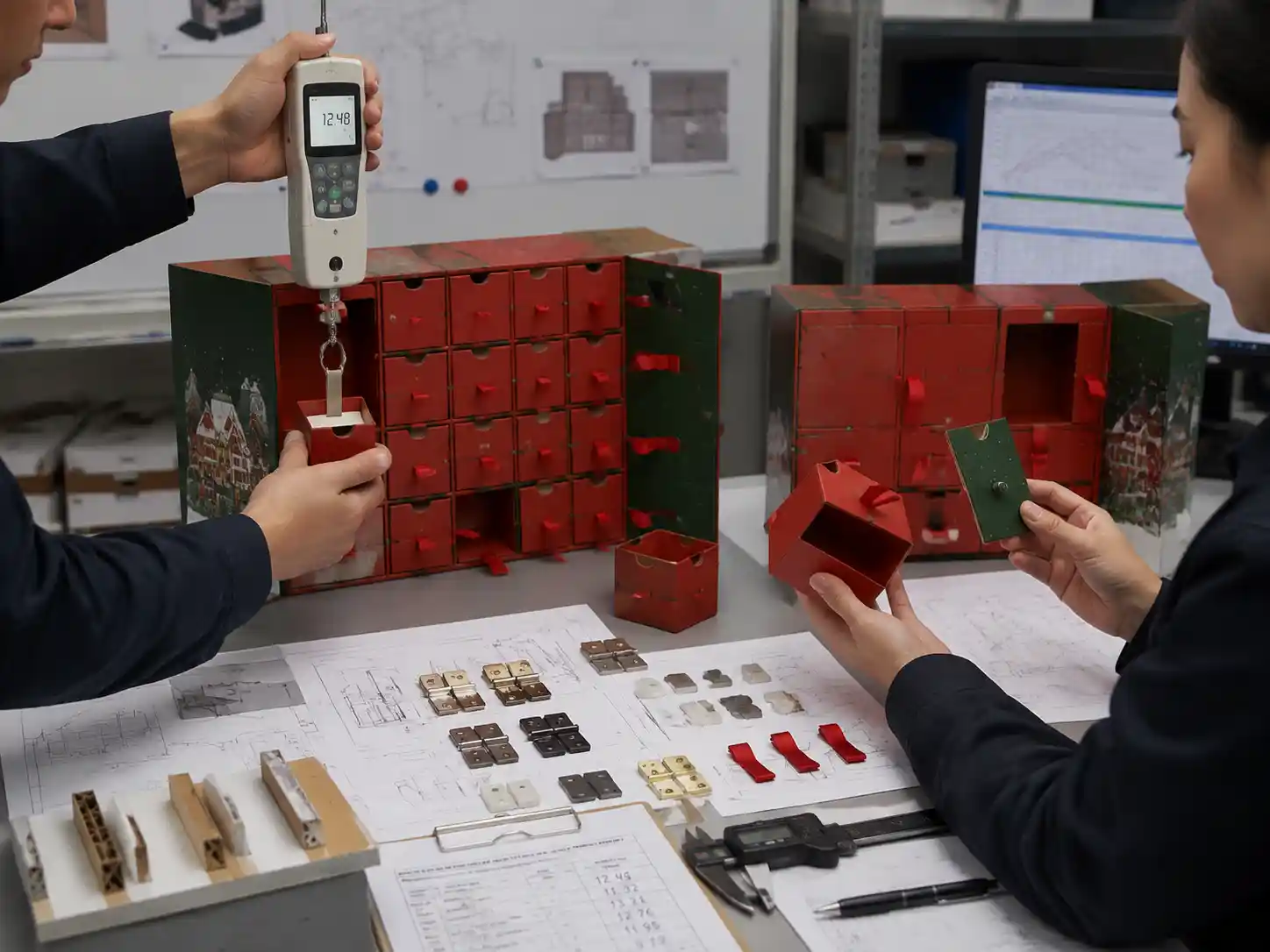
Apply controlled pulling force. Measure the force required to open the drawer and observe whether the drawer front, ribbon, or handle connection shows movement or damage.
-
Repeat opening cycles when required. Repeated operation can reveal fatigue issues that are not visible during a single pull.
-
Record observations and approve changes. Document measurements, photos, structural adjustments, and final approval decisions before production release.

Which Failure Modes Should Engineers Watch For?
Most drawer pull failures happen because force is transferred into a weak area of the structure. Identifying the failure location is more useful than only measuring whether a drawer opens successfully.
- Drawer front separation: The front panel may detach from the drawer body if the bonding area or mechanical connection is insufficient.
- Ribbon or handle tearing: A decorative pull element may fail if the anchor point does not distribute pulling force properly.
- Drawer box deformation: Thin side panels may change shape under repeated opening pressure.
- Misalignment after repeated use: Poor tolerance control may cause uneven gaps or difficult movement.
- Excessive opening resistance: A drawer that requires too much force may damage surrounding structures.
How Do Suppliers Document Drawer Pull Test Results?
Reliable verification depends on evidence, not only visual approval. Suppliers and buyers should maintain records showing what was tested, which sample was used, what measurements were observed, and what structural decisions were approved.
Useful documentation may include:
- Prototype drawings with revision numbers.
- Measurement sheets for drawer dimensions and alignment.
- Pull-force observations and test notes.
- Photos of tested samples and failure points.
- Approval records for final structural changes.
For commercial packaging projects, these records help connect engineering decisions with production requirements and provide a clear reference when reviewing supplier samples.
What Factors Can Change the Required Drawer Pull Strength?
The required strength varies by project because drawer performance depends on structure, materials, and product loading conditions.
| Project Factor | How It Affects Testing |
|---|---|
| Drawer size and depth | Larger drawers may create higher stress on fronts and guides. |
| Product weight inside compartments | Heavier contents increase opening resistance and structural load. |
| Pull method | Ribbon, tab, recessed grip, or hardware handles transfer force differently. |
| Board and reinforcement structure | Material selection changes stiffness and durability. |
What Should Buyers Approve Before Mass Production Starts?
Before production release, buyers should approve the tested structure, not only the appearance sample. The approved version should match the intended manufacturing specification, including drawer construction, attachment method, and reinforcement details.
A practical approval package normally includes the final drawing, tested sample reference, inspection notes, and confirmed structural changes. This reduces the risk of production using an earlier version that has not passed verification.
FAQs About Drawer Pull Strength Testing
Is a visual inspection enough for drawer pull strength?
No. Visual inspection can identify obvious defects, but pull performance requires controlled testing and recorded observations to confirm structural reliability.
Should drawer testing include the final product weight?
When the drawer contains products or representative weights, testing can better simulate actual loading conditions. The approach depends on the project design requirements.
Can a drawer design be changed after testing?
Yes. Testing often identifies areas where reinforcement, attachment methods, or tolerances need adjustment before production approval.
Giftpackpro supports custom advent calendar box development with structural review, prototype evaluation, and production preparation. For projects requiring verified drawer performance, contact our team through request a custom quote to discuss your packaging requirements.