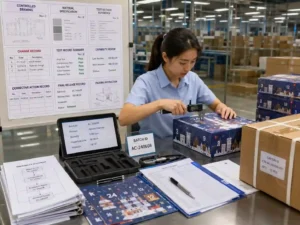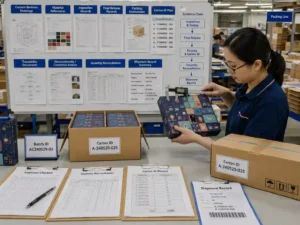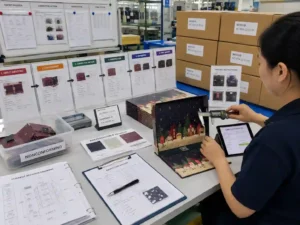
Product orientation should be recorded for insert design as a controlled reference showing how a product sits inside the cavity, including facing direction, support points, critical dimensions, clearance needs, and loading requirements. A clear orientation record helps packaging teams create accurate cavities, reduce fitting issues, and validate samples before production. The record should combine drawings, measurements, product photos, and approval notes rather than relying on verbal instructions.
Why is product orientation important for insert design?
Product orientation determines how the item is positioned, supported, and protected inside the insert cavity. The same product can require different cavity dimensions depending on whether it is placed upright, sideways, flat, angled, or displayed in a specific direction.
For advent calendar boxes and other multi-compartment packaging, orientation affects:
- Available cavity space and overall insert layout
- Required clearance around product surfaces
- Contact points that support product weight
- Visibility and opening experience after packaging
- Risk of movement, damage, or poor fit during handling
These decisions should be recorded during the design stage with measurable references so structural designers and sampling teams work from the same information.
How should product orientation be recorded for insert design?
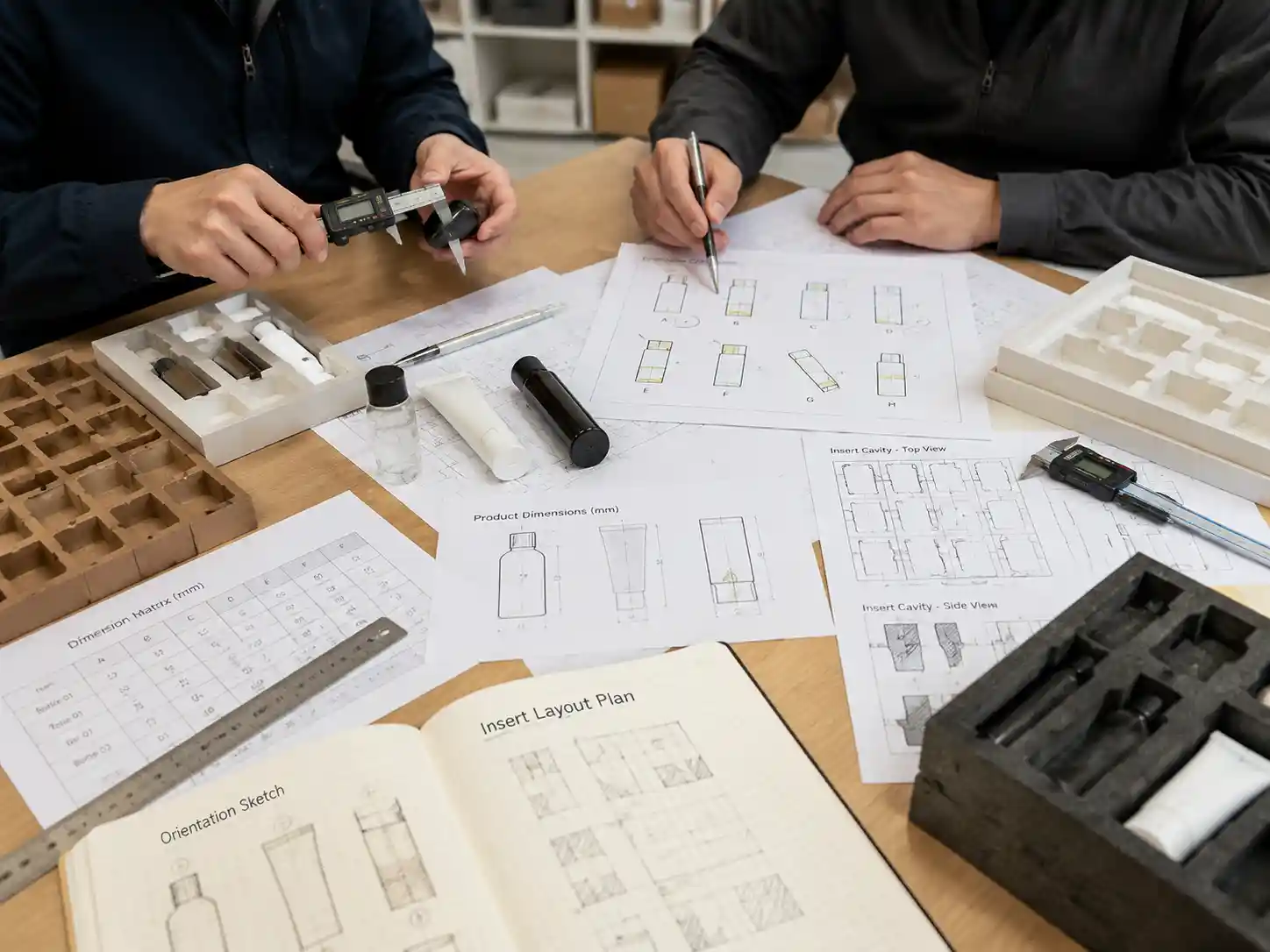
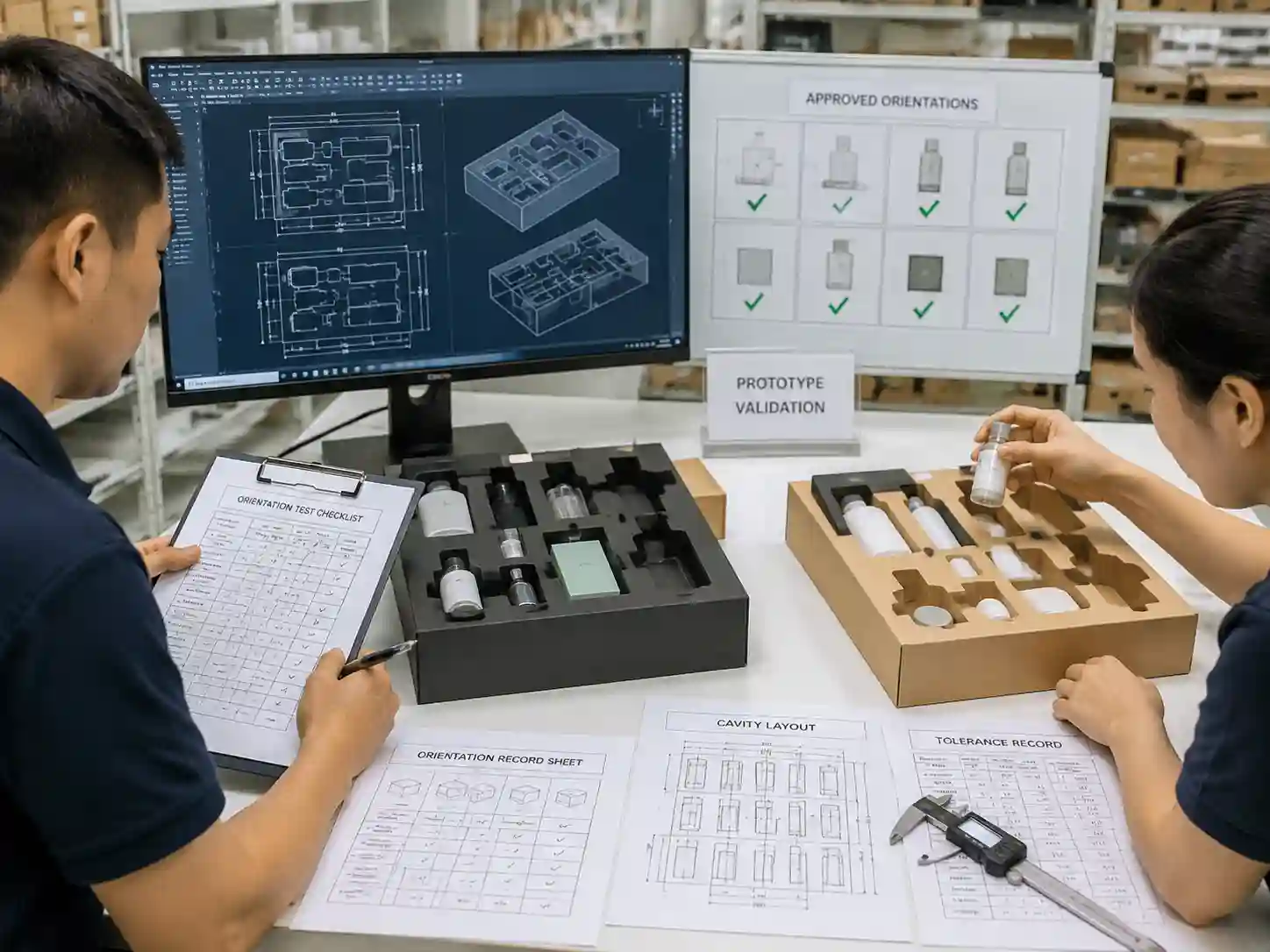
The product orientation insert design record should define the product position, reference faces, dimensions, tolerance requirements, and validation method. A complete record normally includes a marked product drawing, orientation sketch, measurement sheet, and approved sample reference.
What information should be included in an orientation record?
The orientation record should identify the exact way the product is loaded into the cavity. Important information includes:
- Primary facing direction: the side that should face upward, outward, or toward the opening direction
- Reference points: stable surfaces used for measuring and positioning
- Overall dimensions: length, width, height, diameter, or irregular shape measurements
- Contact areas: surfaces where the insert supports or holds the product
- Critical clearance zones: areas requiring additional space for protection or loading
- Weight direction: how the product load transfers into the insert structure
For irregular products, a simple photograph is usually not enough. A marked-up drawing or 3D orientation sketch helps prevent incorrect cavity assumptions.
What measurement steps are used to confirm product orientation?
Packaging teams typically confirm orientation through a sequence of measurements before final insert development. The exact method varies by product shape, material, weight, and required presentation position.
- Define the loading position: Confirm how the product enters and rests inside the cavity.
- Select measurement references: Identify stable surfaces, edges, or center lines for dimension recording.
- Measure external dimensions: Record the maximum occupied space in the selected orientation.
- Identify clearance requirements: Note areas where movement, protection, or easy removal requires additional space.
- Create cavity references: Transfer measurements into insert drawings or CAD layouts.
- Validate with samples: Test the actual product inside a prototype cavity before approval.
| Measurement Item | Purpose | Verification Method |
|---|---|---|
| Product length, width, height | Defines cavity envelope size | Caliper or ruler measurement |
| Orientation angle or facing direction | Controls product presentation position | Marked drawing or loading sample |
| Support contact points | Determines holding structure | Prototype fit inspection |
| Clearance areas | Prevents excessive pressure or movement | Loaded sample check |
How do tolerances affect orientation records?
Tolerance information prevents insert cavities from being designed only around ideal product dimensions. Real production items may have small variations caused by manufacturing processes, materials, closures, labels, or surface finishes.
The orientation record should separate confirmed product dimensions from project-dependent allowances. For example, the measured product size may be verified from samples, while the final clearance allowance depends on product fragility, insert material, and required holding strength.
- Verifiable fact: Actual product dimensions can be measured and recorded from samples.
- Project-dependent recommendation: Clearance values and support pressure should be decided according to product characteristics and packaging requirements.
- Buyer approval point: Final orientation, cavity position, and fit should be approved using physical samples or documented validation records.
How should loaded samples validate product orientation?
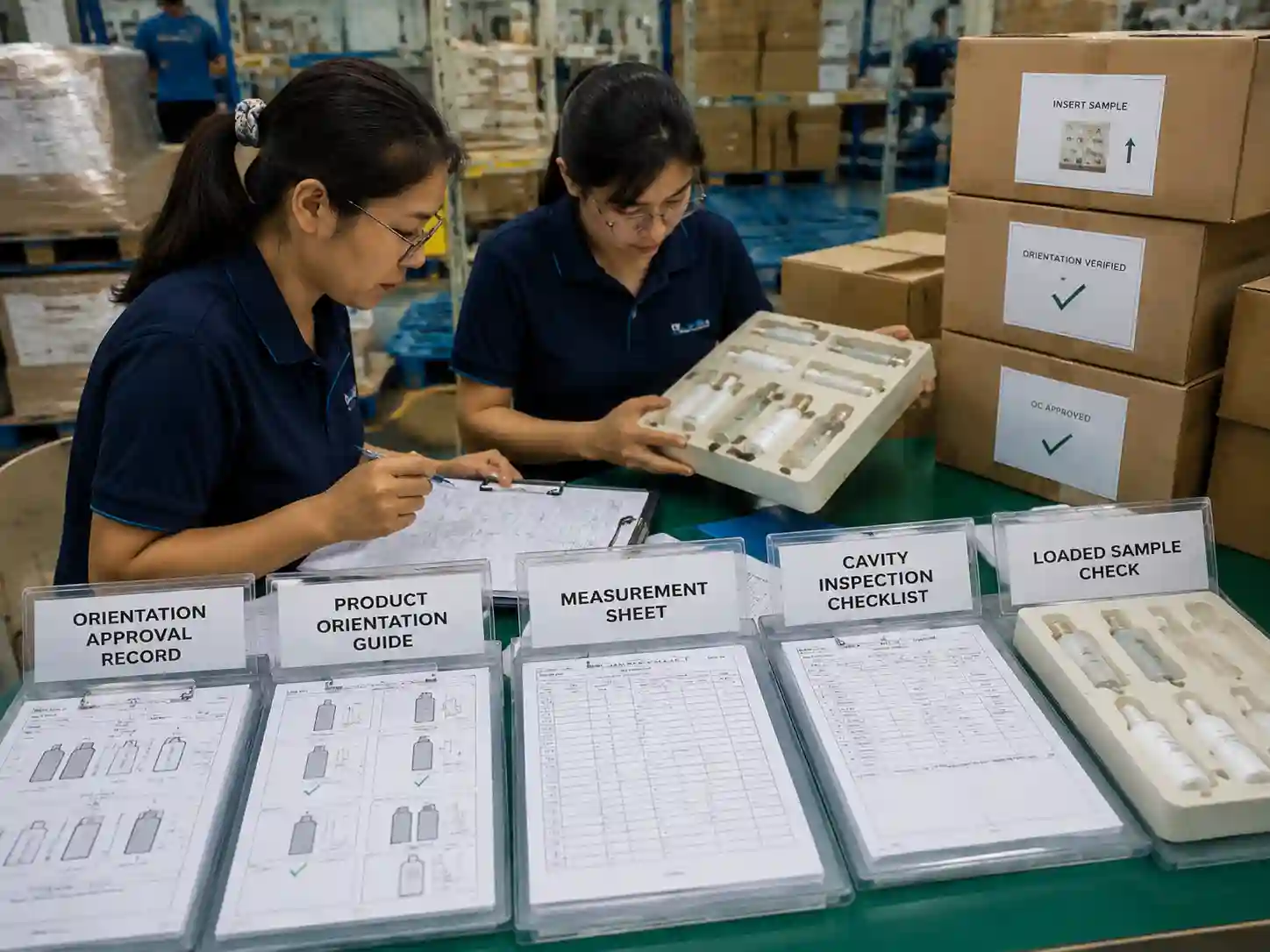
A loaded sample check confirms whether the recorded orientation works in a real insert instead of only on drawings. The product should be placed into the prototype cavity using the approved loading method and inspected for fit, stability, and appearance.
What should a loaded-sample checklist include?
- Product enters the cavity in the correct direction
- Product sits at the intended depth and position
- No excessive pressure is applied to sensitive areas
- No unwanted movement occurs during handling
- Insert structure supports the loaded weight
- Final appearance matches the approved orientation reference
Inspection records, product photos, cavity drawings, and approval notes provide traceability if changes are needed later during sampling or production.
What common mistakes occur when recording product orientation?
The most common problems happen when orientation information is incomplete or communicated without measurable references.
- Using only product photos: Photos show appearance but may not define exact dimensions or support points.
- Ignoring the loading sequence: A cavity may fit the product but fail during actual packing.
- Not recording weight direction: Heavy areas may create pressure on weak insert sections.
- Changing orientation after tooling: Late changes can require insert redesign and additional validation.
Early documentation reduces confusion between product developers, packaging engineers, sampling teams, and suppliers.
How can buyers approve an insert orientation before production?
Buyers should approve orientation using documented evidence rather than only design previews. Useful approval materials include cavity drawings, measured product references, prototype samples, and inspection records.
Giftpackpro supports custom packaging development by combining product information with structural design references through custom advent calendar box services. For projects requiring specific product positioning and insert validation, teams can review suitable custom advent calendar box products and provide product details through a request a custom quote.
FAQs About Product Orientation Records for Inserts
Can product orientation be changed after insert design starts?
Yes, but changes should be reviewed against cavity dimensions, support points, and sample validation because a new orientation may require structural adjustments.
Is a product drawing required for orientation recording?
A drawing is not always required, but a clear dimension record and marked orientation reference are strongly recommended for accurate insert development.
Who should approve the final orientation?
The final orientation should be approved by the parties responsible for product fit, packaging function, and project requirements, using samples or documented validation records.