
Quick answer: To choose compartments for advent calendar boxes, buyers should start with the product size, weight, fragility, presentation requirements, and shipping conditions. The best compartment design combines the right box structure with a suitable insert material such as paper insert, EVA insert, foam, molded pulp, or PET tray. For custom advent calendar boxes, compartment layout decisions should be confirmed during dieline development and prototype sampling because small size errors can affect assembly, product protection, appearance, and export packing performance.
For brands, wholesalers, and retail buyers, compartment selection is not only an interior design choice. It directly affects quotation cost, MOQ planning, lead time, production difficulty, and final customer experience. Giftpackpro supports buyers with custom advent calendar boxes manufacturer solutions covering structure development, inserts, sampling, bulk production, and export preparation.
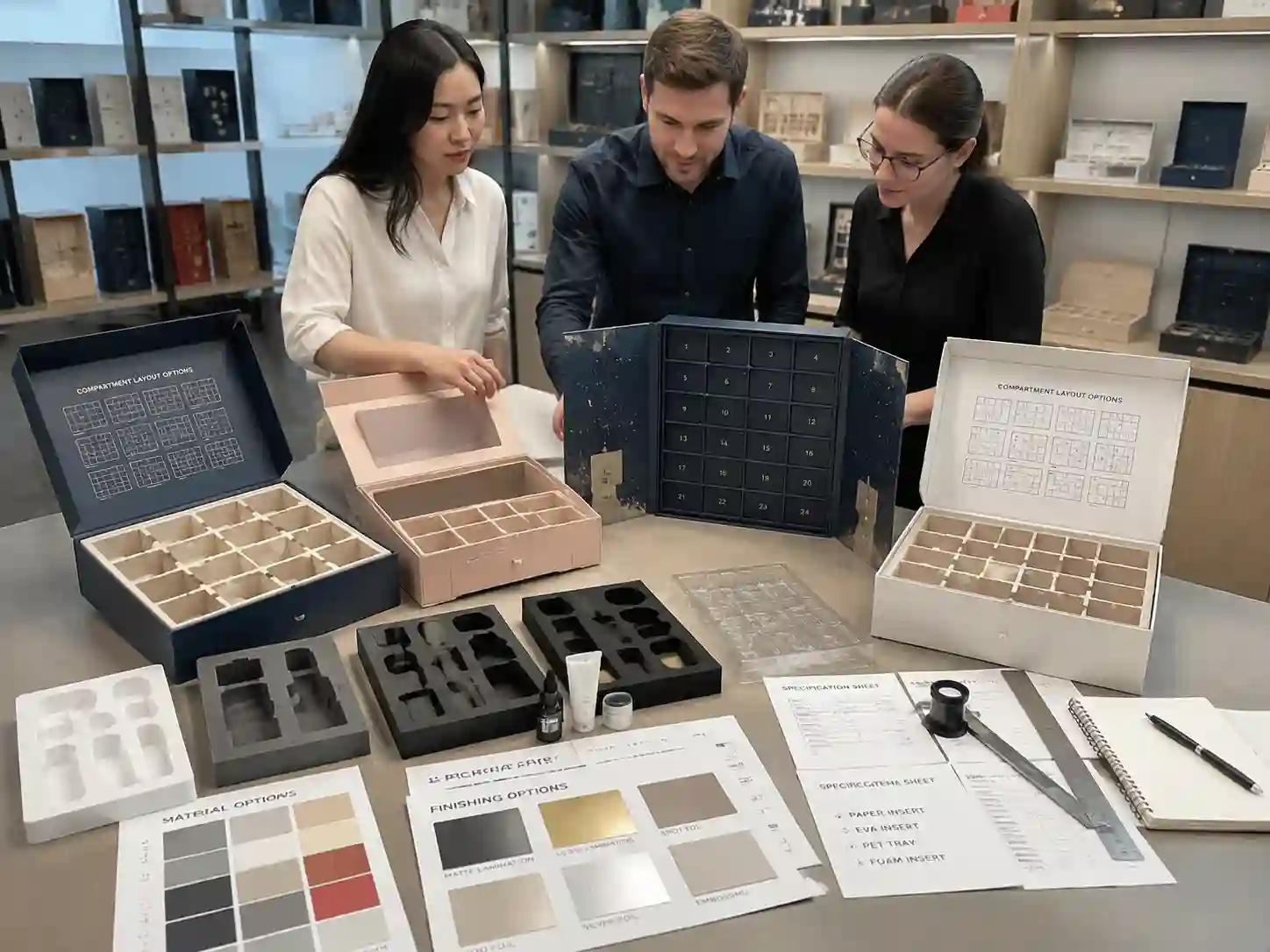
What should buyers consider before choosing compartments for advent calendar boxes?
Before choosing compartments for advent calendar boxes, buyers should define the product requirements first: item dimensions, quantity, weight, protection level, opening experience, and retail positioning. A compartment system should be designed around the actual products instead of selecting an insert first and forcing products to fit later.
Important buyer questions include:
- Are the products identical sizes or multiple different sizes?
- Are items lightweight, fragile, liquid-filled, edible, cosmetic, or premium gift products?
- Does each compartment need individual visibility or protection?
- Will the box be displayed on retail shelves or shipped directly to customers?
- Does the product require extra protection against movement during transportation?
Factory tip: Many compartment problems happen because buyers provide only the product name instead of complete dimensions. A supplier normally needs product length, width, height, weight, quantity, and packaging requirements before creating an accurate insert solution.
Which advent calendar box structures work best with different compartment layouts?
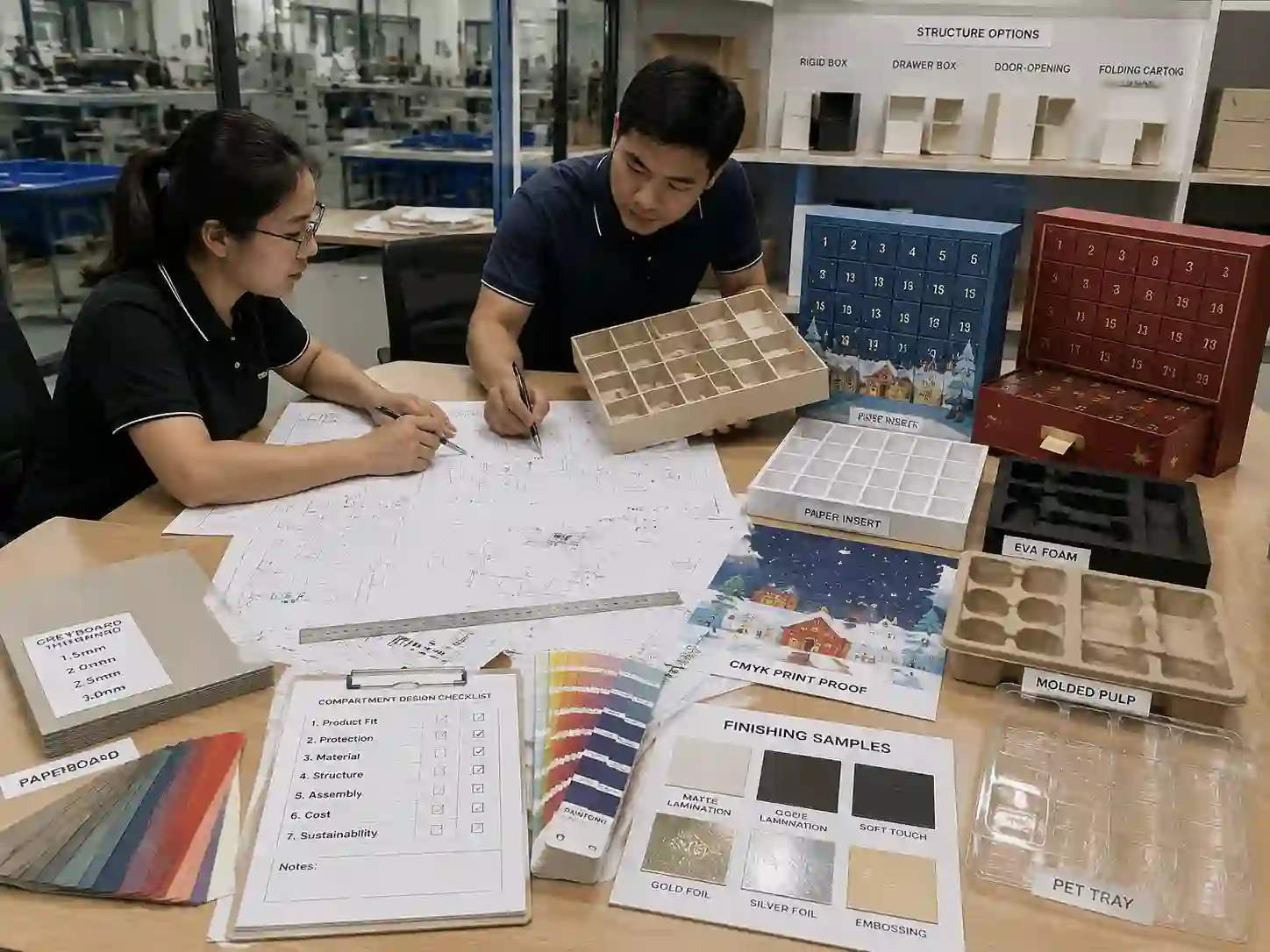
The box structure affects how compartments are arranged, accessed, and protected. Rigid boxes, drawer boxes, door-opening boxes, and folding cartons each support different compartment concepts.
| Box Structure | Suitable Compartment Approach | Common Applications | Buyer Considerations |
|---|---|---|---|
| Rigid box | Premium fitted inserts, layered compartments, removable trays | Luxury gifts, beauty sets, premium seasonal collections | Higher material cost but stronger presentation and protection |
| Drawer box | Pull-out trays with organized product slots | Cosmetics, accessories, small gift items | Requires accurate tray dimensions and smooth movement testing |
| Door-opening box | Individual numbered compartments behind doors or panels | Retail campaigns and promotional gift sets | Requires careful door strength and insert alignment checks |
| Folding carton | Paperboard partitions or folded internal structures | Cost-sensitive projects and large volume orders | Lower cost but requires careful strength testing |
The correct structure depends on the relationship between product value and packaging requirements. For example, a premium cosmetic brand may choose a rigid box with EVA inserts, while a high-volume promotional project may select a folding carton with paperboard compartments.
Buyers can review different structure options through Giftpackpro’s custom advent calendar box products range before preparing a project specification.
How do you choose the right insert material for advent calendar compartments?
The insert material should match the product protection requirements, appearance expectations, and production budget. Paperboard, EVA, foam, molded pulp, and PET tray inserts each provide different advantages.
When should buyers choose paper inserts?
Paper inserts are suitable for lightweight products and projects where cost efficiency, recyclability considerations, and simple compartment separation are important. They are commonly used with folding cartons and some rigid box applications.
Advantages include:
- Lower material cost compared with foam or EVA.
- Easy integration with printed paperboard structures.
- Good suitability for lightweight products.
When are EVA inserts or foam inserts better?
EVA and foam inserts are often selected for premium products that need cushioning, stable positioning, and a high-end presentation. They are suitable for cosmetics, jewelry-style products, electronic accessories, and fragile gift items.
However, buyers should consider that foam and EVA require precise cutting. Incorrect tolerances can cause products to be too tight, difficult to remove, or loose inside the compartment.
When should buyers consider molded pulp or PET trays?
Molded pulp inserts can provide structured protection for specific products, while PET trays are useful when buyers need transparent product visibility and consistent compartment shapes.
For food-related or cosmetic applications, buyers should verify material suitability with suppliers and request relevant documentation when required. For example, food-contact packaging requirements may depend on destination market regulations. Buyers can review official guidance such as FDA food-contact substance information when preparing compliance discussions.
How should compartment size and product fit be tested?
Compartment sizing should be confirmed through product measurements, dieline review, and physical sample testing. A supplier should not rely only on computer drawings because real products may have surface variations, weight differences, or packaging tolerances.
A proper fit test checks:
- Product insertion and removal force.
- Movement inside each compartment.
- Protection around corners and fragile areas.
- Clearance between products and internal walls.
- Assembly performance after the box is filled.
QC tip: A compartment that looks perfect on a dieline may fail during production if the board thickness, wrapping material, insert tolerance, or product packaging changes. Always approve a physical prototype or pre-production sample before mass production.
How do printing and finishing decisions affect compartment design?
Printing and finishing should be considered together with compartment structure because exterior appearance and interior engineering are connected. Artwork placement, folding direction, and finishing areas must match the final dieline.
Common customization decisions include:
- CMYK printing for full-color artwork.
- Pantone matching for brand color consistency.
- Foil stamping for premium highlights.
- Embossing for texture and raised details.
- Spot UV for selected visual effects.
- Matte lamination or gloss lamination for surface protection.
A supplier should review artwork against the approved dieline before producing samples. This reduces risks such as incorrect panel placement, damaged finishing areas, or misaligned compartment openings.
How do buyers compare compartment options during quotation preparation?
Buyers should compare compartment options based on total project requirements rather than only the lowest unit price. A lower-cost insert may increase damage risk, assembly difficulty, or rejection rates during QC.
| Comparison Factor | Questions Buyers Should Ask |
|---|---|
| Material | Does the insert provide enough protection for the product? |
| Structure | Does the box style support the required compartment layout? |
| Sample | Will the supplier provide a prototype or pre-production sample? |
| Production | Can the supplier maintain consistent insert accuracy during mass production? |
| Export packing | Are finished boxes protected inside export cartons and pallets? |
What information should buyers prepare before requesting a compartment quotation?
A professional RFQ helps suppliers provide more accurate pricing, sampling advice, and production schedules. Before contacting a supplier, buyers should prepare:
- Box structure preference: rigid box, drawer box, door-opening box, or folding carton.
- Product dimensions and quantity per box.
- Preferred insert material or protection requirements.
- Artwork files or design references.
- Printing and finishing requirements.
- Target order quantity and expected MOQ range.
- Shipping destination and export packing requirements.
- Required sample timing and launch date.
Giftpackpro provides custom advent calendar box services to help buyers move from concept review to sample approval and bulk production planning.
What common mistakes should buyers avoid when selecting compartments?
The most common mistake is choosing compartment appearance before confirming product engineering requirements. A visually attractive layout may fail if products do not fit securely or if the insert increases production problems.
Common buyer mistakes include:
- Providing incomplete product measurements.
- Approving artwork before confirming the dieline.
- Skipping physical sample testing.
- Ignoring assembly tolerance during mass production.
- Choosing the cheapest insert without considering damage risks.
- Not discussing export carton protection early.
Buyer tip: The best compartment design balances product protection, customer presentation, manufacturing feasibility, and shipping reliability.
How does QC and export packing affect compartment performance?
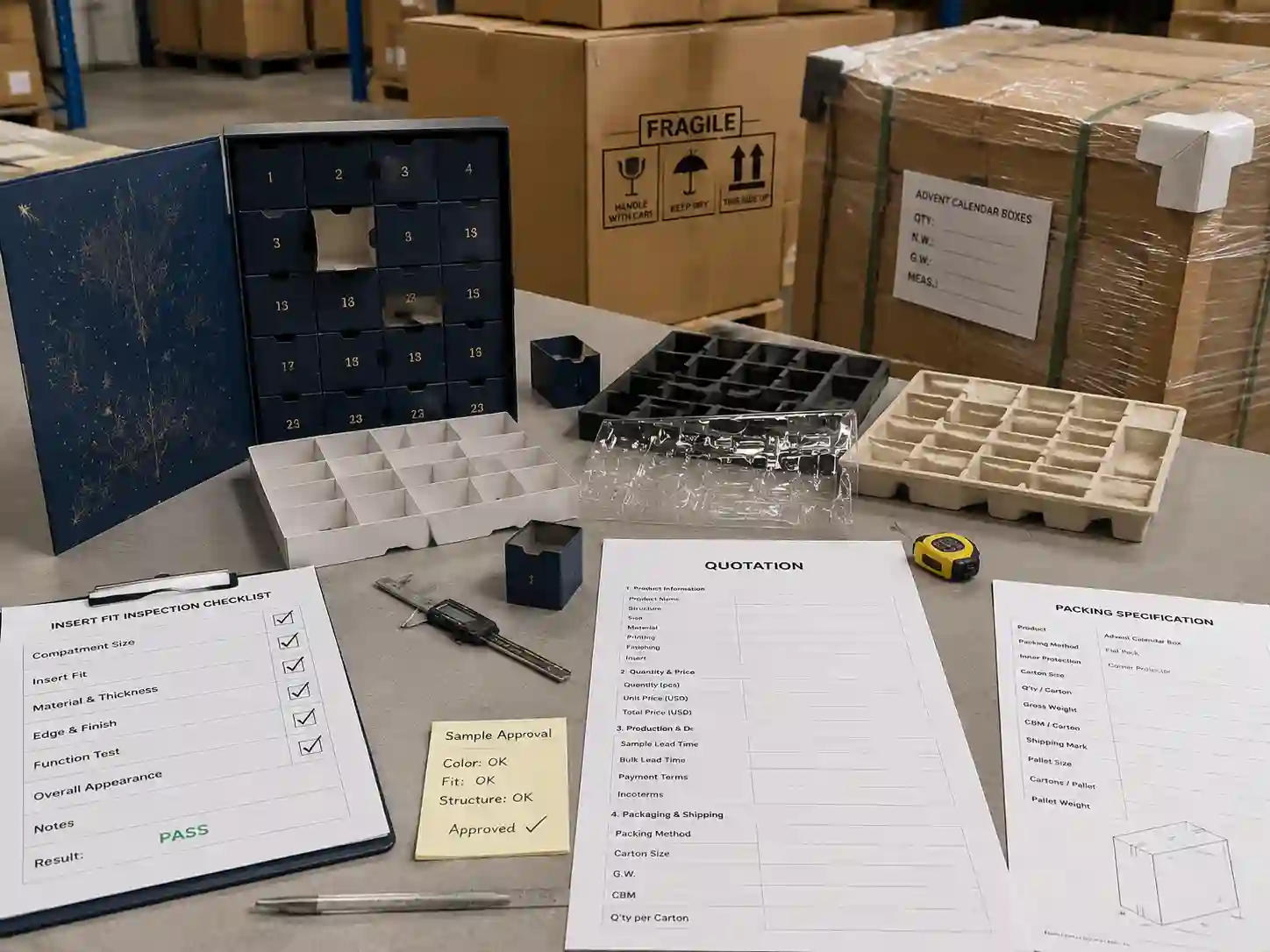
Compartment quality must be checked after assembly, not only during design review. A reliable production process includes insert inspection, product fit testing, printing checks, assembly checks, and final packing inspection.
Typical QC checks include:
- Insert dimensions and cutting accuracy.
- Product placement consistency.
- Box opening and closing performance.
- Printing and finishing quality.
- Protection during carton packing and pallet loading.
For international shipments, export cartons, corner protectors, pallet wrapping, and shipping marks should be planned before production completion. Buyers can also review more practical sourcing information in Giftpackpro’s advent calendar box buying guides.
Frequently asked questions about choosing advent calendar compartments
Can one advent calendar box contain different product sizes?
Yes. Mixed product sizes can be handled with custom compartment layouts, layered trays, adjustable inserts, or different cavity sizes. The supplier should test the complete product assortment during sampling.
Are EVA inserts more expensive than paper inserts?
Generally, EVA inserts require more material processing and precision cutting, so they may increase costs compared with simple paper inserts. However, they can provide better protection and premium presentation for suitable products.
Should buyers finalize compartments before requesting a quotation?
Buyers do not need a complete final design before requesting a quotation, but they should provide product dimensions, quantity, structure preference, and protection requirements to receive a realistic estimate.
Why is a sample important before mass production?
A sample confirms real-world fit, appearance, assembly, and product protection. It allows buyers and factories to correct compartment problems before committing to bulk production.
Prepare your compartment requirements before requesting a custom quote
Choosing compartments for advent calendar boxes requires coordination between product fit, insert materials, structure design, artwork, sampling, QC, and export preparation. Buyers who prepare accurate product information can reduce quotation delays and avoid costly production changes.
Before requesting a sample or quotation from Giftpackpro, prepare your product dimensions, quantity, preferred box structure, insert requirements, artwork status, target market, and shipping expectations. You can request a custom quote with these details to receive a more practical packaging recommendation.
For buyers comparing suppliers, reviewing factory capability, sample process, and production experience is an important step. Learn more about Giftpackpro packaging factory and our approach to custom seasonal packaging development.


