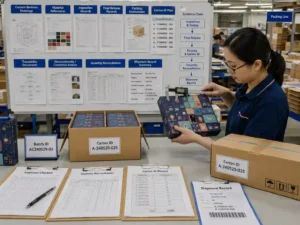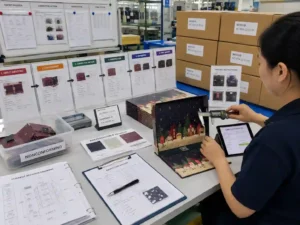
Quick answer: Buyers should confirm advent calendar box assembly details through an approved structural prototype, a loaded pre-production sample, and a written specification covering panel alignment, drawer or door movement, insert position, glue areas, magnets, ribbons, wrapped edges, and packing method. The box must be tested with the actual products, not only inspected empty. Assembly decisions also need to match the sales channel: retail packaging requires consistent shelf presentation, while e-commerce gift sets need stronger retention, protection, and export packing. Before mass production, approve measurable tolerances, functional test methods, reference samples, inspection checkpoints, and quotation assumptions with the supplier.
Assembly quality determines whether a custom advent calendar looks precise, opens correctly, protects every item, and arrives ready for a seasonal launch. A visually attractive sample can still fail during loading, fulfillment, retail handling, or international transport if the internal construction has not been engineered and documented properly.
What assembly details should buyers confirm before choosing a box?
Buyers should first confirm how the outer structure, compartments, inserts, closures, and decorative components are joined together. These decisions affect appearance, loading efficiency, product access, packing volume, labor cost, lead time, and failure risk.
The most important assembly points normally include:
- Whether the outer box is a rigid box, folding carton, drawer box, door-opening box, book-style box, or fold-out structure.
- How greyboard panels or paperboard sections are cut, wrapped, folded, glued, locked, or connected.
- How individual drawers, doors, trays, dividers, and product cavities are positioned.
- Whether the insert is permanently glued, friction-fitted, removable, or divided into several layers.
- Where magnets, ribbons, pull tabs, finger notches, hinges, and locking tabs are installed.
- Which parts will be supplied assembled, partially assembled, or flat packed.
- How finished boxes will be loaded into export cartons and pallets.
Buyer tip: Ask the supplier to identify every manually assembled component. Labor-intensive details can increase unit cost and create more opportunities for variation during mass production.
Which box structure is easiest to assemble and control?
No structure is automatically best. The right option depends on product weight, compartment count, display requirements, campaign positioning, fulfillment method, and target cost.
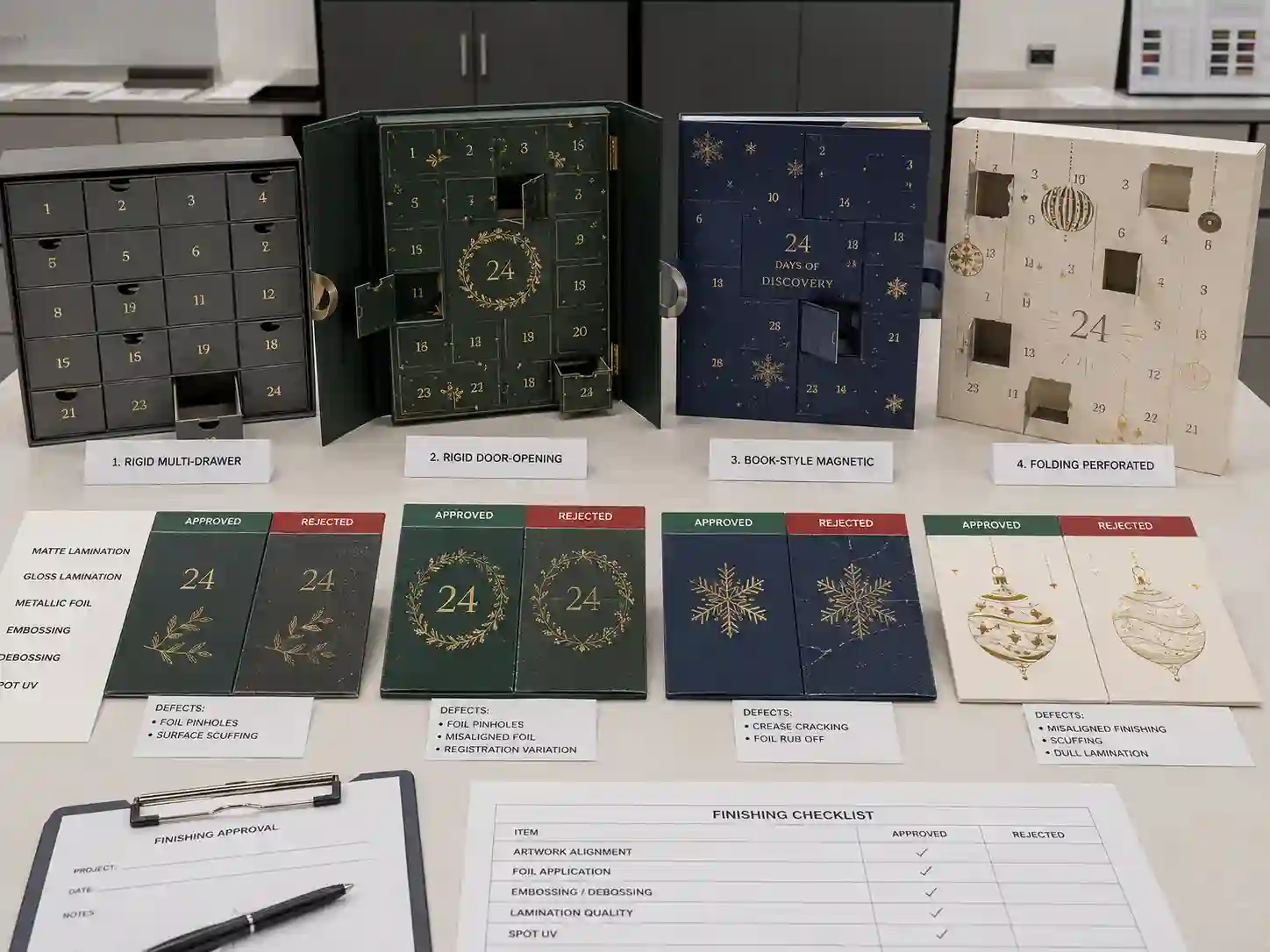
| Structure | Critical assembly details | Best suited to | Main buyer risk |
|---|---|---|---|
| Rigid door-opening box | Greyboard squareness, wrapped edges, door spacing, hinge direction, perforation or finger access, insert alignment | Premium retail displays, cosmetics, gifts, accessories | Doors rubbing, tearing, or failing to align with cavities |
| Multi-drawer rigid box | Drawer dimensions, sleeve clearance, pull ribbon attachment, divider support, drawer-stop position | Premium gift sets and reusable packaging | Drawers becoming tight after wrapping paper, lamination, or humidity changes |
| Book-style magnetic box | Spine flexibility, cover alignment, magnet polarity, magnet position, ribbon or lift-tab placement | High-value campaign kits and influencer gifts | Weak closure, visible magnet marks, or a cover that springs open |
| Folding paperboard carton | Crease accuracy, locking tabs, glue seam, perforated doors, inner tray fit | Higher-volume retail and e-commerce programs | Cracked folds, weak tabs, bowed panels, or difficult hand assembly |
| Fold-out or layered box | Panel sequence, hinge strength, component nesting, load balance, closure alignment | Promotional launches and presentation-led gift sets | Uneven opening, excessive weight on one panel, or complicated packing labor |
Rigid structures usually provide stronger presentation and dimensional stability, but they require more manual wrapping and assembly. Folding cartons can reduce shipping volume when supplied flat, although the buyer or fulfillment partner may then need additional forming and loading labor.
Buyers comparing custom advent calendar box products should evaluate total landed and handling cost rather than comparing the empty-box unit price alone.
How should door, drawer, and panel movement be checked?
Every moving component should operate repeatedly without rubbing, tearing, collapsing, or exposing unintended gaps. Function testing should be completed after printing, finishing, wrapping, insert installation, and product loading because each process changes the final dimensions.
Door-opening assembly checks
- Confirm that each door corresponds to the correct product cavity.
- Check whether the customer can open the door without damaging adjacent artwork.
- Review perforation depth, hinge direction, finger notch size, and door clearance.
- Make sure doors remain closed during handling but do not require excessive force.
- Verify that foil stamping, embossing, or spot UV does not cross a crease in a way that causes cracking.
Drawer assembly checks
- Measure the finished drawer after paper wrapping, not only the bare greyboard.
- Confirm consistent clearance between every drawer and outer sleeve.
- Pull each drawer through several opening cycles while the product is loaded.
- Check ribbon anchoring, knot position, pull-tab length, and adhesive strength.
- Confirm that stacked drawers do not transfer weight onto weaker lower components.
Rigid panel and cover checks
- Inspect box squareness from the front, side, top, and bottom.
- Check corner wrapping, paper overlap, exposed board, bubbles, and loose edges.
- Confirm that book-style covers close centrally and lie flat.
- Check magnet position and polarity before wrapping conceals the components.
- Verify that hinge gaps are sufficient for the selected wrapping paper thickness.
Factory tip: A tolerance that works on an unprinted white prototype may not work after lamination, paper wrapping, foil stamping, and adhesive application. Final functional clearance must be checked on a production-representative sample.
How should inserts be assembled around the actual products?
The insert should hold each product in the intended orientation without blocking doors, restricting drawers, damaging labels, or allowing movement during transport. Product dimensions alone are not enough; weight distribution, cap shape, pouch flexibility, fragile surfaces, and customer finger access also matter.
Common insert options include folded paper inserts, paperboard dividers, clear PET trays, EVA inserts, foam, and molded pulp. Each material requires a different assembly method.
- Paper insert: Check folding sequence, locking tabs, glued sections, wall height, and resistance to collapse.
- PET tray: Confirm forming depth, flange dimensions, cavity draft, sharp-edge control, and tray retention inside the box.
- EVA or foam: Check cavity cutting tolerance, surface covering, adhesive position, odor, and whether removal force damages the product.
- Molded pulp: Confirm dimensional consistency, surface finish, moisture control, product clearance, and support under heavier items.
For bottles, jars, candles, coffee capsules, jewelry cards, stationery, or sealed product pouches, the supplier should receive representative samples or accurate three-dimensional data. When products vary slightly between production batches, the cavity should include controlled tolerance rather than being designed around a single unusually tight sample.
QC tip: Conduct a loaded shake test and an opening-sequence test. A product that remains secure during transport can still be unsuitable if the buyer cannot remove it cleanly from the cavity.
How do artwork and finishing affect box assembly?
Artwork must follow the final structural dieline, including folds, wrapped edges, door cuts, drawer fronts, panel joints, and glue zones. A design approved on a flat screen may appear misaligned after the box is folded or wrapped.
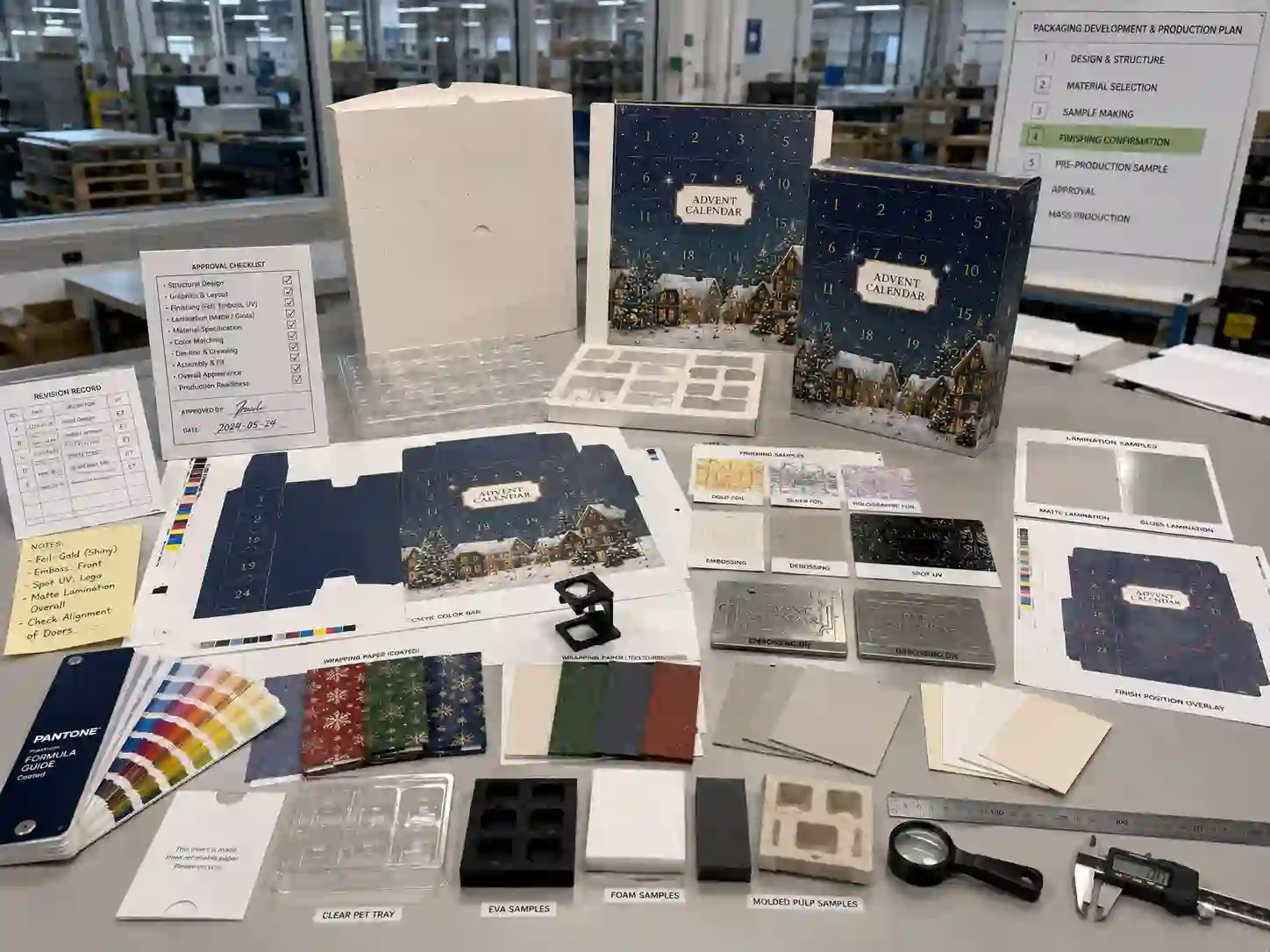
The artwork review should cover:
- Correct panel orientation and numbering sequence.
- Bleed around wrapped edges and die-cut openings.
- Safe distance between text, borders, logos, and cut lines.
- Pattern continuity across doors, drawers, covers, and side panels.
- CMYK and Pantone color expectations across different paper materials.
- Foil stamping, embossing, debossing, and spot UV registration.
- Matte lamination or gloss lamination behavior around folds and perforations.
- Unprinted glue areas where surface finishing could reduce adhesion.
The buyer should approve both a digital artwork file and a physical assembled proof. Dieline revisions must be controlled carefully; using an earlier artwork version with a later structural file is a common source of misaligned numbers, doors, and decorative borders.
Giftpackpro’s custom advent calendar box services can include structure development, insert fitting, artwork checking, sampling, production, inspection, and export packing according to the project requirements.
What sample stages are needed before mass production?
Most custom projects need more than one form of sample. Each sample should answer a different purchasing question rather than trying to confirm structure, color, finishing, and production consistency in a single early prototype.
- Blank structural prototype: Confirms dimensions, opening method, panel sequence, drawer movement, door access, and insert fit.
- Printed sample: Confirms artwork position, color direction, numbering, text size, and finishing appearance.
- Loaded sample: Confirms product retention, weight distribution, customer access, and handling performance.
- Pre-production sample: Uses production-representative materials, printing, finishing, and assembly methods as the signed reference for mass production.
The approved sample should be identified by revision number and approval date. Written comments should distinguish mandatory corrections from optional preferences. Statements such as “make the drawers smoother” are difficult to inspect; measurable requirements such as minimum clearance, ribbon length, or opening-cycle performance are more useful.
Quotable purchasing principle: The approved pre-production sample should define what the factory must reproduce, while the written specification should define how production consistency will be measured.
What assembly tolerances should appear in the QC specification?
The QC specification should identify critical, major, and cosmetic assembly issues. Exact tolerances depend on the structure and material, but the acceptance method must be agreed before production begins.
Typical inspection points include:
- Finished outer dimensions and compartment dimensions.
- Panel squareness and visible corner alignment.
- Door-to-cavity and drawer-to-sleeve alignment.
- Drawer opening force and repeated opening performance.
- Insert movement, cavity fit, and product orientation.
- Magnet alignment, polarity, and closure function.
- Ribbon length, position, attachment, and fraying.
- Glue coverage, glue overflow, lifting paper, and loose joints.
- Wrapped-edge alignment and exposed greyboard.
- Print-to-cut and foil-to-print registration.
- Surface scratches, scuffs, dents, bubbles, and lamination damage.
- Carton quantity, carton weight, shipping marks, and packing configuration.
A reliable supplier should explain where manual variation is likely and how it will be controlled with fixtures, first-piece approval, in-process inspection, and final random inspection. Buyers can learn more about factory capabilities and project coordination through the Giftpackpro packaging factory page.
How does the sales channel change assembly requirements?
Retail, e-commerce, and promotional campaigns create different performance requirements. Buyers should tell the supplier where and how the packaging will be displayed, fulfilled, shipped, opened, and disposed of.
For retail shelves
Prioritize front-panel flatness, consistent dimensions, strong shelf presence, barcode placement, stable stacking, clean corners, and repeatable door or drawer alignment. The assembled box should remain visually square under store lighting and normal shelf handling.
For e-commerce gift sets
Prioritize internal product retention, protection from repeated parcel handling, compact export packing, outer shipping-carton strength, and resistance to scuffing. Consider whether the presentation box will be shipped inside a separate protective mailer or corrugated carton.
For seasonal and promotional launches
Prioritize approval deadlines, product-loading sequence, numbered-compartment accuracy, campaign artwork revisions, and contingency time. Complex assembly should not be approved so late that a small correction delays product filling, vessel booking, retail delivery, or campaign photography.
How do MOQ, labor, and assembly choices affect the quotation?
The quotation is influenced by more than material area. Assembly labor, tooling, component count, finishing sequence, packing configuration, and expected quality tolerance can materially change the price and lead time.
Important cost drivers include:
- Rigid greyboard construction versus folding paperboard.
- Number of doors, drawers, dividers, cavities, and loose components.
- Manual wrapping, gluing, ribbon installation, and magnet placement.
- Paper insert complexity or custom PET, EVA, foam, or molded pulp tooling.
- CMYK printing, Pantone colors, foil stamping, embossing, and spot UV.
- Assembled packing versus flat packing.
- Individual sleeves, tissue sheets, dividers, corner protectors, and master cartons.
- Inspection level, testing requirements, and approved defect limits.
MOQ can vary by structure, material, printing process, tooling, and production efficiency. Buyers should request separate quotations when comparing substantially different structures instead of expecting one price to cover a rigid drawer box, door-opening rigid box, and folding carton.
What should buyers prepare before requesting a quotation?
A complete RFQ allows suppliers to quote the same specification, making price and reliability comparisons more meaningful.
Practical RFQ checklist
- Box style or reference structure.
- Required quantity and possible reorder quantity.
- Product dimensions, weight, shape, and representative samples.
- Number of compartments and opening sequence.
- Preferred insert material and product orientation.
- Finished box dimensions or size constraints.
- Paperboard or greyboard preferences.
- Artwork file, dieline status, CMYK or Pantone requirements.
- Finishing requirements such as foil stamping, embossing, spot UV, or lamination.
- Expected sample type and approval process.
- Retail, e-commerce, wholesale, or promotional application.
- Required delivery date and destination country.
- Assembled, partially assembled, or flat-packed preference.
- Export-carton, pallet, shipping-mark, and barcode requirements.
- Inspection, testing, and compliance documents to be verified.
Provide the same RFQ to every shortlisted supplier. A low quotation based on thinner materials, fewer packing protections, simplified inserts, or excluded assembly work is not directly comparable with a complete quotation.
How should buyers compare assembly suppliers?
Compare suppliers by technical response quality, sample accuracy, revision control, production planning, QC transparency, and export-packing capability—not only by unit price.
Decision guide
- Choose the supplier with the clearest engineering response when the structure has many drawers, doors, layers, or insert cavities.
- Choose the supplier with stronger sampling control when artwork alignment and premium finishing are central to the campaign.
- Choose the supplier with documented loading and packing tests when the order will be sold through e-commerce.
- Choose the supplier with realistic lead-time planning when launch timing is fixed and products must be packed before shipment.
- Reject unclear quotations when materials, assembly state, insert type, sample cost, packing method, or tooling charges are not specified.
Useful questions include: Who checks the first assembled units? How are drawer clearances controlled? Is the insert tested with actual products? Which assembly steps are manual? What is checked before packing? Can the factory provide carton dimensions, gross weight, and pallet calculations before shipment?
How should finished boxes be packed for export?
Export packing should prevent corners, doors, drawers, covers, and decorated surfaces from rubbing or collapsing. The packing method should be confirmed during sampling because it affects carton size, freight efficiency, and landed cost.
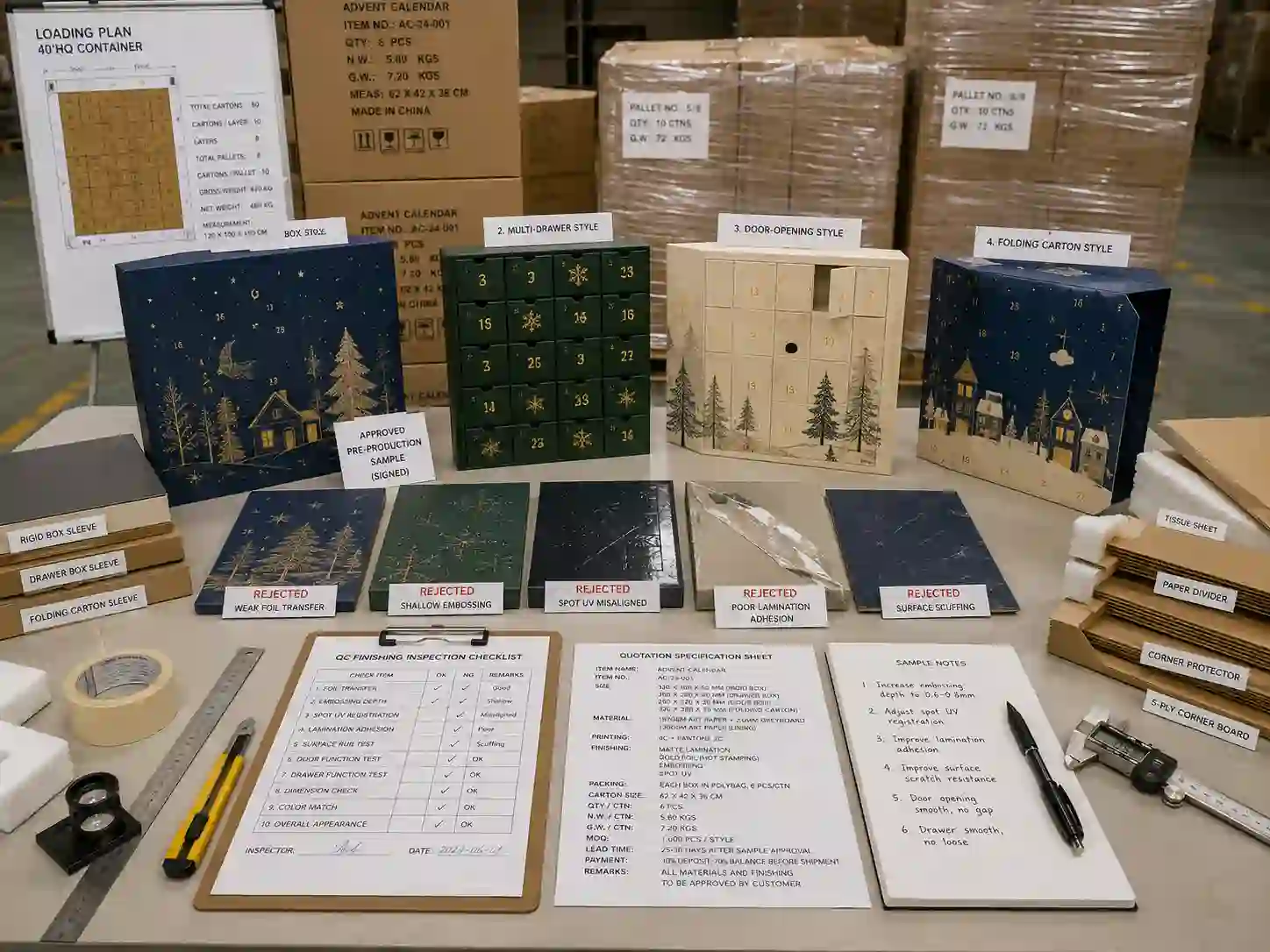
Depending on the structure, protection may include tissue paper, fitted sleeves, paper dividers, corner protectors, individual cartons, reinforced corrugated export cartons, pallet corner boards, and stretch wrap. Heavier rigid boxes may need controlled carton quantities to prevent excessive stacking pressure.
Shipping marks should match the buyer’s purchase order and may include product code, carton number, quantity, destination, gross weight, net weight, dimensions, and handling information. Buyers using retail barcodes can review identification principles through the official GS1 barcode standards. Projects requiring formal distribution testing can also reference procedures from the International Safe Transit Association.
QC tip: Approve the master-carton packing pattern and carton quantity before mass packing starts. Changing the carton configuration after production can alter freight volume, pallet count, compression risk, and shipping documentation.
What common assembly mistakes should buyers avoid?
- Approving an empty sample without loading the actual products.
- Checking the blank structure but not the finished printed and laminated sample.
- Using product dimensions without allowing for caps, seals, pouches, or manufacturing variation.
- Leaving drawer clearance, door force, or insert fit as subjective requirements.
- Approving artwork before the final dieline revision is locked.
- Ignoring glue zones when specifying lamination or spot UV.
- Assuming all boxes will be packed fully assembled without confirming freight impact.
- Comparing quotations that use different board thicknesses, inserts, finishing, or export cartons.
- Failing to keep a signed pre-production sample as the mass-production reference.
- Planning sampling too close to the retail or campaign launch date.
Frequently asked questions about advent calendar box assembly details
Should the actual products be sent to the packaging factory?
Yes, whenever practical. Representative products allow the factory to test insert fit, weight distribution, door access, drawer movement, loading sequence, and transport retention. Accurate drawings can support early development, but physical samples are preferable before final approval.
Can a rigid advent calendar box be shipped flat?
Some collapsible rigid structures can be flat packed, but conventional wrapped greyboard boxes are usually supplied assembled. Buyers should compare freight savings against forming labor, closure strength, appearance, and fulfillment complexity.
When should the assembly specification be frozen?
The specification should be frozen before the pre-production sample is approved and before mass-production materials are ordered. Late changes to dimensions, insert cavities, magnets, ribbons, or artwork can require new tooling and revised lead time.
How many opening cycles should drawers and doors be tested for?
The test should reflect expected customer use and the structure’s purpose. Rather than choosing an unsupported universal number, buyers and suppliers should agree on a repeatable cycle test using a loaded production-representative sample.
Does premium finishing make assembly more difficult?
It can. Foil, embossing, spot UV, and lamination may affect folds, glue adhesion, wrapped edges, and registration around doors or drawers. The final finishing combination should therefore be tested on an assembled sample.
What information should be written into the purchase order?
Include the approved revision, materials, dimensions, insert type, printing and finishing, assembly state, packing quantity, carton specifications, shipping marks, sample reference, inspection requirements, delivery terms, and agreed lead time.
Confirm assembly before approving mass production
Accurate advent calendar box assembly details turn a visual design into packaging that can be produced, loaded, shipped, displayed, and opened consistently. Confirm the final structure with actual products, approve the dieline and artwork revision, test the insert and moving components, define measurable QC points, and document export packing before production begins.
Review additional advent calendar box buying guides, compare options with a custom advent calendar boxes manufacturer, or prepare your product dimensions, quantity, structure preference, artwork, insert requirements, target delivery date, and shipping destination to request a custom quote.