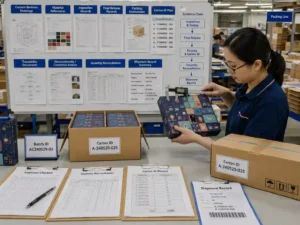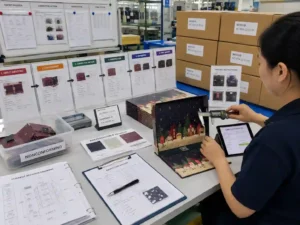
Quick answer: To confirm printing advent calendar boxes before bulk production, approve more than an artwork PDF. Buyers should verify the final dieline, CMYK or Pantone color references, text and barcode accuracy, finishing positions, surface protection, insert orientation, and the appearance of an assembled pre-production sample. The signed sample, approved artwork file, color standard, and defect tolerances should then become the factory’s production references. Printing approval must also consider export packing because rubbing, compression, moisture, and movement inside master cartons can damage an otherwise acceptable printed surface during shipment.
A reliable approval process connects packaging engineering, artwork control, printing, finishing, assembly, quality inspection, and export protection. This is especially important for custom advent calendar boxes because one project may contain dozens of printed doors, drawers, numbers, panels, cavities, and assembly components.
What must buyers understand before confirming advent calendar box printing?
Buyers must understand that print approval is both a visual decision and a production-control decision. A screen preview may confirm the design concept, but it cannot fully prove color, registration, foil position, lamination appearance, board behavior, or durability after assembly.
The first step is to identify the structure being printed. A rigid box, folding carton, drawer box, and door-opening box use different materials and production processes. These differences affect how artwork is divided, where folds or wrapped edges appear, and which areas may shift during assembly.
How does the box structure affect printing approval?
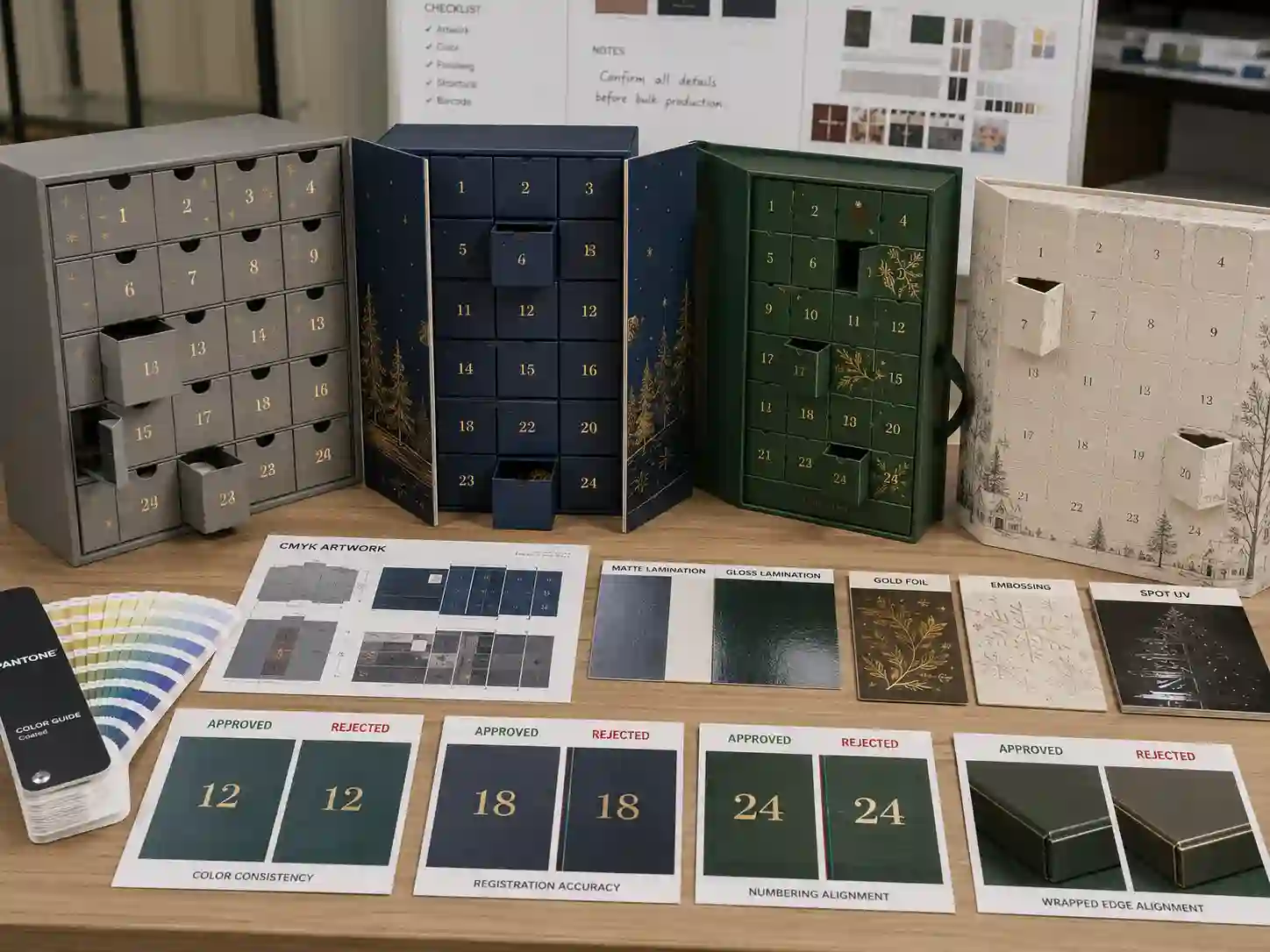
Each structure creates different printing risks:
- Rigid greyboard box: Printed wrapping paper is laminated to greyboard and turned over the edges. Artwork near corners, wrapped edges, hinges, and magnetic closures requires additional tolerance.
- Folding carton: Artwork is printed directly on paperboard before die-cutting and folding. Crease lines, glue flaps, perforated doors, and carton grain direction affect the finished appearance.
- Drawer box: Outer sleeves and individual drawers may be produced separately. Number sequence, drawer orientation, front-panel alignment, and repeated color consistency must be checked.
- Door-opening box: Multiple perforated or hinged doors make registration especially important. Numbers and graphics must remain centered after die-cutting and assembly.
- Book-style magnetic box: Artwork must account for the spine, hinge gap, magnet position, inner panels, and the direction in which the box opens.
Buyer tip: Ask the supplier to mark the front, back, top, bottom, opening direction, glue areas, hidden areas, and visible wrapped edges on the final dieline. This prevents artwork from being approved in the wrong orientation.
Which printing proof should be approved before mass production?
Most custom projects need several levels of approval. The correct proof depends on whether the buyer is checking content, approximate color, exact color, finishing, or the complete assembled result.
| Approval item | What it can confirm | What it cannot fully confirm | Recommended use |
|---|---|---|---|
| Digital artwork PDF | Text, layout, number sequence, images, dieline position, barcode data | Actual printed color, board texture, foil, embossing, lamination | Mandatory artwork-content approval |
| Digital printed proof | General layout and approximate visual appearance | Exact offset-print color and production finishing | Early review or fast design confirmation |
| Press proof or wet proof | Production-like ink, paper interaction, color balance | Complete assembly unless converted into a finished sample | Color-sensitive or high-value projects |
| Finishing sample | Foil, embossing, spot UV, matte or gloss lamination | Full box construction when supplied as a flat sheet | Special-finish approval |
| Pre-production sample | Printing, materials, finishing, structure, insert fit, assembly, opening function | Natural variation across the full production quantity | Final approval reference before mass production |
For a straightforward folding carton with standard CMYK printing, a digital proof and finished printed sample may be sufficient. A premium rigid advent calendar with Pantone colors, foil stamping, embossing, multiple drawers, and a fitted insert normally requires a complete pre-production sample.
The approved sample should be signed or otherwise identified with a date and revision number. The factory should retain one reference, while the buyer or inspection team keeps another when practical.
How should buyers check the final dieline and artwork file?
The buyer should approve artwork only after the structural dieline has been tested. Changing the structure after artwork approval can move panels, cut lines, door positions, numbers, and finishing areas.
A final artwork review should include the following:
- Correct finished dimensions and dieline revision number
- Artwork bleed extending beyond cut lines
- Safe distance between text and cutting, creasing, or perforation lines
- Correct front, back, side, top, and opening orientation
- Correct numbering for drawers, doors, or compartments
- Matching artwork across adjacent panels
- Correct language, punctuation, ingredients, warnings, and legal copy supplied by the buyer
- Images with suitable production resolution
- Fonts outlined or packaged correctly
- Defined CMYK builds and named Pantone references
- Separate layers for foil stamping, embossing, debossing, spot UV, white ink, and cutting guides
- Barcode size, quiet zones, contrast, and placement
- Removal of non-printing notes and obsolete dieline layers from production files
Factory tip: A dieline is not only a cutting outline. It controls where graphics meet folds, door openings, drawer fronts, wrapped edges, magnets, ribbons, and insert cavities. Approving artwork on an untested dieline increases the risk of later rework.
Should advent calendar boxes use CMYK or Pantone printing?
Use CMYK for photographs, gradients, illustrations, and designs containing many colors. Use Pantone references when a specific brand color must remain more consistent across production or when matching between different printed components is important.
CMYK color is created from process ink combinations, so its appearance can vary with paper whiteness, ink density, coating, lamination, and printing conditions. A Pantone reference gives the factory a clearer target, but the printed result can still be affected by the substrate and surface treatment.
Buyers should therefore avoid approving color only from a laptop or phone. Screens use emitted RGB light, while packaging is viewed as printed ink on paper. Even calibrated screens cannot reproduce every printed color or finishing effect accurately.
For critical colors, prepare one of these references:
- A physical Pantone reference identified by the correct coated or uncoated system.
- An approved previous production sample with the target color clearly marked.
- A signed wet proof produced on the specified paper.
- A measurable color target agreed with the supplier and inspection team.
QC tip: Do not describe a color only as “dark red,” “gold,” or “close to the screen.” Record a specific reference and define whether visual comparison will be made under controlled lighting.
How should buyers approve foil, embossing, spot UV, and lamination?
Special finishes should be approved for position, size, contrast, adhesion, and interaction with folds or wrapped edges. A visually attractive digital mockup does not prove that the finish can be produced cleanly.
Foil stamping
Check the foil color, gloss level, coverage, edge sharpness, pinholes, and registration against printed graphics. Fine lines and small reversed text may fill in or break. Foil should not cross tight folds, deep creases, perforations, or heavily wrapped corners unless the process has been tested.
Embossing and debossing
Review depth, edge definition, board deformation, and alignment with printed or foiled elements. Deep embossing may require thicker paper, a suitable backing structure, and more space from cut edges.
Spot UV
Confirm gloss contrast, registration, curing, surface smoothness, and resistance to scratching. Very fine spot UV details may be less stable than larger design areas.
Matte and gloss lamination
Lamination changes color appearance and protects the printed surface. Matte lamination can reduce glare but may show scuffing on dark solid colors. Gloss lamination increases reflectivity and color saturation but can reveal surface irregularities. Buyers should approve the actual laminate type rather than writing only “matte finish” in the purchase order.
Why must printing be checked on an assembled sample?
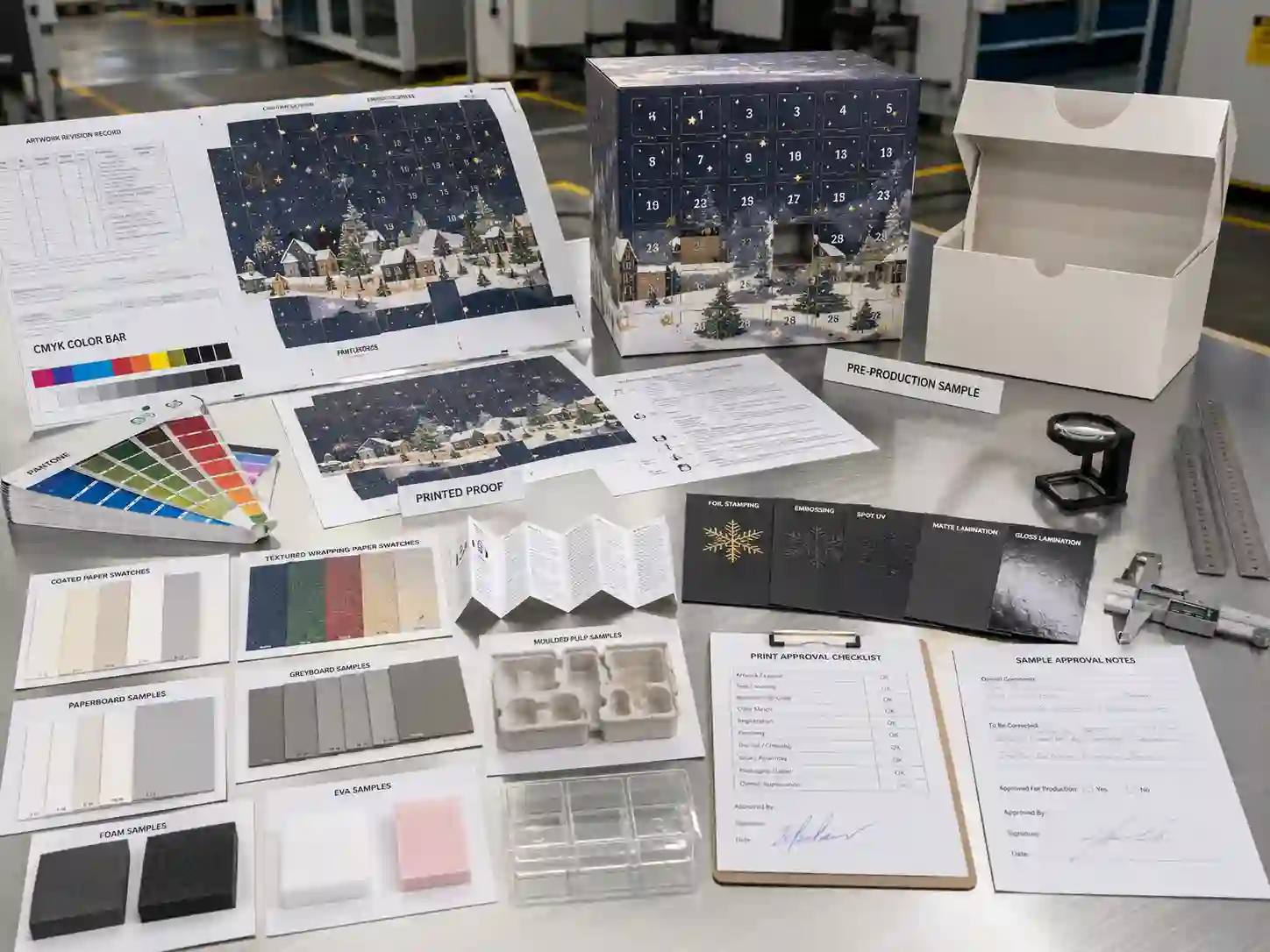
An assembled sample reveals production issues that cannot be seen on a flat printed sheet. Printing may appear correctly positioned before converting but shift visually after wrapping, folding, gluing, drawer insertion, or door assembly.
The pre-production sample should be checked for:
- Alignment of graphics across opening panels
- Centered numbers on doors and drawers
- Consistent visible margins around compartments
- Artwork direction after the box is opened
- Print continuity around rigid-box edges and corners
- Spine and hinge alignment on book-style boxes
- Hidden glue marks or exposed unprinted areas
- Color differences between outer boxes, drawers, sleeves, and inserts
- Scuffing caused by tight drawers or contact between printed surfaces
- Cracking, whitening, or delamination along folds and wrapped edges
Product fit must also be tested before printing approval becomes final. A bottle, sachet, candle, capsule, jewelry card, or accessory may force an insert cavity to move. Any structural change can affect the door layout, drawer size, printed numbering, or panel artwork.
Buyers can review structure and printing options through Giftpackpro’s custom advent calendar box products and discuss sampling requirements through its custom advent calendar box services.
Which insert and product-fit decisions affect printed artwork?
The insert determines where products sit and how the customer opens each compartment. Its cavity layout should be finalized before the buyer approves numbered doors, drawer fronts, product illustrations, or internal instructions.
Common insert options include:
- Folded paper insert: Lightweight and printable, but dependent on accurate folds, locking tabs, and product weight.
- Paperboard partitions: Suitable for compartment separation and flat packing, although they require assembly planning.
- Clear PET tray: Provides accurate cavities and product visibility, but must be checked for fit, movement, and surface scratching.
- EVA or foam insert: Offers secure retention for fragile or premium products, but cavity tolerances and surface finish must be approved.
- Molded pulp insert: Supports paper-based presentation goals, but surface texture and dimensional tolerances may differ from plastic or foam.
For door-opening advent calendars, each door should align with the correct cavity. For drawer boxes, the insert must not force the drawer outward or rub against a printed drawer front. For rigid book-style boxes, the loaded insert should not interfere with closing, magnets, or the printed hinge area.
Buyer tip: Send actual production products whenever possible. Product drawings alone may not reveal flexible pouch expansion, cap variation, label seams, cable placement, or center-of-gravity issues.
How should buyers compare suppliers before approving printing?
Compare suppliers by the clarity of their control process, not only by sample appearance or unit price. A capable supplier should connect artwork revision control with structure, printing, finishing, assembly, inspection, and export packing.
Use this decision guide:
| Supplier question | Strong response | Warning sign |
|---|---|---|
| How are artwork revisions controlled? | Files have revision numbers, approval dates, and a defined production version. | Approvals are handled through mixed chat images without a final file record. |
| How is color confirmed? | The supplier requests a Pantone, wet proof, signed sample, or measurable target. | The supplier promises an exact screen match. |
| Is a complete pre-production sample available? | The sample can include production materials, printing, finishing, insert, and assembly. | Only a digital rendering is offered for a complex rigid structure. |
| How is mass-production printing inspected? | Checks cover color, registration, defects, finishing, assembly, and comparison with the approved sample. | Inspection is described only as “quality checked.” |
| How is printed packaging protected during shipment? | The packing method is specified by unit protection, master carton, pallet plan, and shipping marks. | Carton details are decided only after production is complete. |
Buyers evaluating a custom advent calendar boxes manufacturer should also ask which processes are completed internally, which are outsourced, how subcontracted finishing is controlled, and who has authority to stop production when a print deviation is found.
Information about production background and supplier capabilities should be verified directly. Buyers can review the Giftpackpro packaging factory page as one part of their supplier assessment.
How do MOQ, cost, and lead time affect printing confirmation?
MOQ, cost, and lead time are influenced by structure complexity, printed sheet utilization, material purchasing quantities, tooling, setup waste, finishing processes, assembly labor, and export packing. Buyers should ask for these elements to be separated clearly in the quotation.
Common cost drivers include:
- Number of unique printed components
- Rigid greyboard construction versus folding paperboard
- CMYK only versus CMYK plus Pantone inks
- Number and size of foil or spot UV areas
- Embossing or debossing tooling
- Manual wrapping, drawer assembly, ribbon fitting, and magnet installation
- Paper, PET, EVA, foam, or molded pulp insert tooling
- Digital proof, wet proof, blank prototype, and pre-production sample requirements
- Flat-packed versus assembled delivery
- Individual sleeves, tissue, dividers, corner protection, master cartons, and pallets
Printing approval delays can affect production scheduling. The lead time should begin from a clearly defined milestone, such as receipt of deposit, final artwork approval, sample approval, or material confirmation. Buyers should not assume that approving a quotation automatically reserves printing capacity.
How should printed advent calendar boxes be packed for export?
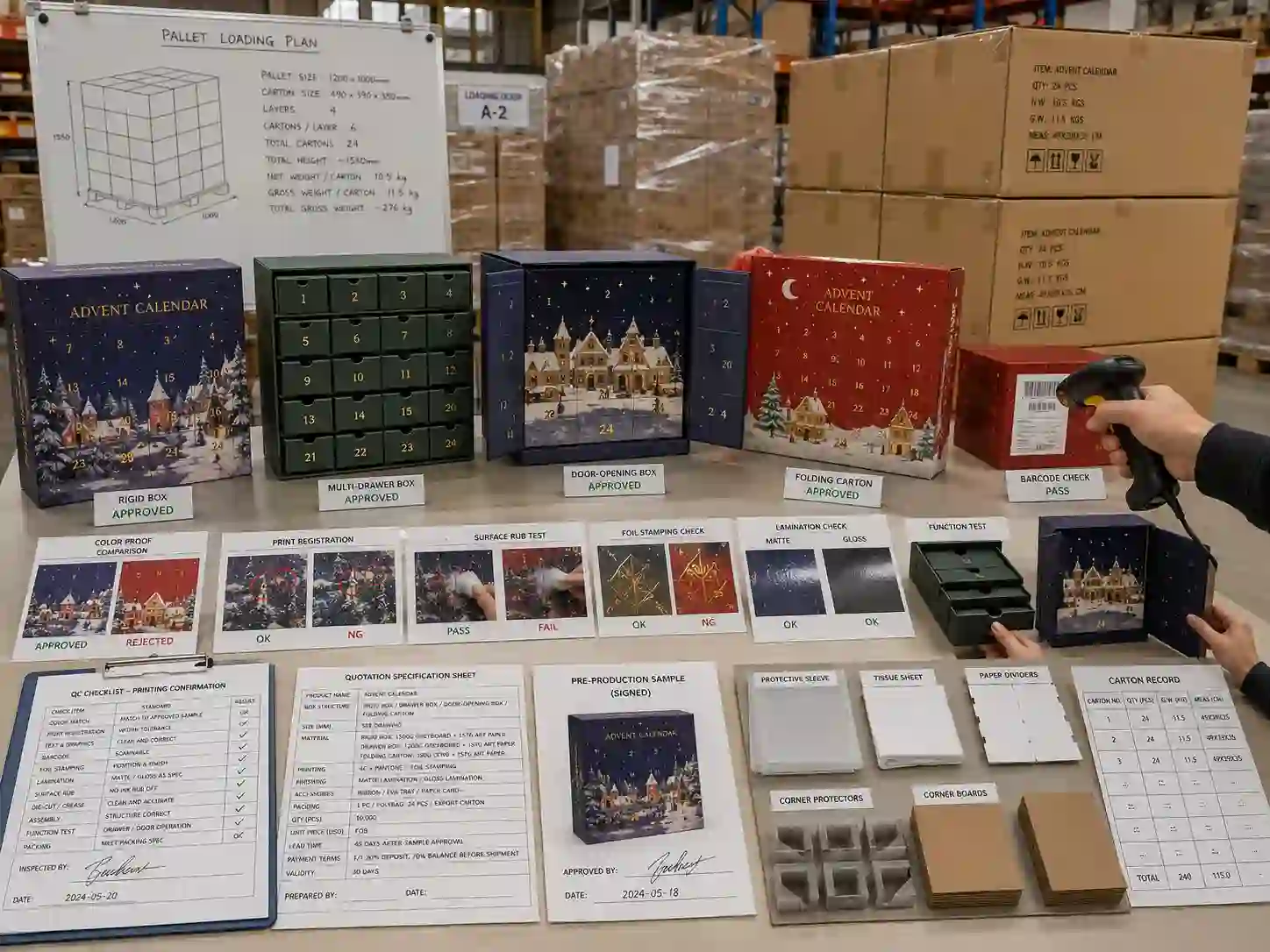
The export-packing method should be confirmed before mass production because it affects box dimensions, assembly labor, carton quantity, freight volume, and the risk of print damage. Printed surfaces require protection from rubbing, pressure, moisture, and movement.
When is flat packing suitable?
Flat packing is most suitable for folding cartons, sleeves, partitions, and structures designed for easy final assembly. It can reduce shipping volume, but the buyer must evaluate local assembly labor, assembly instructions, glue or locking requirements, and the possibility of scratching during handling.
When is assembled packing necessary?
Rigid boxes, multi-drawer calendars, magnetic book-style boxes, and complex door-opening structures are often shipped assembled or partly assembled. This protects structural accuracy and reduces work at the destination, but it increases carton and freight volume.
What should be confirmed for master cartons?
Specify the quantity per carton, carton dimensions, gross and net weight, corrugated grade, internal dividers, stacking direction, moisture protection, and sealing method. Cartons should not be so tight that pressure marks the packaging or so loose that units move and rub during transit.
When should pallets be used?
Pallets can improve handling and stacking control for suitable order volumes and logistics routes. Confirm pallet dimensions, loading pattern, total height, gross weight, corner boards, top protection, stretch wrapping, and whether cartons may overhang the pallet.
Shipping marks should identify the purchase order, SKU, product description, carton number, quantity, destination, dimensions, weight, handling direction, and any buyer-required barcode. Barcode formats and logistics labels should be checked against the buyer’s distribution requirements. Buyers can consult the official GS1 barcode standards when GS1 identification is required.
For projects needing formal transport validation, buyers may also discuss appropriate test methods with their supplier or laboratory using guidance from the International Safe Transit Association.
What QC checks should be completed during mass production?
Mass-production QC should compare actual output with the approved artwork, color reference, pre-production sample, and purchase specification. Approval of one sample does not eliminate normal production variation, so inspection points must be defined.
A practical printing QC checklist includes:
- Confirm the correct artwork revision is released to production.
- Check paper or wrapping material against the approved specification.
- Verify print content, number sequence, language, and barcode data.
- Compare color with the approved physical reference.
- Inspect registration, ink density, scratches, spots, hickeys, streaks, and missing print.
- Check lamination adhesion, bubbles, silvering, scuffing, and color change.
- Inspect foil coverage, edge quality, pinholes, and position.
- Check embossing or spot UV registration and consistency.
- Verify die-cutting, perforation, creasing, and artwork alignment.
- Inspect wrapped edges, corners, glue cleanliness, and exposed board.
- Test drawer movement, door opening, magnets, ribbons, and closures.
- Load actual products and confirm insert retention and closing function.
- Perform rub, handling, and packed-product movement checks where appropriate.
- Compare packed units with the approved master-carton configuration.
- Verify carton labels, shipping marks, carton sequence, quantity, and weight.
QC tip: Define what is critical, major, and minor before inspection. Wrong artwork, unreadable required text, incorrect numbering, or unusable barcodes may require different action from a small cosmetic mark in a hidden area.
What information should buyers prepare before requesting a quotation?
A useful RFQ should describe the complete packaging system rather than asking only for a price based on a photograph. Accurate information helps suppliers compare the same specification and reduces later quotation changes.
Prepare the following:
- Box style or reference structure
- Finished external dimensions
- Product dimensions, weights, quantities, and orientation
- Preferred paperboard or greyboard thickness
- Insert material and cavity requirements
- Artwork status and number of printed components
- CMYK, Pantone, foil, embossing, spot UV, and lamination requirements
- Required prototype, printed sample, or pre-production sample
- Target order quantity and possible reorder quantities
- Required delivery date and destination
- Flat-packed, partly assembled, or fully assembled preference
- Individual protection, master-carton, pallet, and shipping-mark requirements
- Inspection, barcode, testing, and compliance requirements
- Quotation terms required, including tooling, sample, unit, packing, and freight costs
When comparing quotations, check whether each supplier has included the same material, printing method, finishing area, insert, assembly level, unit packing, carton standard, pallet requirement, tooling, sample cost, and delivery term.
Which common printing-approval mistakes should buyers avoid?
The most common mistake is treating artwork approval as complete production approval. Buyers should also avoid these problems:
- Approving colors from an uncalibrated screen without a physical reference
- Starting artwork before the structural dieline is finalized
- Approving a flat print sheet without checking the assembled box
- Using a blank prototype to approve final product fit but never testing the printed sample
- Changing products or insert cavities after artwork approval
- Failing to label the final artwork revision clearly
- Placing fine foil, text, or spot UV too close to folds, doors, or wrapped edges
- Ignoring rubbing between drawers, sleeves, doors, and inserts
- Leaving acceptable color variation and defect criteria undefined
- Confirming master cartons and shipping marks only after production
- Comparing supplier quotations with different packing and inspection assumptions
More practical procurement topics are available in Giftpackpro’s advent calendar box buying guides.
Frequently asked questions about confirming advent calendar box printing
Can a digital PDF be the final printing approval?
A digital PDF can approve text, layout, numbering, and artwork position, but it should not be the only approval for color-sensitive, highly finished, or structurally complex packaging. A physical print or pre-production sample provides stronger control.
Is a Pantone number enough to guarantee an exact color?
No. A Pantone reference defines a target, but paper color, coating, lamination, ink film, and viewing conditions affect the result. The buyer and supplier should agree on the physical comparison method and acceptable variation.
Should the buyer approve a blank prototype before a printed sample?
Yes, especially for a new structure. The blank prototype should confirm dimensions, opening method, compartment layout, product fit, assembly tolerance, and insert function before expensive printing and finishing are produced.
What is the difference between a printed sample and a pre-production sample?
A printed sample may demonstrate artwork and color but use simplified materials or processes. A pre-production sample should represent the intended production structure, materials, printing, finishing, insert, and assembly as closely as practical.
How can dark matte boxes be protected from scuffing?
Test the selected matte lamination or coating, reduce unnecessary surface contact, prevent tight drawer friction, use suitable sleeves or tissue, add dividers where needed, and ensure master cartons prevent movement without excessive compression.
When should shipping marks be approved?
Approve shipping-mark content and placement before cartons are printed or labeled. Carton numbering, SKU data, quantities, weights, destination details, and barcodes should match the final packing list and buyer requirements.
What should buyers send Giftpackpro before sample or quotation preparation?
To confirm printing advent calendar boxes efficiently, send the intended box structure, product dimensions and weights, insert preference, order quantity, artwork or design direction, color references, finishing requirements, sample expectations, delivery destination, target date, and export-packing instructions.
Giftpackpro can then review the dieline, printing method, finishing feasibility, insert fit, sample route, mass-production QC points, master-carton configuration, pallet needs, and shipping-mark requirements. Buyers ready to discuss a project can request a custom quote with these details.