
Quick answer: To confirm materials before advent calendar box production, buyers should approve a complete material specification rather than relying on general descriptions such as “rigid box,” “cardboard insert,” or “matte finish.” The approved specification should identify the paperboard or greyboard thickness, wrapping paper, insert material, surface finishing, adhesive requirements, printing references, product-loading method, export carton protection, and acceptable tolerances. These details should be verified through material swatches, a structural prototype, a printed sample, and preferably a loaded pre-production sample. Mass production should begin only after the supplier, buyer, and quality-control team are working from the same signed specification.
Why must buyers confirm materials before production starts?
Material confirmation prevents the factory from making technically acceptable packaging that does not match the buyer’s expected appearance, strength, fit, or cost. It also creates a measurable reference for purchasing, production, QC, and final inspection.
An advent calendar contains more interacting components than a standard folding carton. A rigid door-opening box may combine greyboard, printed wrapping paper, magnets, hinges, ribbon, internal partitions, removable trays, and multiple adhesives. A drawer box adds sleeve clearances, drawer movement, pull tabs, and repeated assembly tolerances. A folding carton may look simpler, but door perforations, crease quality, insert height, and product retention still depend on the correct materials.
Quotable buyer principle: A material name is not a production specification. “Greyboard,” “PET tray,” or “matte lamination” must be supported by thickness, grade, color, finish, construction, and approved samples.
Buyers comparing a custom advent calendar boxes manufacturer should therefore ask how material specifications are recorded, approved, purchased, checked upon arrival, and controlled during mass production.
Which advent calendar structure should be confirmed first?
Confirm the structure before finalizing decorative materials because the construction determines board thickness, insert design, assembly labor, packing volume, and durability requirements. Changing the structure after artwork approval usually creates new dielines, samples, costs, and lead-time risks.
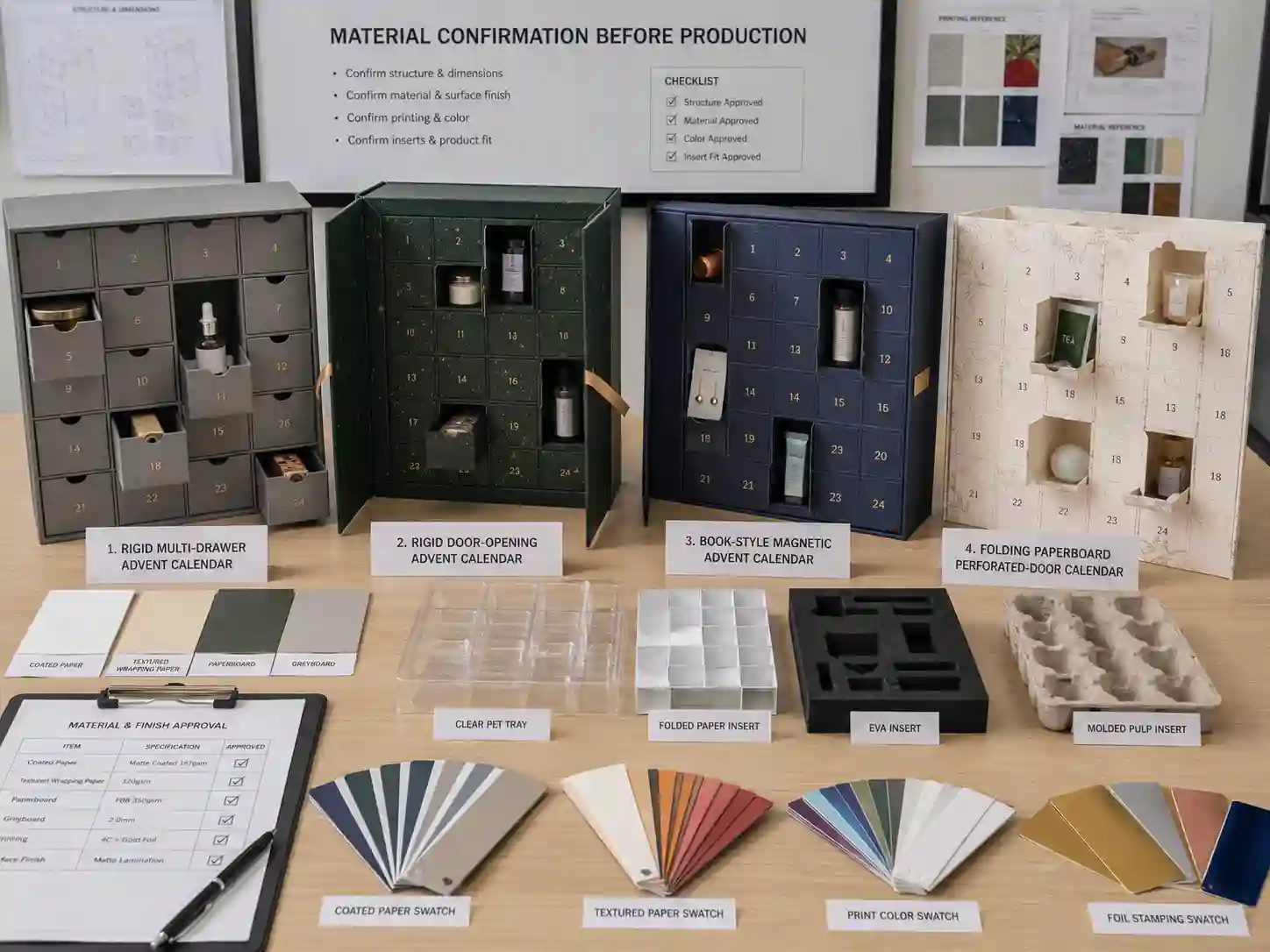
| Structure | Main material decisions | Typical buyer risk | Recommended confirmation method |
|---|---|---|---|
| Rigid door-opening box | Greyboard thickness, wrapping paper, hinge construction, magnet strength, door gap, internal partitions | Warped doors, uneven gaps, weak hinges, visible magnet positions | Finished blank prototype plus printed and loaded sample |
| Multi-drawer rigid box | Drawer board, sleeve board, wrapping paper, pull tab, clearance, base reinforcement | Tight drawers, loose drawers, rubbing surfaces, inconsistent alignment | Repeated drawer-cycle testing with the intended product load |
| Book-style magnetic box | Greyboard, spine gap, magnet position, hinge paper, inner tray material | Cover spring-back, cracked hinge paper, poor closure alignment | Open-close test and loaded closure test |
| Folding carton with perforated doors | Paperboard grade, caliper, grain direction, crease depth, perforation pattern, insert height | Doors tearing early, panels bowing, poor standing strength | White dummy followed by a printed production-material sample |
| Fold-out or modular calendar | Panel board, joint material, connectors, magnets, reinforcement, packing configuration | Misaligned panels, weak joints, high shipping volume | Full assembly test, handling test, and export-carton trial |
Buyer tip: Ask the supplier to state whether dimensions are internal product dimensions, insert cavity dimensions, closed-box dimensions, or finished external dimensions. Confusing these measurements can make a structurally correct box unusable.
How should paperboard and greyboard be specified?
Buyers should confirm board by material type, thickness or grammage, stiffness requirement, color, recycled-content expectation where applicable, and its exact use in the structure. A quotation that says only “cardboard” leaves too much room for substitution.
Greyboard for rigid boxes
Rigid boxes commonly use greyboard as the structural core and printed or specialty paper as the outer wrap. The required thickness depends on the finished dimensions, number of drawers or doors, total product weight, unsupported panel size, and transport conditions.
Thicker greyboard can improve perceived rigidity, but it also increases weight, cost, wrapping difficulty, corner build-up, and shipping volume. It cannot compensate for a weak internal structure, incorrect grain direction, poor adhesive coverage, or inadequate reinforcement.
Paperboard for folding cartons and partitions
Paperboard should be selected according to stiffness, folding performance, print surface, crease behavior, and the weight carried by each compartment. The sample should be produced with the proposed production grade because a white prototype made from substitute board may fold differently from the printed mass-production material.
Request actual caliper measurements when thickness is important. Grammage alone does not guarantee the same stiffness or thickness across different paper grades.
Wrapping and decorative papers
For rigid boxes, confirm the wrapping paper’s surface texture, printability, cracking resistance, scuff resistance, and behavior around corners and hinges. Dark solid colors, uncoated specialty papers, and heavily textured sheets may show rubbing, glue marks, fingerprints, or color variation more easily than standard coated paper.
Buyers requesting responsibly sourced fiber can ask suppliers to provide current supporting documentation and verify claims through the official Forest Stewardship Council rather than relying only on a logo shown in a sales presentation.
How do buyers choose and confirm the insert material?
The insert must be confirmed using the real product dimensions, weight, shape, orientation, and loading process. Choosing an insert from photographs or nominal product measurements is one of the most common causes of loose products, crushed cartons, damaged labels, and slow assembly.
| Insert option | Best suited to | Advantages | Confirmation points |
|---|---|---|---|
| Folded paper insert | Lightweight, regular products | Printable, paper-based, efficient for flat packing | Board stiffness, locking tabs, cavity size, support walls, assembly time |
| Paperboard partitions | Sachets, cards, capsules, small gift items | Simple construction and material separation | Partition height, slot tightness, load distribution, movement during transit |
| Clear PET tray | Cosmetic bottles, candles, small accessories | Precise cavities and clear presentation | Material thickness, cavity draft, flange width, transparency, product removal |
| EVA or foam insert | Fragile, heavy, or premium products | Strong retention and cushioning | Density, thickness, odor, surface finish, cavity tolerance, adhesive method |
| Molded pulp | Products needing molded protection with a fiber-based presentation | Good cushioning and formed support | Tooling, surface texture, moisture control, dimensional consistency |
A good fit is not always a tight fit. Bottles may need finger clearance for removal, flexible pouches may require side support, and printed labels should not rub against sharp insert edges. Product tolerances must also be considered: a cavity designed around one ideal sample may reject normal production variation.
Factory tip: Send at least several representative product units when dimensions vary between batches. The insert should be tested against the largest, smallest, and heaviest acceptable units, not only one hand-selected sample.
What material documents should be approved before mass production?
Buyers should approve one consolidated material specification sheet linked to the final dieline, artwork revision, sample reference, and purchase order. Separate email comments are difficult for production teams to control and can lead to outdated instructions being used.
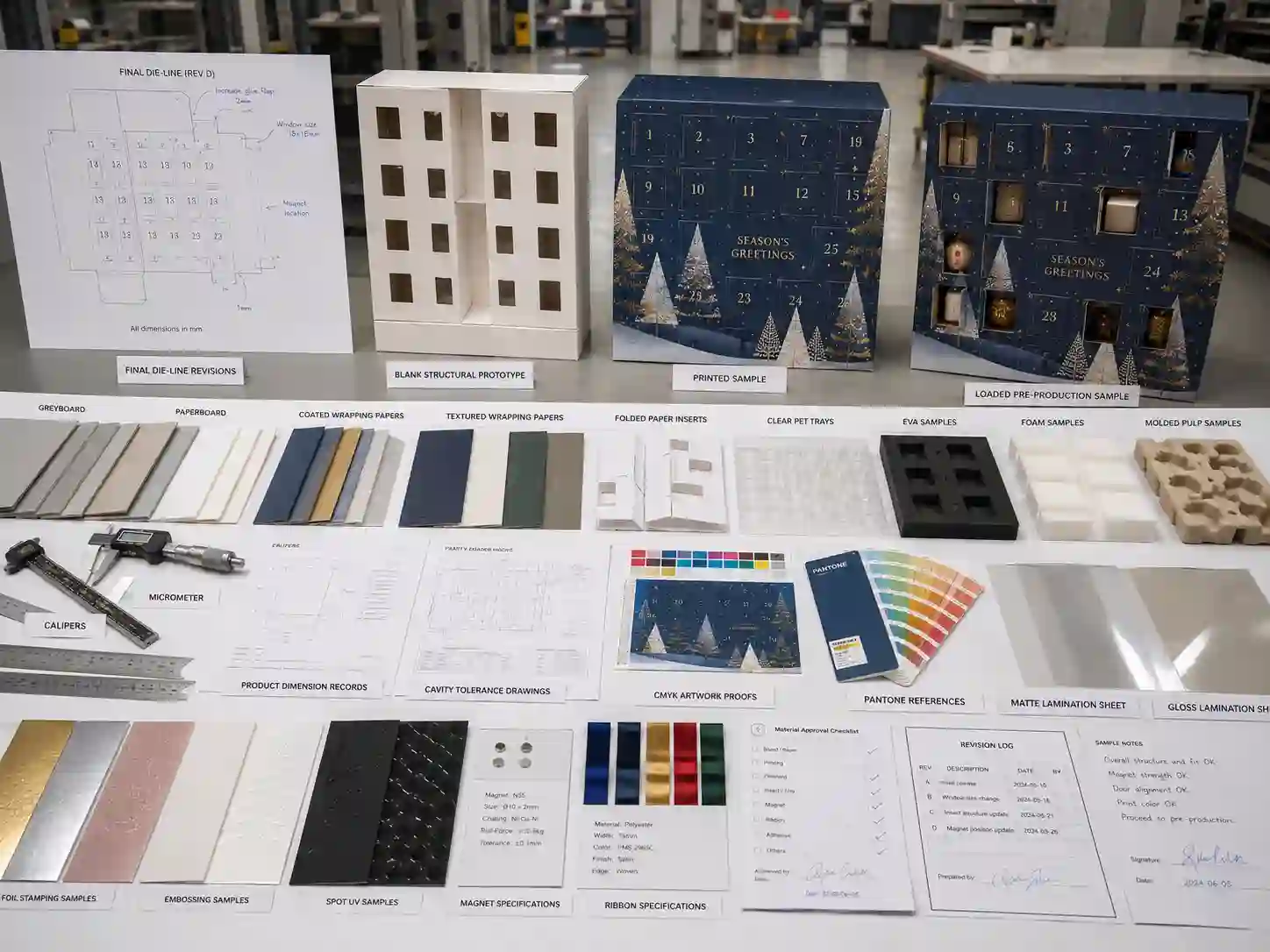
The approved material file should include:
- Final structure name and finished dimensions.
- Greyboard or paperboard grade, thickness, grammage, and intended component.
- Outer wrapping paper, inner lining paper, and visible edge requirements.
- Insert material, thickness, cavity dimensions, and product orientation.
- Magnet, ribbon, pull-tab, window film, hinge, and accessory specifications.
- Approved dieline revision and artwork revision numbers.
- CMYK values, spot colors, physical Pantone references, and color-critical areas.
- Matte lamination, gloss lamination, foil stamping, embossing, debossing, or spot UV details.
- Approved blank sample, printed sample, or pre-production sample identification.
- Assembly tolerances, visual standards, and known limitations accepted by the buyer.
- Export carton, inner protection, pallet, barcode, and shipping-mark requirements.
Giftpackpro’s custom advent calendar box services can be reviewed when buyers need support connecting structural development, materials, sampling, production, and export preparation.
How should printing and surface materials be approved?
Printing should be approved through measurable references rather than a screen image alone. Screen displays, office printers, digital proofs, offset printing, coated papers, and uncoated papers can produce visibly different results.
For ordinary photographic artwork, the buyer should approve the final CMYK file and a contract proof or printed sample appropriate to the project. For brand-critical colors, identify the physical Pantone reference, printing method, substrate, and acceptable tolerance. A Pantone number printed on coated paper will not necessarily look identical on uncoated specialty paper.
What must be checked for special finishes?
Foil stamping requires confirmation of foil color, gloss level, coverage, registration, and behavior over folds or textured papers. Embossing requires agreement on height, depth, backing marks, and whether the board structure can withstand the pressure. Spot UV needs registration control and sufficient contrast with the surrounding surface.
Matte lamination may provide a refined appearance but can show scuffing on dark colors. Gloss lamination can improve wipe resistance but may emphasize reflections and surface imperfections. Soft-touch or specialty coatings should be tested for rubbing, blocking, fingerprint visibility, and compatibility with foil or adhesive areas.
QC tip: Keep one signed color and finish reference at the factory and one with the buyer or inspection team. Final inspection should compare production samples under consistent lighting rather than against a photograph of the approved sample.
Is a material swatch enough, or is a pre-production sample required?
A material swatch is useful for selecting color, texture, thickness, or finish, but it does not prove that all materials will work together in the finished structure. Complex advent calendar boxes should normally be checked through a pre-production sample made as closely as practical to mass-production conditions.
The approval sequence may include:
- Material swatches: Compare paper, board, insert, foil, lamination, ribbon, and accessories.
- Blank structural prototype: Check dimensions, opening method, compartments, insert fit, and assembly logic.
- Printed sample: Check artwork position, color, finishing, wrapping, and visible construction.
- Loaded sample: Test real products, weight distribution, removal, closure, handling, and presentation.
- Pre-production sample: Confirm the final materials and production method before the bulk run.
A prototype may be produced by hand, digital cutting, short-run printing, or sample-making equipment. Buyers should ask which sample elements differ from the planned mass-production process. For example, digitally printed colors, hand-cut PET trays, manually wrapped corners, or substitute greyboard may not reproduce bulk-production results exactly.
Buyers can compare common formats through Giftpackpro’s custom advent calendar box products before selecting a sampling route.
How do material choices affect MOQ, cost, and lead time?
Material choices affect MOQ and lead time through paper purchasing quantities, custom colors, tooling, print setup, finishing setup, insert molds, and assembly complexity. A lower box quantity does not always reduce every material cost proportionally.
Typical cost drivers include:
- Custom-dyed, textured, metallic, or imported specialty papers.
- Thicker greyboard and reinforced rigid-box structures.
- Multiple drawer sizes or compartment constructions.
- Custom PET, molded pulp, EVA, or foam tooling.
- Several foil colors, embossing plates, or spot UV screens.
- Manual wrapping, ribbon fitting, magnet placement, or product-loading labor.
- Material segregation, compliance testing, or documented traceability requirements.
- Low-volume purchasing that does not match standard sheet or roll quantities.
Ask whether the quoted MOQ applies to the finished box, the printed paper, the insert, or a special material. A factory may be able to produce a small quantity of boxes while still requiring the buyer to purchase a larger minimum quantity of custom paper or molded inserts.
Decision guide: Use standard stocked materials when launch timing and cost control are the priorities. Choose custom materials when a distinctive appearance, specific performance, or documented sourcing requirement justifies additional sampling, MOQ, and lead time.
What incoming and in-process material checks should the supplier perform?
The supplier should verify that purchased materials match the approved specification before they enter assembly. QC should also inspect critical characteristics during printing, die cutting, wrapping, insert production, and final assembly rather than waiting until the boxes are complete.
Incoming material inspection
- Board thickness, flatness, moisture condition, stiffness, and visible contamination.
- Paper color, texture, coating, batch consistency, and surface defects.
- PET or foam thickness, density, color, odor, cleanliness, and cavity dimensions.
- Foil, ribbon, magnets, and accessories against approved swatches or samples.
- Material quantity and batch identification against purchasing records.
In-process production control
- Printing color, registration, text clarity, barcode readability, and coating coverage.
- Die-cut dimensions, crease position, perforation strength, and grain direction.
- Greyboard cutting accuracy and component squareness.
- Wrapping alignment, corner quality, glue marks, bubbles, and exposed edges.
- Insert cavity dimensions, locking tabs, product retention, and installation direction.
- Drawer clearance, door gaps, magnet alignment, hinge movement, and closure force.
- Foil stamping, embossing, and spot UV position against approved artwork.
Quotable QC statement: Final inspection cannot repair material errors already built into thousands of assembled boxes. Material identity and critical dimensions must be controlled before and during production.
How should durability be tested with the confirmed materials?
Durability testing should reflect the product load, repeated opening, handling, packing method, and intended distribution route. An empty display sample is not enough when the finished calendar will carry bottles, candles, coffee capsules, confectionery, jewelry, or mixed gifts.
Practical checks include repeated drawer or door opening, loaded lift tests, insert-retention tests, controlled shake tests, surface-rub checks, corner and edge inspection, closure testing, and trial packing into the export carton. Heavy products should be placed in their intended compartments because weight distribution can affect panel bowing and box stability.
For distribution testing, buyers may discuss an appropriate test plan with their supplier or laboratory and review guidance from the official International Safe Transit Association. The suitable test level depends on the actual distribution environment and should not be assumed from a generic packaging claim.
What should buyers confirm for export packing?
Export packing materials should be approved together with the retail box because surface finishes, protruding parts, magnets, ribbons, and rigid corners can be damaged by abrasion or excessive carton movement. The master carton must protect the packaging without creating unnecessary freight volume.
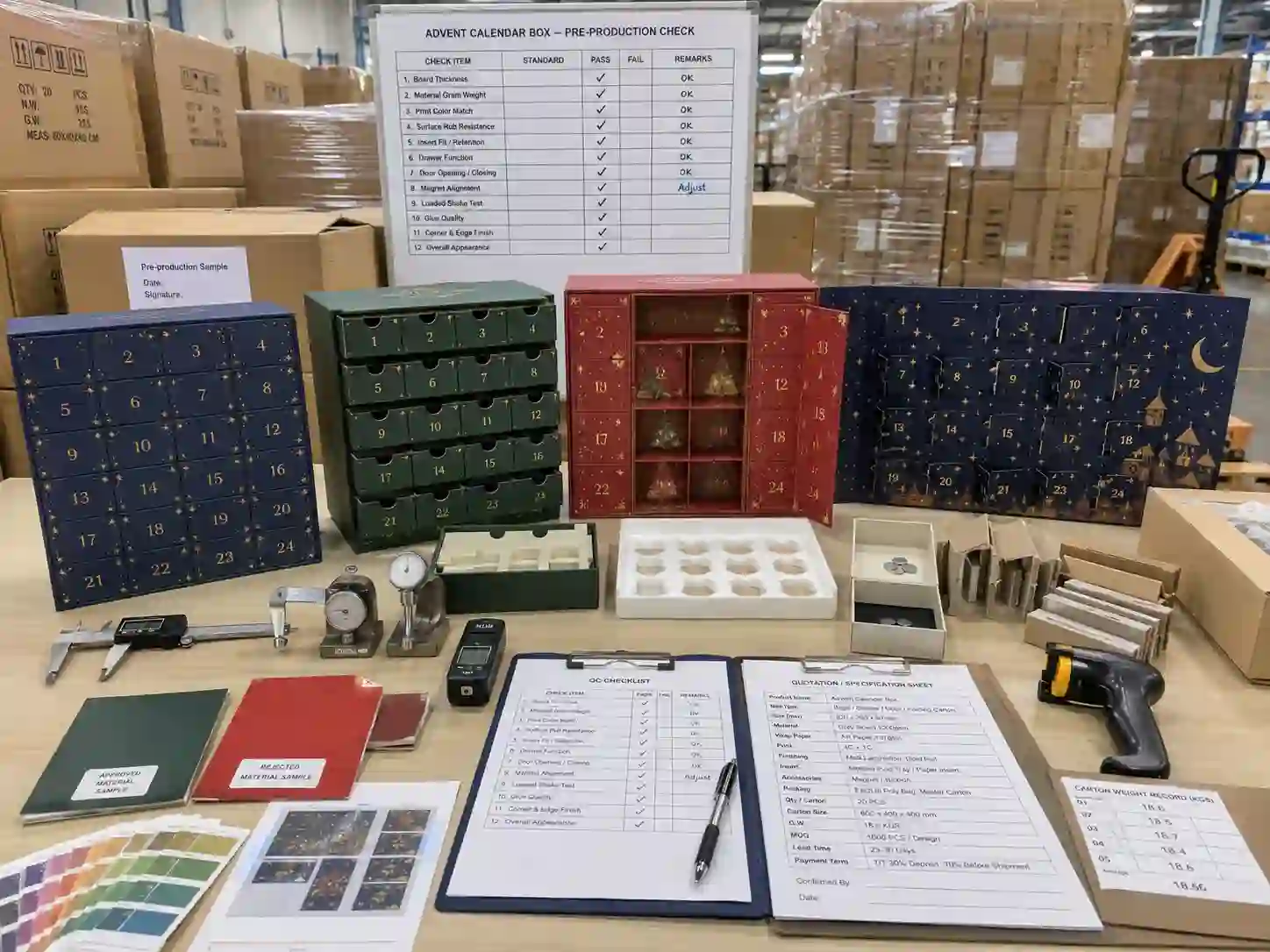
Confirm the following:
- Individual tissue, paper sleeve, polybag, or fitted protective sleeve where required.
- Orientation of each advent calendar inside the export carton.
- Paper dividers, pads, corner protectors, or top-and-bottom cushioning.
- Export carton board grade, dimensions, quantity per carton, and sealing method.
- Gross weight, net weight, carton numbering, SKU, destination, and shipping marks.
- Pallet pattern, maximum stack height, corner boards, stretch wrap, and pallet labels.
- Whether packed cartons will be checked for movement, compression, abrasion, and handling stability.
A large rigid calendar may pass product inspection but still fail in distribution if an oversized export carton allows repeated movement. Conversely, excessive compression can mark matte surfaces, deform doors, or make drawers difficult to open.
How should buyers compare material control between suppliers?
Compare suppliers by the clarity of their specifications and control process, not only by the lowest unit price. A reliable supplier should explain what is included, identify assumptions, show material samples, disclose sample-to-production differences, and maintain approved references for QC.
| Supplier comparison question | Strong response | Warning sign |
|---|---|---|
| How are materials recorded? | Component-level specification linked to dieline and sample revisions | Only general names such as “good cardboard” |
| Can materials be substituted? | No change without documented buyer approval | “Equivalent” materials may be used without notice |
| How is insert fit tested? | Real products, dimensional tolerances, loaded handling tests | Fit judged from photos or one nominal measurement |
| How is color approved? | Physical proof, Pantone reference where needed, signed sample | Approval requested from phone or monitor images |
| What is checked during production? | Incoming, in-process, and final inspection records | Inspection only after all boxes are assembled |
| How is export packing verified? | Trial packing, carton specification, marks, weight, pallet plan | Generic cartons selected after production finishes |
Buyers can also review the capabilities and working process of the Giftpackpro packaging factory and use related advent calendar box buying guides to prepare supplier-comparison questions.
What information is needed for an accurate quotation?
An accurate quotation requires more than the requested quantity and an image reference. Provide enough information for the supplier to calculate materials, printing, tooling, assembly, inspection, and export packing on the same basis.
Prepare this RFQ checklist:
- Box structure or reference format.
- Finished external dimensions and required internal dimensions.
- Product dimensions, weight, quantity, and orientation for every compartment.
- Preferred paperboard, greyboard, wrapping paper, and insert materials.
- Artwork files, color references, and finishing requirements.
- Order quantity and expected repeat-order quantity.
- Required sample type and approval deadline.
- Target mass-production completion date.
- Product-loading responsibility: factory-loaded or buyer-loaded.
- Export destination, packing requirements, pallet requirements, and shipping marks.
- Compliance, documentation, testing, or traceability requirements to be verified.
- Acceptable alternatives when the preferred material affects MOQ or lead time.
Ask the supplier to separate one-time charges such as tooling, molds, printing plates, foil dies, embossing dies, and sample fees from recurring unit costs. This makes alternative structures and future repeat orders easier to compare.
Which material-confirmation mistakes should buyers avoid?
The most common mistakes are approving vague specifications, testing empty packaging, and allowing production to begin before the final sample and artwork revisions are aligned.
- Approving “same as sample” when the sample used substitute materials.
- Confirming board only by grammage and ignoring thickness or stiffness.
- Using nominal product dimensions without manufacturing tolerances.
- Approving insert cavities before testing real products.
- Judging color only from digital screens or emailed photographs.
- Changing artwork after approving foil, embossing, or spot UV positions.
- Failing to record which components may or may not be substituted.
- Ignoring total loaded weight when selecting board and reinforcement.
- Leaving export carton design until after retail-box production.
- Requesting a quotation without dimensions, quantities, finishing, or packing details.
FAQ: Confirming materials for advent calendar box production
Should the buyer approve every material component?
The buyer should approve every component that affects appearance, function, safety, product fit, cost, or compliance. Minor consumables may be controlled by the factory specification, but visible papers, structural boards, inserts, magnets, ribbons, films, finishes, and packing materials should be clearly defined.
Can the mass-production material differ from the sample?
It should not differ without written approval. When a sample uses substitute materials or a different printing process, the supplier should identify those differences before approval and explain how mass production may look or perform differently.
Is a thicker board always better?
No. Board thickness must suit the structure, dimensions, product weight, wrapping process, and freight plan. Excessive thickness may add cost and weight without solving poor reinforcement, inaccurate cutting, or weak assembly.
How many product samples should be sent for insert testing?
Send enough units to represent normal size, shape, and weight variation. For products with variable dimensions, provide the acceptable tolerance range and include both smaller and larger examples.
When should mass production begin?
Mass production should begin after the final dieline, artwork, material specification, sample status, quantity, packing requirements, and production schedule have been approved in writing.
How can buyers prevent unauthorized material substitution?
Identify non-substitutable components in the purchase order, keep signed material references, require written approval for changes, and include material verification in the QC inspection plan.
Prepare your material confirmation package before requesting a quote
To confirm materials for advent calendar box production efficiently, prepare the structure, dimensions, real product samples, insert requirements, preferred board and paper, artwork, colors, finishes, quantity, schedule, and export-packing instructions. Giftpackpro can then review the engineering risks, propose material options, plan the correct sample stages, and prepare a quotation based on defined specifications rather than assumptions.
Send these details through the page to request a custom quote. A complete RFQ helps the factory compare rigid box, drawer box, door-opening box, folding carton, and insert options while identifying cost, MOQ, durability, and lead-time differences before production begins.


