Quick answer: Printed advent calendar box misalignment is usually caused by an inaccurate dieline, artwork positioned without production tolerances, unstable paper or greyboard, inconsistent mounting, incorrect insert fit, or assembly variation. Buyers can reduce the risk by selecting a structure suitable for the artwork, separating critical graphics from cut and fold lines, approving an assembled printed sample, defining measurable alignment tolerances, and checking representative units throughout mass production. The approved sample should confirm not only print position, but also door, drawer, insert, panel, foil, embossing, and closure alignment after the box is fully assembled and loaded.
Misalignment is more than a cosmetic defect. On retail shelves, a shifted graphic can make a premium calendar appear poorly manufactured. In an e-commerce gift set, an off-center logo or mismatched drawer pattern may become highly visible in product photography and customer reviews. For seasonal launches, correcting an alignment problem after mass production can also threaten the delivery schedule.
What does printed advent calendar box misalignment include?
Printed advent calendar box misalignment includes any visible difference between the approved artwork position and the position of graphics, numbers, finishes, doors, drawers, inserts, or panels on the assembled package. The defect may originate in printing, die cutting, mounting, wrapping, gluing, insert installation, or final assembly.
Buyers should distinguish between several alignment problems because each requires a different corrective action:
- Print-to-cut misalignment: Borders, numbers, illustrations, or background blocks do not follow the final cut edge or door opening.
- Print-to-fold misalignment: A graphic crosses a fold incorrectly or appears uneven after a panel is folded.
- Panel-to-panel misalignment: A continuous image does not connect correctly across two doors, covers, drawers, or adjoining panels.
- Finish-to-print misalignment: Foil stamping, embossing, debossing, or spot UV does not register with the printed artwork.
- Component misalignment: Drawer fronts, numbered doors, ribbons, magnets, inserts, or internal trays sit outside their intended positions.
- Assembly misalignment: Printed paper is mounted unevenly on greyboard, or the finished box is not square.
Buyer tip: Ask the supplier to identify the production stage responsible for each defect. A printing-registration problem should not be evaluated in the same way as a hand-wrapping or insert-positioning problem.
Which advent calendar structures have the highest alignment risk?
Structures with repeated compartments, narrow borders, continuous artwork, or multiple assembled components normally require tighter alignment control. A simple folding carton may be easier to register than a rigid multi-drawer calendar with 24 individually wrapped drawer fronts.
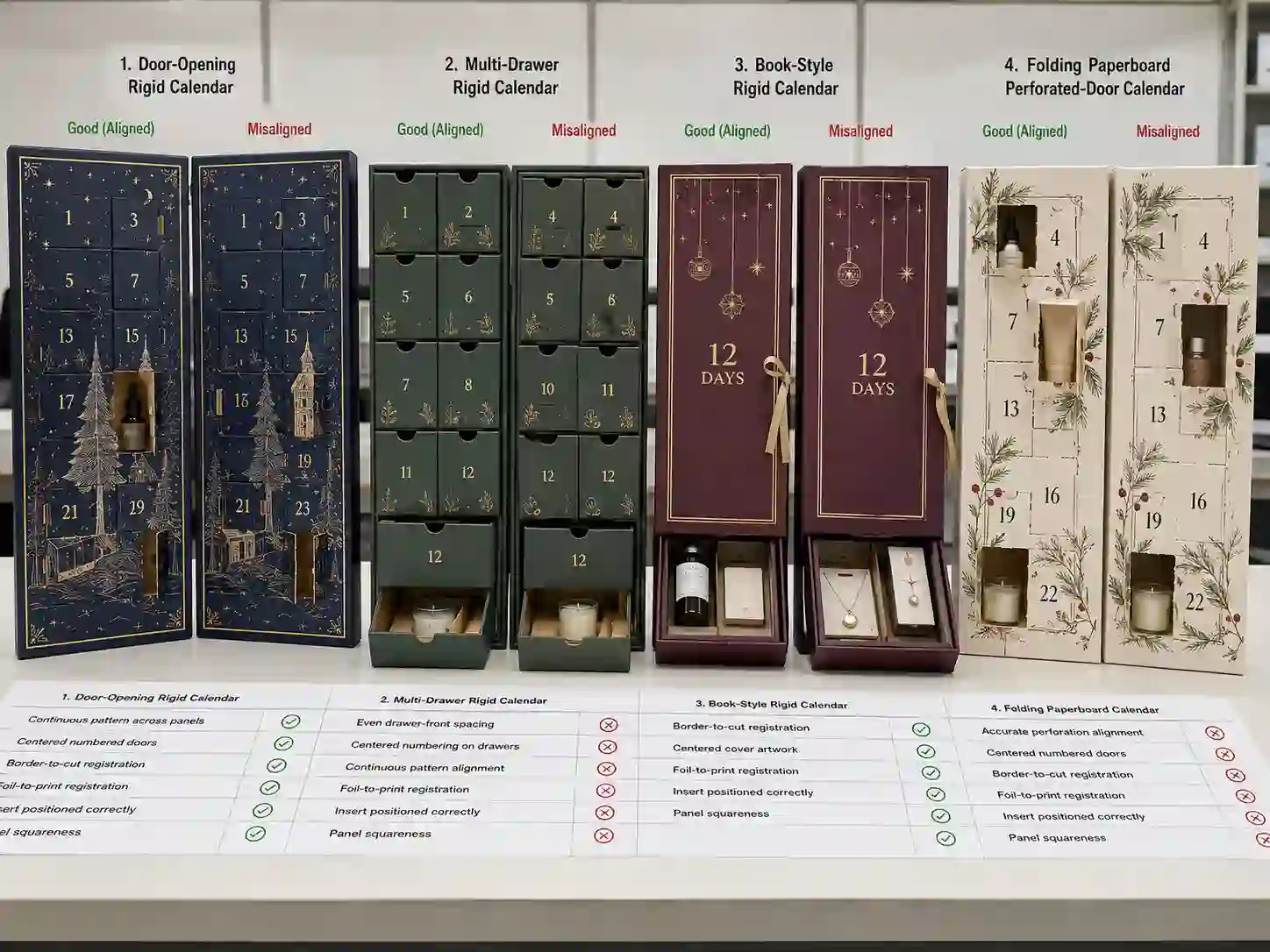
| Structure | Main alignment risks | Recommended buyer controls |
|---|---|---|
| Door-opening folding carton | Numbers shifted from perforated doors, artwork cut by door edges, uneven perforation position | Approve die-cut printed sample; keep numbers and key graphics away from perforations; test all door sizes |
| Rigid door-opening box | Wrapped paper shifts during mounting; door panel and internal cavity do not align | Check mounted panel position, door clearance, wrapping consistency, and loaded product access |
| Multi-drawer rigid box | Drawer-front graphics vary, pattern continuity breaks, drawer gaps appear uneven | Number components during assembly; approve drawer map; inspect rows and columns as a complete set |
| Book-style rigid box | Cover artwork shifts around spine; magnetic closure and inner frame are off-center | Define spine, hinge, and cover tolerances; inspect the closed and fully opened box |
| Hybrid drawer-and-door calendar | Different production methods create inconsistent component positions | Use a master assembly drawing and check every component against common reference points |
When artwork depends on precise continuity, the structure should be evaluated before the design is finalized. A narrow gold border running around 24 doors may look clean on a digital rendering but become difficult to reproduce consistently after printing, die cutting, folding, and assembly.
A custom advent calendar boxes manufacturer should be able to explain where normal production movement can occur and recommend artwork changes before sampling begins.
How should the dieline be prepared to prevent print and cut errors?
The dieline should show cut lines, crease lines, perforations, glue areas, wrapping edges, safe zones, bleed, component numbers, and the orientation of every panel. Artwork should be created on the latest supplier-approved dieline rather than copied from an earlier structure or estimated from finished dimensions.
Important controls include:
- Add sufficient bleed beyond cut edges and perforated doors.
- Keep logos, numbers, small text, borders, and faces of illustrated objects inside a defined safe zone.
- Avoid placing thin frames directly parallel to cut or fold lines unless the supplier confirms the achievable tolerance.
- Mark which artwork must continue across adjacent panels or drawer fronts.
- Confirm whether visible dimensions refer to the flat sheet, wrapped component, or assembled box.
- Lock the dieline layer and prevent accidental scaling during artwork preparation.
- Include a component map for drawers, doors, trays, sleeves, and internal panels.
Factory tip: The artwork file and structural dieline should carry matching revision numbers. A sample produced from dieline version three cannot reliably approve mass production if the final artwork was imposed on version four.
Why are narrow borders particularly risky?
Narrow borders make small production movement visually obvious. A one-millimeter shift may be difficult to notice on a full-bleed pattern but highly visible when a thin line is intended to remain equally spaced around a door or drawer.
For critical borders, buyers can increase the border width, move it farther from the cut line, use a full-bleed background, or replace separate frames with a less registration-sensitive pattern. These changes often improve perceived quality without increasing the material specification.
How do materials and finishes affect alignment?
Paper, paperboard, greyboard, lamination, and specialty finishes can change dimensions or handling behavior during production. Material selection should therefore be included in the alignment review rather than treated only as a strength or appearance decision.
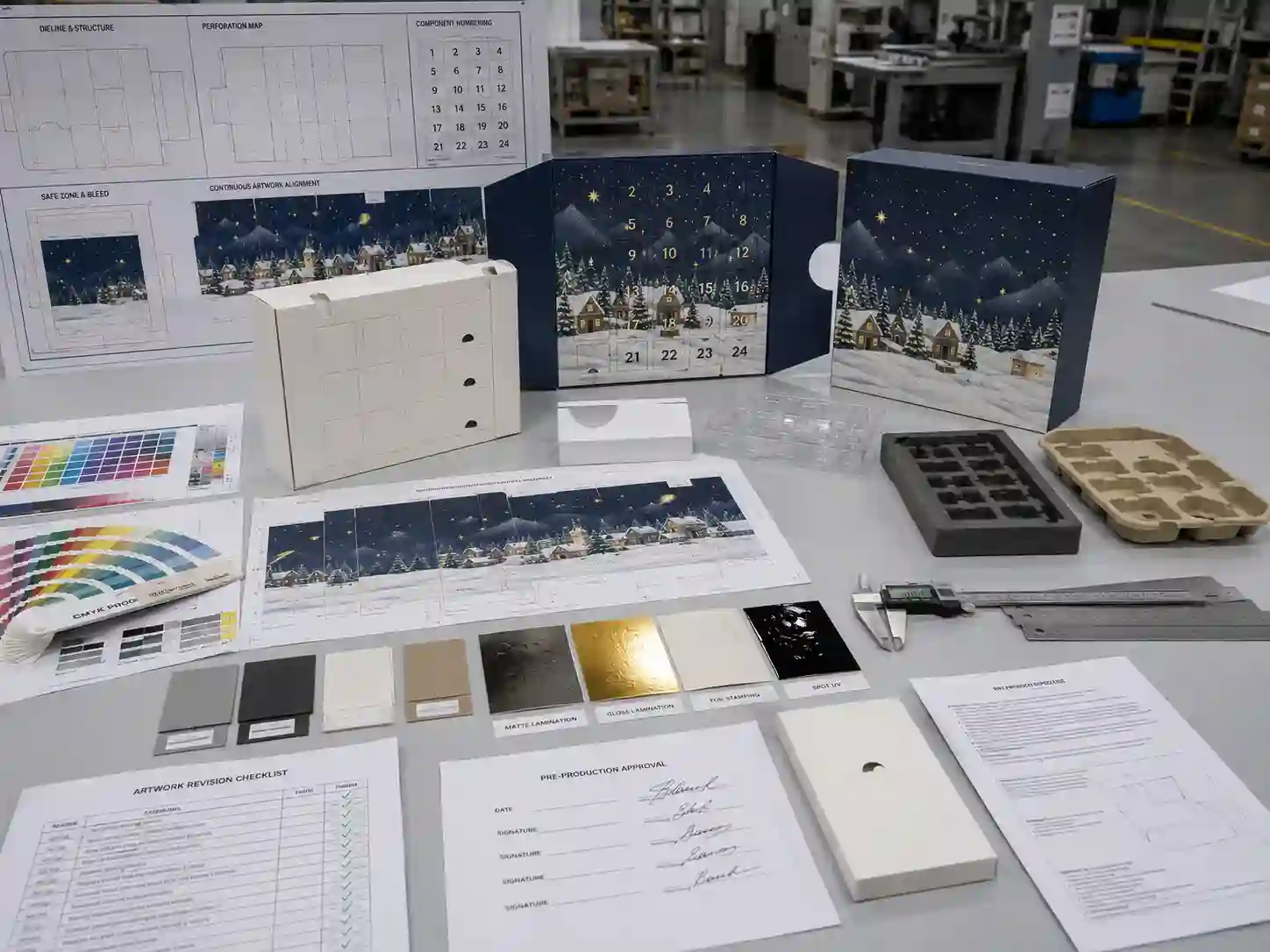
Common material-related risks include:
- Paper expansion or contraction: Moisture and production conditions can affect sheet dimensions between printing, lamination, and die cutting.
- Greyboard variation: Inconsistent cutting or board thickness may change the position of wrapped edges and assembled panels.
- Paper grain direction: Incorrect grain can increase curling, panel distortion, or resistance at folds.
- Lamination tension: Matte lamination or gloss lamination can contribute to curling if material balance is poor.
- Textured or specialty paper: Surface variation can affect printing, foil transfer, and mounting accuracy.
Foil stamping, embossing, and spot UV require separate registration control. The supplier should confirm whether these processes are completed before or after die cutting and how the finishing plate is registered to the printed sheet.
CMYK printing is appropriate for photographic and multi-color designs, while Pantone references can help define important solid brand colors. However, a Pantone target controls color rather than physical position. Buyers should approve both color accuracy and registration accuracy on the sample.
How do inserts contribute to visible misalignment?
An insert can make a correctly printed outer box appear misaligned if products, doors, or drawers do not sit in their intended positions. The insert must locate the products consistently and support the surrounding structure after loading.
For a paper insert, confirm fold accuracy, locking tabs, compartment dimensions, and the position of product openings. For a PET tray, confirm cavity location, flange dimensions, transparency, and movement inside the box. EVA insert and foam insert designs require controlled cutting and secure placement, while molded pulp may require greater dimensional allowance because of its forming characteristics.
Product weight also matters. A heavy bottle placed near one edge can pull an insert out of position, distort a drawer, or create uneven gaps after transport. Product-fit testing should therefore use actual products or dimensionally and weight-accurate samples.
Quotable buyer principle: Insert approval is not complete until the fully loaded insert has been checked inside the assembled printed box.
What should be checked during an insert-fit test?
- Product length, width, height, shape, and weight
- Orientation of labels and visible product faces
- Clearance between the product and door or drawer front
- Resistance to movement when the calendar is tilted or handled
- Ease of product removal without tearing the printed panel
- Insert position after repeated door or drawer operation
- Loaded box flatness, squareness, and closure performance
What samples should buyers approve before mass production?
For alignment-sensitive projects, buyers should approve an assembled printed sample made with production-intent materials and finishes. A digital proof alone can verify text and artwork content, but it cannot prove print-to-cut, panel-to-panel, insert, or assembly alignment.
A practical sampling sequence may include:
- Structural prototype: Confirms dimensions, opening method, compartment arrangement, and basic product fit.
- Digital printed sample: Reviews artwork position, content, approximate color, and visual hierarchy.
- Production-process sample: Uses intended printing, die cutting, wrapping, finishing, inserts, and assembly methods where possible.
- Pre-production sample: Becomes the signed or digitally confirmed reference for mass production and final QC.
During approval, mark acceptable production tolerances instead of relying only on comments such as “keep centered” or “align correctly.” The tolerance should identify the reference point, measurement method, critical components, and acceptance limit agreed with the supplier.
The custom advent calendar box services page can help buyers understand the development steps to discuss before approving a prototype or pre-production sample.
How should alignment be controlled during mass production?
Alignment should be checked at the beginning of production, during production, and after final assembly. Inspecting only finished cartons may identify the problem too late for economical correction.
A useful production control plan includes:
- Verify printing registration and sheet orientation before the full press run.
- Compare die-cut sheets with the approved sample and artwork reference.
- Check foil stamping, embossing, and spot UV registration separately.
- Use positioning jigs or reference guides for repeated rigid-box mounting.
- Number drawer fronts and internal components where sequence matters.
- Inspect the first assembled units before continuing bulk assembly.
- Compare units from early, middle, and late production stages.
- Inspect loaded samples when product weight affects structure or insert position.
QC tip: Alignment inspection should be completed under consistent lighting, with the box placed in a defined viewing position. Visual assessment should be supported by measurements at critical points rather than subjective judgment alone.
Which alignment points should appear on the QC checklist?
- Logo position relative to the front-panel centerline
- Distance between borders and cut edges
- Number position within each door or drawer front
- Continuity of patterns across adjacent components
- Foil, embossing, and spot UV registration
- Drawer gaps and row alignment
- Door position, perforation shape, and hinge direction
- Insert location relative to openings
- Cover, spine, magnet, ribbon, and closure position
- Overall box squareness and panel flatness
How should buyers compare suppliers for alignment-sensitive projects?
Buyers should compare the supplier’s engineering process, sampling detail, production controls, and communication quality—not only the unit quotation. A lower price offers limited value if the supplier cannot control a complex printed structure consistently.
Use this decision guide:
| Supplier question | Strong response to look for | Warning sign |
|---|---|---|
| How will you check artwork against the structure? | Supplier reviews safe zones, bleed, folds, perforations, component orientation, and continuous graphics | Supplier accepts artwork without a technical review |
| What sample will represent bulk production? | Assembled printed sample with intended materials, insert, and finishes | Only a flat proof or rendering is offered |
| How are repeated components positioned? | Component maps, jigs, numbering, and in-process inspections are used | Positioning depends entirely on operator judgment |
| How are tolerances confirmed? | Critical points and acceptance ranges are recorded before production | Supplier gives only a general promise of “good quality” |
| How is bulk QC documented? | Beginning, middle, and end samples are checked against the approved standard | Inspection occurs only after all units are packed |
Buyers can also review the supplier’s experience with comparable custom advent calendar box products, factory capabilities, assembly process, and project communication. Information about the Giftpackpro packaging factory can be used as part of this supplier-evaluation process.
How do MOQ, cost, and lead time relate to alignment control?
MOQ, cost, and lead time are influenced by structure complexity, the number of components, printing method, finishing processes, insert type, and the amount of manual assembly. Tight alignment requirements may also require additional setup, tooling, jigs, inspection, or sorting.
Important cost drivers include:
- Number of individually printed or wrapped drawers and doors
- Rigid greyboard construction versus folding paperboard
- Custom die-cut insert complexity
- Foil stamping, embossing, and spot UV registration requirements
- Continuous artwork across multiple panels
- Manual assembly and component sequencing
- Additional sample rounds or press proofs
- Stricter inspection and defect-sorting requirements
The lowest practical MOQ depends on the structure and production process. Buyers should request quotations at realistic order quantities and ask whether changing the quantity affects printing setup, material purchasing, assembly method, or inspection cost.
Lead time should include artwork checking, sampling, sample revision, material preparation, printing, finishing, die cutting, assembly, QC, and export packing. Seasonal projects should also reserve time for buyer approval and possible corrections before mass production.
Can export packing cause alignment defects after inspection?
Yes. A calendar that passes factory inspection can arrive with shifted drawers, distorted panels, or displaced inserts if the export packing does not control movement and compression. Packing specifications should match the structure, loaded weight, shipping method, and pallet plan.
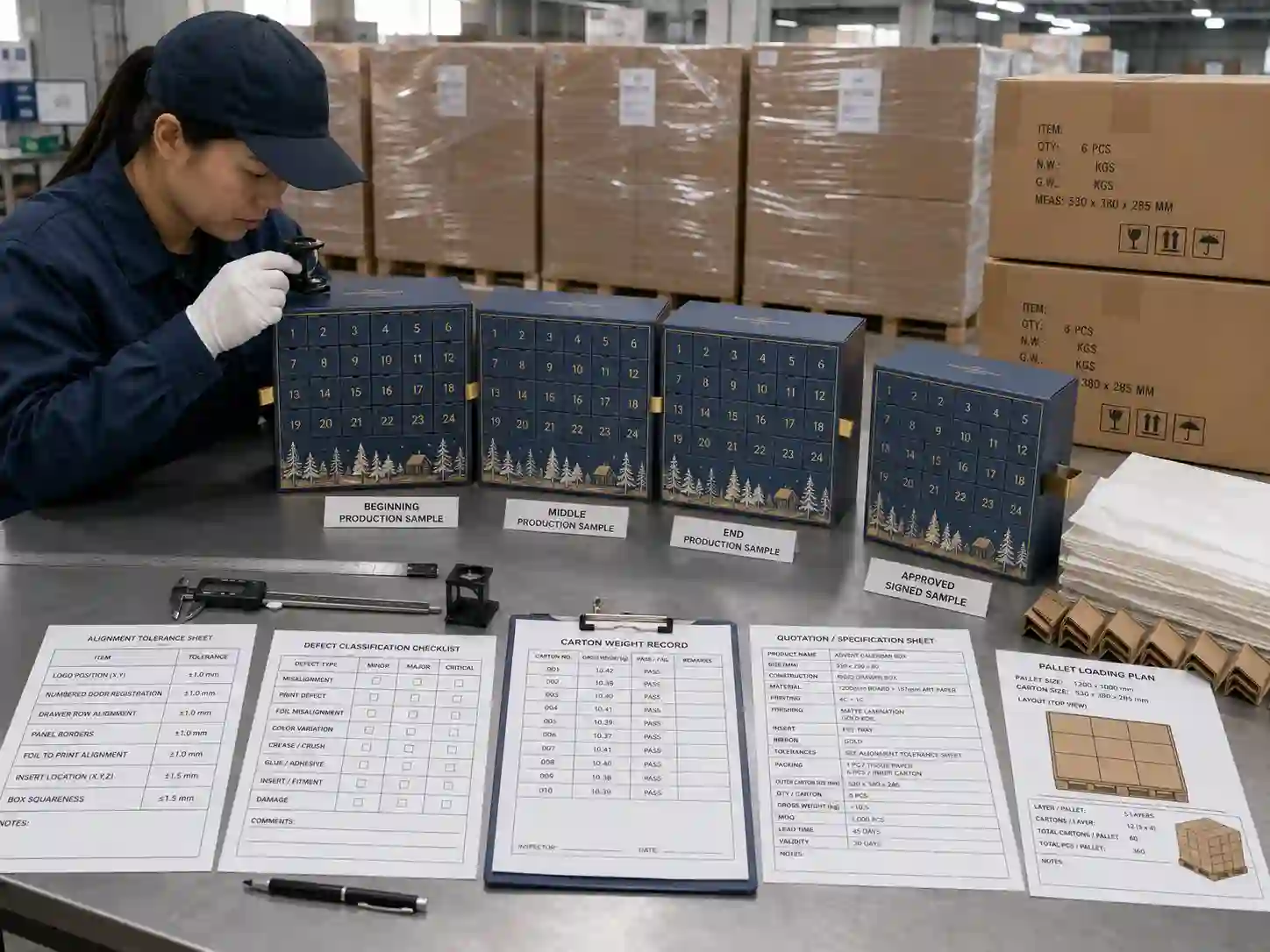
For alignment-sensitive calendars, consider:
- Tissue sheets or protective paper between decorated surfaces
- Paper pads, dividers, or sleeves to prevent component movement
- Corner protectors for rigid boxes
- Correct master-carton strength and internal dimensions
- Controlled carton weight to reduce crushing
- Consistent carton orientation and quantity per carton
- Pallet corner boards, stretch wrap, and stable stacking
- Clear shipping marks, carton numbers, and handling instructions
Transport testing should be considered for high-value, heavy, or e-commerce projects. Buyers can review distribution-test options through the official International Safe Transit Association. For projects using responsibly sourced paper materials, buyers may also verify chain-of-custody claims and sourcing requirements through the official Forest Stewardship Council.
Factory tip: The master carton should restrain the retail boxes without applying enough pressure to bow the front panels or force drawers out of alignment.
What should buyers prepare before requesting a quotation?
A complete RFQ allows the supplier to evaluate alignment risks before calculating the quotation. It also makes supplier comparisons more accurate because each factory is pricing the same structure and quality requirements.
Quotation preparation checklist
- Required finished box dimensions
- Preferred structure: rigid box, folding carton, drawer box, door-opening box, or hybrid
- Number and arrangement of compartments
- Product dimensions, weight, orientation, and fragility
- Preferred insert: paper insert, PET tray, EVA, foam, or molded pulp
- Artwork files or a description of critical graphic positions
- Printing requirements: CMYK, Pantone colors, or both
- Finishes such as foil stamping, embossing, spot UV, matte lamination, or gloss lamination
- Required order quantity and possible repeat quantity
- Target delivery date and destination country
- Retail, e-commerce, promotional campaign, or gift-set application
- Expected sample type and approval process
- Alignment tolerances or critical visual acceptance points
- Export-carton, pallet, barcode, and shipping-mark requirements
Buyers can study additional advent calendar box buying guides before finalizing the RFQ. When the specification is ready, use the request a custom quote page and provide product data, quantity, artwork status, preferred materials, sample requirements, and delivery schedule.
Which common mistakes cause preventable misalignment?
Most avoidable problems begin before mass production. The following mistakes frequently make alignment more difficult or leave suppliers without a measurable approval standard:
- Designing artwork before the final structure and dieline are approved
- Using narrow borders directly beside cut lines or perforations
- Approving a flat proof without checking an assembled printed sample
- Changing product dimensions after the insert sample is approved
- Assuming digital renderings represent production tolerances
- Failing to identify continuous graphics across drawers or panels
- Approving color while ignoring foil, die-cut, and assembly registration
- Using vague instructions instead of measurable critical points
- Allowing mass production to start before sample approval is recorded
- Choosing export packing based only on carton cost
Frequently asked questions about printed advent calendar box misalignment
Can all printed components be aligned perfectly?
No manufacturing process is completely free from variation. The practical objective is to define tolerances that are achievable for the selected structure, material, artwork, finishing, and assembly method. Critical graphics should be designed with those tolerances in mind.
Is a digital sample enough to approve alignment?
A digital sample can help confirm artwork content and general placement, but it cannot fully approve print-to-cut registration, rigid-box wrapping, drawer sequencing, insert position, or finishing registration. Alignment-sensitive orders should use an assembled physical sample.
Which structure is easiest to keep aligned?
A simple folding carton with full-bleed artwork and limited finishing is generally easier to control than a multi-component rigid calendar. However, the best structure depends on product weight, retail presentation, opening experience, campaign positioning, and budget.
Should buyers specify an alignment tolerance in the purchase order?
Yes, critical alignment requirements should be recorded in the approved specification, sample comments, or purchase documentation. The measurement reference and inspection method should also be clear so both parties evaluate the same condition.
Can the insert cause numbered doors to look off-center?
Yes. If the insert shifts or the product pushes against one side, the door opening and product presentation may appear misaligned even when the outer print is correctly positioned. Loaded insert testing is therefore essential.
How early should a seasonal retail project begin?
Start early enough to complete structural development, artwork checking, physical sampling, revision, mass production, QC, export packing, and shipping before the retail or e-commerce launch. More complex rigid, drawer, and heavily finished calendars require more development and assembly time than simple folding cartons.
How can buyers reduce misalignment before placing an order?
The most effective method is to combine packaging engineering, alignment-aware artwork, a fully assembled sample, measurable tolerances, in-process QC, and protective export packing. Printed advent calendar box misalignment should be managed as a complete production-system issue rather than treated only as a printing defect.
Before contacting Giftpackpro, prepare the finished dimensions, product data, structure preference, compartment plan, artwork status, finishes, quantity, delivery date, and critical alignment points. This information allows the factory team to review the dieline, insert, assembly method, sample plan, MOQ, lead time, quality-control requirements, and quotation on the same basis.