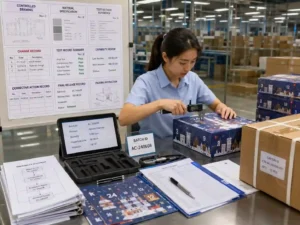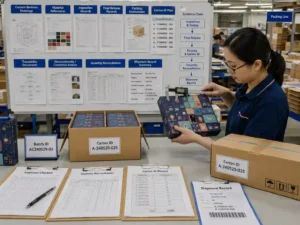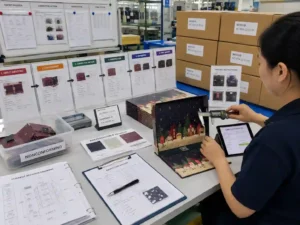
Quick answer: Most advent calendar packaging insert problems begin before mass production because the supplier receives incomplete product data, uses unverified cavity dimensions, or develops the insert separately from the outer box. Buyers can reduce loose products, crushed cartons, blocked drawers, difficult product removal, and shipping damage by providing final product samples, confirming orientation and finger access, testing a loaded prototype, and approving a pre-production sample. The insert, outer structure, artwork, assembly tolerances, and export packing method should be engineered as one packaging system rather than purchased as separate components.
This guide explains how overseas buyers can evaluate insert options, prepare accurate specifications, review samples, compare suppliers, and control quality when sourcing custom advent calendar packaging.
What causes advent calendar packaging insert problems?
Insert failures usually occur when the cavity design does not match the real product, the selected material cannot support the product weight, or manufacturing tolerances are ignored. The issue may appear small during artwork approval but become expensive after product loading or international shipping.
Common problems include:
- Products moving, rotating, or falling out of their intended cavities.
- Cavities that are too tight for efficient manual or automated loading.
- Products that fit but cannot be removed easily by the end user.
- Paper inserts tearing around heavy bottles or irregular accessories.
- PET trays cracking, deforming, or becoming visible through door openings.
- Foam or EVA inserts creating odor, surface marks, or excessive compression.
- Drawer inserts blocking drawer movement or rubbing against the outer sleeve.
- Insert openings failing to align with numbered doors or perforated panels.
- Uneven weight distribution causing the calendar to lean, bow, or open during transit.
- Insert dimensions changing after lamination, folding, gluing, or final assembly.
Buyer tip: A cavity that matches a product’s maximum dimensions exactly is normally too tight. The design must also account for product variation, label seams, caps, protective bags, loading direction, material spring-back, and production tolerances.
Which advent calendar structure is easiest to fit with an insert?
No structure is automatically problem-free. The best option depends on product size, weight, assortment, loading method, opening experience, retail price point, and shipping conditions.
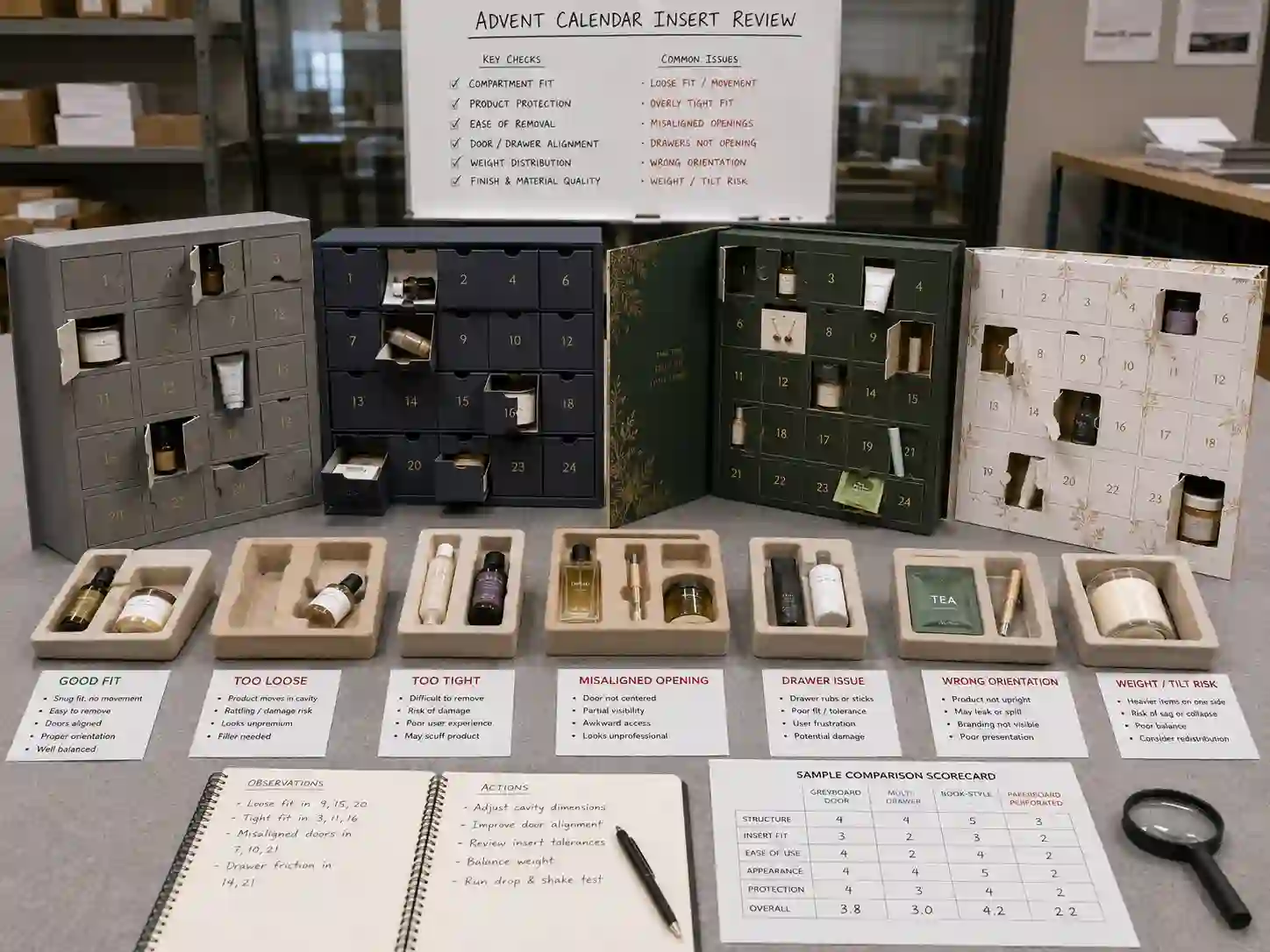
| Calendar structure | Typical insert challenge | Suitable insert options | Best used when |
|---|---|---|---|
| Rigid door-opening box | Door openings must align precisely with cavities, and products must remain close enough to the opening for removal. | Paper insert, PET tray, EVA, foam, molded pulp | The buyer needs a premium presentation with multiple front-opening compartments. |
| Multi-drawer rigid box | Insert thickness and product height can interfere with drawer travel or create friction inside the sleeve. | Paperboard platforms, folded paper inserts, PET trays, EVA pads | Products vary in size or require individual removable compartments. |
| Book-style rigid box | Heavy products can pull against the hinge, distort the internal frame, or make one side significantly heavier. | Paper insert, EVA, foam, PET, molded pulp | A presentation-style opening and strong external structure are priorities. |
| Folding carton with perforated doors | Limited board strength and shallow depth can allow products to shift or press against perforations. | Folded paper insert, paperboard partitions, lightweight PET tray | Lower packed volume, efficient shipping, and cost control are important. |
| Hybrid drawer-and-door calendar | Different compartment systems require separate tolerances and loading checks. | Combination of paper inserts, trays, platforms, and dividers | The assortment includes multiple product formats and a varied opening experience is required. |
A custom advent calendar boxes manufacturer should evaluate the outer structure and insert together. For example, increasing a bottle cavity by 2 mm may require changes to the compartment grid, door dimensions, artwork numbering, and overall box depth.
How should buyers measure products before insert design begins?
Buyers should provide final production products or representative samples and record the maximum length, width, height, weight, orientation, and removal method for every item. Nominal dimensions from a product drawing are not always sufficient.
Measure the complete packed product
Measurements must include the product in the condition in which it will be loaded. A cosmetic bottle may have a shrink sleeve, cap variation, label overlap, protective bag, or tamper seal. A tea sachet may expand after filling. Jewelry cards may bend, while small candles can vary in diameter.
For every compartment, prepare:
- Maximum product dimensions, not only average dimensions.
- Individual product weight.
- Product material and surface sensitivity.
- Required front-facing orientation.
- Whether the item will be placed inside a bag, sleeve, carton, or pouch.
- Acceptable cavity clearance.
- Required finger notch, ribbon pull, push hole, or flexible retaining tab.
- Any restriction on contact materials, odor, dust, or surface abrasion.
Confirm the product loading direction
A cavity can work during hand sampling but fail on a packing line if workers must twist, compress, or force the product into place. The supplier should know whether products will be loaded from the front, top, rear, or into individual drawers.
Factory tip: Loading efficiency should be reviewed during structural sampling. A slightly more complex insert may be justified if it prevents slow packing, incorrect orientation, or product damage during bulk assembly.
Design for product removal as well as retention
Secure retention is only half of the engineering requirement. Buyers should test whether the product can be removed without tearing the insert, damaging the label, or requiring excessive force.
Finger-access features may include semicircular cutouts, side notches, thumb recesses, ribbon pulls, flexible paper tabs, or clearance around the product shoulder. The best choice depends on product shape and the opening available through the door or drawer.
Which insert material should a buyer choose?
The insert material should be selected according to product weight, protection needs, presentation, sustainability targets, tooling budget, order quantity, and packing method. Choosing only by unit price can create higher costs during assembly, rejection, or shipping.

Paper inserts
Folded paperboard inserts are widely used because they can be printed, shipped flat, and integrated with folding-carton or rigid-box structures. They are suitable for lightweight to medium-weight products when folds, locking tabs, bridges, and support walls are engineered correctly.
Paper inserts may fail when the board is too thin, grain direction is ignored, locking tabs open under load, or narrow bridges tear around heavy products. White edges, exposed tabs, and shadow gaps should also be reviewed if presentation is important.
Clear PET trays
PET trays provide consistent molded cavities, good product visibility, and efficient loading. They are often suitable for cosmetic minis, accessories, confectionery packs, stationery, and mixed retail assortments.
Buyers should confirm tray thickness, cavity draft angle, flange dimensions, anti-static requirements, surface finish, and whether the tray is mechanically retained or glued into the box. The thermoforming tool cost should be included in the quotation.
EVA and foam inserts
EVA and foam can provide strong retention and a premium appearance for jewelry, fragrance, glass containers, and higher-value accessories. However, buyers should review density, compression, odor, color consistency, cut-edge quality, lamination, and possible marking on delicate surfaces.
These materials may increase unit cost and packed weight. They can also make product removal difficult if cavities are cut without adequate clearance or finger access.
Molded pulp inserts
Molded pulp can support sustainability-focused packaging and protect products with formed cavities. It is most suitable when the product geometry, quantity, tooling budget, and visual requirements justify a molded solution.
Buyers should review surface texture, color variation, dimensional tolerance, moisture sensitivity, edge strength, and compatibility with the premium appearance expected from the outer box.
How to make the material decision
- Choose a paper insert when shipping efficiency, printability, and moderate protection are priorities.
- Choose a PET tray when consistent molded cavities and fast loading are more important than an all-paper construction.
- Choose EVA or foam when high-value products require strong retention and a premium finish.
- Choose molded pulp when formed protection and fiber-based material positioning justify the tooling and tolerance considerations.
- Use a hybrid insert when one material cannot safely support the complete product assortment.
Buyers with sustainability requirements can ask suppliers to identify paper sources and provide supporting chain-of-custody documentation for verification. Information about responsible forestry claims is available from the official Forest Stewardship Council.
How much clearance should be added around each product?
There is no universal clearance that works for every product and insert material. The correct allowance depends on product variation, cavity shape, loading direction, insert flexibility, surface protection, and production tolerance.
As a practical engineering approach, the supplier should begin with actual product samples, create a tolerance proposal, and validate it through repeated loading and removal tests. A rigid PET cavity may need a different allowance from a flexible paper cradle or foam cutout.
The tolerance review should consider:
- Maximum and minimum product dimensions across production batches.
- Insert cutting, creasing, forming, and assembly variation.
- Outer box and internal frame variation.
- Paper thickness and lamination buildup.
- Whether products will be packed manually or with fixtures.
- Temperature and compression during transportation.
- Whether the product must stay upright, horizontal, or front-facing.
Quotable B2B principle: Insert clearance should be approved as a tested range, not as a single theoretical dimension on a dieline.
How do insert decisions affect artwork and door alignment?
The insert layout controls the visible position of products behind doors, inside drawers, and beneath printed compartment numbers. Therefore, insert engineering must be completed before final artwork is released.
For a door-opening box, the structural dieline should show door cut lines, hinge or perforation direction, safe zones, cavity boundaries, finger-access areas, glue zones, and internal support walls. For drawer boxes, the supplier should confirm drawer-front position, sleeve clearance, pull-tab location, and product height.
Printing and finishing can also affect alignment:
- CMYK artwork should include adequate bleed and safe zones around doors and cut edges.
- Pantone references should be identified when specific brand colors require physical matching.
- Foil stamping, embossing, and spot UV should not cross unstable folds, perforations, or high-pressure insert areas without testing.
- Matte lamination and gloss lamination add surface layers that can influence folding, friction, and component fit.
- Continuous artwork across drawers or doors requires tighter component-position control.
Giftpackpro’s custom advent calendar box services can include structural development, insert planning, artwork checking, sampling, and production preparation so that these elements are reviewed as one project.
What samples are needed before mass production?
Buyers should not approve mass production from a digital rendering alone. At minimum, the project should include a structural prototype and a loaded printed sample using actual or dimensionally accurate products.
Blank structural prototype
A blank prototype checks overall dimensions, compartment arrangement, opening sequence, drawer clearance, door function, insert retention, product loading, and product removal. It is the most efficient stage for structural changes.
Printed sample
A printed sample checks CMYK or Pantone appearance, text position, numbering, foil stamping, embossing, spot UV, lamination, wrapping, and the relationship between graphics and insert openings.
Pre-production sample
A pre-production sample should represent the approved materials, structure, printing, finishing, insert, assembly method, and loaded-product condition as closely as practical. It becomes the reference for mass-production QC.
When reviewing a sample, buyers should:
- Load every product into its assigned cavity.
- Remove every product through the intended door or drawer.
- Open and close all doors or drawers repeatedly.
- Turn the loaded calendar upright, sideways, and upside down.
- Check whether products rotate or migrate.
- Inspect labels and surfaces for scratches or pressure marks.
- Check box squareness and weight balance.
- Pack the sample into the proposed export carton.
- Photograph and document all approved revisions.
Buyers can review additional advent calendar box buying guides before approving the final sample specification.
What insert checks should be included in mass-production QC?
QC should verify cavity dimensions, insert assembly, product retention, product access, door or drawer alignment, and loaded-box performance. Checking only the empty outer box will not identify many insert-related defects.
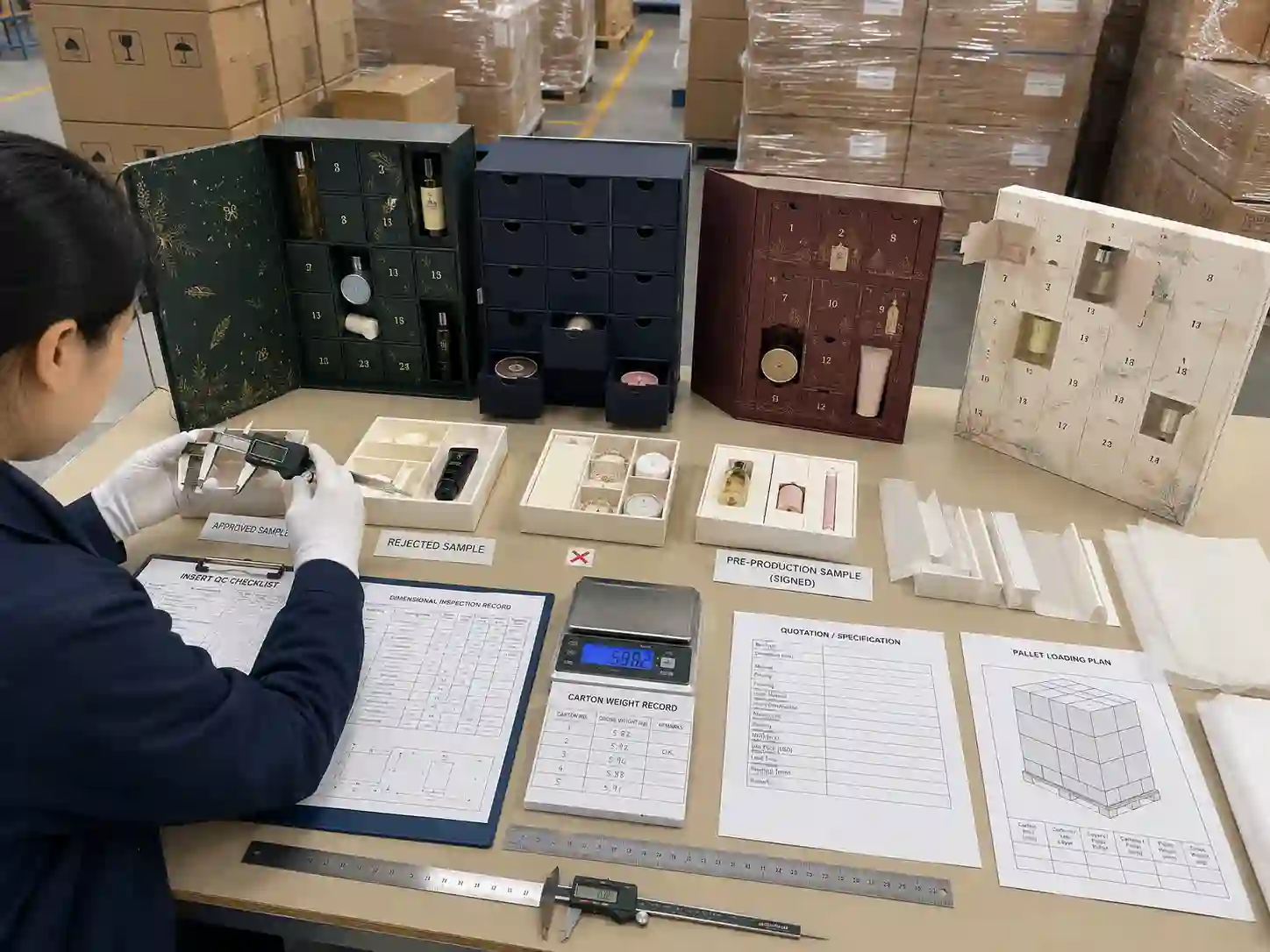
Practical insert QC checklist
- Confirm insert material, thickness, density, color, and surface finish against the approved sample.
- Measure critical cavity dimensions at the beginning, middle, and end of production.
- Check cut edges, creases, locking tabs, formed corners, and glue areas.
- Verify insert orientation inside every box style.
- Confirm cavities align with doors, drawers, and compartment numbers.
- Load representative products from the buyer’s permitted size range.
- Check retention after gentle shaking and orientation changes.
- Check finger access and product removal force.
- Inspect for product scratching, denting, label lifting, or cap pressure.
- Confirm drawers move freely when fully loaded.
- Check that heavy items do not deform internal walls or the outer structure.
- Verify the insert is not visible where the approved design requires a clean presentation.
- Record defects by type, quantity, severity, and corrective action.
QC tip: Keep approved product samples, the signed packaging sample, the latest dieline, and the insert inspection sheet at the production line. Verbal approval is not a reliable mass-production standard.
How should insert performance be tested for export shipping?
Export packing must protect both the outer calendar and the loaded products. A well-fitted insert can still fail if cartons are overpacked, pallets are poorly stacked, or boxes experience excessive compression and vibration.
The buyer and supplier should review:
- Whether calendars will be shipped empty, partially loaded, or fully product-filled.
- Individual protective bags, tissue, paper pads, sleeves, or corner protection.
- Units per export carton and carton gross weight.
- Carton board strength and internal dividers.
- Product orientation inside the master carton.
- Void space that may allow movement.
- Pallet dimensions, stacking pattern, corner boards, and stretch wrap.
- Shipping marks, carton numbering, product codes, and handling symbols.
- Moisture protection required for the shipping route and storage period.
Representative packed-carton testing can be considered when the product value, distribution route, or damage risk justifies it. Buyers can review test procedures and laboratory options through the official International Safe Transit Association.
Quotable B2B principle: The export carton should be specified after the loaded calendar weight and final dimensions are confirmed, not estimated from an early blank prototype.
How do insert choices affect MOQ, cost, and lead time?
Insert cost is influenced by material consumption, tooling, cavity complexity, assembly labor, packing speed, wastage, and inspection requirements. The lowest insert unit price does not always produce the lowest total packed cost.
Important cost drivers include:
- Number of unique cavity shapes.
- Paperboard grade or greyboard thickness.
- PET thermoforming tool and tray thickness.
- EVA or foam density, color, lamination, and cutting process.
- Molded pulp tooling and minimum production volume.
- Number of separate insert components.
- Printing or foil finishing applied to the insert.
- Manual folding, gluing, positioning, or product loading time.
- Required tolerance checks and loaded-product inspections.
- Replacement allowance for rejected components.
MOQ may be determined by the outer box process, printed paper order, tray or molded insert tooling, and efficient production setup. Buyers should ask whether the quoted MOQ applies to one design, one colorway, one insert layout, or the total order across several variations.
Lead time should be separated into structural development, prototype making, artwork approval, material preparation, printing, insert production, box assembly, QC, and export packing. Structural changes made after printed sample approval can restart several of these stages.
How should buyers compare insert suppliers?
Compare suppliers by engineering process and documented control, not only by sample appearance or unit price. A strong supplier should ask detailed product-fit questions before confirming the insert design.
Supplier comparison decision guide
| Evaluation point | Strong supplier response | Warning sign |
|---|---|---|
| Product data | Requests final samples, maximum dimensions, weights, orientation, and packing condition. | Quotes from product photographs without confirming dimensions. |
| Structural development | Coordinates insert cavities, outer box, doors, drawers, and artwork dieline. | Develops the insert and outer box independently. |
| Tolerance planning | Explains proposed clearance and validates it with loading tests. | Uses exact nominal product dimensions as cavity dimensions. |
| Sampling | Offers blank, printed, and pre-production sample stages where appropriate. | Asks for bulk approval from a rendering or flat proof. |
| QC | Defines critical dimensions, inspection frequency, defect categories, and approved references. | Checks only appearance of the empty finished box. |
| Export packing | Calculates carton configuration from final loaded dimensions and weight. | Provides generic carton packing before the final structure is confirmed. |
| Quotation | Separates tooling, sample, insert, finishing, assembly, and packing assumptions. | Provides a low total without explaining specifications or exclusions. |
Buyers can also review the supplier’s production scope, communication process, sampling capability, and quality-control approach. Information about the Giftpackpro packaging factory and available custom advent calendar box products can help procurement teams assess suitable structures before starting an RFQ.
What information should be prepared before requesting a quotation?
A complete RFQ allows the supplier to evaluate the insert accurately and reduces quotation revisions. Product dimensions alone are not enough.
RFQ preparation checklist
- Required calendar structure: rigid box, folding carton, drawer box, door-opening box, book-style box, or hybrid.
- Finished box dimensions or target retail size.
- Quantity and number of artwork versions.
- Product list with maximum dimensions and individual weights.
- Photographs, drawings, or physical samples of every product.
- Required product orientation and opening sequence.
- Preferred insert material or performance requirement.
- Printing requirements, including CMYK or Pantone references.
- Finishes such as matte lamination, gloss lamination, foil stamping, embossing, or spot UV.
- Retail barcode, warning text, recycling marks, or shipping-label areas.
- Whether products will be loaded by the supplier, buyer, or a third-party packer.
- Required sample type and approval deadline.
- Target delivery date and destination country.
- Export-carton, pallet, shipping-mark, and logistics requirements.
- Any material, testing, compliance, or documentation requirements that the supplier must verify.
For a more comparable quotation, ask the supplier to identify the box material, insert material, printing, finishing, tooling, sample cost, MOQ, estimated production lead time, packing method, carton quantity, gross weight assumptions, and quotation validity.
Which insert mistakes should buyers avoid?
The most expensive mistakes are approving the insert before testing real products and changing products after the packaging dieline is finalized.
- Using estimated product dimensions: Final packaging may not fit labels, caps, pouches, or production variation.
- Ignoring removal access: Products may be secure but difficult to take out through small doors.
- Approving an empty sample: Weight, balance, drawer movement, and retention cannot be verified properly.
- Choosing material only by price: Assembly labor, rejects, and shipping damage may outweigh the material saving.
- Finalizing artwork too early: Insert changes may move door openings, numbers, borders, and product positions.
- Using one cavity tolerance for every item: Bottles, sachets, cards, candles, and accessories behave differently.
- Skipping transit-oriented checks: A product may fit on a desk but move after vibration, compression, and repeated handling.
- Comparing incomplete quotations: One supplier may include tooling, assembly, and export packing while another excludes them.
Frequently asked questions about advent calendar inserts
Should buyers send physical products to the packaging factory?
Yes, whenever practical. Physical products allow the factory to confirm maximum dimensions, weight, surface sensitivity, loading direction, retention, and removal. Dimensionally accurate dummy samples may be used during early development, but final products should be tested before mass production.
Can one insert hold products of different sizes?
Yes. A shared insert can use different cavity shapes, raised platforms, retaining tabs, dividers, or multiple layers. However, mixed sizes require careful weight distribution and may increase tooling, material, or assembly complexity.
Why do products become loose after the sample was approved?
Possible causes include product-size variation, insert material changes, die-cutting or forming variation, incorrect assembly, compression during shipping, or approval based on only one sample. QC should define acceptable cavity dimensions and test representative products throughout production.
What is the best insert for heavy glass bottles?
The correct solution depends on bottle shape, weight, fragility, calendar structure, and shipping route. Reinforced paper structures, EVA, foam, PET, molded pulp, or a hybrid system may be considered. A loaded prototype and export-packing test are more reliable than selecting a material by name alone.
Can an all-paper insert replace a plastic tray?
Often, but not always. Paper engineering may use folded walls, bridges, tabs, platforms, and partitions to improve retention. The supplier must test whether the paper structure provides sufficient consistency, loading speed, strength, and product protection.
When should insert design be finalized?
The functional insert should be finalized before the final artwork dieline is released. Minor adjustments may still occur during printed sampling, but major cavity or compartment changes can affect door positions, drawer sizes, graphics, materials, and quotation details.
Does the insert need its own pre-production sample?
The insert should be included in the complete pre-production sample whenever product fit is critical. Buyers should approve the loaded packaging system, not only a separate insert or empty outer box.
Prepare product data before requesting a sample or quote
To prevent advent calendar packaging insert problems, prepare final product dimensions, weights, samples, orientation requirements, preferred structure, quantity, artwork plan, target delivery date, and export-packing expectations. Giftpackpro can then evaluate the cavity layout, insert material, box construction, sampling route, MOQ, lead time, QC points, and quotation assumptions.
Send your product list and packaging brief through the request a custom quote page. The most useful starting package includes one sample of each product, a dimension-and-weight table, reference images, expected order quantity, destination market, and required completion date.