Quick answer: To design influencer gift advent calendar boxes for seasonal campaigns, buyers should start with the campaign channel, gift item list, product sizes, shipping method, retail display plan, and unboxing expectations. The best structure is not only attractive; it must protect mixed products, support content creation, fit e-commerce shipping, and stay realistic for MOQ, sampling, production lead time, and export packing. For B2B purchasing teams, the key decisions are box structure, insert engineering, artwork control, sample approval, QC standards, carton packing, and quotation details before mass production.
What should buyers define before designing influencer gift advent calendar boxes?
Buyers should define the campaign goal, product list, sales channel, shipping route, and launch date before choosing structure or artwork. Influencer gift advent calendar boxes often need to work as PR packaging, retail gift sets, e-commerce bundles, and seasonal promotional kits at the same time.
Unlike a single gift box, an influencer advent calendar usually contains multiple small items in numbered compartments. These may include cosmetic minis, skincare tubes, fragrance sample cards, jewelry cards, candles, stationery, tea sachets, coffee capsules, vouchers, or small accessories. Each item has a different weight, surface finish, fragility, and movement risk. A packaging design that looks good on a screen may fail if the insert does not hold the products during export shipping or if drawers jam after lamination and assembly.
Before asking a supplier for a concept or quotation, prepare a practical brief. It should include the number of days or compartments, product dimensions, product weight, campaign quantity, destination country, shipping method, retail or e-commerce channel, artwork deadline, sample deadline, and expected launch date.
Buyer tip: For influencer seeding campaigns, the first impression matters, but repeatable production matters more. A handmade sample can look perfect, while mass production requires clear dielines, insert tolerances, color standards, and packing instructions.
Which campaign use cases affect the packaging structure?
The right structure depends on how the box will be displayed, shipped, opened, and photographed. A retail shelf campaign may need strong front-facing graphics, while an influencer PR campaign may need a more dramatic unboxing sequence and better product reveal.
| Campaign use case | Recommended structure | Key design priority | Buyer risk to check |
|---|---|---|---|
| Influencer PR seeding | Rigid door-opening box or drawer box | Premium unboxing, product reveal, photo-friendly layout | High shipping damage if inserts are loose or box is too heavy |
| Retail seasonal shelf | Rigid advent calendar or reinforced folding carton | Front panel impact, barcode area, shelf stability | Weak structure may deform under stacking pressure |
| E-commerce gift set | Compact drawer box, book-style box, or mailer-compatible structure | Carton efficiency, drop resistance, product retention | Oversized packaging can increase freight and fulfillment cost |
| Promotional campaign giveaway | Folding carton calendar or paperboard sleeve structure | Cost control, fast assembly, MOQ flexibility | Thin paperboard may not support heavy mixed gifts |
| Wholesale or distributor program | Standardized rigid box with adjustable insert options | Repeatable production, easy SKU planning, export carton efficiency | Too many custom sizes can complicate quotation and lead time |
For buyers comparing custom advent calendar box products, the campaign channel should be discussed before the visual design. A PR calendar sent to influencers may require fewer outer display requirements but more attention to opening sequence, protective insert design, and camera-friendly internal graphics. A retail calendar needs stronger shelf communication, consistent barcode placement, carton labeling, and pallet planning.
Which box structure is best for influencer gift campaigns?
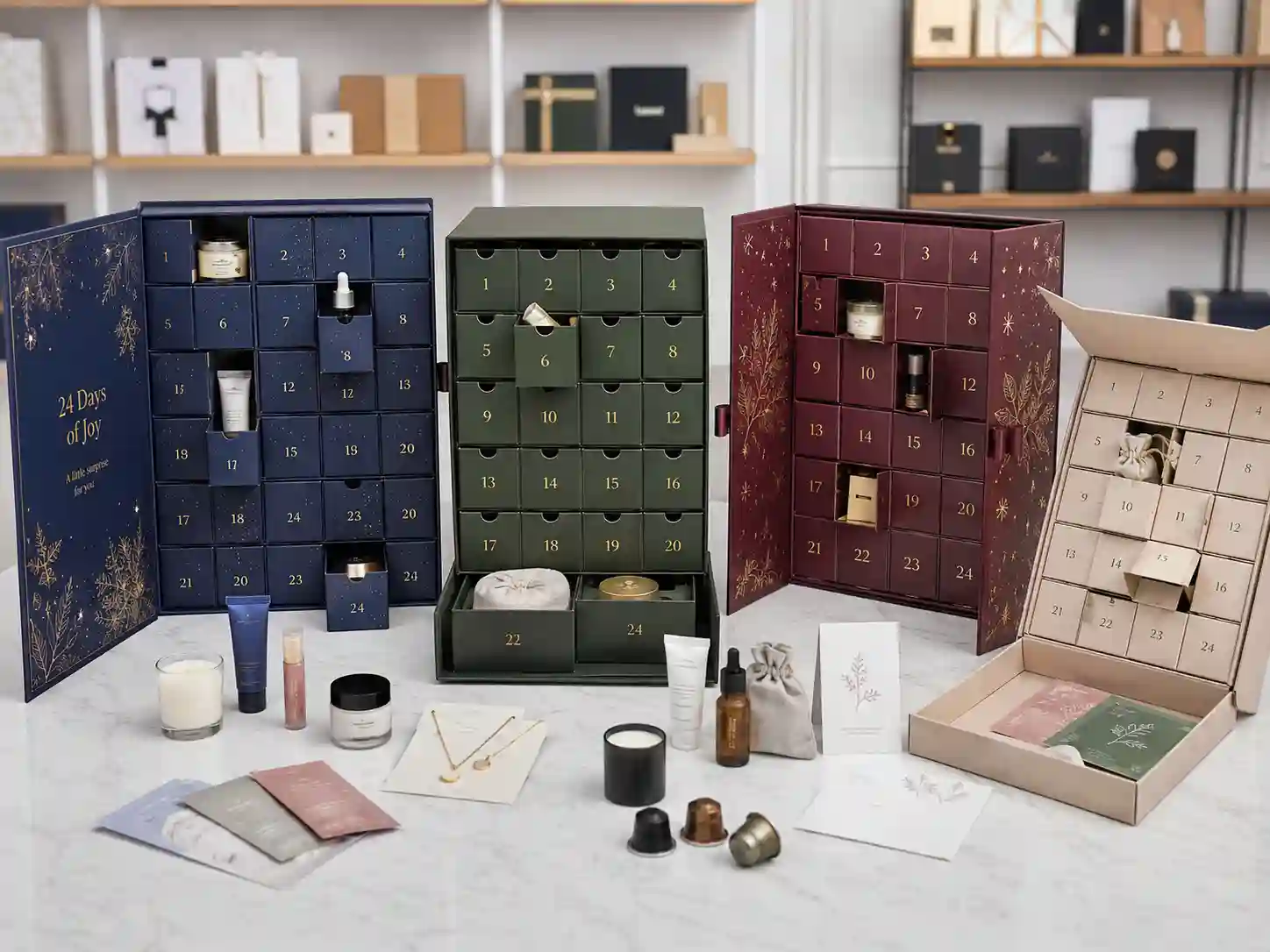
Rigid boxes are usually preferred for premium influencer gifting, while folding carton structures are better for cost-sensitive promotional campaigns. Drawer boxes, door-opening boxes, and book-style rigid boxes each create a different unboxing experience and different production requirements.
When should buyers choose a rigid box?
A rigid box is suitable when the calendar needs a premium look, stronger protection, and a better unboxing experience. It is commonly made with greyboard wrapped by printed paper, specialty paper, or laminated art paper. Rigid construction works well for heavier products, mixed gift sets, and PR kits that must arrive in good condition.
Rigid boxes usually cost more than folding cartons because they require more material, wrapping, assembly, insert fitting, and export packing space. However, for influencer gift advent calendar boxes, the added structure can reduce deformation and improve perceived value.
When does a drawer box work better?
A drawer box works well when the campaign needs daily reveal moments and product separation. Each drawer can hold one or more products, and the outer sleeve can carry main campaign artwork.
The buyer should check drawer sliding tolerance during sampling. Lamination, paper thickness, glue amount, and manual assembly can all affect how smoothly drawers open. If the drawers are too tight, influencers may struggle during filming; if too loose, drawers may shift during shipping.
When is a door-opening box useful?
A door-opening box is useful when the buyer wants a strong front reveal and a retail-friendly display. The inside can use numbered doors, trays, or compartments, while the outside can present seasonal campaign artwork.
Door-opening structures need careful hinge and magnet planning if magnets are used. For export markets, buyers should also confirm whether magnets, metal parts, or special closures create any logistics or compliance concerns.
When can a folding carton be enough?
A folding carton can be enough for lightweight promotional gifts, lower unit costs, and larger campaign quantities. It is usually made with paperboard rather than thick greyboard, so it can be more space-efficient in production and shipping.
Folding cartons are less suitable for heavy candles, glass bottles, dense accessories, or mixed items that require strong separation. If buyers choose folding carton calendars, the insert and outer carton packing become especially important.
How should inserts be engineered for influencer gift advent calendar boxes?
The insert should be designed from real product dimensions, not estimated product categories. For influencer gift advent calendar boxes, insert engineering directly affects presentation, product safety, assembly speed, and the unboxing experience.
Each item should be measured by length, width, height, weight, shape, and surface sensitivity. Tubes, mini bottles, sachets, cards, jewelry pieces, and small pouches behave differently in transit. A product that fits in a sample may still move during export if the cavity is too shallow or if the product center of gravity is not considered.
| Insert type | Best for | Advantages | Points to confirm |
|---|---|---|---|
| Paper insert | Cards, sachets, light accessories, small boxes | Paper-based, printable, cost-efficient, good for flat items | Creasing strength, locking tabs, assembly time, product movement |
| PET tray | Cosmetic minis, tubes, small bottles, mixed gift items | Precise cavities, clear product positioning, efficient loading | Tray thickness, mold cost, cavity tolerance, recycling expectations |
| EVA insert | Premium gifts, jewelry, fragile small products | Good cushioning, clean presentation, strong product holding | Material thickness, cutting edge quality, odor control, cost |
| Foam insert | Fragile samples, bottles, candles, delicate items | Protective cushioning and flexible cutting | Compression, surface marks, export temperature conditions |
| Molded pulp insert | Eco-positioned gift sets and heavier items | Paper-based look, good cushioning, custom molded shape | Tooling, surface texture, drying tolerance, space requirements |
Factory tip: Send real filled products or accurate dummy samples before confirming the insert. Empty bottles, lightweight mockups, or estimated dimensions can lead to wrong cavity depth and poor product retention in mass production.
How should artwork, printing, and finishes support seasonal campaigns?
Artwork should support the campaign message while staying practical for production. Buyers should confirm dieline accuracy, bleed, safe areas, CMYK or Pantone color requirements, barcode placement, numbering, and finish areas before sample production.
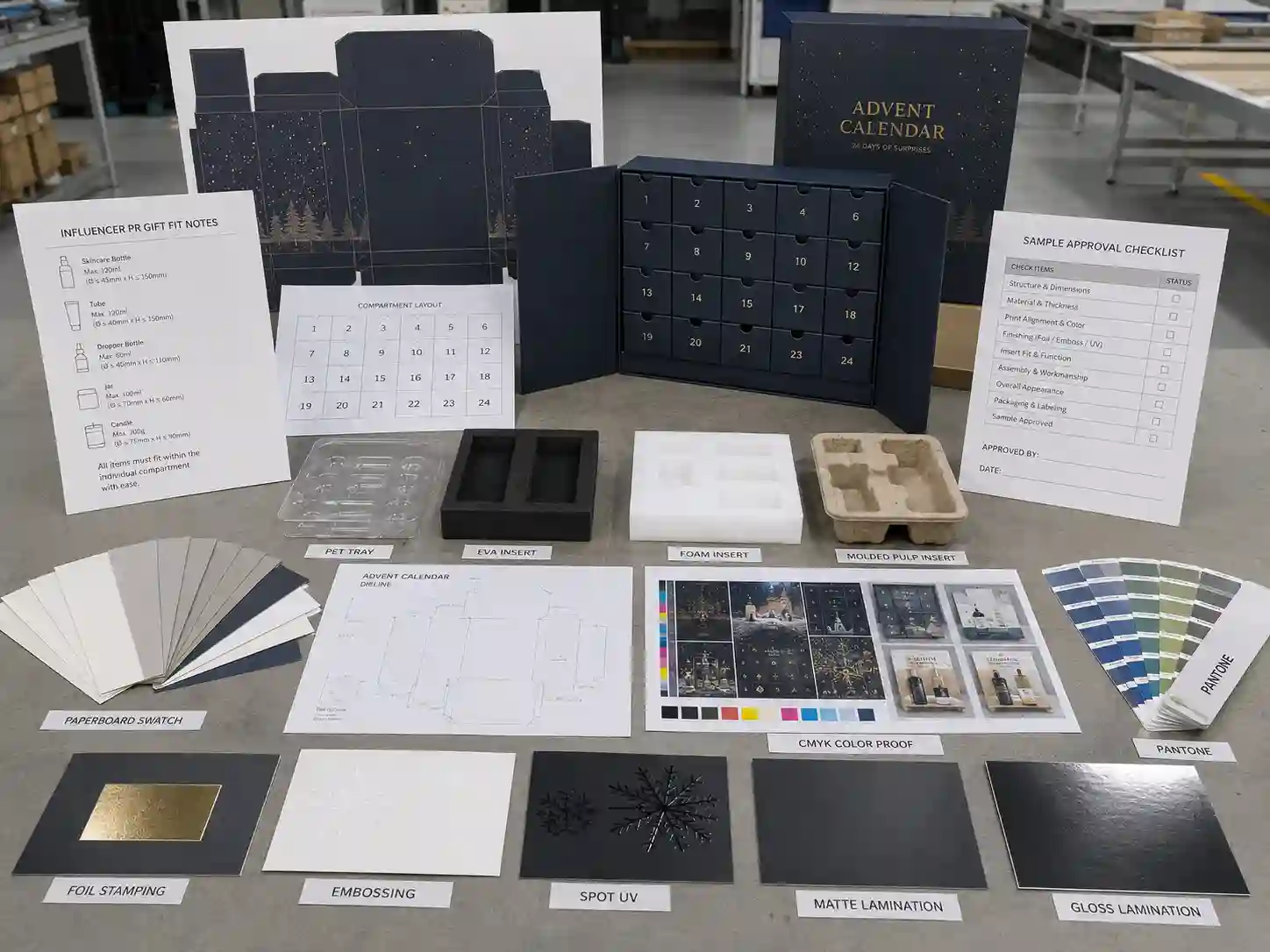
Influencer calendars often use strong visual themes because the package may appear in photos, videos, livestreams, retail pages, or social campaign materials. However, the artwork must still respect manufacturing limits. Doors, drawers, hinges, seams, folds, and insert edges can interrupt graphics if the dieline is not reviewed carefully.
Common printing and finishing choices include CMYK printing, Pantone spot colors, foil stamping, embossing, debossing, spot UV, matte lamination, gloss lamination, soft-touch lamination, and specialty paper wrapping. These finishes can improve the premium look, but they also affect cost, lead time, color matching, scratch resistance, and sample approval.
Foil stamping works well for campaign titles, numbers, or premium accents, but very fine lines may break or fill in. Embossing can add texture, but buyers should check whether the raised area crosses folds or door cuts. Spot UV can highlight icons or product names, but registration tolerance should be reviewed on a printed sample. Matte lamination can look premium but may show scuffs during shipping; gloss lamination can make colors appear brighter but may create glare in photography.
For barcode and retail labeling, buyers can reference official barcode guidance from GS1. For paper sourcing claims, buyers should verify supplier documents and can learn more from FSC if FSC-certified material is required for the project.
What sampling steps should happen before mass production?
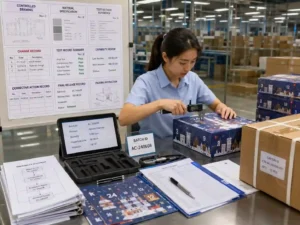
Sampling should prove structure, fit, artwork, opening function, and packing method before mass production begins. A good sample process usually includes dieline confirmation, blank sample, printed sample, and pre-production sample approval.
- Dieline review: Confirm compartment count, product layout, fold lines, cut lines, glue areas, drawer sizes, door sizes, insert dimensions, and barcode label area.
- Blank sample: Check structure, size, insert fit, product loading, opening function, and carton efficiency without final printing.
- Printed sample: Review color, artwork position, numbering, finish effects, lamination, foil stamping, embossing, and overall visual appearance.
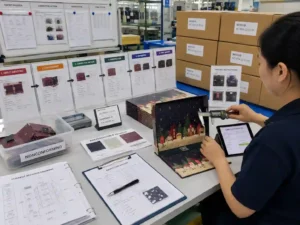
- Loaded sample test: Place real products inside the calendar and simulate handling, drawer movement, door opening, and outer carton packing.
- Pre-production sample: Approve final material, color, structure, insert, finish, and packing method before bulk production.
QC tip: Do not approve mass production from artwork files alone. For influencer gift calendars, the buyer should approve a physical sample with real or realistic product weight, because the insert and structure must work together.
How do MOQ, cost, and lead time affect seasonal campaign planning?
MOQ, cost, and lead time depend on structure complexity, material choice, printing method, insert type, finishing, order quantity, and assembly requirements. Seasonal campaigns should be planned early because sampling revisions and export shipping can take longer than expected.
Rigid influencer calendars usually have higher MOQ and longer production time than simple folding cartons because they require greyboard cutting, printed paper mounting, wrapping, drying, insert making, assembly, inspection, and export packing. PET trays or molded pulp inserts may require tooling, while paper inserts may be faster but less protective for irregular items.
Cost drivers include box size, number of compartments, board thickness, printed area, specialty paper, foil stamping area, embossing tooling, spot UV coverage, drawer count, insert material, manual assembly time, inner protection, export carton strength, and palletization requirements. A small calendar with many drawers can be more labor-intensive than a larger but simpler door-opening box.
| Cost driver | Why it matters | How buyers can control it |
|---|---|---|
| Box size | Larger boxes use more paperboard, greyboard, wrap paper, and carton space | Group products by size and avoid unnecessary empty space |
| Compartment count | More doors or drawers increase cutting, assembly, and QC work | Choose a practical layout based on campaign value, not only day count |
| Insert material | PET, EVA, foam, molded pulp, and paper inserts have different tooling and labor needs | Match insert strength to actual product weight and fragility |
| Printing and finishes | Foil stamping, embossing, spot UV, and lamination add process steps | Use premium effects on key areas instead of covering the full box |
| Assembly method | Manual drawer loading and complex structures increase labor time | Simplify drawer sizes and standardize repeated components |
How should buyers compare suppliers for influencer gift advent calendar boxes?
Buyers should compare suppliers by engineering ability, communication clarity, sample quality, quotation detail, QC process, and export experience. The lowest unit price is not always the lowest total project cost if sampling, damage, delays, or unclear packing instructions create problems later.
A reliable supplier should be able to discuss dieline logic, board thickness, insert options, printing tolerance, sample revisions, production lead time, carton packing, shipping marks, and final inspection. They should also ask practical questions about product size, weight, channel, and campaign timeline instead of quoting only from a reference image.
When reviewing custom advent calendar box services, buyers should look for support across design development, material selection, sample making, production planning, quality control, and export packing. The supplier should help translate campaign goals into manufacturable packaging.
Supplier comparison checklist
- Can the supplier create or check the dieline based on real product dimensions?
- Can they recommend rigid box, folding carton, drawer box, or door-opening box structures based on campaign use?
- Do they explain insert options such as paper insert, PET tray, EVA insert, foam, and molded pulp?
- Do they provide blank samples, printed samples, and pre-production samples when needed?
- Do they explain CMYK, Pantone, lamination, foil stamping, embossing, and spot UV limitations clearly?
- Do they include export carton, pallet, shipping marks, and carton label requirements in the discussion?
- Do they provide a detailed quotation rather than a vague unit price?
- Do they understand retail shelf, e-commerce shipping, influencer PR, and seasonal launch timelines?
What QC checks matter before export shipment?
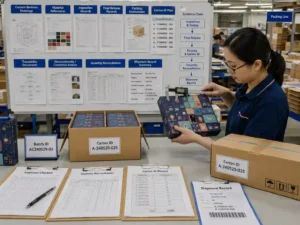
QC should check structure, printing, insert fit, product loading, function, appearance, carton packing, and labeling before shipment. For influencer gift advent calendar boxes, small defects can become highly visible because the package may be filmed, photographed, or reviewed publicly.
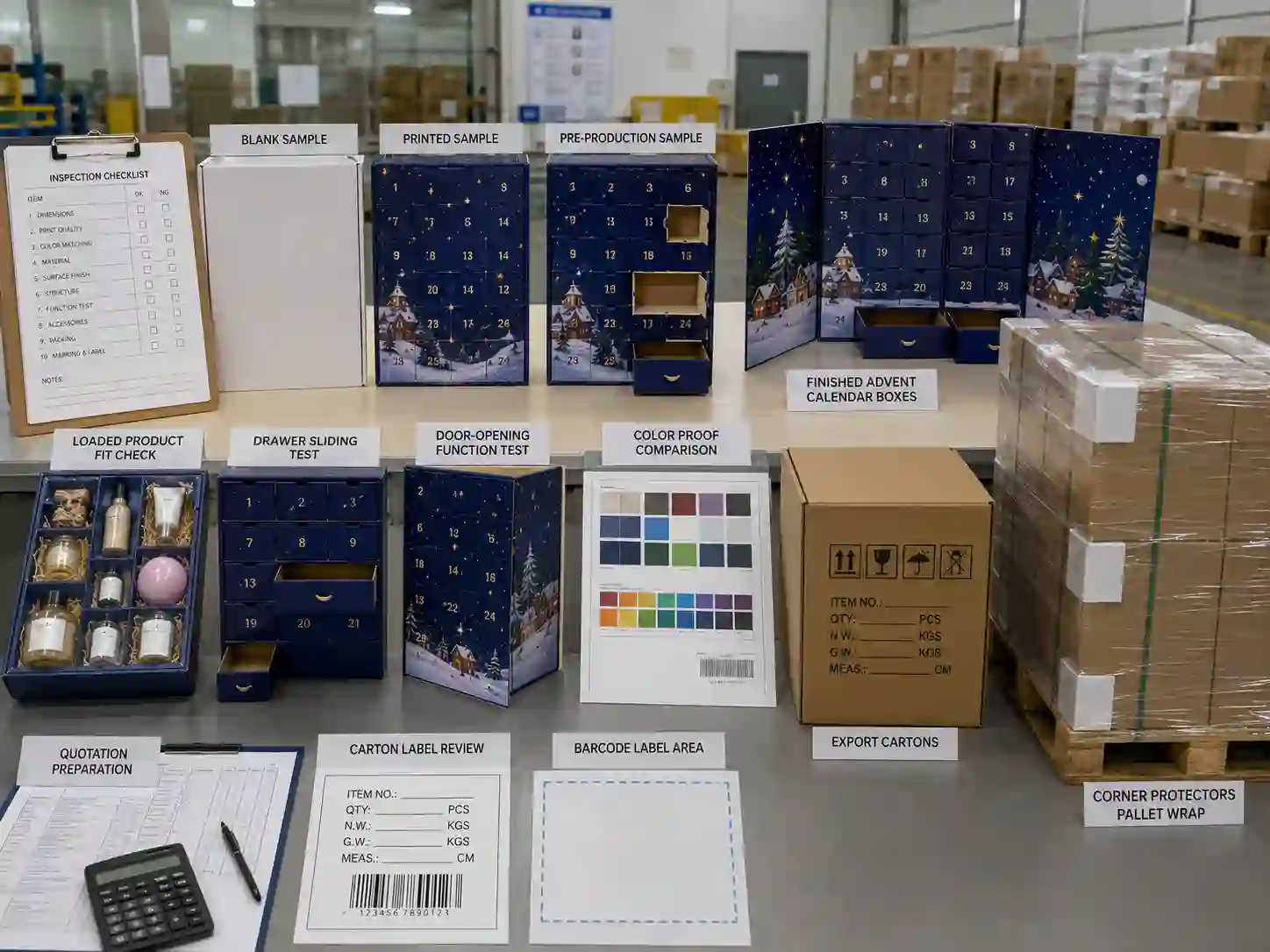
Important inspection points include box dimensions, board thickness, color consistency, lamination condition, foil position, embossing depth, door perforation, drawer sliding, glue strength, insert fit, compartment numbering, barcode area, carton label accuracy, and shipping mark consistency. If the calendar includes mixed product weights, the loaded sample should be checked for movement after handling.
Export packing should be planned before mass production, not after finished goods are ready. Buyers should confirm whether the boxes ship flat, semi-assembled, or fully assembled. Rigid influencer calendars often ship assembled, which protects the structure but increases carton volume. Folding carton calendars may allow more efficient packing but require careful assembly control.
Common export packing details include inner polybag or tissue protection, corner protectors, divider boards, master export cartons, carton drop resistance, pallet wrapping, pallet height limits, shipping marks, barcode label area, and destination warehouse requirements. If the product will move through e-commerce fulfillment, carton strength and label placement should be discussed early.
Decision guide: Which design route should your campaign choose?
The best design route depends on campaign value, quantity, product weight, shipping method, and launch schedule. Buyers can use the following guide before requesting a sample or quotation from a custom advent calendar boxes manufacturer.
| Buyer situation | Recommended route | Why this route works |
|---|---|---|
| Premium influencer PR kit with mixed beauty, candle, or jewelry items | Rigid door-opening box with PET, EVA, foam, or mixed insert system | Creates strong presentation and better protection for varied products |
| Retail seasonal gift set with front-facing display needs | Rigid calendar or reinforced folding carton with clear barcode zone | Balances shelf impact, structure, and retail labeling requirements |
| E-commerce bundle shipped directly to customers or influencers | Compact rigid drawer box or mailer-compatible calendar with strong export carton | Reduces movement risk and supports fulfillment handling |
| Large promotional giveaway with lightweight items | Folding carton with paper insert | Controls cost and supports higher-volume campaign distribution |
| Campaign with tight artwork approval schedule | Simpler structure with fewer finishes and faster sample loop | Reduces production risk and helps protect launch timing |
What information should buyers prepare before requesting a quotation?
Buyers should prepare product details, structure preferences, artwork requirements, quantity, destination, packing needs, and timeline before requesting a quotation. A clear RFQ helps the factory provide a realistic price, sample plan, MOQ, and lead time.
For a faster and more accurate response from Giftpackpro, prepare the following before you request a custom quote:
- Project name and campaign type: influencer PR, retail shelf, e-commerce gift set, wholesale program, or promotional launch.
- Quantity range and expected repeat order potential.
- Number of compartments, product list, and daily gift arrangement.
- Product dimensions, weight, fragility, and whether real samples can be sent.
- Preferred structure: rigid box, folding carton, drawer box, door-opening box, book-style box, or open to factory recommendation.
- Insert preference: paper insert, PET tray, EVA insert, foam, molded pulp, or mixed insert design.
- Artwork files, dieline if available, CMYK or Pantone color needs, and finish requirements.
- Retail needs such as barcode area, label position, shelf display direction, and outer carton information.
- Export details including destination country, shipping method, pallet requirements, and shipping marks.
- Target dates for sample approval, mass production, shipment, warehouse arrival, and campaign launch.
Buyer tip: A complete RFQ should ask for unit price, sample cost, mold or tooling cost, MOQ, lead time, packing method, carton size, estimated gross weight, payment terms, and validity period. This makes supplier comparison more accurate than comparing unit price alone.
What common mistakes should buyers avoid?
Most packaging problems happen when buyers approve visuals before checking structure, insert fit, production tolerance, or export packing. Influencer campaigns can be especially risky because the final box must look good and survive handling before it appears on camera.
- Choosing structure from appearance only: A beautiful drawer concept may fail if the drawer tolerance is too tight after lamination and assembly.
- Using estimated product sizes: Even a few millimeters can affect insert fit, door closing, and carton packing.
- Ignoring product weight: Heavy candles, bottles, or accessories may need stronger greyboard, reinforced corners, or deeper cavities.
- Adding too many finishes: Full-area foil, embossing, and spot UV can increase cost, sample time, and registration risk.
- Approving only digital proofs: Physical samples are needed to check color, function, insert fit, and real handling.
- Forgetting export packing: A premium box can still arrive damaged if the master carton, corner protection, or pallet plan is weak.
- Starting too late: Seasonal launch calendars need time for design, sampling, revision, production, QC, and international shipping.
FAQ: Buyer questions about influencer gift advent calendar boxes
Are influencer gift advent calendar boxes different from retail advent calendar boxes?
Yes. Influencer gift advent calendar boxes usually focus more on unboxing sequence, photography, product reveal, and shipping protection for PR delivery. Retail advent calendar boxes also need stronger shelf communication, barcode placement, display orientation, and carton labeling for store or warehouse handling.
What is the best material for a premium influencer calendar?
For premium campaigns, greyboard rigid boxes wrapped with printed or specialty paper are often preferred. Paperboard folding cartons can work for lightweight or cost-sensitive campaigns, but buyers should check whether the structure can support the product weight and shipping route.
Should buyers choose paper insert, PET tray, EVA, foam, or molded pulp?
The insert should match the product. Paper inserts suit light and flat items, PET trays suit precise cavities for mixed small products, EVA and foam suit premium or fragile items, and molded pulp can support paper-based positioning with cushioning. Many projects use a mixed insert system.
How many samples are needed before production?
Many B2B projects need at least a blank sample and a printed sample. Complex influencer gift calendars may also need a loaded sample and a pre-production sample before mass production to confirm structure, artwork, insert fit, finishing, and packing method.
What affects the MOQ of custom advent calendar boxes?
MOQ is affected by material purchasing, printing setup, tooling, insert type, structure complexity, and factory production planning. A simple folding carton may have a different MOQ from a rigid drawer calendar with PET tray tooling and multiple finishing processes.
How early should buyers start a seasonal campaign project?
Buyers should start early enough to allow for product measurement, dieline design, blank sample, printed sample, revisions, pre-production approval, mass production, QC, export packing, and international shipping. The more complex the structure and insert, the more planning time is needed.
How can Giftpackpro support seasonal influencer gift packaging projects?
Giftpackpro supports overseas brands, wholesalers, gift companies, retail buyers, purchasing teams, and packaging distributors with custom advent calendar development for seasonal campaigns. Buyers can review more advent calendar box buying guides, learn about the Giftpackpro packaging factory, compare available structures through custom advent calendar box products, and use custom advent calendar box services to move from concept to sample and production.
To design influencer gift advent calendar boxes successfully, prepare product dimensions, product weights, campaign channel, structure preference, insert requirements, artwork files, quantity, destination, packing rules, and launch timeline before requesting a quotation. A clear brief helps the factory recommend the right box structure, insert system, sample route, QC plan, export carton method, and lead time for your seasonal campaign.