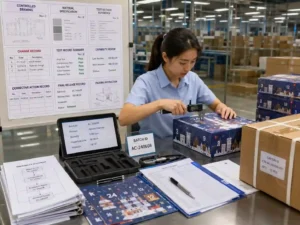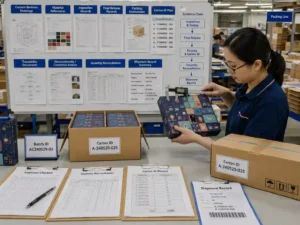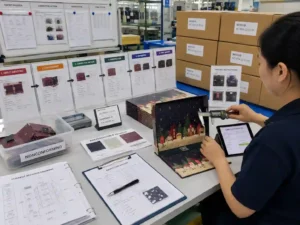
Quick answer: Influencer gift advent calendar boxes should be planned around product fit, unboxing sequence, insert protection, print consistency, shipping strength, and campaign deadlines. For B2B buyers, the best result usually comes from confirming the product list first, then choosing a rigid box, drawer box, door-opening box, or folding carton structure, followed by insert testing, dieline approval, artwork proofing, pre-production sample confirmation, QC standards, and export-packing details. A reliable supplier should help you compare cost, MOQ, lead time, material options, sampling risks, and shipping protection before mass production begins.
Influencer seeding campaigns create different packaging requirements from normal retail gift sets. The box must protect many small products, create a controlled reveal order, photograph well, open smoothly on camera, and still survive international export shipping. For overseas brands, wholesalers, e-commerce sellers, and purchasing teams, influencer gift advent calendar boxes are not only presentation packaging; they are campaign assets that need engineering, production control, and quotation clarity.
This buying guide explains the structure, inserts, materials, printing, sampling, QC, export packing, and quotation decisions that matter before you ask a custom advent calendar boxes manufacturer for a sample or bulk price.
What should buyers confirm before choosing influencer gift advent calendar boxes?
Buyers should confirm the product list, campaign purpose, shipping route, target quantity, artwork status, and required delivery date before choosing a structure. These details decide the box size, insert material, paperboard strength, printing process, MOQ, sample method, and final quotation.
An influencer PR calendar often carries mixed products such as cosmetic minis, skincare tubes, fragrance sample cards, jewelry cards, stationery items, candles, tea sachets, coffee capsules, or small accessories. Each product may have different height, weight, fragility, and leakage risk. If the supplier receives only a general idea such as “24 small gifts,” the first quotation may be inaccurate because the structure and insert cannot be engineered properly.
Buyer tip: A good RFQ should not start with box dimensions only. It should start with product dimensions, weight, product order, required compartment count, campaign date, and whether the box will be shipped empty, loaded, flat packed, or fully assembled.
- Product list with length, width, height, and weight for each item
- Number of compartments, such as 12, 24, 25, or a custom count
- Expected box style, such as drawer box, door-opening box, book-style rigid box, or folding carton
- Insert preference, such as paper insert, PET tray, EVA insert, foam, or molded pulp
- Artwork status, including dieline readiness, CMYK files, Pantone colors, logo effects, and barcode area
- Sample deadline, bulk delivery deadline, and launch date
- Export packing method, pallet requirement, carton marks, and destination market
Which box structure is best for influencer PR campaigns?
The best structure depends on product weight, unboxing style, budget, and shipping method. Rigid boxes are better for premium influencer kits, drawer boxes are good for controlled reveal experiences, door-opening boxes work well for numbered calendar layouts, and folding cartons are suitable for lighter promotional campaigns.
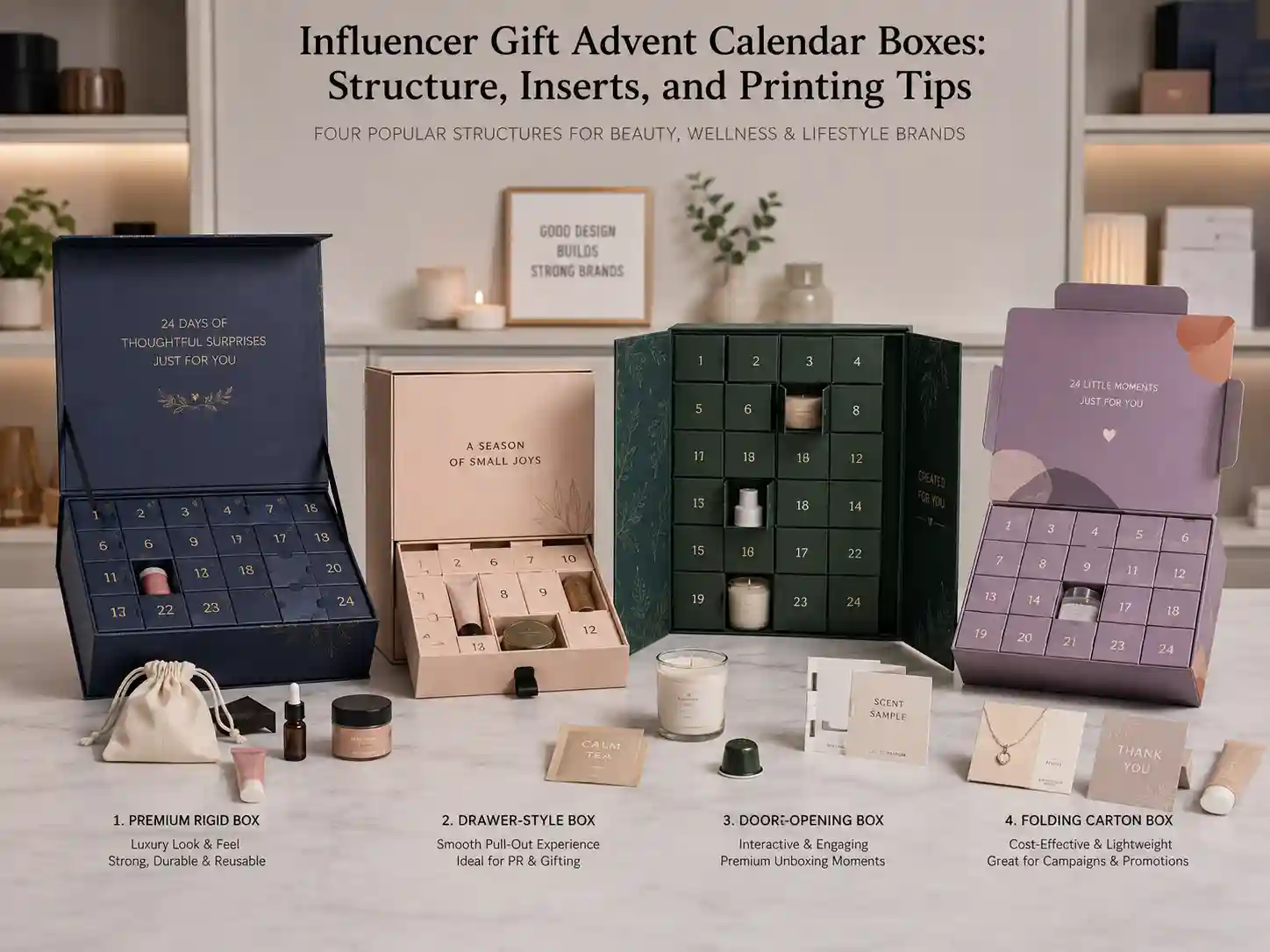
| Structure option | Best use case | Key advantage | Buyer risk to check |
|---|---|---|---|
| Rigid box advent calendar | Premium beauty, jewelry, candle, or creator PR gift campaigns | Strong appearance, good shelf impact, premium opening feel | Higher unit cost, larger export volume, longer production time |
| Drawer box | Influencer unboxing videos where each item should slide out smoothly | Good interaction, reusable feel, clear numbered sequence | Drawer tolerance must be tested after printing, wrapping, and loading |
| Door-opening box | Classic numbered advent calendar layout with daily reveal panels | Strong visual impact and easy compartment storytelling | Door perforation, hinge strength, and insert alignment must be controlled |
| Folding carton calendar | Lightweight promotional gift campaigns and larger MOQ orders | Lower material cost and more efficient packing | May need extra reinforcement for heavier or fragile products |
| Book-style magnetic box | High-value influencer gift sets and press kits | Premium presentation and strong front-cover branding | Magnet position, greyboard thickness, and closure alignment must be approved |
A rigid box made from greyboard wrapped with printed paper usually gives the most premium look, but it may not be the most economical for every campaign. A folding carton can be a better choice when the products are light, the budget is tight, and the campaign quantity is high. A drawer box can be very attractive for video content, but the supplier must control the drawer gap, paper wrapping thickness, and insert friction so the drawer does not jam.
Factory tip: For influencer gift advent calendar boxes, the structure should be tested with loaded products, not empty compartments. A drawer that works smoothly when empty may become tight after insert deformation, product weight, or paper wrapping tolerance is added.
How should inserts be selected for product fit and presentation?
Inserts should be selected according to product shape, weight, fragility, sustainability preference, visual style, and assembly method. Paper inserts are cost-effective and recyclable-looking, PET trays offer precise cavities, EVA and foam provide cushioning, and molded pulp gives a natural material appearance.
The insert is one of the most important engineering decisions because it controls how the products sit inside the calendar. Poor insert planning can cause loose products, crushed doors, scratched surfaces, leaking bottles, or a weak unboxing experience. For influencer gifting, the insert also affects how the calendar looks when opened on camera.
When is a paper insert suitable?
A paper insert is suitable for lightweight products, flat items, sachets, cards, mini boxes, and campaigns that want a paper-based packaging solution. It can be folded, glued, layered, or combined with divider walls.
Paper inserts are often used for stationery, tea sachets, small cosmetic cartons, jewelry cards, and light accessories. However, they need accurate creasing, folding tolerance, and enough board strength. If a compartment wall is too thin, the products may move during transport.
When should buyers consider a PET tray?
A PET tray is suitable when each product requires a precise cavity, clear display, or stable positioning. It is often used for cosmetic minis, skincare bottles, fragrance samples, and small shaped items.
PET trays can hold irregular products more securely than basic paper dividers, but tooling, material thickness, and cavity depth affect cost and lead time. Buyers should ask whether the tray will be transparent, white, black, or printed, and whether the product can be removed easily during unboxing.
When are EVA, foam, or molded pulp inserts better?
EVA and foam inserts are better for fragile, high-value, or heavy products that need cushioning. Molded pulp is useful when buyers want a more natural, molded, paper-based presentation for suitable product shapes.
EVA creates a clean and premium look, especially for fragrance bottles, glass jars, or metal accessories. Foam can reduce movement and protect fragile items, but buyers should confirm density, smell, surface finish, and color. Molded pulp can work for eco-positioned campaigns, but mold cost, texture, and dimensional tolerance must be reviewed carefully.
QC tip: Insert approval should include a shake test, removal test, loaded storage test, and open-door test. The buyer should approve how the product fits, how easily it can be removed, and whether it stays in position after carton handling.
What materials affect strength, cost, and campaign quality?
The main material decisions are greyboard thickness, paperboard grade, printed paper, insert material, lamination, and protective packing. Heavier products and premium campaign positioning usually require stronger greyboard, reinforced corners, and more controlled assembly.
Rigid influencer calendar boxes commonly use greyboard wrapped with printed art paper. Folding carton calendars use paperboard that can be printed, die-cut, creased, folded, and assembled more efficiently. The right choice depends on the product weight, box size, compartment layout, shipping route, and target cost.
For a high-value PR calendar with glass minis or candles, buyers may need stronger greyboard, reinforced inner trays, corner protection, and export cartons with better compression resistance. For lightweight stationery or sachet campaigns, a folding carton structure with paper dividers may be enough.
Buyers should also verify any sustainability claims with their own compliance team and request documentation from the supplier where needed. If paper sourcing is important, buyers can learn more from the official FSC website and then ask suppliers what documentation can be provided for the specific order.
How should artwork, dielines, and printing be controlled?
Artwork should be prepared on the approved dieline, with clear bleed, safe area, compartment numbers, barcode area, printing process notes, and color references. For influencer gift advent calendar boxes, print consistency matters because the box may appear in photos, videos, retail pages, and campaign reports.
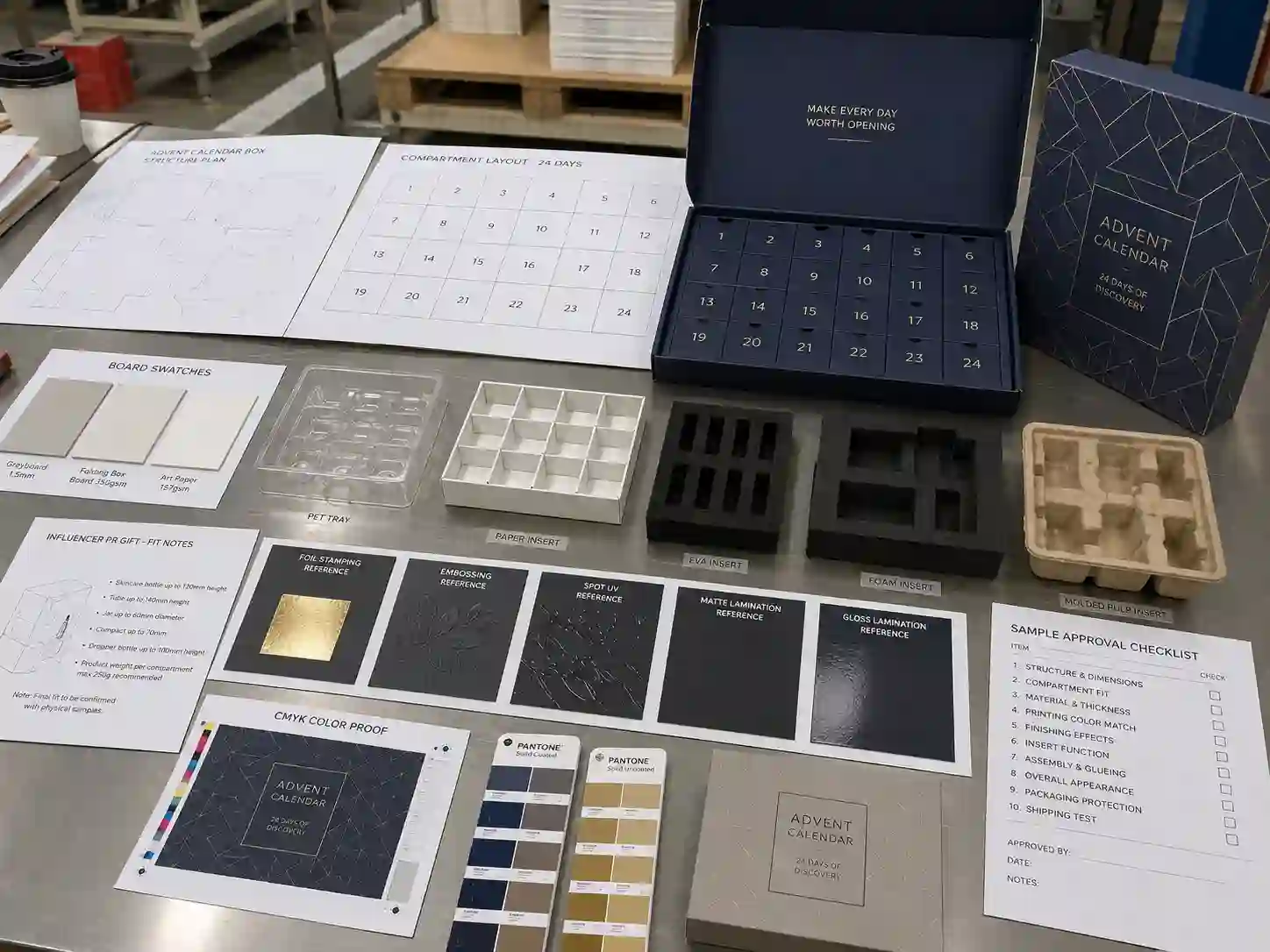
The dieline is the bridge between design and production. It should show cut lines, crease lines, glue areas, door openings, drawer panels, inner trays, insert positions, and visible surfaces. When the artwork is applied without checking the structure, logos may be hidden by folds, numbers may shift across doors, and important text may fall on crease lines.
Which printing and finishing options are common?
Common options include CMYK printing, Pantone spot colors, foil stamping, embossing, debossing, spot UV, matte lamination, and gloss lamination. These should be chosen based on brand guidelines, photography requirements, durability, and budget.
- CMYK printing: suitable for full-color artwork, gradients, illustrations, and campaign graphics.
- Pantone color: useful when a brand color must be matched more closely than standard CMYK output.
- Foil stamping: creates metallic highlights for logos, numbers, borders, or campaign names.
- Embossing or debossing: adds tactile detail to the cover, logo, or numbered areas.
- Spot UV: creates selective shine on matte backgrounds, useful for premium contrast.
- Matte lamination: gives a soft, premium look and helps reduce glare in photography.
- Gloss lamination: creates a brighter surface but may reflect more light in influencer videos.
Factory tip: Special finishing should be tested on the real paper, not judged only from a digital mockup. Foil stamping, embossing, and spot UV can shift slightly during production, so the artwork should avoid ultra-thin alignment details on door cuts or fold edges.
How do MOQ, sample type, and lead time affect the project?
MOQ, sampling, and lead time depend on structure complexity, materials, printing process, insert tooling, assembly labor, and export packing. Buyers should not compare quotations only by unit price unless the sample type, structure, insert, paper specification, finishing, and packing method are the same.
Influencer campaign packaging often requires more development time than a simple printed box because each compartment must match a product. The more SKUs inside the calendar, the more time is needed for insert testing, sample revisions, assembly instructions, and QC planning.
| Project stage | Buyer decision | Why it affects cost or time |
|---|---|---|
| Blank sample | Confirm size, structure, opening method, and insert layout | Fastest way to check engineering before printing |
| Printed sample | Review artwork, color, lamination, foil, embossing, and spot UV | Shows visual effect but may cost more and take longer |
| Pre-production sample | Approve final material, color, structure, insert, and packing method | Acts as the production standard for mass production |
| Mass production | Confirm approved sample, QC checklist, carton marks, and delivery plan | Reduces disputes and avoids last-minute changes |
For many custom advent calendar boxes, a blank sample is the practical first step because it checks the structure before expensive printing plates, foil dies, or insert tooling are finalized. A printed sample is better when the campaign depends heavily on visual impact. A pre-production sample should be approved before mass production so the factory and buyer share the same standard.
Giftpackpro provides custom advent calendar box services for buyers who need help moving from concept, dieline, insert testing, sample approval, and bulk production planning to export packing.
How should buyers compare suppliers for influencer calendar packaging?
Buyers should compare suppliers by engineering support, sample accuracy, insert experience, artwork checking, QC process, communication speed, export packing ability, and quotation transparency. A lower unit price may become expensive if the supplier misses product-fit details or cannot control assembly quality.
A qualified supplier should ask practical questions before quoting. If the supplier quotes immediately without asking for product size, loaded weight, compartment count, artwork status, sample requirement, and packing method, the quotation may not reflect the real project.
Supplier comparison checklist
- Can the supplier explain the difference between rigid box, drawer box, door-opening box, and folding carton options?
- Can they create or check a dieline for the exact compartment layout?
- Can they recommend paper insert, PET tray, EVA insert, foam, or molded pulp based on product fit?
- Can they provide a blank sample, printed sample, and pre-production sample if needed?
- Do they check CMYK, Pantone, foil stamping, embossing, spot UV, matte lamination, and gloss lamination feasibility?
- Do they define QC points for structure, color, glue, door opening, drawer sliding, and insert fit?
- Can they explain export carton strength, pallet planning, shipping marks, and barcode label area?
- Do they provide a clear quotation with material, size, quantity, finishing, sample cost, packing, and lead time?
Buyers can review custom advent calendar box products to compare different structures and use advent calendar box buying guides to prepare more detailed purchasing questions before contacting a factory.
What QC points matter most before mass production shipment?
The most important QC points are size accuracy, color consistency, insert fit, door or drawer function, glue strength, surface quality, product loading, carton packing, and shipping mark accuracy. These checks should be based on the approved pre-production sample, not only on verbal instructions.
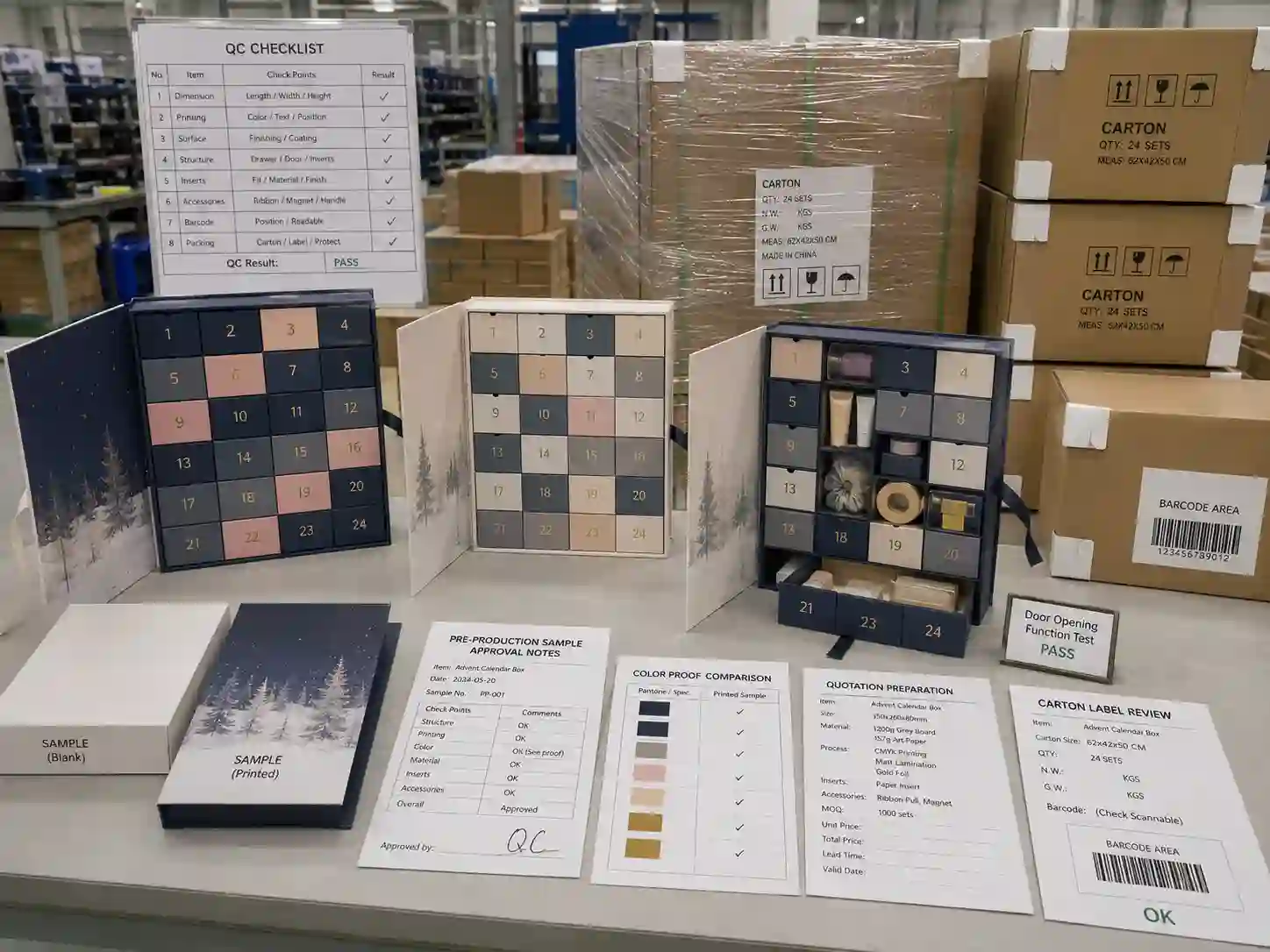
Influencer gift advent calendar boxes often have many moving parts. A small tolerance issue can affect the unboxing experience. Doors may tear too easily, drawers may stick, compartments may become loose, foil may shift, or loaded products may press against the front panel. These risks are easier to prevent when the QC checklist is built before mass production.
Practical QC checklist for buyers
- Check box dimensions against the approved dieline and sample.
- Compare printed colors with CMYK proof, Pantone reference, or signed sample.
- Inspect foil stamping, embossing, debossing, and spot UV registration.
- Test matte lamination or gloss lamination for scratches, bubbles, peeling, or glue marks.
- Load actual products into the insert and check movement, removal, and presentation.
- Open every door or drawer type to confirm function and reveal sequence.
- Check glue areas, corners, wrapped edges, magnet position, and drawer alignment.
- Review barcode label area, carton labels, and generic shipping marks.
- Confirm export carton quantity, inner protection, corner protectors, and pallet wrap.
- Keep signed sample photos and inspection records before shipment release.
QC tip: For calendars with multiple compartments, inspection should include both random visual checks and functional checks. A box can look acceptable from the outside but still fail if products are loose, doors do not open cleanly, or drawers become tight after loading.
How should export packing be planned to reduce damage?
Export packing should be planned according to box structure, loaded weight, shipping method, carton stacking, pallet use, and destination requirements. Influencer gift boxes with rigid structures or fragile contents often need stronger export cartons, corner protectors, inner separation, and pallet wrap.
Some buyers ship empty boxes to a co-packer, while others ask the factory to pack loaded calendars. These two methods require different carton sizes, labor planning, and QC points. Empty assembled boxes may waste carton space but reduce final assembly complexity. Flat packing can reduce volume for some folding carton styles, but rigid drawer or door-opening structures are often shipped assembled.
Buyers should also prepare shipping marks and barcode label areas early. For retail or e-commerce fulfillment, barcode data should follow the buyer’s platform or retailer requirement. For general barcode standards, buyers may refer to official GS1 barcode standards and confirm the final label format with their sales channel.
For high-value or fragile loaded calendars, buyers may request drop-test or transit-test discussions with their packaging team. The International Safe Transit Association provides information about package testing through ISTA design and testing guidance, which can help buyers understand when transport testing may be useful.
Decision guide: which option should you choose?
Choose the structure and insert based on product value, campaign role, unboxing requirement, and shipping risk. The most premium option is not always the best option; the best option is the one that protects the product, supports the campaign, fits the budget, and can be produced reliably on time.
| Buyer situation | Recommended direction | Reason |
|---|---|---|
| Premium beauty or fragrance influencer campaign | Rigid box with PET tray, EVA, or foam insert | Stronger presentation and better protection for small bottles or jars |
| Creator PR kit focused on video unboxing | Drawer box or door-opening box with tested opening tolerance | Creates interaction and clear reveal sequence for content |
| Large promotional campaign with lightweight products | Folding carton with paper insert | Balances cost, speed, and packing efficiency |
| Eco-positioned gift set | Paperboard structure with paper insert or molded pulp where suitable | Supports a paper-based look while still requiring fit testing |
| Fragile glass or candle items | Rigid box with cushioned insert and reinforced export carton | Reduces movement, cracking, and corner damage during shipping |
What information should buyers prepare before requesting a quotation?
Buyers should prepare a complete RFQ package with product details, box requirements, artwork information, quantity, sample expectations, packing method, and delivery deadline. A clear RFQ helps the supplier quote accurately and reduces repeated revisions.
Quotation preparation checklist
- Product name, dimensions, weight, and photos for each item
- Required compartment count and product arrangement order
- Preferred structure: rigid box, drawer box, door-opening box, book-style box, or folding carton
- Insert type preference or request for supplier recommendation
- Box size target or product layout if size is not confirmed
- Artwork files, brand color references, logo position, and dieline status
- Printing requirements: CMYK, Pantone, foil stamping, embossing, spot UV, matte lamination, or gloss lamination
- Estimated order quantity and required MOQ discussion
- Sample type: blank sample, printed sample, or pre-production sample
- Shipping method, export carton requirement, pallet requirement, and destination country
- Campaign launch date, warehouse arrival deadline, and inspection requirement
When you contact the Giftpackpro packaging factory, sharing these details helps the team recommend a practical structure, insert, material, sample plan, and quotation instead of giving a generic estimate.
What common mistakes should buyers avoid?
The most common mistakes are quoting before product dimensions are ready, choosing structure by appearance only, ignoring insert testing, approving artwork without a dieline check, changing products after sample approval, and underestimating export packing. These mistakes can cause delays, cost increases, and quality disputes.
- Mistake 1: Quoting from photos only. A reference image does not show board thickness, insert design, product weight, or carton packing.
- Mistake 2: Choosing the cheapest insert. A low-cost insert can become expensive if products move, scratch, leak, or damage the front doors.
- Mistake 3: Skipping the blank sample. For custom compartment layouts, a blank sample can reveal structure problems before printing begins.
- Mistake 4: Using unapproved colors. Digital screens cannot replace printed proof, Pantone reference, or signed sample approval.
- Mistake 5: Ignoring assembly tolerance. Drawer sliding, door opening, magnet closure, and insert fit can change after wrapping and loading.
- Mistake 6: Treating export cartons as an afterthought. A beautiful calendar can still arrive damaged if carton strength, pallet wrap, and corner protection are not planned.
FAQ: Influencer gift advent calendar boxes
What is the best structure for influencer gift advent calendar boxes?
The best structure depends on product weight, campaign positioning, and unboxing style. Rigid boxes and drawer boxes are common for premium PR campaigns, while folding cartons can work for lighter promotional campaigns with tighter budgets.
Do I need a custom insert?
Most influencer calendar projects need a custom insert because mixed products usually have different shapes and weights. A custom paper insert, PET tray, EVA insert, foam insert, or molded pulp insert helps control movement and presentation.
Should I approve a blank sample or printed sample first?
For complex structures, approve a blank sample first to check size, opening method, and insert fit. Then approve a printed sample or pre-production sample to confirm color, finishing, material, and final assembly quality.
What affects the MOQ?
MOQ is affected by material sourcing, printing setup, die-cutting, foil or embossing tools, insert tooling, assembly labor, and order complexity. More customized structures and special inserts usually require more planning than simple folding cartons.
How can I reduce the risk of delay?
Confirm the product list, dieline, artwork, sample type, color standard, packing method, and delivery date early. Avoid changing product dimensions or artwork after sample approval because even small changes can affect insert tooling and production scheduling.
Can influencer gift calendars be shipped loaded?
Yes, but loaded shipping requires stronger insert testing, product fit checks, export carton planning, and sometimes extra corner protection or pallet control. Buyers should confirm whether the factory, co-packer, or warehouse will load the products.
What should be included in the final quotation?
The quotation should include size, structure, material, insert type, printing, finishing, MOQ, sample cost, sample lead time, bulk lead time, packing method, carton details, payment terms, and shipping terms where applicable.
How can Giftpackpro help with sample and quotation planning?
For influencer gift advent calendar boxes, the safest purchasing process is to prepare product details first, confirm the structure and insert plan, approve the dieline, review the sample, and define QC and export packing before mass production. This approach helps buyers avoid loose products, poor opening function, color disputes, carton damage, and unclear quotations.
To start a practical discussion with Giftpackpro, prepare your product list, product dimensions, target quantity, preferred structure, artwork files, insert preference, sample deadline, and delivery date. Then use the request a custom quote page to ask for structure suggestions, sample options, MOQ guidance, and export-packing advice for your campaign.