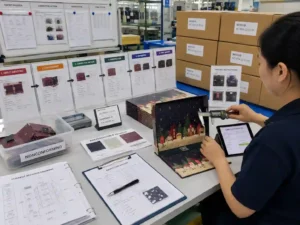
Quick answer: Corporate gift advent calendar boxes should be designed with the export journey in mind, not only the desktop unboxing moment. Buyers need to confirm the box structure, insert material, product fit, printing proof, carton strength, pallet plan, shipping marks, and inspection standard before mass production. For overseas orders, the main choice is whether the calendar ships flat-packed, semi-assembled, fully assembled, or pre-loaded with gifts. Each option affects unit cost, MOQ, lead time, carton size, labor, and damage risk. A good supplier should provide a dieline, sample, pre-production sample, packing method, carton specification, and quotation details before bulk production starts.
For B2B corporate gifting campaigns, packaging failure usually happens in two places: poor product fit inside the calendar and poor protection during export shipping. A premium rigid box may look strong at sample stage, but if the drawers move, inserts loosen, cartons are underfilled, or pallets are poorly wrapped, overseas delivery can still create crushed corners, scratched surfaces, color rubbing, and misaligned compartments.
This guide explains how overseas brands, wholesalers, retail buyers, e-commerce sellers, and gift companies should evaluate corporate gift advent calendar boxes from structure to inserts, printing, QC, export packing, and quotation preparation. Giftpackpro works as a custom advent calendar boxes manufacturer for buyers who need practical factory-side control, not decorative consumer storytelling.
What should buyers confirm before choosing corporate gift advent calendar boxes?
Buyers should confirm the gift item list, calendar structure, insert method, shipping mode, target order quantity, sample approval process, and final export packing method before choosing a design. These decisions decide whether the packaging is practical for production, assembly, warehousing, and international transport.
Corporate gift calendars often contain mixed items such as stationery, tea sachets, coffee capsules, mini candles, keychains, gift cards, accessories, small pouches, or promotional samples. The packaging must protect different sizes and weights inside one calendar system. A drawer calendar may work well for reusable corporate gifting, while a door-opening paperboard calendar may be better for promotional campaigns with lighter items and lower freight budget.
Buyer tip: Do not approve an advent calendar layout before confirming the actual gift dimensions and weight. A 2 mm difference in insert opening size can affect drawer movement, product removal, and export vibration performance.
Which box structure is best for export-packed corporate gift calendars?
The best structure depends on gift weight, campaign positioning, assembly labor, and shipping space. Rigid boxes offer a premium presentation and better stacking feel, while folding cartons can reduce freight volume when flat packing is possible.

For corporate gift programs, the structure must support both presentation and logistics. A client-facing gift box may need a premium surface, accurate numbering, smooth door opening, and a neat reveal. A wholesale or distributor order may also need efficient carton loading, clear shipping marks, and stable pallet stacking.
| Structure option | Best use case | Export packing impact | Buyer watch point |
|---|---|---|---|
| Rigid box calendar | Premium corporate gifts, VIP gifting, retail display | Usually ships assembled; higher carton volume but stronger presentation | Check corner protection, surface rubbing, and carton compression |
| Door-opening box | Light gifts, campaign samples, numbered reveal designs | Can be assembled or partially flat-packed depending on structure | Check door perforation, tear line strength, and item retention |
| Drawer box | Reusable corporate calendars, accessories, stationery, jewelry cards | Requires drawer sliding tests and anti-movement packing | Check drawer gap, pull tab strength, and friction after loading |
| Folding carton calendar | Promotional volume orders, lighter items, freight-sensitive projects | Can reduce shipping volume when flat-packed | Check folding line accuracy, assembly instruction, and carton stacking |
| Magnetic closure calendar | High-end gift sets and executive campaigns | Often needs individual wrapping to prevent surface marks | Check magnet alignment, closure strength, and air freight restrictions if applicable |
Should corporate gift advent calendar boxes be shipped flat-packed or assembled?
Flat packing reduces shipping volume but increases buyer-side assembly work. Fully assembled packing improves presentation control but increases carton size, freight cost, and the need for stronger export protection.
Flat-packed calendars are useful when the buyer has a local assembly team, fulfillment partner, or gift-packing facility. The supplier should provide clear folding lines, assembly tolerance, and packing instructions. Assembled calendars are better when the buyer wants factory-controlled structure, insert placement, and appearance consistency before delivery.
Semi-assembled packing is often a practical compromise. For example, the main shell may be assembled at the factory, while inserts, drawers, or product loading are completed near the destination market. This can reduce damage risk compared with full flat packing while still saving some freight space.
How should inserts be engineered for mixed corporate gift items?
Inserts should hold each gift securely during handling, vibration, and carton movement while still allowing easy removal by the recipient. The right insert depends on product weight, shape, fragility, sustainability target, and whether the calendar is shipped empty or loaded.
Paper inserts are common for lightweight corporate gifts, gift cards, sachets, small stationery, and promotional samples. PET trays can give accurate cavity shapes and product visibility when used inside a printed calendar. EVA insert and foam are better for heavier or fragile items such as mini bottles, candles, small tech accessories, or premium keepsakes. Molded pulp may be considered when the buyer wants a paper-based insert direction, but tooling, shape detail, and surface texture should be reviewed during sampling.
Factory tip: Insert design should be tested with real products, not only CAD dimensions. Sachets can bend, candles can scuff, coffee capsules can rotate, and small pouches can compress during transport.
What insert details should be checked before mass production?
Buyers should check cavity size, product removal space, insert height, compartment wall strength, glue position, and tolerance after loading. The insert must work with the box structure and the export packing method together.
- Confirm actual product length, width, height, weight, and shape variation.
- Check whether each item needs a finger notch, ribbon pull, paper band, or protective sleeve.
- Test whether the insert moves when the calendar is tilted or shaken lightly.
- Confirm whether heavy items sit near the bottom or center of the calendar for balance.
- Check whether the insert causes door bulging, drawer jamming, or surface deformation.
- Review whether PET, EVA, foam, paperboard, or molded pulp matches the brand’s sustainability and cost expectations.
What printing and finishing choices affect export durability?
Printing and finishing should be selected not only for appearance but also for rubbing resistance, color consistency, and carton handling durability. Matte lamination, gloss lamination, spot UV, foil stamping, and embossing all require different QC checks before export packing.
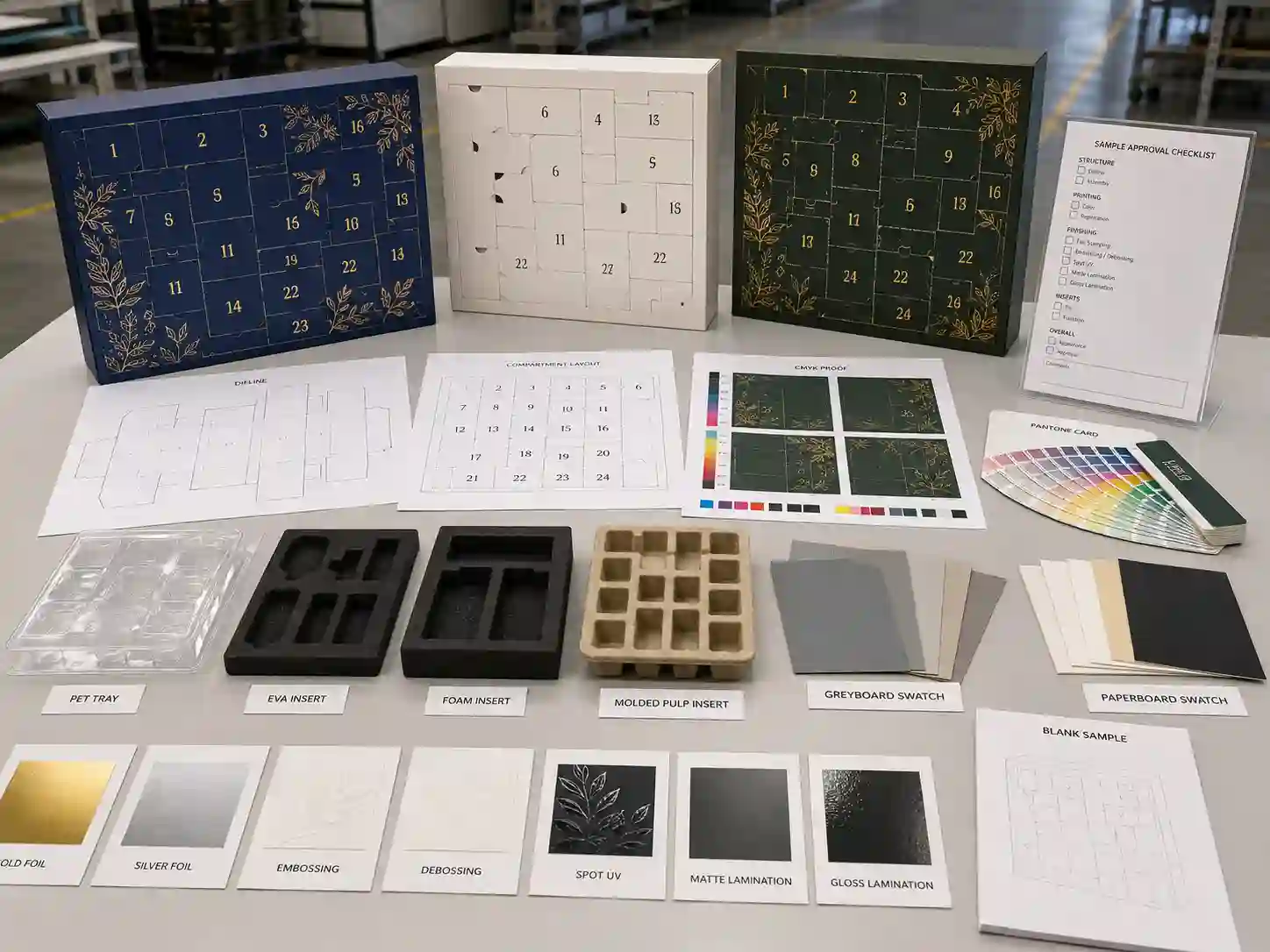
Corporate gift calendars are often handled by factories, forwarders, warehouses, sales teams, and final recipients. A beautiful CMYK print can still become a complaint if the dark background rubs against another box, foil flakes at the edges, or the numbered doors crack after opening. Buyers should review a printed sample and, for important campaigns, a pre-production sample before approving mass production.
Pantone color matching is useful when the corporate campaign has strict brand color requirements. However, buyers should provide realistic tolerance expectations because paper material, lamination, ink absorption, and viewing light can affect the final appearance. For metallic finishes, foil stamping position should be checked against the dieline, fold lines, door edges, and drawer pull areas.
QC tip: Finishing should be inspected after assembly, not only on flat printed sheets. Embossing pressure, foil alignment, and spot UV registration can look acceptable before folding but shift visually after the box is formed.
How should sampling reduce export packing risks?
Sampling should prove product fit, structure strength, print accuracy, assembly tolerance, and packing method before mass production. A sample is not only for appearance approval; it is a working prototype for production and shipping decisions.
For corporate gift advent calendar boxes, buyers usually need three approval stages. A blank sample checks structure, insert fit, drawer movement, door opening, and overall size. A printed sample checks artwork, CMYK or Pantone color, finishing, numbering, lamination, foil stamping, embossing, and surface effect. A pre-production sample confirms the final material, print, insert, assembly method, and export packing approach before bulk production.
What should be included in a sample approval checklist?
A sample approval checklist should compare the approved sample against the final order requirements. This helps prevent small sample-stage assumptions from becoming mass production defects.
- Confirm the approved dieline version and artwork version number.
- Check box size, compartment size, insert opening size, and carton quantity per master carton.
- Test all drawers, doors, tabs, ribbons, magnets, or closures.
- Load real gift items and check movement, fit, removal, and balance.
- Review printing color under agreed lighting conditions.
- Check foil stamping, embossing, spot UV, matte lamination, or gloss lamination position.
- Confirm individual wrapping, polybag, tissue, paper sleeve, or protective divider needs.
- Approve export carton material, carton size, shipping marks, and pallet plan.
How do MOQ, cost, and lead time change with export packing choices?
MOQ, cost, and lead time are affected by structure complexity, material selection, insert type, printing process, finishing, assembly labor, and carton packing volume. Export packing is a real cost driver because it affects labor, carton material, warehouse space, and freight efficiency.
A rigid corporate gift calendar with EVA insert, foil stamping, embossing, and fully assembled export packing will usually require more material, handwork, and carton space than a folding carton calendar with paper insert and flat-packed delivery. Buyers should compare total landed cost instead of only unit box price.
Lead time also changes by approval speed. Delayed artwork, unclear product dimensions, repeated sample revisions, or late shipping mark confirmation can affect production scheduling. For better planning, buyers should discuss sample timing, pre-production approval, mass production, final inspection, export carton packing, and booking with the supplier early.
Which cost drivers should buyers compare in a quotation?
Buyers should compare the full packaging system, not only the outer box. The quotation should clearly show structure, material, insert, printing, finishing, assembly, packing, carton, pallet, and shipping-related assumptions.
- Structure: rigid box, folding carton, drawer box, door-opening box, magnetic closure, book-style box, or custom structure.
- Material: paperboard, greyboard thickness, specialty paper, coated paper, corrugated board, and surface protection.
- Insert: paper insert, PET tray, EVA insert, foam, molded pulp, or mixed insert system.
- Printing: CMYK, Pantone spot color, inside printing, numbered doors, instruction cards, and barcode areas.
- Finishing: foil stamping, embossing, debossing, spot UV, matte lamination, gloss lamination, varnish, or texture paper.
- Assembly: hand assembly, drawer insertion, insert gluing, product loading, individual wrapping, and final packing.
- Export packing: master carton specification, carton quantity, inner protection, palletizing, pallet wrap, and shipping marks.
What export packing method reduces damage for corporate gift advent calendar boxes?
The best export packing method prevents compression, corner damage, surface rubbing, moisture exposure, and movement inside master cartons. The supplier should design export packing around the finished calendar size, weight, surface finish, and shipping route.

For assembled rigid calendars, each piece may need individual wrapping, corner protection, tissue paper, sleeve protection, or separators inside the carton. For flat-packed folding cartons, the key risk is bending, edge crushing, and mixed component loss. For drawer calendars, the drawers should not slide open during transit. For door-opening calendars, pressure should not damage the perforated or pre-cut door areas.
Master cartons should be sized to avoid both over-compression and loose movement. Underfilled cartons can collapse during stacking, while overfilled cartons can create pressure marks on the calendar surface. Palletizing should consider carton orientation, stack height, corner boards, pallet wrap, moisture protection, and container loading method.
For transport validation, buyers can discuss recognized package testing methods with suppliers or logistics partners. The International Safe Transit Association provides packaging performance test procedures used in distribution environments. For barcode and logistics label planning, buyers can also refer to GS1 barcode standards when preparing retail or warehouse requirements.
How should shipping marks and carton labels be prepared?
Shipping marks should be clear, consistent, and approved before carton printing or labeling. Poor shipping marks can delay warehousing, customs coordination, distributor receiving, and e-commerce fulfillment.
Common shipping mark information may include item name or code, purchase order number, carton number, quantity per carton, gross weight, net weight, carton dimensions, country of origin statement if required, handling symbols, destination, and barcode label area. Buyers should confirm exact requirements with their importer, forwarder, retailer, or fulfillment warehouse before mass packing.
Buyer tip: Do not wait until the goods are finished to prepare shipping marks. Carton label size, barcode area, pallet label position, and warehouse receiving rules should be checked before export cartons are produced.
Decision guide: which packing option should your team choose?
Choose the packing option according to your assembly resources, freight budget, damage tolerance, and presentation requirements. The more premium and fragile the calendar, the more important factory-controlled assembly and protective export packing become.
| Buyer situation | Recommended packing direction | Why it works |
|---|---|---|
| You have a local fulfillment team and need lower freight volume | Flat-packed or semi-assembled packing | Reduces carton volume and allows local loading or kitting |
| You need premium executive gifts ready for distribution | Fully assembled packing with individual protection | Improves presentation control and reduces buyer-side labor |
| Your calendar contains fragile or heavy gifts | Assembled packing with tested EVA, foam, PET, or reinforced paper insert | Controls item movement and reduces compartment stress |
| You sell through retail or e-commerce warehouses | Carton labels, barcode areas, pallet labels, and drop-handling review | Supports receiving, scanning, storage, and shipping workflows |
| You need a lower-cost promotional campaign | Folding carton structure with paper insert and optimized master carton | Balances unit cost, print area, and shipping efficiency |
What QC points should be inspected before export?
Final QC should inspect structure, inserts, printing, finishing, assembly, function, cleanliness, carton packing, and shipping marks. For corporate gift calendars, inspection should include loaded-product checks when the buyer provides or approves the actual gift items.
Important QC points include box dimensions, drawer sliding, door opening, glue strength, magnet alignment, ribbon attachment, insert fixation, product movement, color consistency, lamination scratches, foil stamping defects, embossing position, barcode area, carton quantity, carton weight, and pallet condition.
Practical export QC checklist for buyers
- Approved sample, dieline, artwork, and pre-production sample are available at inspection.
- Box structure matches approved dimensions and opens correctly.
- All numbered compartments align with the artwork and gift plan.
- Insert holds each item securely without bending, rattling, or blocking removal.
- Printed color, Pantone reference, finishing, and surface protection meet approval tolerance.
- Carton quantity, inner packing, carton size, gross weight, and net weight match the packing list.
- Export carton strength is suitable for stacking and handling route.
- Shipping marks, carton labels, barcode label areas, and pallet labels are correct.
- Corner protectors, pallet wrap, and moisture protection are applied when required.
- Random cartons are opened to confirm product mix, calendar orientation, and inner protection.
QC tip: A finished calendar should be checked after it has been placed into the master carton, not only on the worktable. Some defects only appear when cartons are stacked, moved, or packed tightly.
How should buyers compare corporate gift calendar suppliers?
Buyers should compare suppliers by packaging engineering ability, sample accuracy, insert testing, print control, QC process, export packing experience, and communication detail. A low unit price is not useful if the supplier cannot control structure tolerance, product fit, or carton protection.
A suitable supplier should ask for gift item dimensions, weight, artwork requirements, target quantity, delivery market, shipping method, and packing preference before quoting. The supplier should also explain whether the design is better as a rigid box, folding carton, drawer box, door-opening structure, or another custom solution.
Giftpackpro provides custom advent calendar box services for structure development, sampling, insert planning, printing, finishing, QC, and export packing. Buyers can also review custom advent calendar box products to compare structure ideas before sending a quotation request.
What information should buyers prepare before requesting a quotation?
Buyers should prepare product dimensions, target structure, quantity, artwork requirements, insert preference, packing method, shipping mark requirements, and delivery schedule before requesting a quotation. Complete RFQ information allows the factory to quote the real packaging system instead of guessing.
Before asking Giftpackpro to request a custom quote, prepare the following details:
- Corporate gift campaign type, sales channel, and target market.
- Gift item list with size, weight, material, fragility, and quantity per calendar.
- Preferred structure: rigid box, folding carton, drawer box, door-opening box, or custom design.
- Insert preference: paper insert, PET tray, EVA insert, foam, molded pulp, or supplier recommendation.
- Artwork files, dieline requirements, CMYK or Pantone colors, and finishing expectations.
- Expected MOQ or order quantity, sample needs, and required delivery date.
- Flat-packed, semi-assembled, fully assembled, or loaded packing preference.
- Master carton requirements, pallet requirements, barcode label area, and shipping marks.
- Inspection requirements, approved sample process, and pre-production sample expectations.
If you are still comparing structures, the advent calendar box buying guides can help your purchasing team understand design, sampling, MOQ, QC, and export packing decisions before confirming the RFQ. You can also learn more about the Giftpackpro packaging factory when evaluating production and supplier reliability.
What common mistakes should buyers avoid?
The most common mistakes are approving artwork before insert testing, choosing a premium structure without checking freight volume, ignoring shipping marks until the last stage, and comparing suppliers only by unit price. These mistakes can increase rework, delay shipment, or cause avoidable damage during export.
- Mistake 1: Quoting without real product sizes. Estimated sizes can lead to wrong cavities, poor fit, and sample revisions.
- Mistake 2: Ignoring carton volume. A larger assembled rigid box may look better but can increase freight and warehouse cost.
- Mistake 3: Approving only digital artwork. Physical printed samples reveal color, lamination, foil, and folding issues.
- Mistake 4: Using weak inserts for heavy items. Heavy gifts can deform paperboard compartments if not engineered correctly.
- Mistake 5: Missing pre-production approval. Mass production should not start until structure, insert, printing, and packing are confirmed.
- Mistake 6: Treating export cartons as an afterthought. Carton strength, palletizing, and shipping marks affect the final delivery condition.
FAQ: corporate gift advent calendar boxes for export packing and shipping
Can corporate gift advent calendar boxes be shipped flat-packed?
Yes, some folding carton and semi-assembled structures can be shipped flat-packed to reduce freight volume. However, buyers must confirm local assembly labor, assembly instructions, component counting, and the risk of bending or missing parts.
Are rigid boxes better than folding cartons for corporate gift calendars?
Rigid boxes are better for premium presentation and stronger shelf feel, while folding cartons are better for cost control, lighter campaigns, and flat packing. The best choice depends on gift weight, budget, order quantity, and shipping plan.
Which insert is best for corporate gift items?
Paper inserts work for many lightweight gifts, PET trays provide accurate cavities, EVA and foam support heavier or fragile items, and molded pulp can support paper-based packaging goals. The insert should be selected after testing real product samples.
Do buyers need a pre-production sample?
For custom corporate gift advent calendar boxes, a pre-production sample is strongly recommended before mass production. It confirms final material, color, finishing, insert fit, assembly tolerance, and packing method.
What should be checked on export cartons?
Buyers should check carton size, board strength, quantity per carton, gross weight, net weight, inner protection, carton label, shipping marks, barcode area, and pallet stacking plan. These details should match the packing list and buyer warehouse requirements.
How can damage during shipping be reduced?
Damage can be reduced by using suitable inserts, individual wrapping, correct carton size, corner protection, pallet wrap, controlled stacking height, clear handling marks, and final carton inspection before shipment.
CTA: prepare a better RFQ for corporate gift advent calendar boxes
To receive an accurate quotation for corporate gift advent calendar boxes, prepare your gift item list, dimensions, target quantity, preferred structure, insert requirement, artwork files, finishing choices, sample deadline, packing method, shipping marks, and delivery plan. Clear information helps Giftpackpro recommend the right structure, create a useful sample, control QC, and design export packing that reduces damage risk before shipment.